
Using Annuities for Retirement Income Wisely
Annuities for retirement income can do more than pay for life — a QLAC lets you defer required IRA withdrawals to age 85. See how much to annuitize.

In This Article
If you’ve spent decades saving for retirement, one question can keep you up at night: will the money actually last? Annuities for retirement income exist to answer it — they turn a lump sum into a paycheck you can’t outlive.
This guide is built for three readers. If you’re a pre-retiree mapping out income, the strategy section has a method to size the decision. If you’re holding a lump sum from a rollover or pension buyout and deciding what to do, the current payout numbers are for you. And if market swings have left you craving guarantees, the safety section explains exactly what protects your money.
Here’s why the stakes are real. According to the Social Security Administration’s actuarial life table, a 65-year-old man can expect to live about 17.5 more years and a woman about 20.1 — and roughly 1 in 3 people who reach 65 live past 90. A $100,000 immediate annuity currently pays a 65-year-old man around $625 a month for life. The strategy is in how you use it.
ℹ️ Financial Disclaimer: This article is for educational purposes only and is not personalized investment, tax, insurance, or retirement advice. Annuities are complex insurance contracts whose suitability depends on your full financial picture, and the activities discussed here — investment selection, tax planning, insurance-product purchase, and retirement-withdrawal timing — carry real consequences. Figures are current as of the date shown and change frequently. Before buying, surrendering, or annuitizing, consult a fiduciary financial advisor and a CPA or tax professional.
How an annuity turns your savings into income you can’t outlive
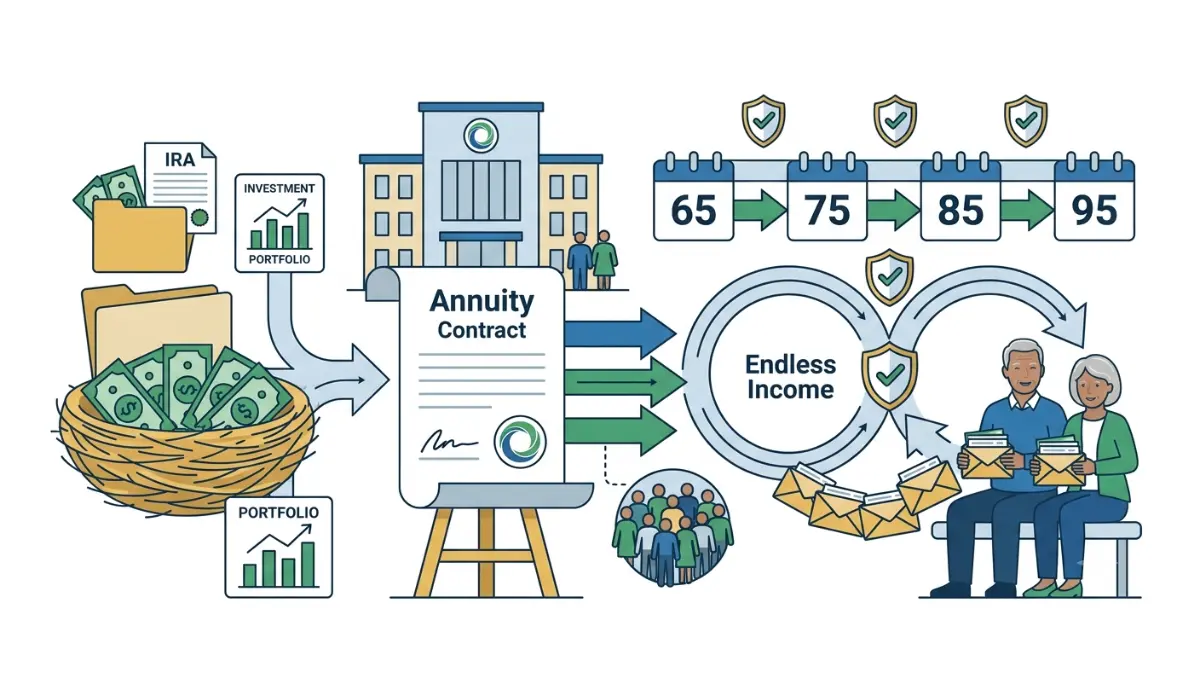
An income annuity is a contract: you hand an insurance company a lump sum, and it promises payments for life. The income is higher than a same-sized bond ladder can safely produce, and the reason is mortality pooling.
What “mortality credits” actually mean
🔍 How It Works: When thousands of people buy lifetime annuities, some die earlier than expected and some live far longer. The insurer pays everyone from the same pool, so the funds released by those who die early help fund the payments of those who live long. Those “mortality credits” are the extra yield a lifetime annuity provides over self-funding — the one thing you can’t replicate on your own.
The tradeoff is real: in exchange for that guarantee, you generally give up access to the principal once payments begin.
Income annuities vs. growth annuities
Not every annuity pays income right away. Income annuities — immediate and deferred income annuities — are built to pay a paycheck. Accumulation annuities, like fixed, fixed-indexed, and variable contracts, grow money first and can convert to income later. For the full landscape, our guide to what an annuity is and what it really costs breaks down every type.
When does annuitizing make sense — and how much should you do?
The honest answer to “how much should I annuitize” starts with a method, not a percentage: cover your essential expenses with guaranteed income, and keep the rest invested for growth and flexibility.
The income-floor idea: cover the essentials, invest the rest
Picture an income floor — the baseline of guaranteed money that covers what you must pay every month: housing, food, utilities, insurance, healthcare. Social Security already provides part of it. An annuity can fill whatever’s left, so a market downturn never threatens your essentials.

The fill-the-gap method
Sizing the decision is one subtraction:
- Add up your essential monthly expenses.
- Subtract guaranteed income you already have (Social Security, any pension).
- The remainder is your income gap — the only part an annuity needs to fill.
So $5,000 in essentials minus $2,500 from Social Security leaves a $2,500 gap. That’s the figure you’d shop an annuity to cover — not your whole nest egg. Model your own numbers with our retirement income calculator and a Social Security benefit estimate.
⚠️ Costly Mistake: Annuitizing far more than your gap. Once you convert a lump sum to lifetime income, that money is generally locked away — putting too much in leaves you without liquidity for emergencies, healthcare, or heirs.
Annuity income vs. the 4% rule
The 4% rule withdraws 4% of an invested portfolio in year one, then adjusts for inflation — flexible, but market-dependent and not guaranteed. An annuity is the reverse: guaranteed for life, with no flexibility once it starts. Many retirees blend both — annuitize the gap, invest the rest.
✅ Action Step: Before committing, ask a fiduciary financial advisor: “Given my essential expenses, Social Security, and other income, how much guaranteed income do I actually need, and does annuitizing part of my savings fit my plan?”
Which annuity gives you retirement income? SPIA, DIA, QLAC and income riders
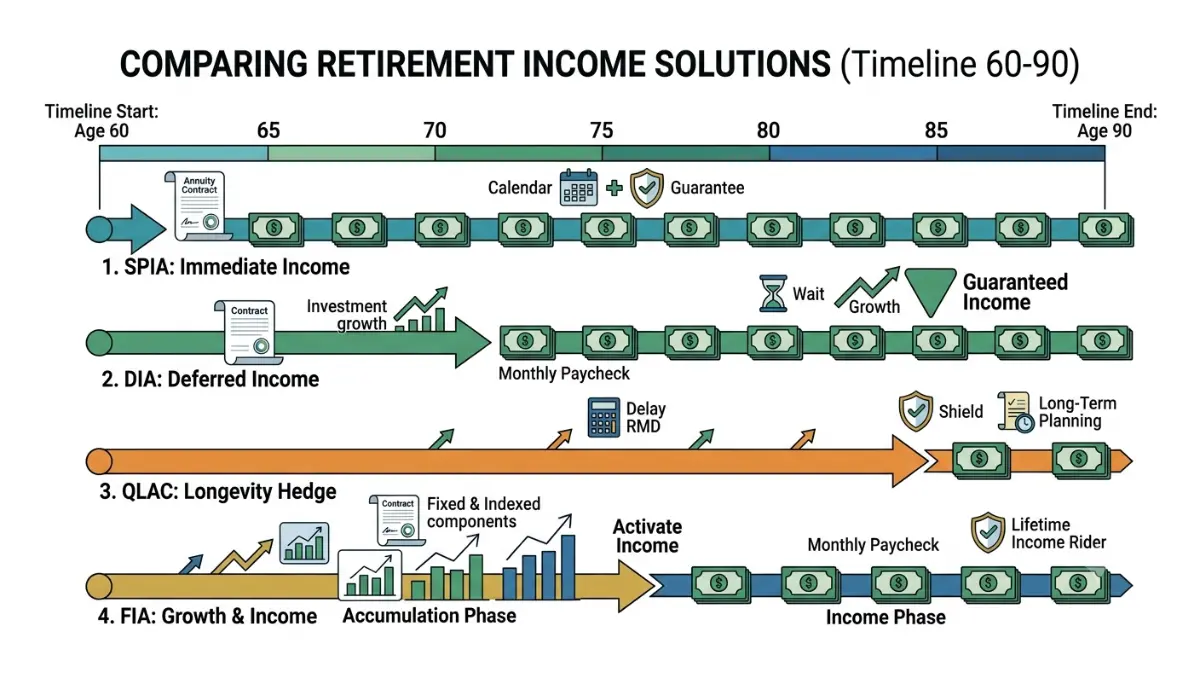
Four annuity types produce retirement income, and the right one depends on when you want the paychecks to start.
Income now: the SPIA
A single premium immediate annuity turns a lump sum into income that begins within about a year. It’s the simplest, most cost-effective way to buy a lifetime paycheck. Our explainer on how a single premium immediate annuity works covers the mechanics.
Income later: DIAs and the QLAC
A deferred income annuity lets you buy now and start income on a future date — the longer you wait, the larger the payments. A special version, the qualified longevity annuity contract (QLAC), is funded from a traditional IRA or 401(k). For 2026, the IRS allows up to $210,000 per person in a QLAC, and it defers both income and required withdrawals on that money to as late as age 85. The SEC’s investor guidance on longevity annuities is a neutral overview, and our piece on how a QLAC can reduce your RMDs covers the strategy.
Income with upside: a fixed-indexed annuity with a rider
A fixed-indexed annuity with a lifetime income rider ties growth to a market index with downside protection, then guarantees income. It offers more potential than a SPIA but carries higher ongoing fees.
| Type | Income starts | Best for |
|---|---|---|
| SPIA | Within ~12 months | Income needed now, simply |
| DIA | A future date you pick | Locking in higher income later |
| QLAC | As late as age 85 | Hedging a long life + cutting RMDs |
| Fixed-indexed + rider | When you activate it | Growth potential with a floor |
Source: product structures per SEC Investor.gov; QLAC limit per IRS (2026 tax year).
What annuities pay right now — and what each option costs you
A $100,000 immediate annuity currently pays a 65-year-old man roughly $625 a month for life, based on annuity payout rates surveyed in mid-2026 — though the exact figure moves with interest rates and the options you choose.
Current payout snapshot (June 2026)
📊 Data Point: For a $100,000 single premium immediate annuity (life-only), mid-2026 quotes run about $625/month for a 65-year-old man and roughly $590 for a 65-year-old woman, who is expected to live longer. A joint contract covering both spouses starts near $535/month. — Source: immediate-annuity quote engines (e.g., ImmediateAnnuities.com), surveyed June 2026; illustrative and subject to change.
| Scenario ($100K, age 65) | Approx. monthly income | Key detail |
|---|---|---|
| Single man, life-only | ~$625 | Highest payout; stops at death |
| Single woman, life-only | ~$590 | Longer life expectancy lowers it |
| Joint (both 65) | ~$535 | Pays until the second death |
Source: immediate-annuity quotes surveyed June 2026; rates change without notice. Compare what a $100,000 annuity pays each month and payout rates by age.
Why today’s payouts are near 15-year highs
Annuity payouts track interest rates. The Federal Reserve has held its federal funds target range at 3.50%–3.75% as of its June 2026 meeting, and that elevated-rate backdrop has pushed immediate-annuity income to roughly 15-year highs.
What options cost: joint, period-certain and inflation riders
Every guarantee you add lowers the monthly check. A joint payout, a period-certain guarantee (which pays heirs if you die early), and an inflation adjustment all reduce your starting income. Before locking in, it helps to compare keeping that money invested instead.
How retirement income from an annuity is taxed
Annuity income is taxed one of two ways, depending entirely on the money used to buy it.
Qualified vs. non-qualified: the core split
A qualified annuity is funded with pre-tax retirement money (an IRA or 401(k)), so the IRS treats 100% of each payment as ordinary income. A non-qualified annuity is bought with after-tax dollars, so only the earnings portion is taxable. Our guide to qualified versus non-qualified annuity taxes walks through both.
The exclusion ratio on non-qualified annuities
🔍 How It Works: With a non-qualified annuity, the IRS applies an exclusion ratio to split each payment. Part is treated as a tax-free return of your original principal, and part is taxable earnings. Once you’ve recovered your full investment, every later payment becomes fully taxable. The mechanics are set out in IRS Publication 575.
Annuities, RMDs and the QLAC deferral
Most retirement accounts require withdrawals starting at age 73, rising to 75 in 2033. Annuity payments from an IRA satisfy the IRS required minimum distribution rules for those assets, and a QLAC can push the start date to age 85. Withdrawing before age 59½ generally triggers a 10% additional tax.
✅ Action Step: Ask a CPA: “Given my income sources, how will these payments be taxed, how does the exclusion ratio apply to my contract, and how does annuitizing change my RMDs and tax bracket?”
The risks and tradeoffs to weigh before you annuitize
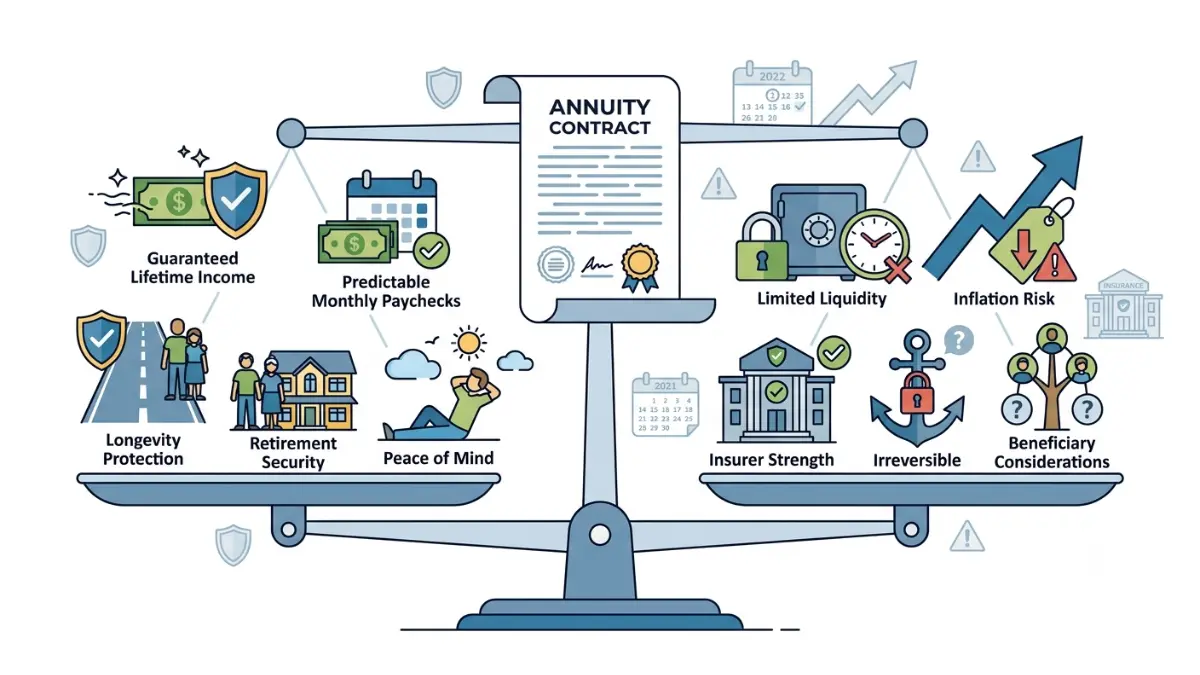
An annuity solves longevity risk, but it carries tradeoffs you should weigh with clear eyes.
You usually can’t undo it (and inflation can erode it)
Once income payments begin, the decision is generally irreversible — you can’t reclaim the lump sum. A fixed payment also loses purchasing power over time unless you pay for an inflation adjustment, which lowers your starting income.
What happens if the insurer fails — the $250,000 backstop
Annuities are not FDIC-insured; the FDIC explicitly excludes annuities from deposit insurance. Your protection is the issuing insurer’s financial strength plus your state guaranty association. In most states, that association covers up to $250,000 in present value of annuity benefits per owner, per insurer under the NAIC model law — though limits vary by state. Read what your state guaranty association covers for the details.
The most common mistakes
The frequent errors: annuitizing too much, ignoring an insurer’s AM Best rating, and overpaying for complex products. Variable and indexed annuities can carry 2%–4% in annual fees — see the real costs of variable annuities.
⚠️ Costly Mistake: Buying from a weakly rated insurer, or putting more than your state’s guaranty limit with one company. Spreading large amounts across two highly rated insurers keeps each contract within the protected limit.
Annuities for retirement income: frequently asked questions
1. Are annuities a good idea for retirement income?
They can be, for the right job. An annuity converts savings into guaranteed lifetime income, which is valuable if you’re worried about outliving your money. The strategy most planners favor isn’t all-or-nothing: cover essential expenses with guaranteed income and keep the rest invested. Whether it fits depends on your full plan, so consult a fiduciary advisor.
2. How much does a $100,000 annuity pay per month?
As of mid-2026, a $100,000 single premium immediate annuity pays a 65-year-old man roughly $625 a month for life, and about $590 for a woman, who is expected to live longer. A joint contract starts near $535. These are illustrative quotes — your actual payout changes with interest rates, age, and the options you choose.
3. What is the best annuity for retirement income?
There’s no single best one. A SPIA is simplest if you need income now. A deferred income annuity or QLAC suits income you want later, often at a higher payout. A fixed-indexed annuity with an income rider adds growth potential at higher cost. The best fit depends on when you need the paychecks to start.
4. How much of my retirement savings should I annuitize?
Only enough to fill your income gap — not your whole nest egg. Add up essential monthly expenses, subtract Social Security and any pension, and the remainder is the gap an annuity can cover. Annuitizing more locks away money you may need for emergencies or heirs. A fiduciary advisor can confirm the right amount for you.
5. Are annuity payments taxed?
Yes. If the annuity was funded with pre-tax retirement money, 100% of each payment is taxed as ordinary income. If it was bought with after-tax dollars, only the earnings portion is taxable under an exclusion ratio, until your principal is recovered. Taxes depend on your contract and income, so confirm the details with a CPA.
6. Can you lose money in an annuity?
In an income annuity, the main risk isn’t market loss — it’s irrevocability and inflation. Once payments begin you generally can’t reclaim the lump sum, and a fixed payment loses purchasing power over time. Variable and indexed annuities carry market risk and 2%–4% annual fees. Guarantees also depend on the issuing insurer’s financial strength.
7. What happens if the insurance company that issued my annuity fails?
Annuities aren’t FDIC-insured. If the insurer fails, your state guaranty association steps in — in most states covering up to $250,000 in present value of annuity benefits per owner, per insurer, though limits vary. Amounts above the limit become a claim against the insurer’s estate. Choosing a highly rated insurer is your first line of protection.
8. Is an annuity better than the 4% rule?
Neither is universally better; they solve different problems. The 4% rule keeps your money invested and flexible but isn’t guaranteed and depends on markets. An annuity guarantees income for life but gives up flexibility once it starts. Many retirees blend both — annuitize the income gap and invest the rest for growth and liquidity.
9. What is a QLAC and how does it lower my RMDs?
A qualified longevity annuity contract is a deferred annuity bought inside a traditional IRA or 401(k). For the 2026 tax year, you can fund up to $210,000 per person. The money used is excluded from required minimum distribution calculations until payments begin, which can be as late as age 85 — lowering your RMDs and the taxes on them.
10. Do annuity payments keep up with inflation?
Not by default. A standard fixed annuity pays the same amount for life, so inflation erodes its purchasing power over decades. You can add an inflation adjustment, but it meaningfully lowers your starting payment. Some retirees instead keep part of their savings invested to provide growth alongside the annuity’s guaranteed income.
11. When is the best age to buy an annuity for income?
It depends on when you need the income. Payouts rise with age, because the insurer expects to pay for fewer years — so waiting often produces a higher monthly figure. Buying around 65–75 is common for immediate income. There’s no perfect age; weigh your income needs against locking up the money.
Putting an annuity to work in your retirement plan
An annuity isn’t a product to simply buy or skip — it’s a tool for one specific job: turning part of your savings into income you can’t outlive. The strategy is the same whatever your balance: size your income gap, fill that piece with a guaranteed paycheck, and keep the rest working for growth and flexibility. Run your own gap, get quotes from insurers rated A or better, and have a fiduciary advisor and a CPA check the plan before you commit. Done deliberately, an annuity can take the fear of running out of money off the table.
Related Articles
 Annuity
How an annuity works, what it pays, and the real costs
June 8, 2026 Annuity
How a 1035 Exchange Lets You Swap Annuities Tax-Free
June 25, 2026 Annuity
Choosing the Best Age to Buy an Annuity for Your Goals
June 27, 2026 Annuity
How Annuities Work, and Whether One Is Worth It
June 10, 2026 Annuity
Is a Fixed Annuity the Right Home for Your Cash?
June 11, 2026 Annuity
What a Variable Annuity Really Costs You
June 12, 2026 Annuity
The Key Protections If Your Annuity Insurer Fails
June 26, 2026 Annuity
How Annuity Payout Rates Change With Your Age, 60 to 75
June 19, 2026 Annuity
How to Decide If an Annuity Is Right for You
June 25, 2026
Informational disclaimer
The content on Finance Authority Hub is provided for general informational and educational purposes only and should not be considered personalized financial, investment, tax, legal, or professional advice. Financial decisions depend on your individual goals, income, risk tolerance, location, and regulatory situation. Before acting on any information, strategy, estimate, or calculator result, consult a qualified licensed professional who can evaluate your specific circumstances.