
How to buy an annuity the right way, step by step
Buying an annuity? Six steps protect you — from checking the insurer’s AM Best rating to the 10–30 day free-look window that lets you cancel free.

In This Article
How to buy an annuity, step by step
Buying an annuity means handing an insurance company a lump sum — or a series of payments — in exchange for guaranteed income, tax-deferred growth, or both. If you are a pre-retiree converting a maturing CD or a rollover into lifetime income, someone who was just handed a sales pitch and wants to check it, or a saver weighing an annuity against a bank CD, this checklist is built for you. The decision matters because an annuity is a long-term insurance contract, not a bank deposit, and its guarantees rest on the issuing insurer’s financial strength rather than the federal government.
To buy an annuity well, you work through six steps: decide whether one fits your goal, match the type to that goal, vet the insurer’s strength, compare the real costs, confirm the tax treatment, and use the free-look period to verify before you commit. Each step below ties to a specific rule or figure from a named regulator, so you can check the claim yourself instead of trusting a sales script. Start with what an annuity is and how the income works if you need the foundation first.
ℹ️ Financial Disclaimer: This article is educational and not investment, tax, or insurance advice. Annuities are long-term insurance contracts whose costs, features, and tax treatment vary by product, carrier, and state. Figures cited come from the SEC, IRS, NAIC, and the Federal Reserve as of the last-reviewed date and can change. Before buying, surrendering, or exchanging an annuity, consult a fiduciary financial advisor and a CPA about your specific situation.
Step 1: Decide whether an annuity actually fits your goal
An annuity earns its place only when it solves a problem your other accounts cannot — reliable income you cannot outlive, or tax-deferred growth after you have maxed other options. Buying one because a salesperson framed it as urgent is the most common way people end up in the wrong product. Deciding not to buy is a legitimate, sometimes smarter, outcome.

What problem does an annuity solve for you?
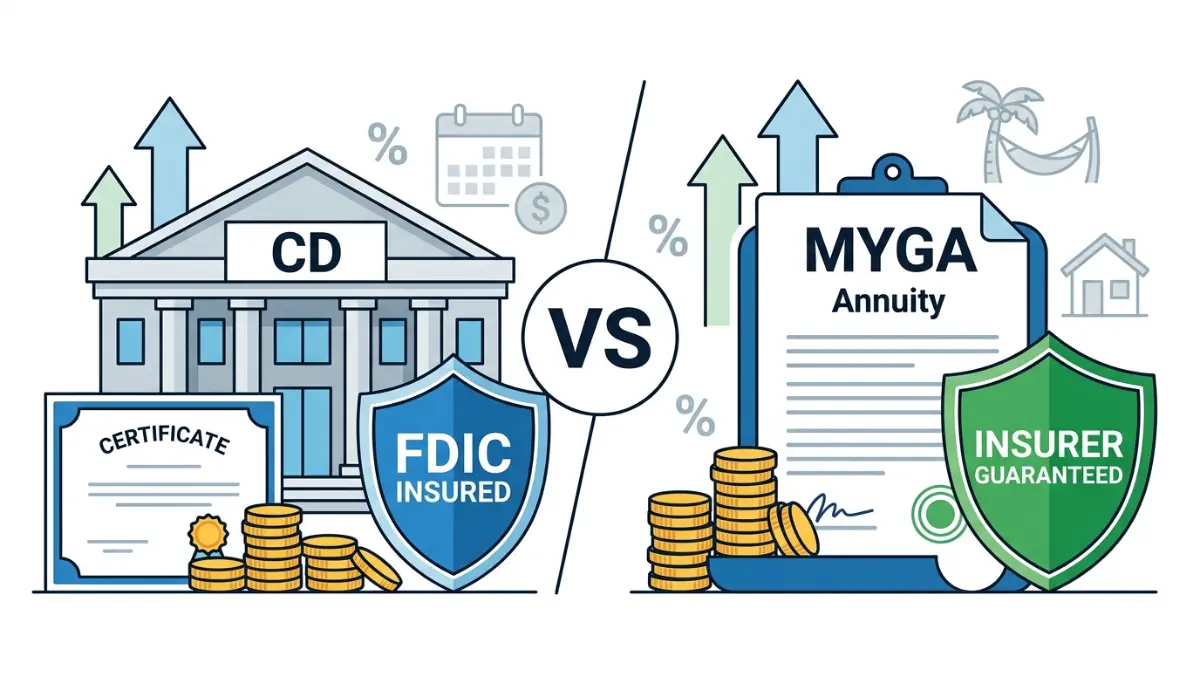
Annuities answer three needs: guaranteed lifetime income, safe tax-deferred growth, or a death benefit for a beneficiary. The SEC notes annuities suit investors with a long-term horizon, and that buying one inside an IRA or 401(k) adds no extra tax deferral because those accounts are already tax-advantaged, as explained in the SEC’s overview of how annuities work. If you mainly want a higher guaranteed rate than a bank pays, run the math first with how an annuity stacks up against a CD.
How much do you need to buy one?
There is no universal minimum. Many deferred annuities start around $5,000 to $10,000, while a single-premium immediate annuity often needs $100,000 or more to produce meaningful lifetime income.
📊 Data Point: The Federal Reserve held its federal funds target range at 3.50%–3.75% in June 2026 — Source: Federal Reserve (FOMC statement, June 17, 2026). Elevated rates have kept fixed annuity payouts near multi-year highs.
✅ Action Step: Before shopping, estimate the monthly income gap an annuity would need to fill after Social Security and any pension — then ask a fiduciary advisor whether an annuity or staying invested better closes it.
Step by step: the 6-step annuity buying checklist
This is the core sequence. Work it in order, because each step depends on the one before — you cannot compare costs sensibly until you know which type fits, and you should not sign until you have vetted the carrier.
The 6 steps at a glance
To buy an annuity, follow these six steps:
- Decide whether an annuity fits your goal — confirm it solves an income or tax-deferral need your other accounts do not.
- Match the type to that goal — immediate for income now, a fixed (MYGA) or indexed contract for protected growth, variable for market exposure.
- Vet the insurer’s financial strength — check the AM Best rating and the state guaranty-association backstop.
- Compare the real costs and get 2–3 quotes — fees, the surrender schedule, and any rider charges.
- Confirm the tax treatment for your situation — qualified versus non-qualified, and the age-59½ and age-73 rules.
- Use the free-look period to verify before you commit — read the contract and cancel free if it does not match the pitch.
What to gather before you start
Have four things written down before you call anyone: your retirement income gap, your time horizon, the source of funds (taxable cash, an IRA, or an existing annuity for a 1035 exchange), and your risk tolerance. A seller who knows you have done this homework is far less able to steer you.
✅ Action Step: Download our free Before You Sign: 12 Questions to Ask Any Annuity Seller checklist and bring it to every quote conversation.
Step 2: Match the annuity type to your goal
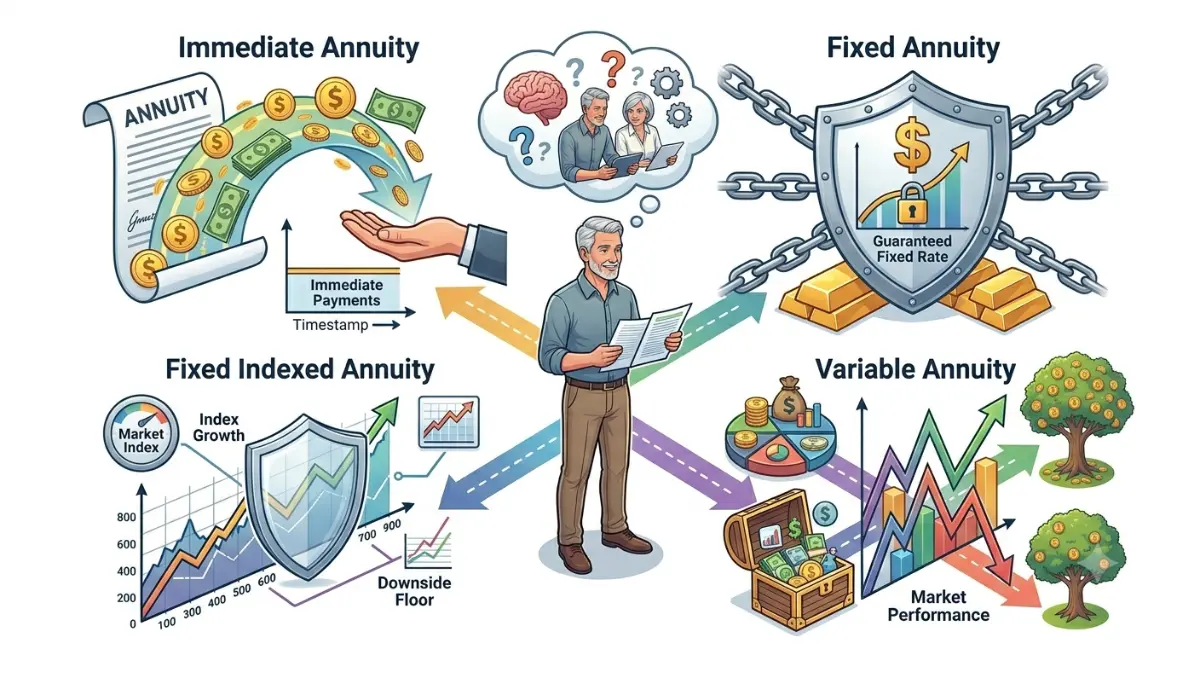
Your timeline drives the category, and each annuity type makes a different trade between access, growth, and protection. The table below pairs each type with the goal it serves and a current rate or cap, so you can self-select before a seller does it for you.
| Annuity type | How it grows | Principal protected? | Typical 2026 rate/cap | Best for |
|---|---|---|---|---|
| Immediate (SPIA) | Converts a lump sum into income now | Income, not accumulation | Payout fixed at purchase | Income starting within ~30 days |
| Fixed / MYGA | Guaranteed rate for a set term | Yes | ~5.00%–5.75% (A-rated) | CD-like guaranteed growth |
| Fixed indexed (FIA) | Index-linked, with a 0% floor | Yes | Caps ~8%–12% point-to-point | Some upside, no market loss |
| Variable | Market subaccounts | No — can lose value | Varies with the market | Market exposure, tax-deferred |
Source: rates and caps from carrier rate aggregators (AnnuityRateWatch), June 2026 ; product structure and securities status per the SEC and FINRA.
Income now vs. growth later
If you need income within a year, an immediate annuity converts a lump sum into payments that typically begin within about 30 days. If income is years away, a deferred contract — fixed, indexed, or variable — grows first and pays later. The longer your horizon, the more a guarantee or market exposure has time to matter.
Fixed, indexed, and variable — the trade-offs
A fixed annuity, or MYGA, locks a guaranteed rate for a set term and protects your principal, much like a CD — you can compare a MYGA against a bank CD to see the gap. A fixed indexed annuity adds index-linked upside with a 0% floor but caps your gains, while a variable annuity invests in market subaccounts and can lose principal, which is why FINRA regulates it as a security. See how fixed and variable annuities compare in detail and how MYGAs actually work before deciding.
🔍 How It Works: A fixed indexed annuity credits interest based on an index like the S&P 500, but two limits apply. A cap sets the most you can earn in a period (often 8%–12%), and a 0% floor means a down market credits zero rather than a loss — you trade some upside for downside protection.
✅ Action Step: Compare locking a fixed rate against staying invested, then ask a fiduciary advisor which category fits your timeline and what you give up for the guarantee — not which specific product to buy.

Steps 3 and 4: Check the costs and the carrier before you sign
Two things sellers tend to gloss over decide whether a contract is fair: what it really costs, and whether the insurer can actually pay. Here is the cost reality on a $100,000 contract, by type.
| On a $100,000 contract | No-annual-fee MYGA | Fee-loaded variable annuity |
|---|---|---|
| Annual M&E charge | $0 | ~$1,250 (1.25%) |
| Fund / subaccount expenses | $0 | ~$600–$3,000 (0.6%–3%) |
| Income / living-benefit rider | $0 (none) | ~$1,000 (≈1%) |
| Approx. total annual cost | $0 in annual fees* | up to ~$3,900 (≈3.9%) |
A MYGA charges no annual fee but applies a surrender charge if you withdraw above the free allowance during the term. Source: mortality-and-expense charge per the SEC investor bulletin; fund, rider, and total ranges per published carrier and SEC data.
What an annuity actually costs
Costs depend entirely on the type. A fixed annuity, or MYGA, has no annual fees but charges a surrender penalty if you withdraw more than the free allowance — often up to 10% a year — during a term that usually runs 3 to 10 years, with the charge starting around 7%–10% and declining about one point a year. A variable annuity flips this: no surrender concern if you wait, but real ongoing fees every year.
📊 Data Point: A variable annuity’s base “mortality and expense” charge typically runs about 1.25% of account value per year — Source: SEC, Updated Investor Bulletin: Variable Annuities. Add fund expenses and riders, and the all-in cost can approach 3.9%.
Is the insurance company safe?
Vet the carrier in two steps. First, check its AM Best financial-strength rating — most advisors recommend A- or above for a long-term contract. Second, know your backstop: every state’s guaranty association, coordinated nationally by NOLHGA, covers at least $250,000 in present value of annuity benefits per owner, per insurer. Annuities are not FDIC-insured, so that guarantee depends on the insurer’s claims-paying ability.
⚠️ Costly Mistake: Concentrating more than your state’s guaranty limit — commonly $250,000 — with a single insurer leaves the excess unprotected if that carrier fails. Spreading a large premium across two or more A-rated carriers keeps each contract within the per-insurer limit.
Can you lose money in an annuity?
With a fixed or indexed annuity, your principal is protected from market loss; with a variable annuity, you can lose value. And with any annuity, cashing out early can cost you through surrender charges. See the full breakdown of annuity fees and the specific costs and risks of variable annuities.

Steps 5 and 6: Taxes, the free-look period, and finalizing
The last two steps are the tax reality and the safety valve that lets you back out. Both are governed by clear IRS and state rules, not the seller’s promises.
How annuities are taxed (qualified vs. non-qualified)
You owe no tax when you buy an annuity; the tax comes later. A non-qualified annuity (bought with after-tax money) grows tax-deferred, and withdrawals are taxed as ordinary income on a last-in, first-out basis — meaning gains come out, and are taxed, first, per the IRS rules on pension and annuity income. Taking gains before age 59½ generally adds a 10% IRS penalty on top of regular income tax.
A qualified annuity held inside an IRA or 401(k) follows that account’s rules, including required minimum distributions that generally begin at age 73 under current law. If RMDs are a concern, a qualified longevity annuity contract can defer them on the dollars you use, up to age 85. The difference between qualified and non-qualified contracts changes both your tax bill and your withdrawal timing.
Using the free-look period to cancel risk-free
Yes — you can cancel an annuity after buying it. Every state requires a free-look period, usually at least 10 days and up to about 30 in many states, during which you can cancel for any reason and receive a full refund with no surrender charge. The clock starts when the contract is delivered, so review it the day it arrives.
🔍 How It Works: To use the free-look window, do not call the agent who sold you the contract — call the insurance company directly, using the number on the policy, and confirm every promised feature is actually in writing. If anything is missing or wrong, request cancellation in writing within the calendar-day window for a full refund.
✅ Action Step: Before you withdraw a dollar, ask a CPA how the annuity’s gains will be taxed in your bracket and whether the age-73 RMD rule affects your timing — annuity tax treatment is specific to your situation.
Mistakes to avoid when buying an annuity
You have the sequence; the last protection is knowing what trips buyers up at the moment of decision. None of these requires expert knowledge — only attention.
Red flags during the sales process
Pressure to sign before you have read the contract, or to skip the free-look period, is a reason to slow down, not speed up. Be wary of riders you do not need stacked onto the contract, since each one adds cost — on a variable annuity the fees can approach 3.9% a year. And a high advertised rate from a weakly rated insurer is not a bargain if the carrier’s strength is in doubt.
⚠️ Costly Mistake: Replacing one annuity with another resets the surrender clock and can restart years of charges. FINRA flags annuity exchanges as a frequent source of unsuitable sales, so confirm the new contract is genuinely better before swapping.
Questions to ask before you sign
Ask for the all-in annual cost including every rider, the carrier’s current AM Best rating, the length and schedule of the surrender period, and exactly how withdrawals will be taxed. If a seller cannot answer these plainly, that hesitation is your answer.
✅ Action Step: Run every quote through the 12 Questions to Ask Any Annuity Seller checklist, and verify any promise by calling the insurance carrier directly — never only the agent.
Frequently asked questions about buying an annuity
1. How much money do you need to buy an annuity?
There is no universal minimum. Many deferred annuities start around $5,000 to $10,000, while a single-premium immediate annuity often needs $100,000 or more to generate meaningful lifetime income. The right amount depends on the income gap you are filling, so confirm the figure with a fiduciary advisor before committing.
2. What is the best age to buy an annuity?
There is no single ideal age. The answer depends on when you need income and your RMD timeline, since required minimum distributions on qualified accounts generally begin at age 73. Buying an immediate annuity when rates are higher locks in larger payouts, but a fiduciary advisor can match the timing to your plan.
3. Can you lose money in an annuity?
With a fixed or indexed annuity, your principal is protected from market loss; with a variable annuity, you can lose value. Cashing out any annuity early can also cost you through surrender charges, and annuities are not FDIC-insured. Discuss your risk tolerance with a financial advisor before you buy.
4. How long does it take to buy an annuity?
Funding the contract — by transfer, rollover, or a 1035 exchange from an existing annuity — can take a few days to a few weeks. A single-premium immediate annuity often begins paying income within about 30 days. Once the contract is delivered, your free-look clock starts immediately.
5. Is buying an annuity worth it?
It depends on the trade you are making. An annuity buys guaranteed income and tax-deferred growth, but in exchange for reduced liquidity and, on some products, real ongoing fees. Whether that trade fits depends on your other income sources and risk tolerance, so review it with a fiduciary advisor.
6. What’s the difference between a fixed and variable annuity?
A fixed annuity, or MYGA, pays a guaranteed rate, protects your principal, and charges no annual fee. A variable annuity invests in market subaccounts that can lose value and carries ongoing fees, including a mortality-and-expense charge around 1.25% a year. A financial advisor can help you weigh the two.
7. Do you pay taxes when you buy an annuity?
No — you owe no tax at purchase. A non-qualified annuity grows tax-deferred, and withdrawals are taxed as ordinary income, with a 10% IRS penalty on gains taken before age 59½. Because annuity taxation is specific to your situation, confirm the details with a CPA.
8. Can you buy an annuity inside an IRA?
Yes. An annuity held inside an IRA or 401(k) is a qualified annuity and follows that account’s rules, including required minimum distributions that generally begin at age 73. A qualified longevity annuity contract can defer RMDs on those funds up to age 85. Ask a CPA how this fits your retirement tax plan.
9. What fees do you pay to buy an annuity?
A MYGA has no annual fees but charges surrender penalties for early withdrawals. A variable annuity carries a mortality-and-expense charge around 1.25%, fund expenses of roughly 0.6% to 3%, and optional riders near 1% — costs that can total around 3.9% a year. A financial advisor can confirm the all-in cost of any contract.
10. How do you avoid annuity scams or bad sales tactics?
Use the free-look period, and verify any promise by calling the insurance carrier directly rather than the agent who sold the contract. Never let anyone pressure you into signing before you have read the contract in full. When in doubt, have a fiduciary advisor review the terms.
11. Can you cancel an annuity after you buy it?
Yes, during the free-look period — usually at least 10 days, and up to about 30 in many states — you can cancel for any reason and receive a full refund with no surrender charge. After that window closes, surrender charges and possible taxes apply. Review the contract the day it arrives.
Your next step before you buy
Buying an annuity comes down to those six steps: confirm it fits, match the type, vet the carrier, compare the costs, check the taxes, and use the free-look period as your safety valve. Take them in order and you turn a high-pressure sales situation into a decision you control — nothing here has to be rushed, because the free-look window exists precisely so you can verify before you commit.
If you are still weighing whether an annuity belongs in your plan at all, revisit what an annuity is and how the income works and size your retirement income gap first. Then bring the 12-question checklist to every conversation.
Related Articles
 Annuity
Annuity vs. CD, Explained for the Money You Can’t Lose
June 20, 2026 Annuity
A Clear Guide to RILA Annuity Buffers and Caps
June 15, 2026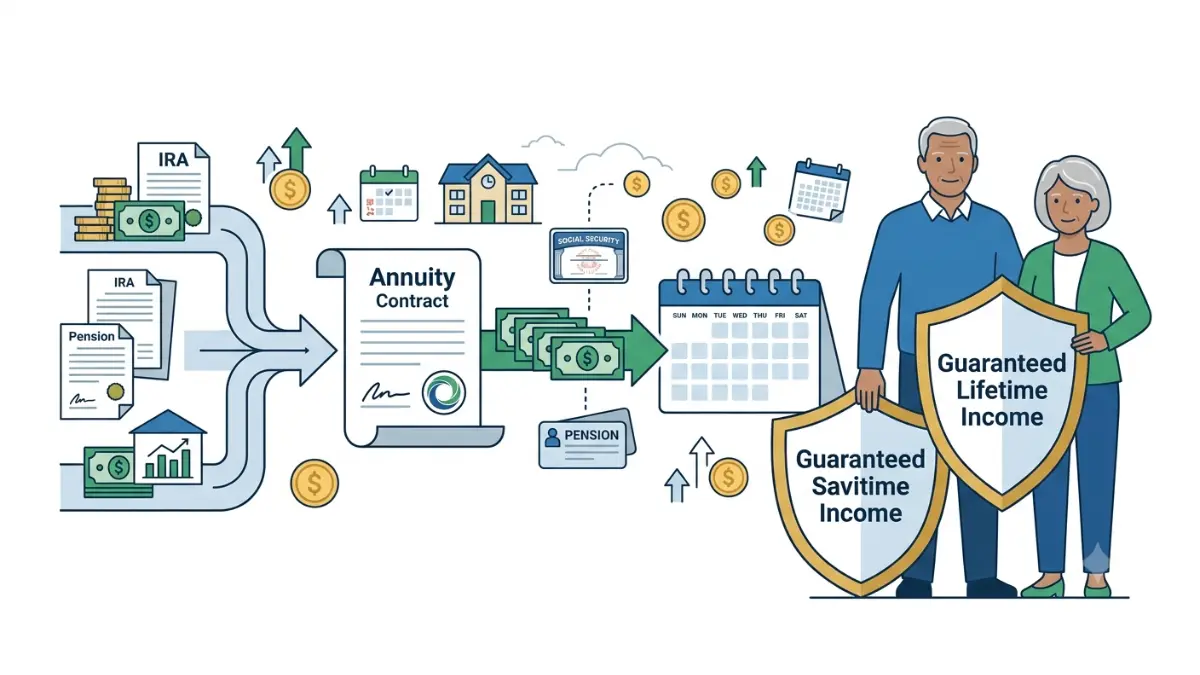 Annuity
Using Annuities for Retirement Income Wisely
June 27, 2026 Annuity
How Qualified vs Non-Qualified Annuity Taxes Compare
June 24, 2026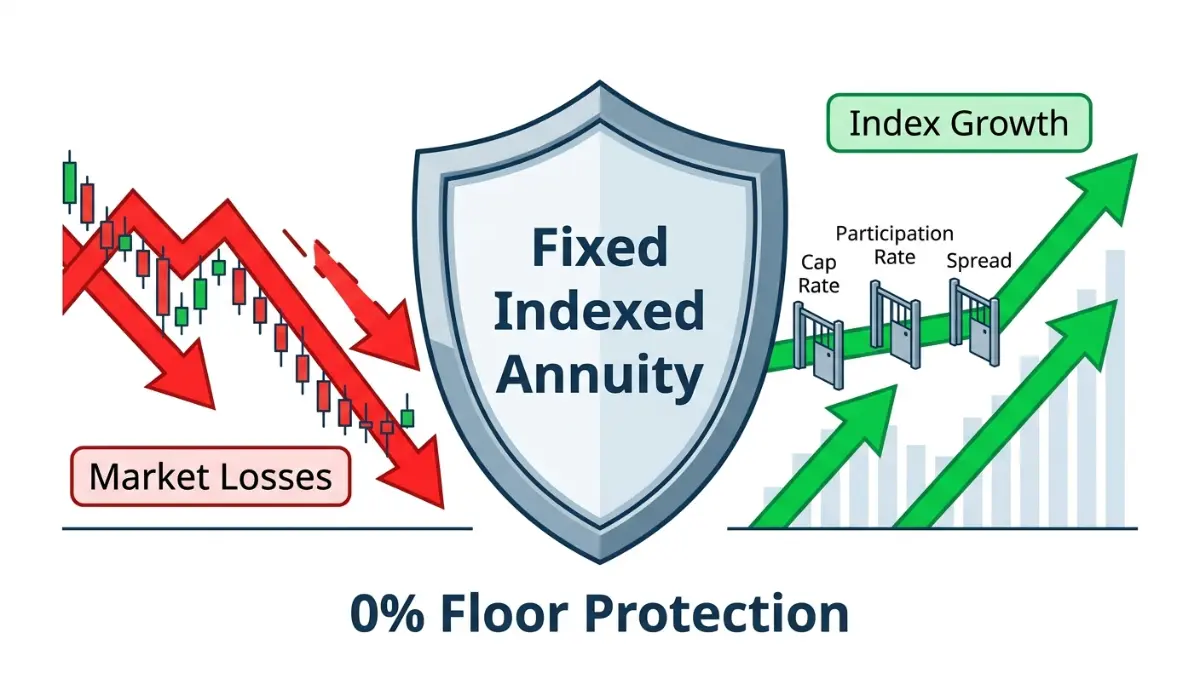 Annuity
A Clear Look at Fixed Indexed Annuity Caps, Floors, and Returns
June 15, 2026 Annuity
What Heirs Should Know About Inherited Annuity Taxes
June 24, 2026 Annuity
What Happens to Your Annuity When You Die, Made Clear
June 26, 2026 Annuity
What an Annuity vs. an IRA Really Means for Your Taxes
June 20, 2026 Annuity
What average annuity returns really look like
June 19, 2026
Informational disclaimer
The content on Finance Authority Hub is provided for general informational and educational purposes only and should not be considered personalized financial, investment, tax, legal, or professional advice. Financial decisions depend on your individual goals, income, risk tolerance, location, and regulatory situation. Before acting on any information, strategy, estimate, or calculator result, consult a qualified licensed professional who can evaluate your specific circumstances.