How Qualified vs Non-Qualified Annuity Taxes Compare
Qualified vs non-qualified annuity taxes hinge on one detail—whether your principal was already taxed—and it changes how much you keep.

In This Article
Qualified vs. Non-Qualified Annuity Taxes: What’s the Difference?
The difference between a qualified and a non-qualified annuity comes down to one thing at tax time: a qualified annuity payout is taxed in full as ordinary income, while a non-qualified annuity is taxed only on its earnings. That single rule decides how much you keep.
Where you go from here depends on your situation. If you’re comparing annuities before you buy, start with how the two are funded and taxed in the next section. If you already own one and are planning a withdrawal, skip to the penalty, RMD, and timing rules. If you’ve inherited an annuity, the section on what heirs owe is written for you. And if you’re deciding which type to fund, the decision framework lays out who each one suits.
Every rule here traces back to the IRS, and this site has no annuity to sell — so the aim is the clearest, most accurate answer, not a product pitch. If you’re new to the topic, it helps to first understand what an annuity is and how it works.
ℹ️ Financial Disclaimer: This article is general educational information, not tax, investment, or insurance advice. Annuity taxation depends on your specific contract, your income, and your state of residence. The figures shown are illustrative and verified against current IRS sources as of June 2026. Consult a CPA, an enrolled agent, or a fiduciary financial advisor before making any withdrawal, purchase, rollover, or estate decision involving an annuity.
What makes an annuity “qualified” or “non-qualified”
The label has nothing to do with the insurance product itself — it’s about the money that funded it.

A qualified annuity is funded with pre-tax dollars and held inside a retirement plan such as a traditional IRA, 401(k), or 403(b). Because that money was never taxed going in, the IRS taxes the full amount on the way out. That’s the same trade-off you’d weigh when looking at how an annuity compares with a 401(k).
A non-qualified annuity is funded with after-tax dollars — personal savings you’ve already paid income tax on. You get no deduction for funding it, but only the growth is taxed later; your original deposit, your cost basis, comes back tax-free.
Both grow tax-deferred while the money stays inside, which is the shared advantage. You can see how tax-deferred growth compounds over time to understand why that matters.
💡 Expert Note: A common point of confusion is treating “tax-deferred” as “tax-free.” Both annuity types defer tax on growth, but neither erases it — a qualified annuity defers tax on everything, while a non-qualified annuity defers tax on the earnings only.
How each annuity type is taxed when you take money out
When you withdraw, the funding source from the last section decides what’s taxable.
With a qualified annuity, the entire withdrawal is taxed as ordinary income — the same rates as a paycheck, not the lower long-term capital gains rates. With a non-qualified annuity, only the earnings are taxed; your principal returns tax-free.
🔍 How It Works: Annuity growth is always taxed at ordinary income rates, never as capital gains, even if the money grew for decades. The IRS treats it as deferred income — which is why timing a withdrawal into a lower-income year can lower the tax.
Here is the same $260,000 contract, built two ways, showing the tax at withdrawal. The figures are illustrative.
| Annuity type | What’s taxable at withdrawal | What’s tax-free | Illustrative tax @ 22%* | Key detail |
|---|---|---|---|---|
| Non-qualified (after-tax) | $60,000 earnings only | $200,000 principal | ~$13,200 | You already paid tax on the $200,000 |
| Qualified (pre-tax / IRA) | $260,000 (entire amount) | $0 | ~$57,200 | Contributions went in pre-tax; deduction taken up front |
*Assumes a $200,000 after-tax basis grown to $260,000. The 22% rate is an illustration, not your rate — and a $260,000 one-year withdrawal would likely push into higher brackets. Source: tax treatment per IRS Publication 575; dollar figures computed by the editorial team.

The qualified column looks far worse, but it isn’t a penalty: those contributions went in pre-tax, so the holder already took a deduction and deferred tax on the whole sum. The non-qualified holder paid tax on the $200,000 years earlier. You can estimate the ordinary income tax on a withdrawal for your own bracket.
✅ Action Step: Before withdrawing a large sum, ask a CPA: “Given my bracket and state, what’s the actual tax on a withdrawal of $X from this contract this year, versus splitting it across two years?”
Non-qualified annuities: withdrawals vs. annuitized income
A non-qualified annuity is taxed two different ways depending on how you take the money out.
If you take a lump-sum or partial withdrawal before turning the contract into income, the IRS uses the LIFO rule — last-in, first-out. Your earnings are treated as coming out first, so withdrawals are fully taxable until all the gains are gone; only then does your tax-free principal come back.
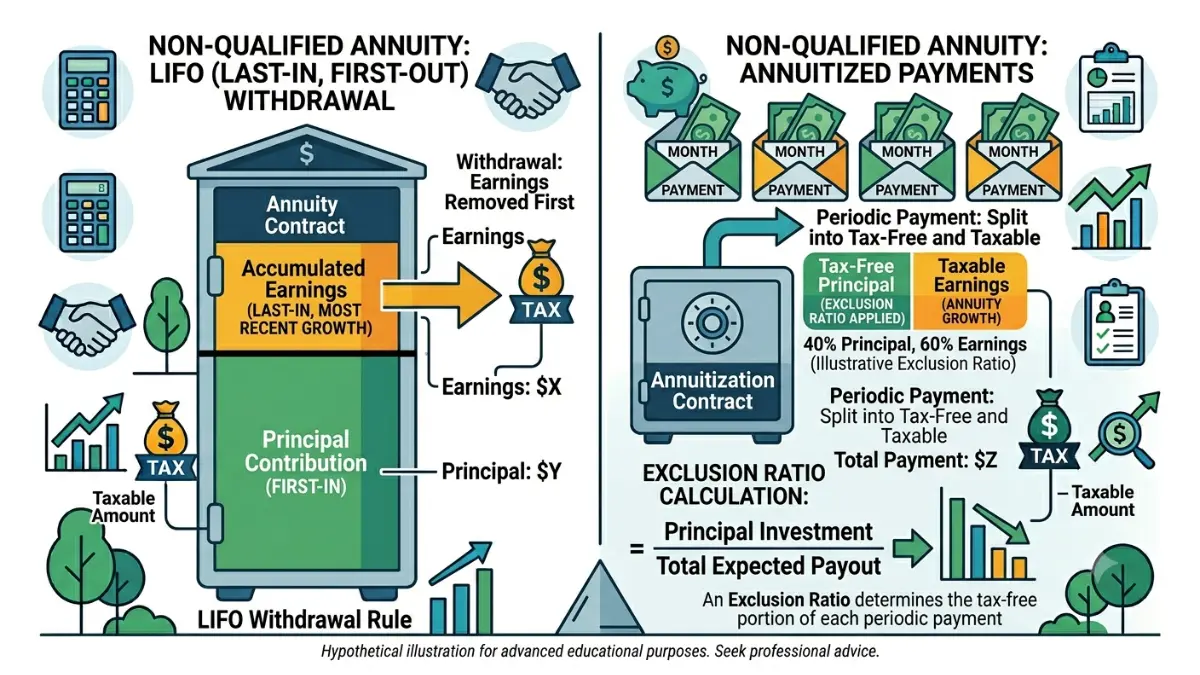
If you annuitize — convert the contract into a stream of payments — each payment is split using the exclusion ratio. Part of every payment is tax-free return of principal, and part is taxable earnings, until you’ve recovered your full basis.
🔍 How It Works: The exclusion ratio is your after-tax investment divided by the total expected payout. If you put in $200,000 and the contract is expected to pay roughly $288,000 over your life expectancy, the ratio is about 69% — so around 69% of each payment is tax-free and 31% is taxable, until your $200,000 basis is fully recovered. After that, payments are fully taxable.
These mechanics come straight from IRS Publication 575 and the IRS General Rule for annuities.
✅ Action Step: Ask your insurer and a CPA: “Will you compute my exclusion ratio for me, or do I need to use the IRS General Rule worksheet for this contract?”
Penalties, RMDs, and the timing rules that differ
Three timing rules can change your tax bill, and they don’t apply equally to both annuity types.
Before age 59½, a withdrawal usually triggers a 10% early-withdrawal penalty on top of income tax. For a non-qualified annuity, that penalty hits only the taxable earnings, not your already-taxed principal.

⚠️ Costly Mistake: Pulling money from any annuity before 59½ can cost a 10% federal penalty plus ordinary income tax — and that’s separate from any surrender charge your insurer adds. Narrow exceptions to the early-withdrawal penalty exist for disability, certain medical costs, and substantially equal periodic payments under IRS Rule 72(t).
Surrender charges are a separate cost worth understanding alongside the IRS penalty — see the breakdown of annuity fees and surrender charges.
Required minimum distributions (RMDs) are where the two diverge most. A qualified annuity follows the same RMD rules as a traditional IRA — you must start withdrawing at age 73 under the SECURE 2.0 Act. A non-qualified annuity has no lifetime RMDs, so you control the timing; in some plans, a QLAC can push required distributions even later.
📊 Data Point: For 2026, the IRS caps that bind qualified annuities are $24,500 for 401(k) elective deferrals and $7,500 for IRAs ($8,600 if you’re 50 or older) — Source: IRS Notice 2025-67 (2026 limits). Non-qualified annuities have no IRS contribution limit.
High earners face one more layer: the 3.8% Net Investment Income Tax can apply to non-qualified annuity earnings if your modified adjusted gross income tops $200,000 (single) or $250,000 (married filing jointly). It applies to the earnings only, never your principal. You can project your 401(k) balance at retirement to see how RMDs might affect your future income.
⚠️ Costly Mistake: Miss a required distribution on a qualified annuity and you face a 25% excise tax under the SECURE 2.0 Act — reduced to 10% if you correct it within two years. The IRS required minimum distribution rules set a December 31 deadline each year.
Which annuity is better for your taxes?
Neither type is universally better — the right fit depends on the money you’re using and your tax outlook.
A qualified annuity tends to suit you if you’re funding it with pre-tax retirement money and expect to be in a lower tax bracket in retirement than you are now. You won’t get extra tax deferral beyond what the IRA or 401(k) already provides, but you may value the guaranteed-income feature. It helps to see how annuity and IRA tax rules stack up side by side.
A non-qualified annuity tends to suit you if you’ve already maxed out your retirement accounts and want more tax-deferred growth on after-tax savings — with the bonus of no lifetime RMDs and full control over when income starts. You can model your retirement income to test the timing, and read more on how annuity payments are taxed once income begins.
🔍 How It Works: Both annuity types tax earnings as ordinary income and both grow tax-deferred. The choice isn’t a tax loophole — it’s about which bucket of money you’re using, pre-tax or after-tax, and how much timing flexibility you want.
✅ Action Step: Ask a fiduciary advisor and a CPA together: “Given my current versus expected future bracket and my existing retirement accounts, which wrapper minimizes my lifetime tax?”
Common tax mistakes and what heirs owe
A few avoidable errors cost annuity owners and their families real money at tax time.
The three most common: withdrawing before 59½ and eating the 10% penalty, forgetting a required distribution on a qualified contract, and assuming an inherited annuity gets the same tax break as inherited stock.
⚠️ Costly Mistake: A non-qualified annuity does not receive a step-up in basis at death the way stocks or real estate do. Your beneficiary pays ordinary income tax on the earnings — the growth between what you paid and the contract’s value.
How an inherited annuity is taxed depends on the beneficiary. A surviving spouse usually has the most flexibility and can often continue the contract; non-spouse heirs typically follow a set payout schedule, with the earnings taxed as ordinary income as they come out.
✅ Action Step: If you’ve inherited an annuity, before touching it ask a CPA: “What are my payout options as this type of beneficiary, and what’s the tax on each one?”
Qualified vs non-qualified annuity taxes: FAQs
1. Is a qualified or non-qualified annuity better for taxes?
Neither wins universally. A qualified annuity fits pre-tax retirement money when you expect a lower bracket later; a non-qualified annuity fits after-tax savings once retirement accounts are maxed, and it has no lifetime RMDs. Both tax earnings as ordinary income. Consult a CPA or fiduciary advisor about your specific bracket and goals.
2. Are non-qualified annuity withdrawals taxable?
Yes, but only the earnings portion. Under the LIFO rule, withdrawals come out earnings-first and are fully taxable until the gains are used up; after that, your original after-tax principal returns tax-free. The taxable earnings are taxed as ordinary income. A tax professional can confirm how this applies to your contract.
3. Do you pay taxes on the principal of a non-qualified annuity?
No. Because you funded a non-qualified annuity with after-tax dollars, your principal is your cost basis and comes back tax-free. Only the growth is taxable. When you annuitize, the exclusion ratio spreads that tax-free principal across your payments until your basis is fully recovered.
4. What is the 10% penalty on annuity withdrawals?
It’s an extra 10% federal tax on amounts withdrawn before age 59½, on top of ordinary income tax. For a non-qualified annuity, it applies only to the taxable earnings. Exceptions include disability, certain medical costs, and 72(t) substantially equal payments. Ask a CPA whether an exception fits your situation.
5. Do non-qualified annuities have RMDs?
No. Non-qualified annuities have no required minimum distributions during the owner’s lifetime, so you decide when income starts. Qualified annuities follow IRA rules and require distributions beginning at age 73. This timing flexibility is one of the main planning advantages of a non-qualified contract. A fiduciary advisor can help you plan withdrawal timing.
6. Are annuity withdrawals taxed as capital gains or ordinary income?
Ordinary income, always. Unlike stocks held in a brokerage account, annuity earnings never qualify for the lower long-term capital gains rates, regardless of how long the money grew. This applies to both qualified and non-qualified annuities. The difference between the two is only how much of the withdrawal is taxable.
7. How is an inherited annuity taxed?
The earnings are taxable to the beneficiary as ordinary income, and a non-qualified annuity gets no step-up in basis. A surviving spouse usually has more options, including continuing the contract; non-spouse heirs generally follow a set payout schedule. Consult a CPA before taking any distribution from an inherited annuity.
8. Can you switch annuities without paying tax?
Often yes, through a 1035 exchange — an IRS provision that lets you swap one annuity contract for another without triggering tax, as long as it’s a direct transfer. Your cost basis carries over. Surrender charges and a new surrender schedule may still apply, so review the contract terms with a CPA first.
9. What is the exclusion ratio?
It’s the formula that splits an annuitized non-qualified payment into tax-free and taxable parts: your after-tax investment divided by the total expected payout. The result is the share of each payment that’s tax-free return of principal; the rest is taxable earnings until your basis is recovered, after which payments are fully taxable.
10. Does the 3.8% NIIT apply to annuities?
It can. Earnings from a non-qualified annuity count toward the 3.8% Net Investment Income Tax if your modified adjusted gross income exceeds $200,000 (single) or $250,000 (married filing jointly). It applies only to the taxable earnings, not your principal. A CPA can confirm whether the NIIT affects you.
11. Can you have both a qualified and non-qualified annuity?
Yes. Many people own both and use each for a different purpose — a qualified annuity for pre-tax retirement dollars and a non-qualified annuity for after-tax savings and timing flexibility. They follow separate tax and distribution rules. A fiduciary advisor can help you coordinate the two within your overall plan.
The bottom line on annuity taxes
The rule that matters most is simple: a qualified annuity is taxed in full as ordinary income, while a non-qualified annuity is taxed only on its earnings.
Everything else — the LIFO rule, the exclusion ratio, the 10% penalty, RMDs, and the tax your heirs face — flows from how the contract was funded. Get the wrapper right for the money you’re using, and time your withdrawals with your tax bracket in mind.
Before any withdrawal, purchase, or rollover, take the verified figures here to a CPA or fiduciary advisor for the call on your specific situation. The full picture starts with understanding how annuities work and what they really cost.
Informational disclaimer
The content on Finance Authority Hub is provided for general informational and educational purposes only and should not be considered personalized financial, investment, tax, legal, or professional advice. Financial decisions depend on your individual goals, income, risk tolerance, location, and regulatory situation. Before acting on any information, strategy, estimate, or calculator result, consult a qualified licensed professional who can evaluate your specific circumstances.