
Home Loan vs Mortgage: Are They the Same Thing? (2026 Answer)
Millions of Americans confuse home loans and mortgages — they’re related but legally different. Here’s the 2026 breakdown that could save you thousands.
In This Article
Quick Answer: A home loan is the money you borrow to purchase a property. A mortgage is the legal agreement that ties that loan to your property as collateral. In everyday American usage, both terms mean the same thing — but legally, they are two different instruments that work together. Every home loan involves a mortgage. But not every mortgage is a simple home loan.
Home Loan vs Mortgage — What’s the Real Difference?
Most Americans use “home loan” and “mortgage” interchangeably. Your bank uses both words. Your real estate agent uses both words. Even the federal government uses both words in overlapping ways. So which is which — and does it even matter?
Yes, it matters. Here’s why.
What Is a Home Loan?
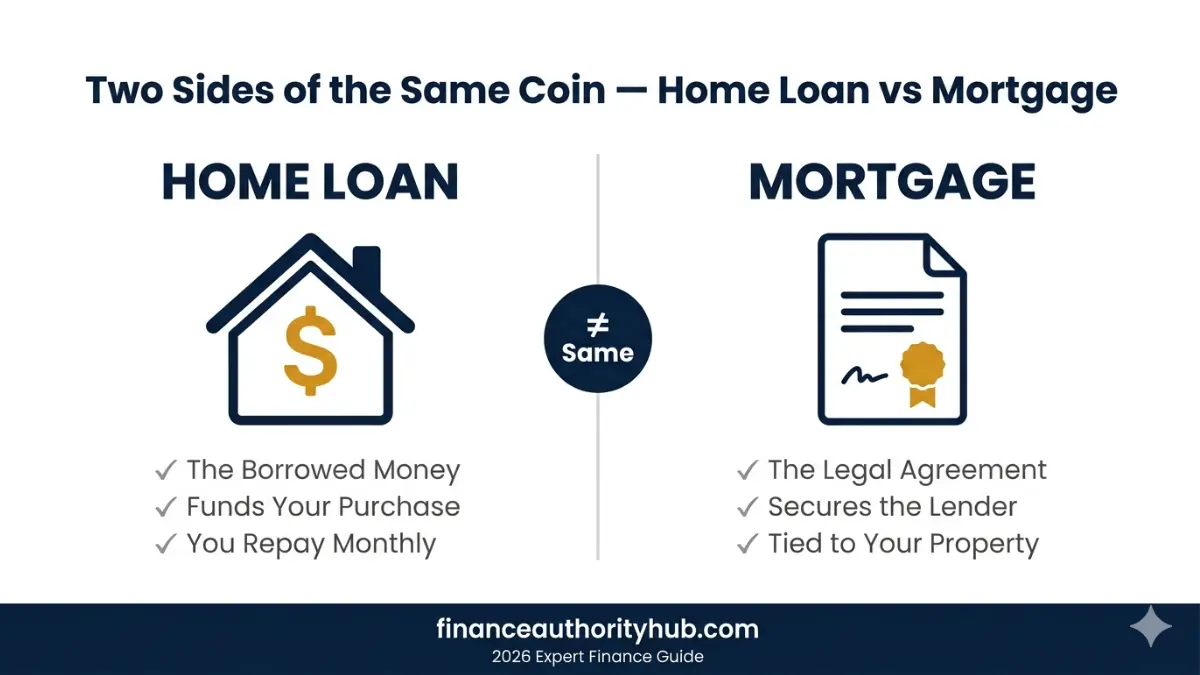
A home loan is the financial product — the actual sum of money a lender provides so you can buy a residential property. You borrow the funds, you repay them in monthly installments over 15 to 30 years, and you pay interest on the outstanding balance throughout the loan term.
Think of a home loan as the debt itself — the dollar amount you owe.
What Is a Mortgage?
A mortgage is the legal security instrument — a written contract that gives the lender a legal claim (called a lien) over your property until the home loan is fully repaid. It’s not the money. It’s the legal framework that protects the lender’s investment.
Think of the mortgage as the contract that backs the debt.
Why Are They Used Interchangeably?
In practice, every residential property purchase in the United States involves both documents signed simultaneously. Since you can’t have one without the other, lenders, media, and consumers naturally merged the two terms into one. The Consumer Financial Protection Bureau (CFPB) defines mortgage loans as loans organized by size and government-program status — blending both concepts under a single term.
Home Loan vs Mortgage: Core Comparison
| Feature | Home Loan | Mortgage |
|---|---|---|
| What it is | The borrowed money | The legal security agreement |
| Purpose | Fund property purchase | Protect the lender’s investment |
| Who benefits | The borrower (buys a home) | The lender (recovers asset if default) |
| Document type | Promissory note | Mortgage deed / deed of trust |
| Expires when | Loan is fully repaid | Lien released after full repayment |
| Can exist alone? | No — needs mortgage as security | Yes — second mortgages, HELOCs exist separately |
Key Takeaway: The home loan is the money. The mortgage is the contract. When someone says “I got a mortgage,” they mean they completed both steps at once.
How a Home Loan and Mortgage Work Together
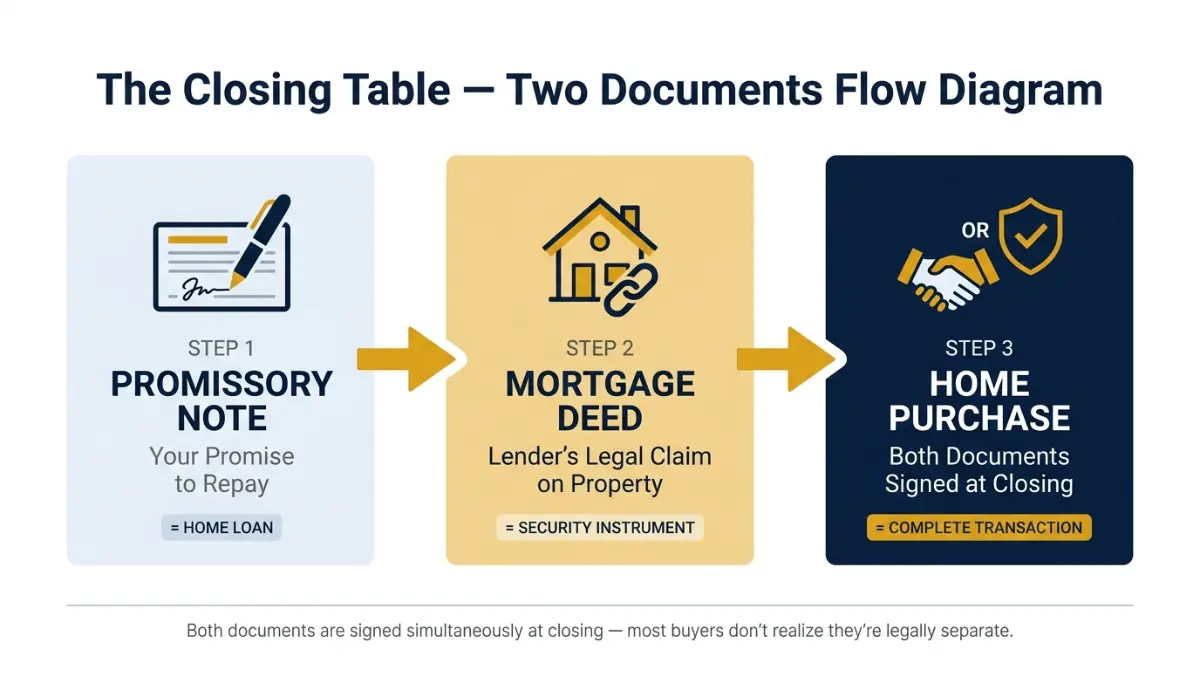
When you sit down at a closing table to buy a home, you sign two critical documents — and most first-time buyers don’t realize they’re legally different.
The Two Documents You Sign
Document 1 — The Promissory Note (the home loan): This is your personal promise to repay the lender. It states the loan amount, interest rate, repayment schedule, and consequences of default. You are personally liable for this debt.
Document 2 — The Mortgage Deed (the mortgage): This is the security instrument that gives the lender a lien on your property. If you default, the lender has the legal right to foreclose — meaning they can seize and sell the home to recover their money.
Both documents are signed together. The home loan can’t function without the mortgage providing security, and the mortgage has no purpose without a home loan to back.
What Is a Mortgage Lien?
A mortgage lien is the lender’s legal claim on your property. Until your home loan is fully repaid, the lender holds a first lien position — meaning they are first in line to recover funds if the property is sold or foreclosed. You can use our home equity calculator to track how much lien-free equity you’ve built as you pay down your home loan.
What Happens If You Default?
If you stop making mortgage payments, the lender initiates foreclosure — a legal process that allows them to take ownership of your home and sell it. According to the U.S. Department of Housing and Urban Development (HUD), lenders typically begin foreclosure proceedings after 3 to 6 missed payments. This is the mortgage doing its legal job — protecting the lender’s interest.
What This Means For You: The mortgage isn’t there to benefit you. It’s the lender’s safety net. The more equity you build, the more financial protection you have. Track your loan balance regularly and consider refinancing if rates drop — use our mortgage refinance calculator to model your savings.
Home Loan vs Mortgage — Does Your Country Change the Answer?
The terminology debate between “home loan” and “mortgage” isn’t just semantic — it’s geographic. How your country uses these terms dramatically affects what products are available to you and what the legal framework looks like.
Since 95% of our readers are in the United States, here’s what matters most — plus critical context for those buying in other Tier 1 markets.
USA: Are They the Same Thing?
In the United States, home loan and mortgage are functionally identical in everyday use. All major loan types — conventional loans, FHA loans, VA loans, and USDA loans — are all technically mortgage loans. The Federal Housing Finance Agency (FHFA) oversees the conforming loan market that governs most of these products.
Key US distinction: A “mortgage loan” in the US refers to the combined product of home loan + security instrument. There is no separate “home loan vs mortgage loan” product split in the American market.
UK: Mortgage Is the Standard Term
In the United Kingdom, “mortgage” is the dominant and almost exclusively used term. “Home loan” is rarely used by British lenders or consumers. UK mortgages operate under a different regulatory framework and typically feature shorter initial fixed periods (2–5 years) before rolling onto a variable rate, which is structurally different from US 30-year fixed mortgages.
Canada and Australia: A Mixed Picture
- Canada: “Mortgage” is the standard term. The Canada Mortgage and Housing Corporation (CMHC) requires mortgage insurance on all home loans with less than 20% down payment — a major structural difference from the US.
- Australia: “Home loan” is actually the preferred consumer term — Australians typically say “I got a home loan” rather than “I got a mortgage.” However, the underlying legal instrument is still a mortgage deed.
Country Terminology Summary
| Country | Common Term Used | Interchangeable? | Key Regulatory Body |
|---|---|---|---|
| USA | Mortgage / Home Loan | ✅ Yes | CFPB, FHFA |
| UK | Mortgage | Mostly | FCA |
| Canada | Mortgage | ✅ Yes | CMHC |
| Australia | Home Loan | ✅ Yes | ASIC |
Bottom Line for US Buyers: In America, whether a lender says “home loan” or “mortgage,” they mean the same product. Focus less on terminology and more on loan type, interest rate, and total cost.
Types of Home Loans and Mortgage Products Explained
Not all home loans are structured the same. Understanding the different types of mortgage loans available in 2026 is critical to choosing the right product for your financial situation. Learn more in our complete guide to types of home loans to go deeper on each product.
Conventional, FHA, VA, and USDA Loans
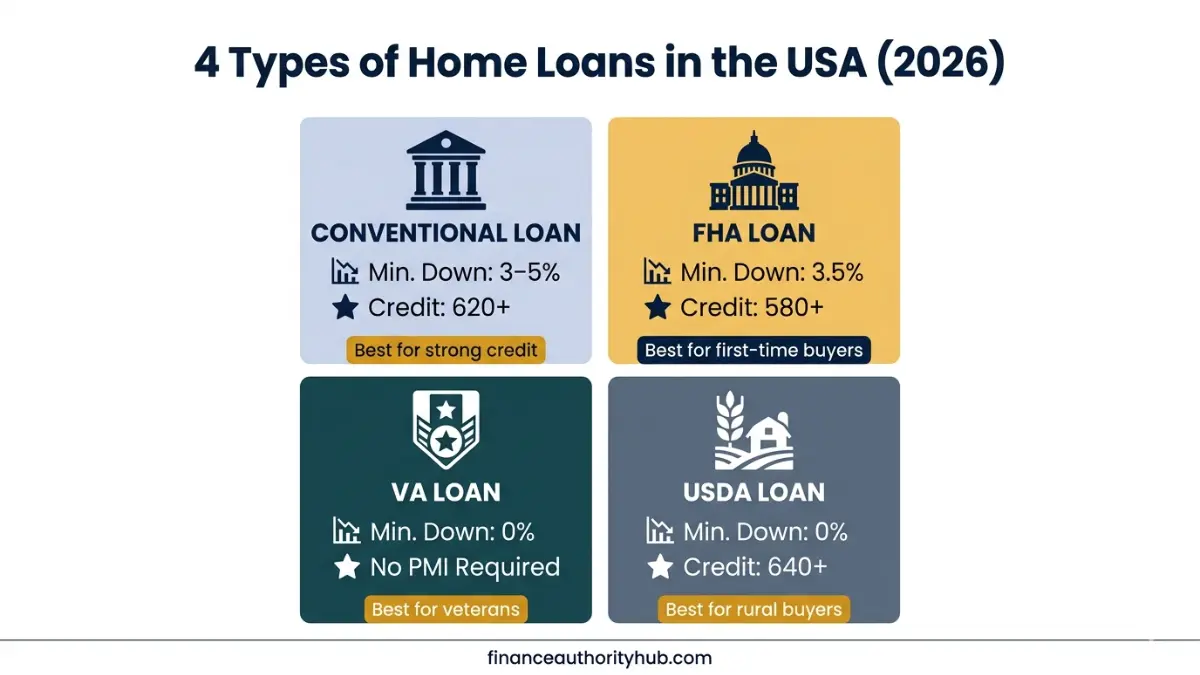
These are the four primary mortgage loan types for US home buyers:
| Loan Type | Min. Down Payment | Min. Credit Score | Best For | Government-Backed? |
|---|---|---|---|---|
| Conventional | 3–5% | 620 | Strong credit buyers | ❌ No |
| FHA Loan | 3.5% | 580 | First-time buyers, lower credit | ✅ Yes (FHA/HUD) |
| VA Loan | 0% | No minimum (lender sets) | Veterans, active military | ✅ Yes (VA) |
| USDA Loan | 0% | 640 | Rural area buyers, income limits apply | ✅ Yes (USDA) |
| Jumbo Loan | 10–20% | 700+ | High-value properties ($806,500+) | ❌ No |
FHA loans — insured by the Federal Housing Administration — are among the most accessible mortgage products for first-time American buyers. VA loans offer the single best deal available: zero down payment, no PMI, and competitive rates for those who qualify.
Before deciding which loan type fits your situation, use our home affordability calculator to see how much home you can realistically afford at current interest rates.
Second Mortgages, HELOCs, and Home Equity Loans
Once you’ve built equity in your home, you can borrow against it. These products are technically separate mortgages — they’re not home loans for purchase, but mortgage instruments secured against a property you already own.
- Home Equity Loan: A lump-sum second mortgage at a fixed rate. You borrow against your home’s equity and repay it like a traditional loan.
- HELOC (Home Equity Line of Credit): A revolving credit line secured by your home. You draw funds as needed during a set draw period.
- Cash-Out Refinance: Replaces your existing mortgage with a new, larger home loan — you take the difference in cash.
Explore how home equity works and four strategic ways to use it in our guide: Home Equity — 4 Ways to Use It in 2026.
Fixed-Rate vs Adjustable-Rate Mortgage
| Feature | Fixed-Rate Mortgage | Adjustable-Rate Mortgage (ARM) |
|---|---|---|
| Interest Rate | Locked for entire term | Fixed initially, then adjusts periodically |
| Monthly Payment | Stable and predictable | Can rise or fall after initial period |
| Best For | Long-term homeowners, rate stability | Short-term owners, expecting to sell/refinance |
| Most Common Term | 30-year, 15-year | 5/1 ARM, 7/1 ARM |
Pro Tip: If you plan to stay in your home for 7+ years, a fixed-rate mortgage almost always wins on total cost. Use our 15 vs 30-year mortgage comparison to model the real cost difference.
Home Loan vs Mortgage — Rates, Costs & Tax Benefits in 2026
Understanding the real cost of a home loan and mortgage is where most borrowers make expensive mistakes. Here’s the 2026 data picture.
What Are Current Mortgage Rates in 2026?
As of March 2026, according to Bankrate’s national lender survey:
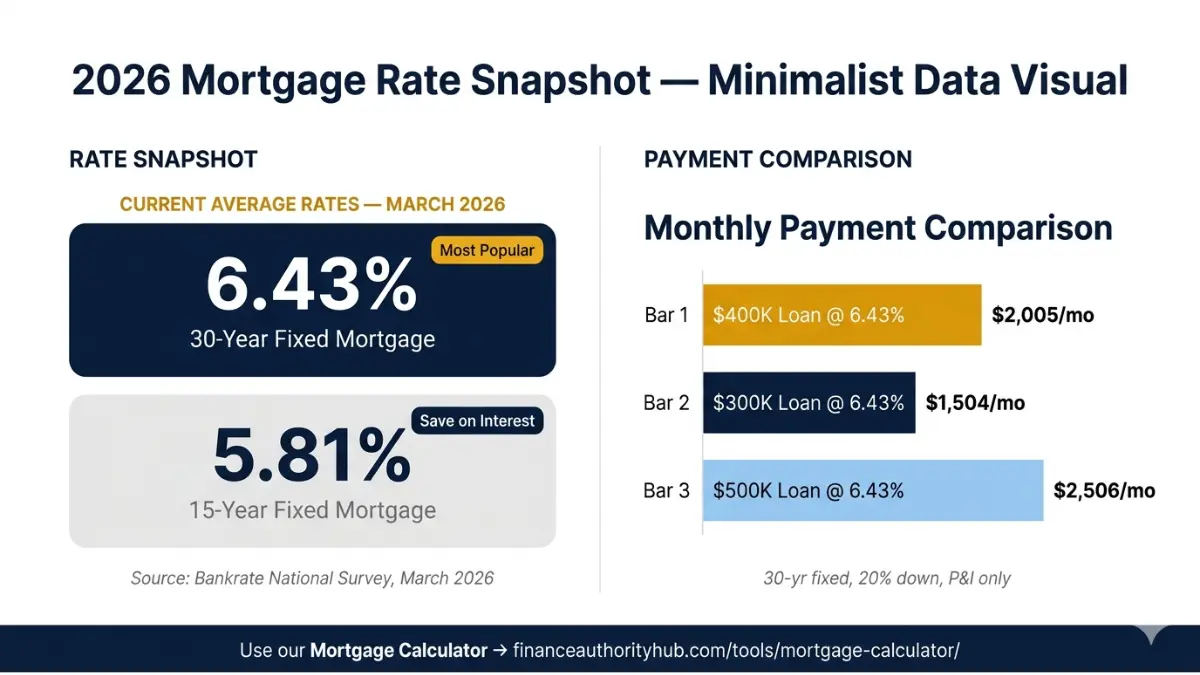
- 30-year fixed mortgage rate: ~6.43% APR
- 15-year fixed mortgage rate: ~5.81% APR
Rates have remained elevated compared to the historic lows of 2020–2021. The Federal Reserve held rates unchanged at its March 18, 2026 meeting, signaling no immediate relief for mortgage borrowers. You can compare current rates by state using our lowest mortgage rates by state guide.
How Much Does a Mortgage Actually Cost? (2026 Estimates)
The table below shows estimated monthly principal + interest for a 30-year fixed-rate mortgage at 6.43% APR, with 20% down:
| Home Price | Loan Amount (80%) | Est. Monthly Payment | Total Paid Over 30 Years |
|---|---|---|---|
| $300,000 | $240,000 | ~$1,504 | ~$541,440 |
| $400,000 | $320,000 | ~$2,005 | ~$721,800 |
| $500,000 | $400,000 | ~$2,506 | ~$902,160 |
| $600,000 | $480,000 | ~$3,008 | ~$1,082,880 |
Note: These figures include principal and interest only. Property taxes, homeowner’s insurance, and PMI (if applicable) increase your actual monthly payment. Use our mortgage calculator for a fully personalized estimate including all costs.
What Is PMI and How Do You Avoid It?
If your down payment is less than 20%, most conventional lenders require Private Mortgage Insurance (PMI) — typically 0.5%–1.5% of the loan amount annually. On a $400,000 loan, that’s an extra $166–$500 per month.
Three ways to avoid PMI:
- Put 20% or more down at closing
- Use a piggyback loan (80/10/10 structure)
- Reach 20% equity and request PMI cancellation (required by law under the Homeowners Protection Act)
Track your loan-to-value ratio — the key PMI trigger metric — with our loan to value calculator.
Can You Deduct Mortgage Interest on Your Taxes?
Yes — for most US homeowners, mortgage interest is tax-deductible. Per IRS Topic 504, you can deduct mortgage interest paid on up to $750,000 of home acquisition debt (for loans originated after December 15, 2017) if you itemize deductions.
Key 2026 rules:
- Only applies if you itemize deductions on Schedule A (not standard deduction)
- Applies to your primary residence and one secondary home
- Points paid on a home loan may also be deductible in the year paid
What This Means For You: The mortgage interest deduction can save thousands annually — but only if your total itemized deductions exceed the standard deduction ($15,000 single / $30,000 married filing jointly in 2026). For full tax planning context, see our 2026 Tax Brackets guide.
Home Loan vs Mortgage — Which Is Right for You?
Now that you understand what separates a home loan from a mortgage, the more important question is: which mortgage product fits your specific goal in 2026?
Use this decision framework:
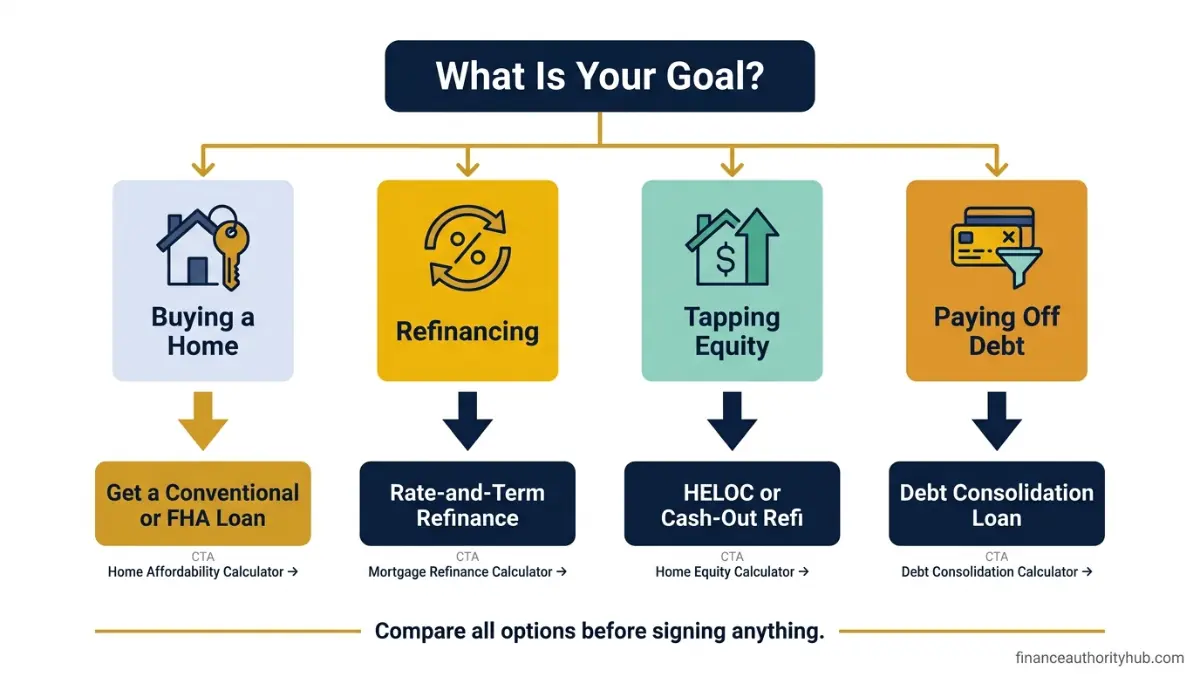
Your Goal → Your Product
| Your Situation | Best Product | First Step |
|---|---|---|
| Buying your first home | FHA loan (low down) or conventional loan | Home Affordability Calculator |
| Refinancing for a lower rate | Rate-and-term refinance | Mortgage Refinance Calculator |
| Pulling equity out of existing home | Cash-out refinance or HELOC | Home Equity Calculator |
| Comparing rent vs. buying | Model total cost of ownership | Rent vs Buy Calculator |
| Paying off high-interest debt using equity | Home equity loan or consolidation | Debt Consolidation Calculator |
Buying a Home for the First Time?
Start with your credit score and down payment amount — these two factors determine which loan type you qualify for and what interest rate you’ll receive. Read our step-by-step first home buying guide for 2026 before speaking to any lender.
Before any lender conversation, know these three numbers:
- Your credit score (620+ for conventional, 580+ for FHA)
- Your debt-to-income ratio (keep below 43% for most loans) — check it with our debt-to-income ratio calculator
- Your estimated down payment and closing costs — use our down payment calculator and closing cost calculator
Refinancing or Tapping Equity?
If you already own a home and rates have dropped since you originally borrowed, a refinance could save you significantly. Also explore our full refi rates guide to understand when refinancing actually makes financial sense — not just when rates drop, but when the break-even timeline is in your favor.
Final Thought: Whether you call it a home loan or a mortgage, what matters is securing the right terms, the lowest cost structure, and a monthly payment you can comfortably sustain. Always compare at least 3 lenders — even a 0.25% rate difference on a $400,000 home loan saves over $18,000 over 30 years.
Frequently Asked Questions (FAQs)
1. Is a home loan and a mortgage the same thing?
In the United States, yes — for all practical purposes. A home loan refers to the borrowed funds; a mortgage is the legal agreement securing those funds against the property. Both are executed together at closing, so Americans use the terms interchangeably.
2. What is the main difference between a home loan and a mortgage?
A home loan is the debt — the money you borrow. A mortgage is the security instrument — the legal contract giving the lender a lien on your property. The home loan can’t exist without the mortgage backing it.
3. Can you have a home loan without a mortgage?
Not in standard residential property financing. Every home loan in the US requires a mortgage (or deed of trust) as collateral. Unsecured home financing would carry extreme interest rates and is not offered by mainstream lenders.
4. What is a mortgage lien?
A mortgage lien is the lender’s legal claim on your property. It means the lender has a secured interest in your home until the loan is fully paid off. If you default, this lien gives them the right to foreclose and sell the property.
5. Which typically has a lower interest rate — a home loan or a personal loan?
Home loans (mortgages) almost always carry lower interest rates than personal loans because the property serves as collateral, significantly reducing lender risk. In 2026, average 30-year mortgage rates are ~6.43%, while personal loan rates average 11–25%.
6. What is a second mortgage?
A second mortgage is an additional loan taken against a home you already own, sitting behind your primary mortgage in lien priority. Home equity loans and HELOCs are common types. If you default, the primary mortgage lender is paid first.
7. What happens to my mortgage if I can’t make payments?
After typically 3–6 missed payments, the lender begins the foreclosure process. This allows them to legally take ownership of your property and sell it to recover the outstanding loan balance. Contact your lender immediately if you’re struggling — most offer hardship programs before foreclosure begins.
8. Is a mortgage loan the same as a loan against property (LAP)?
In the US, no — a “mortgage loan” typically means a home purchase loan. In India and some other markets, a “mortgage loan” specifically refers to a Loan Against Property (LAP), where you borrow against a property you already own for other purposes. These are structurally and legally different products.
9. How much can I borrow with a home loan in 2026?
Conforming loan limits set by the FHFA for 2026 are $806,500 for most US counties. High-cost areas have higher limits. Jumbo loans cover amounts above these thresholds. Your actual borrowing limit depends on income, credit score, DTI ratio, and down payment.
10. What is the difference between a home loan and a home equity loan?
A home loan is used to buy a property. A home equity loan is borrowed against equity in a property you already own. Home equity loans are a type of second mortgage — they don’t fund the original purchase, they monetize existing ownership.
11. Do “home loan” and “mortgage” mean the same thing in the UK and Australia?
In the UK, “mortgage” is the standard term and “home loan” is rarely used. In Australia, “home loan” is the dominant consumer term while “mortgage” refers to the legal instrument. Both countries use slightly different regulatory frameworks, but the underlying concept — borrowing money to buy a property, secured against that property — is identical.
Disclaimer
This article is for educational and informational purposes only and does not constitute financial, legal, or tax advice. Mortgage products, interest rates, and tax laws are subject to change. Always consult a licensed mortgage professional, financial advisor, or tax expert before making any home financing decisions. Loan eligibility requirements vary by lender.
Related Articles
 Mortgage Basics
What Is a Home Loan? Complete Guide for U.S. Borrowers (2026)
March 22, 2026 Mortgage Basics
How Does a Home Loan Work Step by Step? (2026 Guide)
March 22, 2026 Mortgage Basics
Buy Your First Home 2026: Save $15K+ (Complete First-Time Buyer Guide)
January 27, 2026 Mortgage Basics
7 Biggest Mistakes First-Time Home Buyers Make (And How to Avoid Them)
April 20, 2026 Mortgage Basics
Mortgage Amortization Explained: How Every Payment Breaks Down in 2026
March 26, 2026
Informational disclaimer
The content on Finance Authority Hub is provided for general informational and educational purposes only and should not be considered personalized financial, investment, tax, legal, or professional advice. Financial decisions depend on your individual goals, income, risk tolerance, location, and regulatory situation. Before acting on any information, strategy, estimate, or calculator result, consult a qualified licensed professional who can evaluate your specific circumstances.