The parts of your Social Security statement worth checking
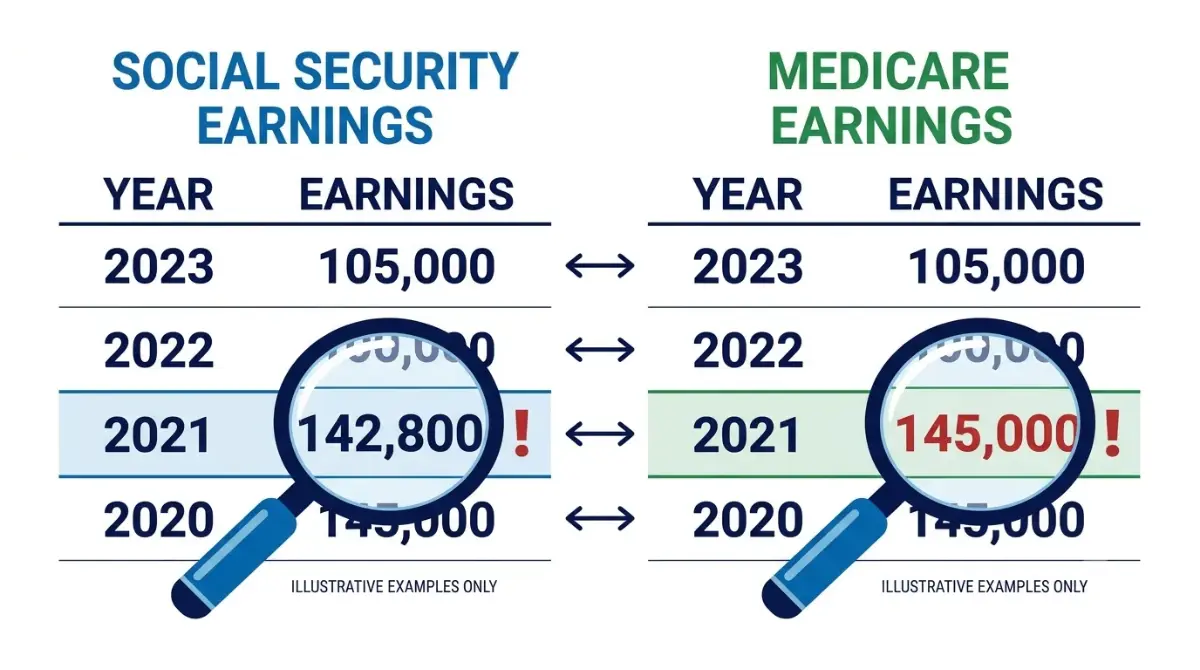
Your Social Security statement has two earnings columns. Below the taxable maximum they should match — in SSA’s own sample, one year doesn’t.

In This Article
Start with these three checks, in this order
If a Social Security statement just arrived in your post at 60 or older, the number on the front is not the one to check first. Turn to the earnings table.
If you are within ten years of claiming, check the small line of text sitting beside the benefit estimate before you plan around the estimate itself. It contains an assumption about your future that may already be wrong.
If you have never opened one, start by getting the online version — the printed copy cannot show you the years most likely to hold a mistake.
And if something already looks wrong, skip to the deadline. One year on your record expires every April.
Three checks, in this order: the assumption beside the estimate, the two columns in the earnings table, and the year that expires next. Each takes a few minutes. Together they cover almost every costly error a working record can carry.
ℹ️ Financial Disclaimer: This article is educational and does not provide personalized investment, tax, lending, credit, insurance, or debt-relief advice. Social Security benefit amounts, earnings-record corrections, and their tax consequences depend on facts specific to you. Before acting on anything here, consult the Social Security Administration directly about your record, and a fiduciary advisor, a CPA, or a qualified attorney about the money decisions that follow from it.
How to get the version that’s actually current
The document you can check properly is the online one, not the copy in the envelope.
The mailed summary versus the online record
The printed statement compresses your early working life. In the Social Security Administration’s own published sample, the years 1971–1980, 1981–1990 and 1991–2000 appear as three combined totals rather than thirty separate rows.
The statement says so directly: it has combined your earlier years, and your complete earnings record is available online. Those compressed decades are exactly where an old employer, a name change, or a mistyped number is most likely to sit.
Who still gets one in the post
The SSA mails statements to workers aged 60 and older who do not have an online account, three months before their birthday. Everyone else views it through a my Social Security account.
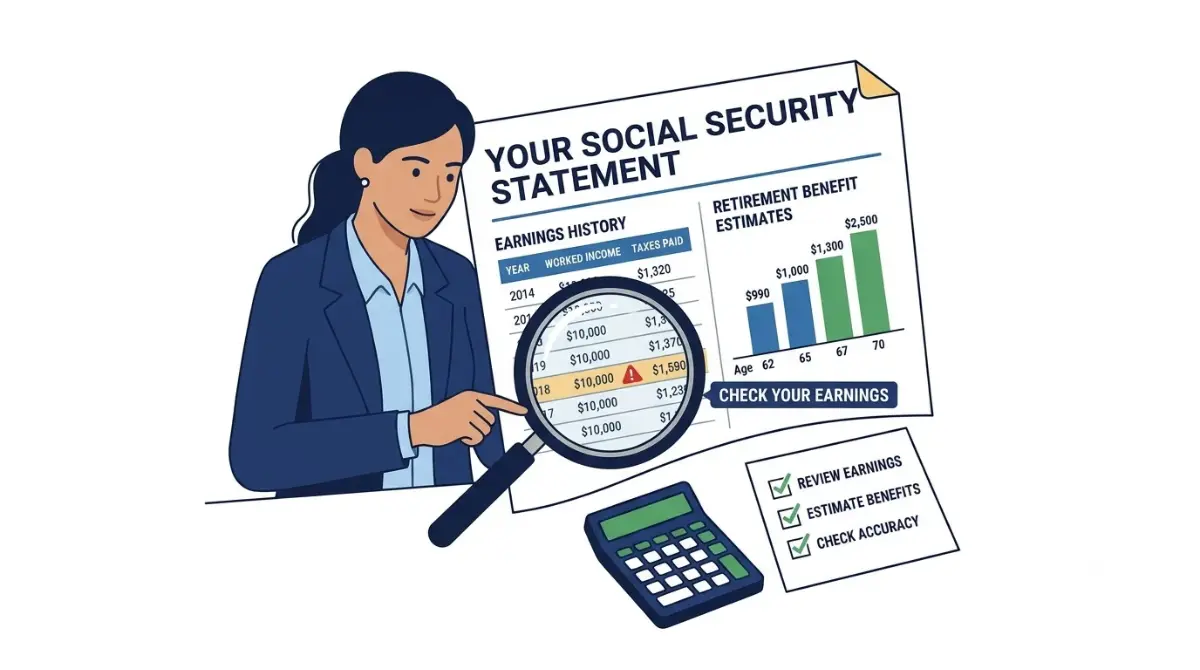
The redesigned statement carries a bar chart of retirement estimates at nine different ages, your earnings history, and instructions for reporting an error. Nine age-banded fact sheets now accompany it.
Why the login changed
New accounts can only be created through Login.gov or ID.me. The SSA retired its own username-and-password sign-in on June 7, 2025, so credentials created before then no longer work.
Verifying your identity with either provider is a one-time task the SSA estimates takes 5 to 20 minutes. You must be 18 or older and have a Social Security number.
✅ Action Step: Before checking anything else, open the full year-by-year earnings record inside your account rather than the summary PDF. If you cannot get past identity verification, call 1-800-772-1213 and ask for an appointment at a field office — the record can be reviewed with a claims representative in person.
The credits line on page one — the one confirming you qualify — is a separate question with its own rules, covered in our guide to how many Social Security work credits you actually need. What the record itself becomes is explained in how your highest 35 years turn into a monthly benefit.
Check one: the assumption printed beside your estimate
The estimate holds only if one assumption holds — and the statement prints that assumption a few lines below the chart.

What the nine-age chart is really showing
The chart shows what your monthly retirement benefit would be at each age from 62 to 70. Each month you wait raises the amount, permanently.
It is a projection, not a quotation. Nothing on the page is a commitment.
The earnings assumption, in the SSA’s own words
The sample statement states that the personalized estimates are based on earnings to date and assume the worker continues to earn a stated annual amount until benefits start. That figure — your recent earnings level — is printed on your own copy.
That single line is the difference between a useful estimate and a misleading one. It assumes your career continues at today’s pay.
If you are about to stop working
For anyone facing redundancy at 58, moving to part-time work, or retiring early, the printed estimate overstates what will actually arrive. The assumption behind it stopped being true.
⚠️ Costly Mistake: Building a retirement plan around the age-70 bar without reading the assumption underneath it. A worker who stops earning at 60 but plans around a figure that assumes earnings through 70 has built the plan on a scenario that will not happen — and the gap widens the longer the assumed earnings run.
You can test a different earnings path with our Social Security benefit calculator, and see how your estimate sits against reality in our breakdown of the average Social Security benefit and how the distribution actually falls. The CFPB’s planning tool for comparing claiming ages covers the timing decision itself.
Check two: do your two earnings columns agree?
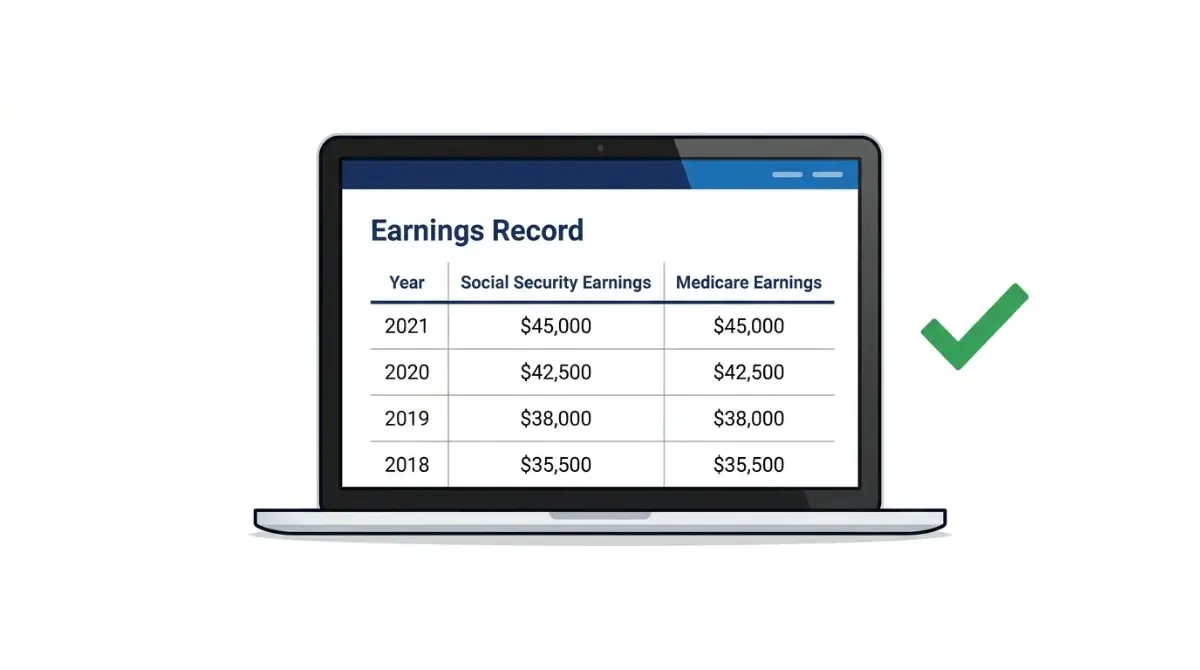
Below the taxable maximum, the two columns in your earnings table should be identical. They differ for four reasons.
- Your earnings exceeded the cap. The taxable maximum is $184,500 for 2026. The statement says plainly that earnings above the limit do not appear on your earnings record — so the Social Security column stops at the cap while the Medicare column keeps going.
- The year is before 1966. The Medicare column is headed “began 1966” on the statement itself. Earlier years have nothing to show.
- The year is 1991, 1992 or 1993. Medicare briefly had its own separate, higher ceiling in those three years — $125,000, $130,200 and $135,000 respectively — before it was removed entirely from 1994 onward.
- The work was covered for Medicare but not Social Security. Some public-sector employment has historically carried Medicare coverage without Social Security coverage, which shows as Medicare earnings alongside little or no Social Security earnings in the same year.

What each column is, and where it comes from
The two columns are the annual totals of two boxes on your W-2 form — Social Security wages and Medicare wages. Our guide to what each W-2 box actually reports walks through which is which.
🔍 How It Works: Your employer reports both figures to the SSA every year. For an ordinary worker earning under the cap, the same wages are subject to both taxes, so both boxes carry the same number and both columns should match to the dollar. When they do not — and none of the four reasons above applies — something in the reporting chain went wrong.
The row inside the SSA’s own sample
The SSA publishes two sample statements, one for online viewing and one for the mailed version. Both carry an identical earnings table for a fictional worker whose pay runs from roughly $34,000 to $54,000 a year.
Every row matches across both columns except one. The 2010 row shows $45,666 taxed for Social Security against $45,847 taxed for Medicare — a $181 gap in a year when those earnings sat at less than half the cap then in force.
Whether the sample is illustrating the signal or simply carries an artifact, it is the clearest demonstration available of what the test looks for, and anyone can open the public PDF and see it. A mismatch below the cap is the single most checkable sign that a year needs attention.
💡 Expert Note: The SSA’s own instruction on the statement is to review the earnings history because future benefits are based on that record. The two-column comparison is simply the fastest way to act on that instruction — it turns a wall of numbers into one yes-or-no question per row.
You can see how the cap changes what leaves a paycheck with our paycheck withholding calculator.
Check three: which year expires next
There is a correction deadline, and almost every article about it stops one word too early.

The three-year rule, and how the date is computed
The SSA’s guidance is that ordinarily you cannot correct your earnings after 3 years, 3 months and 15 days from the end of the taxable year in which the wages were paid. The same limit appears in the SSA Handbook and rests on Section 205(c) of the Social Security Act.
🔍 How It Works: Count from the end of the year, not from your birthday or the filing date. Wages paid in 2023 run to December 31, 2023, plus three years to December 31, 2026, plus three months to March 31, 2027, plus fifteen days — closing on April 15, 2027. On the same arithmetic, 2022 wages closed on April 15, 2026, 2024 wages close in 2028, and 2025 wages close in 2029.
That gives you a priority order rather than a panic. The oldest year still inside the window is the one to look at first.
The four exceptions the SSA publishes
The word doing the work in that sentence is ordinarily. The SSA lists four situations in which a record can be corrected after the limit has passed:
- To confirm records against tax returns filed with the Internal Revenue Service.
- To correct errors caused by employee omissions from processed employer reports, or by missing reports.
- To correct errors “on the face of the record” — ones the SSA can find by examining its own processed reports.
- To include wages an employer reported as paid to a person but which do not appear in the SSA’s records.
⚠️ Costly Mistake: Reading “3 years, 3 months and 15 days” as a closed door and abandoning a year that is still recoverable. At least one page ranking for this topic carries a headline stating that no adjustments are possible after three years — but the first exception alone covers anyone who still holds, or can obtain, the tax return that reported those wages.
What a recovered year is actually worth depends on where it lands in the benefit formula, which our explainer on how the Social Security bend points work sets out.
How to prove a year you no longer have paperwork for
The exceptions turn on evidence, which is where most people give up.
What the SSA accepts, and where to get it
The SSA says it helps to have documents such as Forms W-2 and pay stubs. The problem is obvious for a year that is decades old.
| Source | Coverage | Cost | Key detail |
|---|---|---|---|
| IRS wage and income transcript | Past ten tax years | Free | Shows what employers reported; current year incomplete until earnings post |
| SSA W-2 copies | Any year from 1978 to the present | Free for a Social Security reason; $62 otherwise | You must state the reason |
| Your own tax return | However long you kept it | Free | Directly triggers the first exception |
| Former employer’s payroll records | Varies widely | Free | Third-party payroll providers often hold more than the employer does |
Sources: IRS Topic no. 159; Social Security Administration FAQ on obtaining Forms W-2, certified July 20, 2026.
The IRS transcript, and where it stops
You can request a wage and income transcript from the IRS covering the past ten tax years. Beyond ten years, that route is closed.
The W-2 copies the SSA has kept since 1978
📊 Data Point: The SSA can provide copies or printouts of Forms W-2 for any year from 1978 to the present, free of charge where they are needed for a Social Security-related reason, and $62 per request otherwise — Source: Social Security Administration, FAQ certified July 20, 2026.
This is the gap the IRS cannot fill, and it is nearly forty years deeper.
⚠️ Costly Mistake: Sending the request without saying why you need it. The SSA states that if you do not give a reason, it assumes the forms are for non-program purposes — which is the difference between free and $62. Note that the current request form itself shows a slightly lower fee than the FAQ does, so confirm the amount on the form before sending payment.
Self-employment years
Self-employment income reaches your record through your filed return rather than an employer report, and it can post later than wage income. Our guide to which 1099 forms report what, and when covers the reporting side.
Who fixes what: your employer, the IRS, or the SSA
The order you approach them in decides how long this takes.
- Your employer files a corrected W-2. Form W-2 C exists specifically to correct a W-2 already filed with the Social Security Administration. Start here whenever the year is recent enough that the employer still exists.
- The IRS compels the employer. If the W-2 has not been corrected by the end of February, IRS guidance is that a representative can open a Form W-2 complaint on 1-800-829-1040. The IRS then writes to the employer requesting a corrected form within ten days, and sends you Form 4852 to use in the meantime.
- You verify the result at the SSA. That same IRS guidance directs the worker to check wages through a my Social Security account after September 30.
- The SSA corrects its own record. Where the record itself is wrong rather than the employer’s report, the route is Form SSA-7008, Request for Correction of Earnings Record.

If the earnings are not yours at all
Wage reports the SSA cannot match to a name and number go into its Earnings Suspense File rather than onto anyone’s record.
📊 Data Point: As of September 2024 the Earnings Suspense File held more than $2.3 trillion in wages and over 415 million wage items — Source: Social Security Administration Office of the Inspector General, fiscal 2024 major management challenges report.
Most mismatches are reporting failures or unreported name changes rather than anything sinister. Treat it as a records problem first and raise it with the SSA before paying for any monitoring service.
✅ Action Step: Ask the SSA claims representative one specific question: “Is this an employer reporting problem or a suspense-file match, and which form do you want from me?” The answer determines whether you are waiting on your employer or filing SSA-7008 yourself. Correction timelines circulate widely online but conflict badly and none traces to the SSA, so plan on following up rather than on a fixed number of days.
Fixing this at 35 costs an afternoon; at 65 it costs whatever paperwork has survived, as our retirement planning guide for your 30s sets out in a wider context.
Social Security statement questions people actually ask
1. Who still receives a paper Social Security statement?
The SSA mails statements to workers aged 60 and older who do not have an online my Social Security account, arriving three months before their birthday. Everyone else views the statement online. The mailed version is a summary; the complete year-by-year earnings record is only available through the account.
2. Why doesn’t my statement show every year separately?
The printed statement combines earlier working years into blocks — the SSA’s own sample groups 1971–1980, 1981–1990 and 1991–2000 into three totals. The statement itself directs you to view the complete record online. Those compressed years are the ones most likely to hold an unnoticed error.
3. Does the Social Security statement estimate assume I keep working?
Yes. The statement states that the estimates are based on your earnings to date and assume you continue to earn a stated annual amount until benefits begin, and it prints that amount on your copy. If you stop working or reduce your hours before claiming, the estimate overstates what you will receive.
4. Why are my Medicare earnings higher than my Social Security earnings?
Usually because your pay exceeded the taxable maximum, which is $184,500 for 2026 — the statement notes that earnings above the limit do not appear on the record. Medicare has had no ceiling since 1994, and had its own higher ceiling in 1991, 1992 and 1993.
5. What if a year is missing from my Social Security statement entirely?
Recent years may simply not have posted yet. For older years, treat a blank as a reporting failure and check it against your own tax return for that year. The correction route is Form SSA-7008, and the first step is confirming what your employer actually reported.
6. Can I fix an error older than three years?
Often, yes. The ordinary limit is 3 years, 3 months and 15 days after the year the wages were paid, but the SSA publishes four exceptions — including confirming records against tax returns filed with the IRS, and including wages an employer reported that never reached your record. Ask the SSA which exception applies to your year.
7. What proof does the SSA accept for an earnings correction?
Forms W-2 and pay stubs are the documents the SSA names as helpful, and a filed tax return directly supports the first published exception. Employer payroll records also work. Gather the documentation before contacting the SSA, since the burden of raising doubt about the record sits with you.
8. How do I get a W-2 from a year in the 1990s?
The SSA holds copies of Forms W-2 for any year from 1978 to the present, and provides them free where you need them for a Social Security-related reason. State that reason in the request — without one, the SSA assumes a non-program purpose and charges a fee. The IRS transcript route only reaches back ten years.
9. How long does a correction to my earnings record take?
No figure is given here deliberately. Timelines quoted on other sites range from a matter of weeks to several months, they contradict each other, and none traces to a published SSA source. Plan on following up with the SSA rather than waiting on a fixed date.
10. Someone else’s earnings are on my record — what should I do?
Raise it with the SSA first. Unmatched wage reports normally sit in the Earnings Suspense File rather than posting to a record, so an entry that is not yours usually points to a reporting error or an unreported name change. The SSA can tell you which it is before you take any other step.
11. Does checking my Social Security statement change anything on my record?
No. Viewing your statement or your earnings history is purely a read — it does not trigger a claim, alter your benefit, or start any application. Reviewing it annually is what the SSA itself recommends, precisely because errors are easier to fix while the documentation still exists.
Do this before you close the tab
Open the online record rather than the printed summary, because the printed one cannot show you the years that matter most.
Read the assumption beside the estimate and ask whether your career really continues at today’s pay until you claim. Then run the two columns down the earnings table and mark every row that disagrees below the cap.
Finally, find the oldest year still inside the window — for wages paid in 2023, that closes on April 15, 2027 — and start there.
✅ Action Step: Put a recurring reminder in your calendar for early each year to check the record once, and pull the relevant tax return before contacting the SSA rather than after. Where the record is right and the projection is simply smaller than you hoped, our guides to retirement savings benchmarks by age and the full retirement income picture cover what fills the gap.
Informational disclaimer
The content on Finance Authority Hub is provided for general informational and educational purposes only and should not be considered personalized financial, investment, tax, legal, or professional advice. Financial decisions depend on your individual goals, income, risk tolerance, location, and regulatory situation. Before acting on any information, strategy, estimate, or calculator result, consult a qualified licensed professional who can evaluate your specific circumstances.