
How Injured Spouse Relief Returns Your Share of a Joint Refund
Injured spouse relief returns your share of a joint refund taken for your spouse’s debt, and an e-filed Form 8379 takes about 11 weeks to process.
In This Article
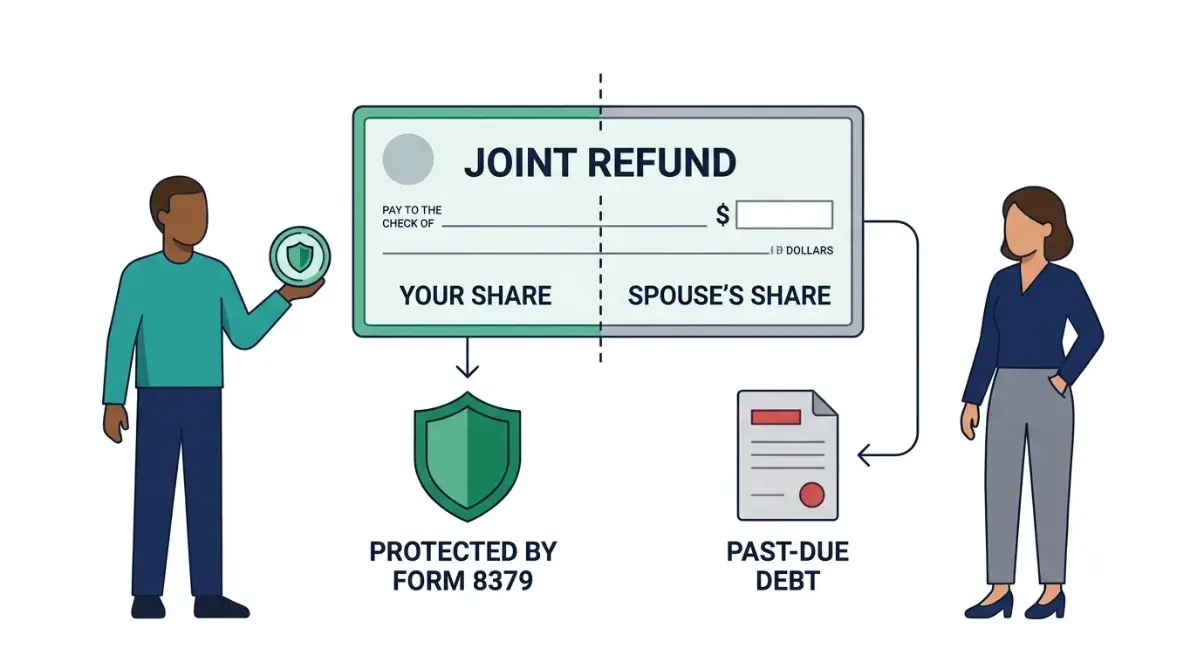
Your joint refund was taken for your spouse’s debt
You filed jointly, expected a refund, and learned it went to a debt that isn’t yours. Injured spouse relief lets you ask the IRS for your share back on Form 8379.
If the offset already happened
Confirm the debt is only your spouse’s, then file Form 8379 by itself.
If you expect it this filing season
Attach Form 8379 to your joint return; the Taxpayer Advocate Service says the IRS generally processes it before an offset. Facing a tax bill from your spouse’s errors instead? See the innocent spouse comparison.
ℹ️ Financial Disclaimer: This article is general education about federal tax refunds, refund offsets, and IRS filing rules. It is not tax, legal, lending, debt-relief, investment, or insurance advice for your situation. Before acting, confirm your details with the IRS, a CPA or enrolled agent, or a tax attorney.
What injured spouse relief is (and what it isn’t)
Injured spouse relief lets the spouse who doesn’t owe a debt reclaim their share of a joint refund applied to the other spouse’s past-due debt. You file Form 8379, Injured Spouse Allocation, and the IRS figures your share (the IRS overview of injured spouse relief).
Debts that can take a joint refund
A spouse’s past-due federal tax, state income tax, state unemployment compensation debt, child support, or federal non-tax debt such as a student loan. The Bureau of the Fiscal Service sends the notice for all but federal tax offsets; see how tax refund offsets work.
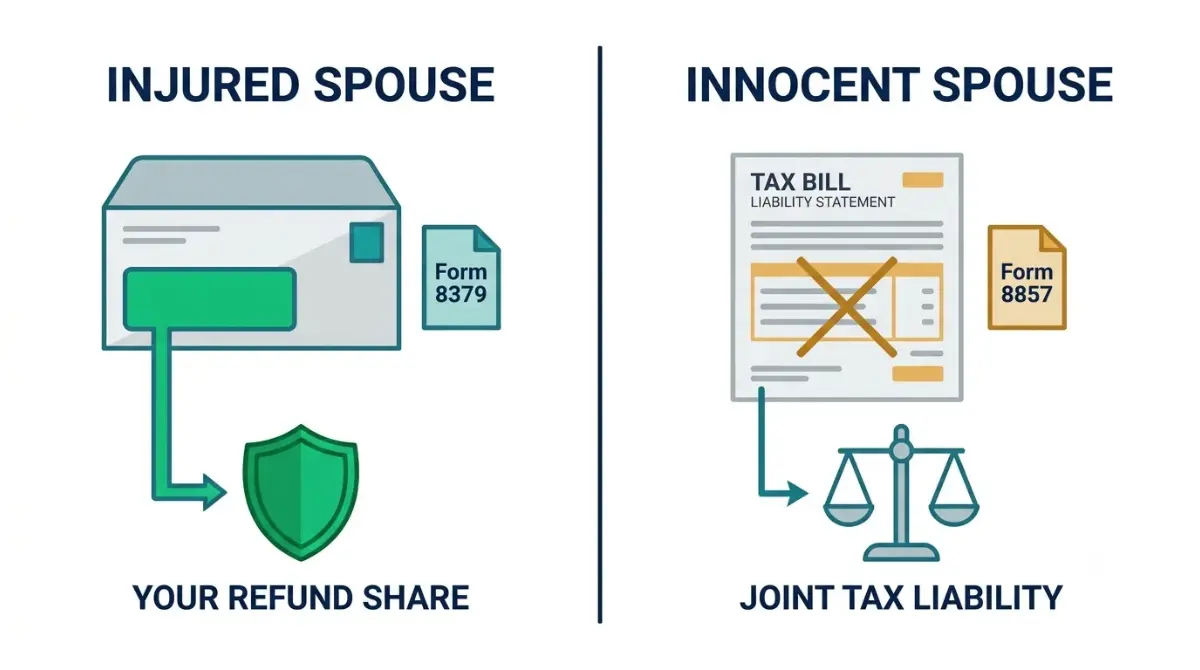
Injured spouse vs. innocent spouse
Innocent spouse relief (Form 8857) instead relieves certain joint tax bills; see IRS Publication 971 on innocent spouse relief.
💡 Expert Note: Injured means your share of a refund; innocent means a tax bill you shouldn’t owe.
Do you qualify as an injured spouse?
You may qualify as an injured spouse if all three apply:
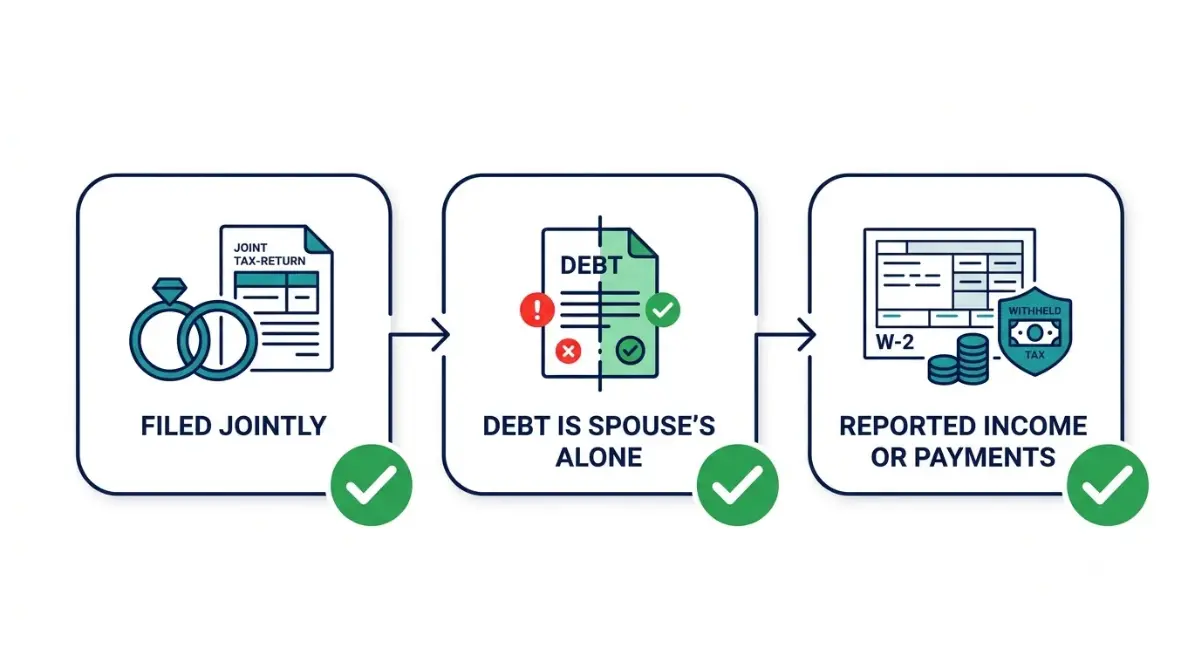
- You filed jointly, and your refund share was or will be applied to your spouse’s past-due debt.
- You aren’t legally obligated to pay it.
- You reported income and payments, such as tax withheld, or a refundable credit.
The three-part test
These mirror Part I of the official Form 8379 instructions. A debt you also owe doesn’t qualify.
If you live in a community property state
Arizona, California, Idaho, Louisiana, Nevada, New Mexico, Texas, Washington, and Wisconsin use special rules. There, 50% of a joint overpayment (except the earned income credit) generally goes to non-federal-tax debts.
⚠️ Costly Mistake: Some guides list the wrong states. Use the IRS’s nine, and expect a smaller share back.
✅ Action Step: Ask a CPA: “Under our state’s rules, how much of our overpayment can go to my spouse’s debt?”
How the IRS splits a joint refund: a worked example
The IRS treats each spouse as filing separately, then splits the joint tax in proportion to each one’s separate tax.
The method in three steps
🔍 How It Works: (1) Each item goes to the spouse who would report it, and the basic standard deduction splits in half. (2) Each spouse’s separate tax sets their percentage. (3) Your percentage times the joint tax is your share; your withholding minus that share is your refund.
Example: Maya and Dev’s 2025 return
Hypothetical couple: Dev owes past-due child support exceeding their refund; no dependents or credits.
| Line | Joint return | Maya (injured spouse) | Dev | Key Detail |
|---|---|---|---|---|
| Wages | $80,000 | $52,000 | $28,000 | From each W-2 |
| Standard deduction | $31,500 | $15,750 | $15,750 | Split in half |
| Tax (2025 rates) | $5,343 | $4,111.50 | $1,231.50 | 76.95% / 23.05% |
| Withholding | $7,500 | $5,600 | $1,900 | From each W-2 |
| Refund | $2,157 | $1,488.50 | $668.50 | Dev’s part can still be offset |
Source: FinanceAuthorityHub calculation using IRS 2025 tax rates and standard deduction; tax tables may differ by a few dollars. Illustration only; the IRS figures your actual amount.
Without Form 8379, all $2,157 could go to Dev’s debt; with it, Maya gets $1,488.50 back.
Credits change the split; estimate first with the full tax refund formula or our federal income tax calculator.
✅ Action Step: Have credits? Ask a CPA: “Which credits would Form 8379 allocate to me?”
How to file Form 8379, step by step
Get it complete the first time.
Filing with your joint return vs. by itself
- Confirm the debt is subject to offset.
- Complete Parts I–III, assigning each item to the spouse who would report it.
- With your return: e-file it, or on paper write “Injured Spouse” in the upper left of page 1.
- By itself: attach both spouses’ W-2s and 1099s showing withholding, not the joint return.
- Mail it to the IRS service center the instructions list for your situation.
Amending for a bigger refund? Attach another Form 8379; see amended return refund wait times.
The deadline and the every-year rule
File within 3 years from the original return’s due date (including extensions) or 2 years from paying the offset tax, whichever is later. Each year needs its own Form 8379.
✅ Action Step: Ask a CPA: “Would filing separately protect my refund better than Form 8379?”
How long injured spouse relief takes, and who to call
Expect about 8 to 14 weeks, depending on how you file:
| How you file Form 8379 | Typical processing time | Key Detail |
|---|---|---|
| With a paper joint return | About 14 weeks | Write “Injured Spouse” on page 1 |
| With an e-filed joint return | About 11 weeks | Fastest with-return option |
| By itself, after processing | About 8 weeks | Skip the joint return copy |
Source: IRS, Instructions for Form 8379 (11/2024). Errors add time.
Where to get answers
- Bureau of the Fiscal Service, 800-304-3107: whether a non-IRS debt will be offset.
- The IRS: only if your notice shows a different refund than your return (the IRS page on reduced refunds).
- Taxpayer Advocate Service, 877-777-4778: free help if a claim stalls.
Still waiting? See what to do when a refund is delayed.
Mistakes that delay or sink an injured spouse claim
Most delays come from avoidable slips.
Paperwork mistakes
- Filing when no past-due debt exists, which delays your refund
- Leaving out W-2s or 1099s, or sending an incomplete form
- Putting an item in the wrong spouse’s column
Expectation mistakes
- Expecting relief on a debt you also owe
- Expecting the debt to vanish; your spouse still owes it
- Using Form 8379 to escape a joint tax bill, which is Form 8857’s job
Injured spouse relief FAQ
1. What is injured spouse relief?
Injured spouse relief lets the spouse who doesn’t owe a debt reclaim their share of a joint refund applied to the other spouse’s past-due debt. A CPA or enrolled agent can confirm it fits your case.
2. How is injured spouse relief different from innocent spouse relief?
Injured spouse relief returns your refund share via Form 8379; innocent spouse relief (Form 8857) can relieve a joint tax bill. A CPA can tell you which applies.
3. Who qualifies for injured spouse relief?
You qualify if you filed jointly, don’t owe your spouse’s past-due debt, and reported income and payments or a refundable credit. Confirm eligibility with a CPA or enrolled agent.
4. Which debts can trigger an injured spouse claim?
An injured spouse claim covers past-due federal tax, state income or unemployment debts, child support, and federal non-tax debts like student loans. A tax professional can review your notice.
5. How much will injured spouse relief give back?
Injured spouse relief returns your withholding minus your share of joint tax; in our example, $1,488.50 of $2,157. Ask a CPA to estimate yours.
6. How long does injured spouse relief take?
Injured spouse relief takes about 14 weeks with a paper return, 11 if e-filed, and 8 when Form 8379 is filed alone. A tax professional can check a stalled claim.
7. Can I file for injured spouse relief after my refund was taken?
Yes. For injured spouse relief after an offset, file Form 8379 by itself; processing takes about 8 weeks. A CPA can review your form first.
8. Can I e-file Form 8379 for injured spouse relief?
Yes, Form 8379 can be e-filed with your joint return. Filed by itself, it’s mailed to an IRS service center. A tax preparer can handle the e-file.
9. What is the deadline for injured spouse relief?
The injured spouse relief deadline is 3 years from the return’s due date, including extensions, or 2 years from payment, whichever is later. Confirm your deadline with a CPA or enrolled agent.
10. Does injured spouse relief work in community property states?
Yes, but injured spouse relief follows special rules there; 50% of a joint overpayment generally goes to non-federal-tax debts. A CPA can apply your state’s rules.
11. Do I need to file Form 8379 every year for injured spouse relief?
Yes. Injured spouse relief requires a separate Form 8379 for each year you want your share returned. A tax professional can track your filings.
Your next step to claim your share
Confirm the debt is your spouse’s alone, check the three-part test, and estimate your share. Then file Form 8379 with every W-2 attached; a complete claim is the quickest way to your money.
Related Articles
 Tax Refund
What to Do With Tax Refund Money in a Clear, Simple Order
October 15, 2026 Tax Refund
The Right Way to Check Your Tax Refund Status With the IRS
October 6, 2026 Tax Refund
Is Your Tax Refund Lower Than Last Year? Find the Real Reason
October 10, 2026 Tax Refund
Should Your Tax Refund Pay Debt or Save? Find the Right Split
October 14, 2026 Tax Refund
How a Tax Refund Affects SSI, SNAP and Medicaid Benefits
October 16, 2026 Tax Refund
What a Tax Refund Advance Loan Really Costs You
October 16, 2026 Tax Refund
Set the Right Overtime Tips Deduction Withholding for 2026
October 13, 2026 Tax Refund
Self-Employed Tax Refund or Bill? A Clear 2026 Walkthrough
October 14, 2026 Tax Refund
The Right Way to Answer IRS Letter 5071C and Release Your Refund
October 17, 2026
Informational disclaimer
The content on Finance Authority Hub is provided for general informational and educational purposes only and should not be considered personalized financial, investment, tax, legal, or professional advice. Financial decisions depend on your individual goals, income, risk tolerance, location, and regulatory situation. Before acting on any information, strategy, estimate, or calculator result, consult a qualified licensed professional who can evaluate your specific circumstances.