An excess IRA contribution is fixable — here’s how and by when
An excess IRA contribution is fixable — but a $7,500 excess can come back as $7,200, and your custodian is not making a mistake.
In This Article
First, work out which deadline you’re on
You put too much into an IRA. The money can come back out, and the fix costs less than the word “penalty” suggests.
What matters right now is a date, so start here:
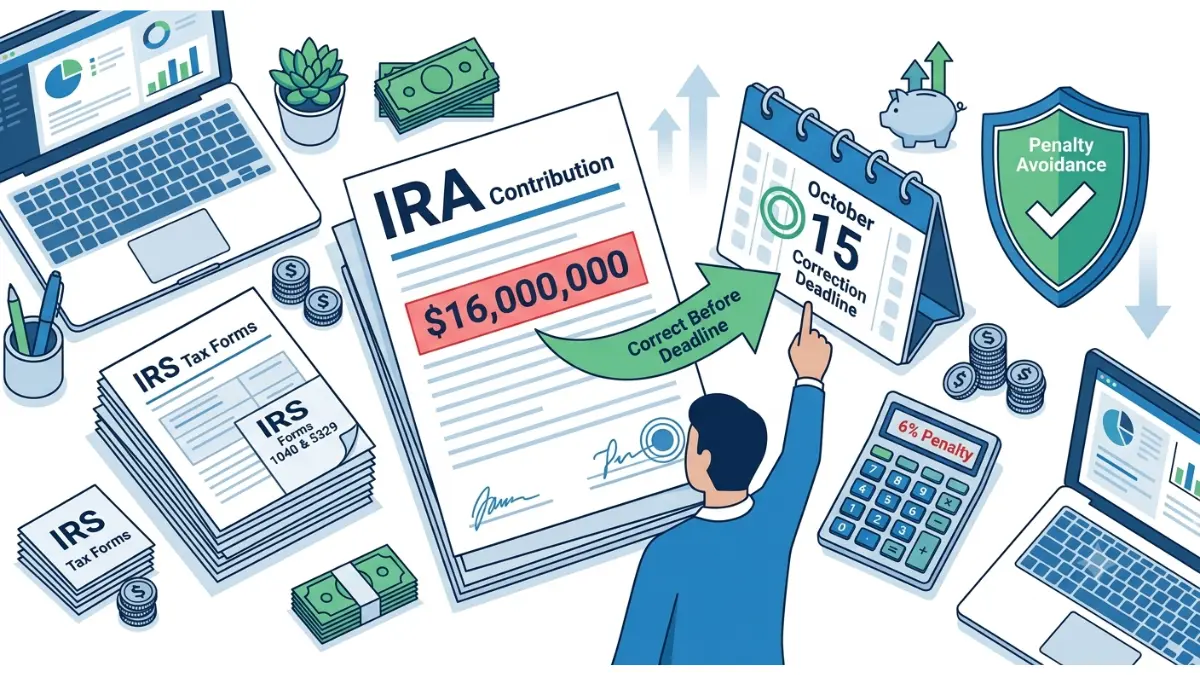
- Contributed for 2025, and it’s still before October 15, 2026? You can undo it cleanly — see the clean fix below.
- Past that date? Two options remain, and neither is a disaster.
- An older excess you never corrected? The last two sections are yours.
The IRS charges 6% a year on an excess IRA contribution, for each year it is still sitting in the account at the end of the tax year. It stops for good the year the excess is gone, which is why acting quickly beats acting perfectly.
One distinction to settle early. The deadline for making a contribution and the deadline for correcting one are two different dates set by two different rules — 2025 contributions had to be in by April 15, 2026, but the correction window runs months longer.
Fixing this year is one problem. Not repeating it is a different one, and it starts with which IRA your income actually allows before the next contribution goes in.
ℹ️ Financial Disclaimer: This article is educational and is not personalized investment, tax, lending, insurance, or debt advice. IRA contribution rules, excise taxes, and filing requirements depend on facts specific to you — your compensation, filing status, income, age, and what other retirement accounts you hold. Consult a CPA, an enrolled agent, a tax attorney, or a fiduciary financial advisor before acting on anything here. FinanceAuthorityHub does not maintain a panel of credentialed financial reviewers, and nothing on this page has been reviewed by one.
What actually counts as an excess IRA contribution
An excess contribution is any amount above what you were allowed to put in for that tax year — and the allowance is smaller than most people assume.
For 2026, the IRS caps total contributions across all your traditional and Roth IRAs at $7,500, or $8,600 if you are 50 or older by year end. That is a combined ceiling, not a per-account one. If you want the full picture across years, the site’s guide to IRA contribution limits covers it.
📊 Data Point: The 2026 IRA contribution limit is $7,500, with a $1,100 catch-up for savers 50 and older — a total of $8,600 — Source: IRS news release IR-2025-111 on the 2026 limits, November 2025.
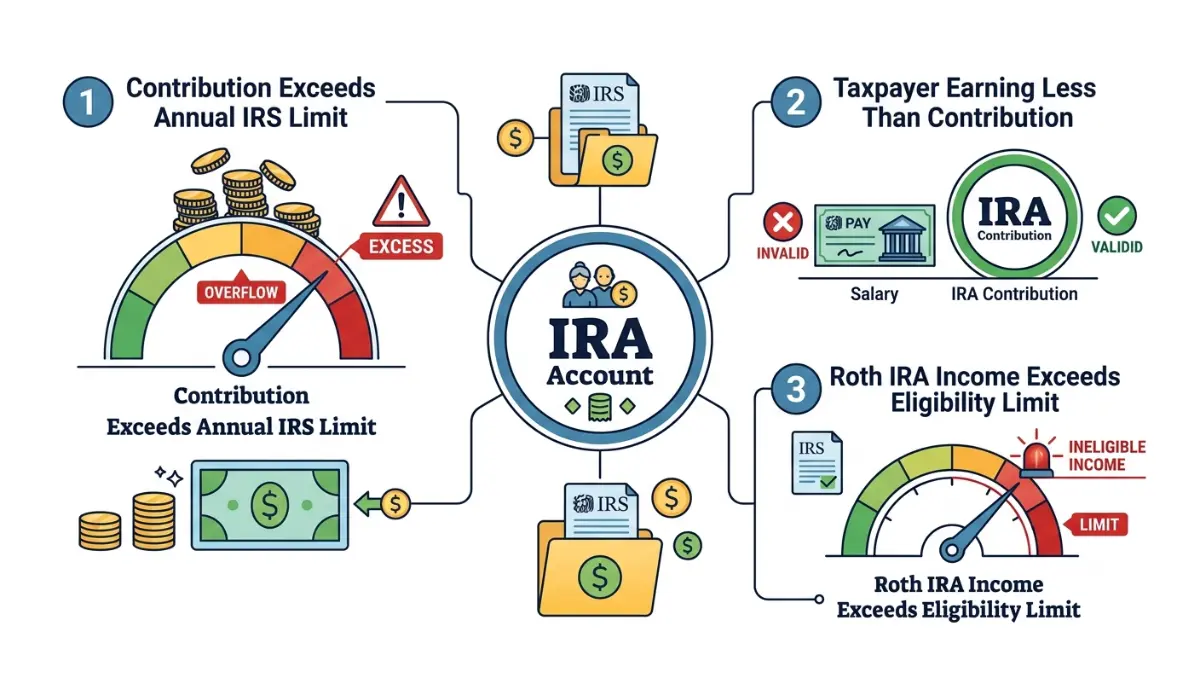
You went over the dollar limit
The simplest version: two accounts, two contributions, one ceiling. Automatic monthly transfers that keep running past the annual cap do the same thing quietly.
An improper rollover contribution also counts as an excess, according to the IRS’s own list of what makes a contribution excessive. A rollover that qualifies does not — properly executed 401(k)-to-IRA rollovers sit outside the annual limit entirely, as do qualified reservist repayments.
You contributed more than you earned
Your limit is the smaller of the dollar cap or your taxable compensation for the year. Earn $4,000 and contribute $7,500, and $3,500 of it is excess.
This catches two groups hardest. Retirees are one: rental income, interest, dividends, and pension or annuity income are not compensation for IRA purposes. Self-employed savers are the other, when net earnings land lower than the figure they contributed against in January.
Your income was too high for a Roth
Roth eligibility phases out by income. For 2026 the range is $153,000 to $168,000 for single and head-of-household filers, and $242,000 to $252,000 for married couples filing jointly. Above the top of your range, the allowed Roth contribution is zero — and the whole contribution is excess.
A raise, a bonus, or a spouse’s new job in December can do this retroactively. The Roth IRA calculator will tell you whether your income allowed a contribution at all, and the Roth income phase-out rules explain the partial band in between.
One relief: a contribution you cannot deduct is not an excess contribution. Non-deductible and excessive are different problems, and the first one is legal.
What the 6% penalty costs, year by year
The excise tax is 6% of the excess amount, charged for each year the excess is still in the account at the end of the tax year — and it cannot exceed 6% of the combined value of all your IRAs at that date.
| Excess amount | 6% for one year | Three years, uncorrected | Key detail |
|---|---|---|---|
| $1,000 | $60 | $180 | Often less than the fee to fix it late |
| $3,000 | $180 | $540 | The most common accidental range |
| $7,500 | $450 | $1,350 | A full 2026 limit contributed twice |
| $8,600 | $516 | $1,548 | The age-50 ceiling, doubled up |
Figures calculated at the 6% rate published by the IRS; no other assumption is included. Source: IRS, Retirement topics — IRA contribution limits, reviewed March 2026.
What 6% works out to in dollars
A $3,000 excess costs $180 a year. That is real money and worth a phone call, but it is not the catastrophe the word “penalty” implies.
The number that should move you is the repeat. Left alone for four years, the same $3,000 costs $720 — and the fix never got any harder in the meantime.
The cap most articles leave out
The tax cannot be more than 6% of what your IRAs are actually worth on December 31. For a small or badly-timed account, that ceiling can be lower than 6% of the excess itself.
🔍 How It Works: The 6% is charged on the excess, not on the account, and not on the excess plus interest. Each year is assessed independently at year end — so it accumulates in a straight line rather than compounding. The moment the excess no longer exists on December 31, that year and every year after it are clean.
The clean fix: a return of excess plus earnings
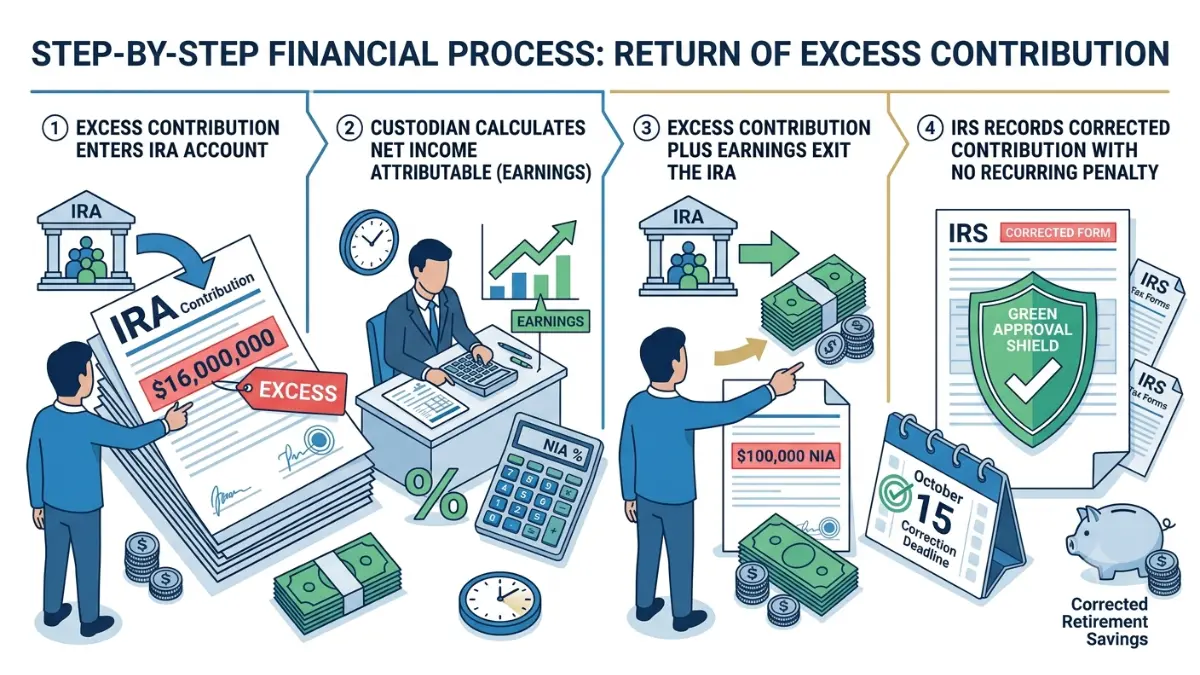
If you are still inside the window, one transaction erases the problem: a return of excess contribution, which removes the money and whatever it earned, and the IRS treats the contribution as though it never happened.
To avoid the 6% entirely, four things must be true:
- You withdraw the excess by the due date of your return, including extensions.
- You withdraw the earnings attributable to it as well.
- You do not claim a deduction for the withdrawn amount.
- You report those earnings as income for the year the contribution was made.
What to ask your custodian for
Use the words. Ask for a return of excess contribution for tax year [year], including net income attributable — not a withdrawal, not a distribution.
The wording matters because the two transactions are reported differently and only one of them cures the excess. Custodians have their own forms and cut-off times for this, so call rather than clicking through the standard withdrawal screen.
⚠️ Costly Mistake: Taking an ordinary withdrawal instead of a return of excess leaves the excess technically uncorrected, produces the wrong tax reporting, and can trigger income tax on money that should never have been taxed. The account balance looks right and the paperwork is wrong. Fixing that afterwards is harder than getting it right the first time.
How the earnings figure is calculated
Your custodian normally computes this, but you should be able to check it.
🔍 How It Works: The Treasury regulation on returned contributions sets one formula: net income = the contribution × (adjusted closing balance − adjusted opening balance) ÷ adjusted opening balance. The opening balance is what the IRA was worth just before the contribution went in, plus that contribution. The closing balance is what it is worth just before the money comes out.
Worked example. You contribute $7,500 on February 15, 2026, to an account worth $30,000 immediately beforehand, so the adjusted opening balance is $37,500. By the time you correct it, the account is worth $40,500 and nothing else has moved in or out.
The calculation runs $7,500 × ($40,500 − $37,500) ÷ $37,500 = $600. So $8,100 leaves the account: your $7,500 plus $600 of earnings, and that $600 is taxable income for 2026 — the year of the contribution, not the year of the withdrawal, per the IRS’s Form 8606 instructions.
What happens if the market fell
Run the identical facts with the account at $36,000 instead. The formula gives $7,500 × ($36,000 − $37,500) ÷ $37,500 = −$300.
Only $7,200 comes back. Nothing is taxable, the $300 loss stays absorbed inside the account, and you have been correctly refunded less than you put in. This is the single most common source of “my custodian sent me the wrong amount” calls, and the custodian is usually right.
One piece of good news on timing: since December 29, 2022, the 10% early-withdrawal penalty no longer applies to the earnings in a corrective distribution made by the deadline, even if you are under 59½. Publication 590-A’s rules on returning a contribution set out the full mechanics.
✅ Action Step: Before you call, write down four things: the tax year the contribution was for, the exact dollar amount, the date it was deposited, and whether you have filed that year’s return yet. Ask the custodian to confirm the net income attributable figure and the tax year they will report it under.
Two other fixes: recharacterize or amend
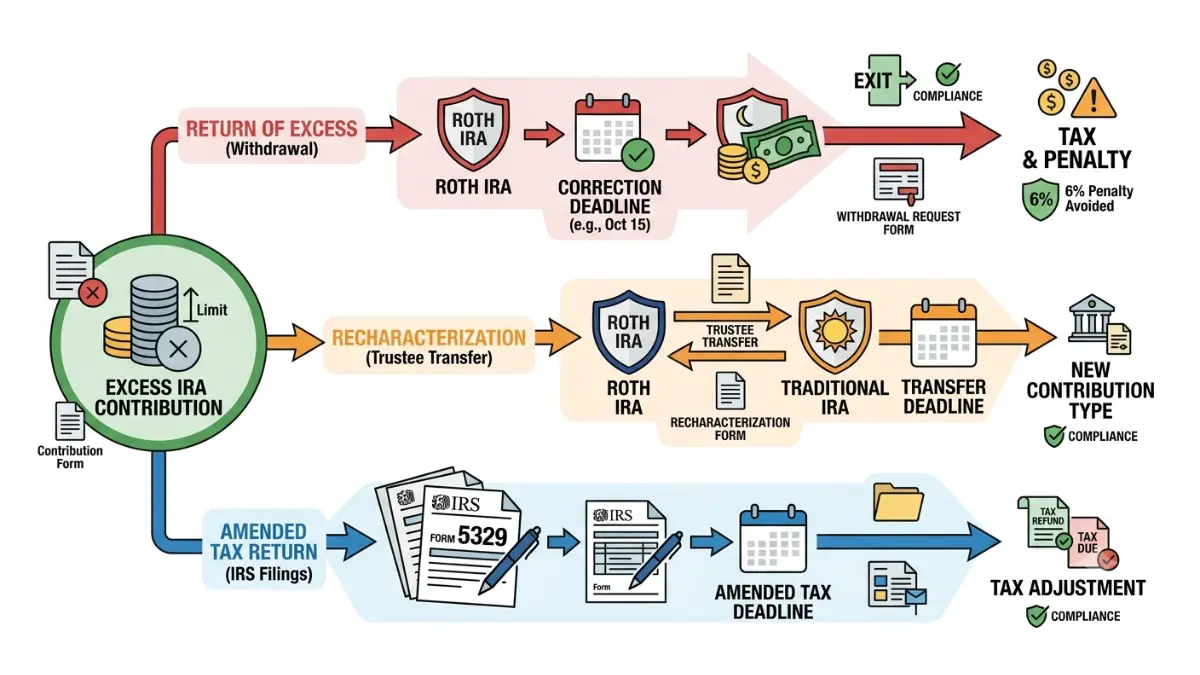
A straight return of excess is not the only route inside the window, and for some situations it is not the best one.
| Route | What it does | Deadline | Best for |
|---|---|---|---|
| Return of excess | Removes contribution + earnings; treated as never made | Due date including extensions | Genuine over-contributions |
| Recharacterization | Moves it to the other type of IRA | Due date including extensions | Roth contributions blocked by income |
| Six-month relief | Removes it after you have already filed | Six months past the original due date | Filed on time, spotted it late |
| Do nothing yet | Pay 6%, correct later | No deadline — the tax repeats | Readers already past the dates above |
Deadlines per IRS guidance on excess contributions and recharacterization; the tax consequences of each route differ and are covered in the sections above and below.
Move it to the other kind of IRA
A recharacterization tells your custodian to move the contribution plus its earnings into the other type of IRA by trustee-to-trustee transfer. Done by the due date including extensions, the contribution is treated as having been made to the second IRA all along.
For someone whose income closed the Roth door, that is often the cleaner outcome — the money stays invested instead of coming out. The IRS’s recharacterisation guidance sets out the mechanics, and note one hard limit: a conversion cannot be recharacterized, and has not been able to be since 2018.
🔍 How It Works: Recharacterizing moves a contribution; it does not erase one. The earnings travel with it, calculated on the same formula used for a return of excess, and the receiving IRA is treated as having held the money from the original date.
If you already filed without fixing it
Filing your return without correcting the excess does not close the door. You can still have the contribution returned within six months of the original due date — excluding extensions — and then file an amended return with “Filed pursuant to section 301.9100-2” entered at the top, reporting the related earnings.
For 2025 contributions, that six-month window and the extended filing date land on the same day. Whether you extended or filed on time and missed it, October 15, 2026 is the wall.
✅ Action Step: If a recharacterization would land the money in a traditional IRA, ask a CPA or enrolled agent this before you move anything: “If I recharacterize this Roth contribution into a traditional IRA, what does the pro-rata rule do to my existing traditional IRA balances?” The answer changes the maths for anyone holding pre-tax IRA money.
If you’re past the deadline: withdraw or absorb it
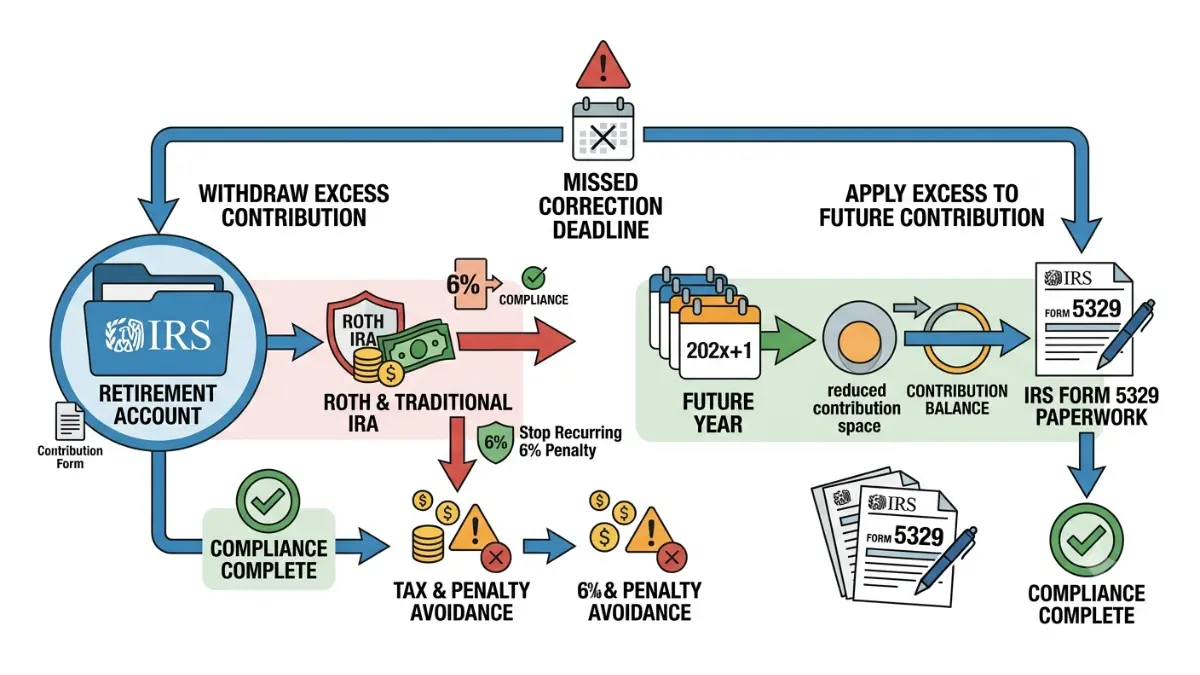
Missing the date costs you the 6% for that year. It does not cost you the fix, and two routes stay open indefinitely:
- Withdraw the excess. After the deadline the earnings calculation is no longer part of it — you take out the excess amount itself.
- Absorb it. Contribute less than your limit in a later year and apply the old excess against the unused room.
Take the money out and stop the clock
The 6% applies for each year the excess is still there on December 31, so a withdrawal in December and one in the following January are a full year apart in cost.
Whether the withdrawn money is taxable depends on conditions specific to your case — whether a deduction was claimed or allowable, and whether that year’s total contributions stayed within that year’s limit. For a Roth, the Roth withdrawal ordering rules decide what comes out first. This is genuinely fact-dependent and worth twenty minutes of professional time.
Or use it up as next year’s contribution
🔍 How It Works: Absorbing means skipping or shrinking a future contribution so the old excess fills the gap. It costs nothing in cash, but it uses up contribution room you would otherwise have had — and the 6% still applies for every year the excess sat there beforehand, including the year you absorb it if it is still present at year end.
SECURE 2.0 also changed how long the IRS has to assess this tax, tying the clock to the filing of your income tax return rather than leaving it open until a Form 5329 appears. The number of years depends on which return applies to you, and it is not a figure to guess at.
✅ Action Step: For a multi-year excess, ask a CPA or enrolled agent: “For each year this excess sat in the account, what do I owe, which year’s Form 5329 does it belong on, and has the assessment period closed on any of them?”
Five mistakes that turn a small problem into a big one
Most of the damage here is procedural, not financial — the account gets fixed and the paperwork does not.
Which part of Form 5329 you need
Form 5329 is where this tax is reported. Excess contributions to a traditional IRA go in Part III; Roth IRA excess contributions go in Part IV.
If you had to pull earnings out before turning 59½, they go on line 1 and come back off on line 2 with exception number 21 — the code that reflects the removal of the 10% charge. The line-by-line instructions for Form 5329 carry the detail, including the rule that a form filed by itself has to go in on paper, signed.
The mistakes that cost people the most
- Taking a normal withdrawal instead of a return of excess.
- Removing the contribution but leaving the earnings behind.
- Assuming the custodian filed something with the IRS on your behalf.
- Using the current year’s Form 5329 for an older year.
- Fixing the account and never filing the form at all.
⚠️ Costly Mistake: A prior year has to be reported on that year’s version of Form 5329, not this year’s. Filing the wrong version is one of the quiet reasons an excess stays technically uncorrected for years while the account itself looks fine. If you have also met this form through the other penalty Form 5329 reports, the same year-specific rule applies there.
Excess IRA contribution questions, answered
1. What happens if you contribute too much to an IRA?
An excess IRA contribution is taxed at 6% of the excess amount for each year it remains in the account at the end of the tax year. The tax cannot exceed 6% of the combined value of all your IRAs at that date. On a $3,000 excess that is $180 a year until it is corrected.
2. How do I fix an excess IRA contribution?
Ask your custodian for a return of excess contribution for the relevant tax year, including net income attributable. Both the contribution and its earnings must come out, you cannot claim a deduction for the withdrawn amount, and the earnings are reported as income. Confirm the figures with a CPA if your situation spans more than one year.
3. What is the deadline to remove an excess IRA contribution?
The due date of your return for the year of the contribution, including extensions. For a 2025 contribution that is October 15, 2026. If you filed on time without correcting it, a separate six-month window runs to the same date and requires an amended return.
4. Is the 6% penalty charged every year?
Yes, for every year the excess is still in the account on the last day of the tax year. It is charged on the excess amount each year rather than compounding, and it stops permanently once the excess no longer exists at year end. Correcting in December rather than January saves a full year.
5. Do I have to take the earnings out too?
Inside the deadline, yes — removing the contribution alone does not cure the excess. After the deadline the earnings calculation no longer applies and you withdraw the excess amount itself. The distinction is one of the most common reasons a correction fails to work as intended.
6. Are the earnings taxable, and in which year?
The earnings withdrawn with a timely correction are taxable income for the year the contribution was made, not the year the money left the account. That can mean amending an already-filed return. A CPA or enrolled agent can confirm which year’s return the amount belongs on.
7. Is there still a 10% early-withdrawal penalty on those earnings?
No. Since December 29, 2022, the 10% additional tax no longer applies to the earnings in a corrective distribution made by the due date of the return, including extensions, even for savers under 59½. On Form 5329 this appears as exception number 21.
8. Can I leave the excess in and use it as next year’s contribution?
Yes. If a later year’s contributions come in under the limit, the earlier excess can be applied against that unused room. It costs no cash, but the 6% still applies for every year the excess remained in the account beforehand, and it consumes contribution room you would otherwise have used.
9. What if I contributed to a Roth IRA and my income was too high?
Above the top of your 2026 phase-out range — $168,000 single, $252,000 married filing jointly — the allowed Roth contribution is zero and the whole amount is excess. Recharacterizing it into a traditional IRA by the deadline is often cleaner than withdrawing. Ask a CPA about the pro-rata rule first.
10. Do I still file Form 5329 if I fixed it in time?
If the excess is fully corrected by the deadline and the contributions are treated as never made, the excess-contribution tax does not apply. Earnings withdrawn before age 59½ still appear on Form 5329 with exception number 21. Your preparer or tax software should confirm what your specific correction requires.
11. What if the excess happened three years ago and I never fixed it?
You may owe the 6% for each of those years, reported on each year’s own version of Form 5329, and the excess needs removing or absorbing to stop it recurring. SECURE 2.0 limits how far back the IRS can assess. A CPA should price the whole sequence before you file anything.
Your next three steps
Three things, in order.
Work out which side of October 15, 2026 you are on — that single fact decides everything else. Call your custodian and use the exact phrase, a return of excess contribution for the tax year in question, including net income attributable. Then put Form 5329 on the list for the relevant year’s return, even if the account is already back in order.
The account is fixable in an afternoon. The habit that caused it is worth a little more thought — including where the next dollar should go instead, and a chance to re-run the plan with the corrected contribution.

Informational disclaimer
The content on Finance Authority Hub is provided for general informational and educational purposes only and should not be considered personalized financial, investment, tax, legal, or professional advice. Financial decisions depend on your individual goals, income, risk tolerance, location, and regulatory situation. Before acting on any information, strategy, estimate, or calculator result, consult a qualified licensed professional who can evaluate your specific circumstances.