What the Inherited IRA 10-Year Rule Means for Heirs
Inherited an IRA? The 10-year rule sets a December 31 deadline in year 10 — and whether you owe a yearly withdrawal hinges on one fact about the owner.
In This Article
If you’ve just inherited an IRA, there’s now a clock running — and two questions probably matter more than any others: by when do you have to take the money out, and do you owe anything every year along the way?
This guide answers both in plain terms, written mainly for the most common case: an adult child or other non-spouse beneficiary who inherited from a parent or relative. If you’re a surviving spouse, you have extra options, and there’s a section below just for you. If you inherited a Roth IRA, the rules bend in your favor, and that’s covered too.
The short version: most people who inherit an IRA now have to empty it within 10 years. But whether you also owe a withdrawal each year depends on one specific fact about the person who died. Let’s start with what the rule actually says.
ℹ️ Financial Disclaimer: This article is general educational information about inherited IRAs, not personalized investment, tax, or legal advice. The rules depend on your exact situation — your relationship to the original owner, their age and date of death, and whether the account is a traditional or Roth IRA. Before you withdraw, roll over, or file anything, confirm your specific facts with a fiduciary financial advisor, a CPA, or a qualified tax attorney.
What the inherited IRA 10-year rule actually says
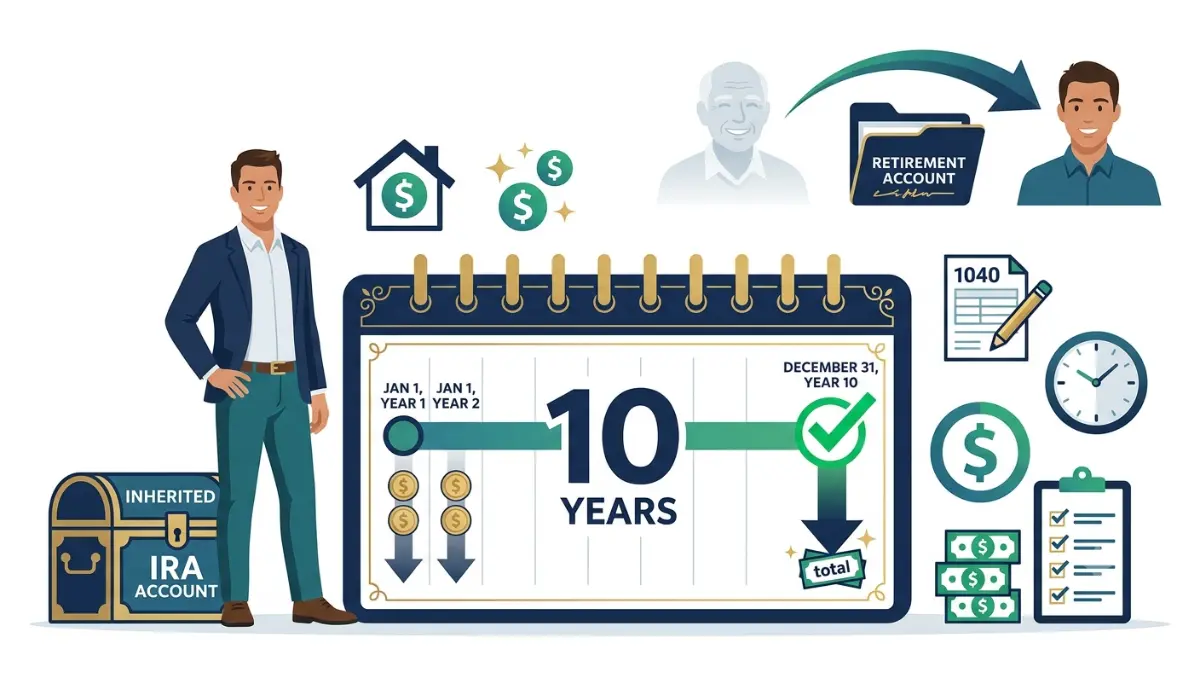
The inherited IRA 10-year rule is straightforward at its core: if you inherited the account from someone who died in 2020 or later, and you’re a non-spouse beneficiary, you generally must withdraw the entire balance by December 31 of the 10th year after the year of death. Inherit in 2025, and the account must be empty by December 31, 2035.
This replaced the old “stretch IRA,” which let beneficiaries spread withdrawals — and the tax bill — across their own lifetime. The SECURE Act of 2019 ended that for most non-spouse heirs, per the IRS’s rules for required minimum distributions. The money still grows tax-deferred inside the 10 years; the rule only sets the deadline to empty it.
One thing trips people up: the account type drives everything that follows. Knowing whether the account is a traditional or Roth IRA tells you how it’s taxed and whether yearly withdrawals apply. It also helps to see which type of IRA you inherited within the wider family of accounts.
⚠️ Costly Mistake: The 10-year clock does not reset. If you inherited a few years ago and haven’t touched the account, you don’t get a fresh 10 years starting now — the deadline still counts from the original owner’s year of death.
Do you have to take money out every year?
Here’s the question that confuses almost everyone: within those 10 years, do you have to withdraw something each year, or can you wait until the very end? It comes down to one fact — whether the original owner had already started their own required minimum distributions before they died.
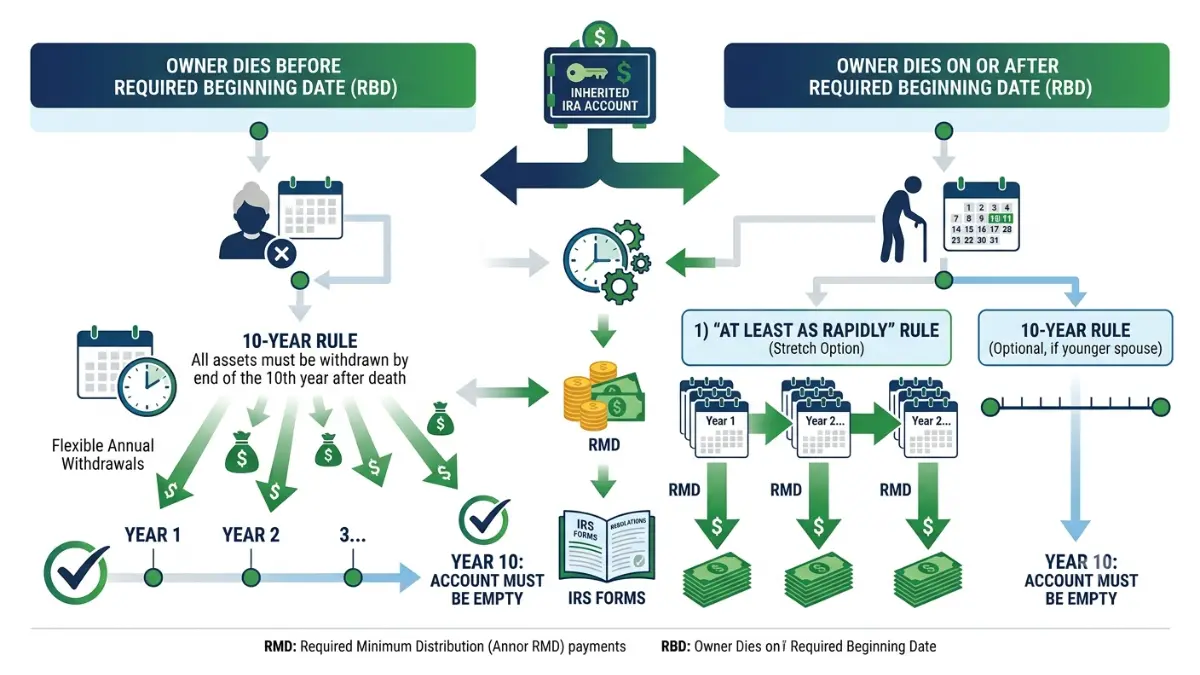
If the owner died before their required beginning date
If they hadn’t started yet, you owe no annual withdrawals. You can take money out whenever you like — nothing for nine years, a little each year, or one lump sum — as long as the account is empty by the end of year 10. The required beginning date is April 1 of the year after the owner turns 73 (rising to 75 in 2033); there’s more on the owner’s required beginning date and how it’s set.
If the owner died on or after that date
If they had already started, you must take a withdrawal in each of years 1 through 9, then empty the rest in year 10. The same before-or-after logic drives a parallel 10-year rule for inherited 401(k)s.
🔍 How It Works: When annual withdrawals apply, each year’s amount is your account balance divided by a life expectancy factor for your age, taken from the IRS Single Life Table in IRS Publication 590-B. You set the factor in year one and subtract 1.0 from it each year after.
💡 Expert Note: The IRS waived these annual withdrawals for 2021 through 2024 while the rules were being finalized. Starting with 2025 they’re required — so a common point of confusion is assuming the pause still applies. It doesn’t.
✅ Action Step: Before year-end, confirm with a CPA or fiduciary advisor whether the owner had reached their required beginning date, and ask: “Given the exact date of death, do I owe a withdrawal this year, and how is it calculated?”
Who’s exempt: eligible designated beneficiaries
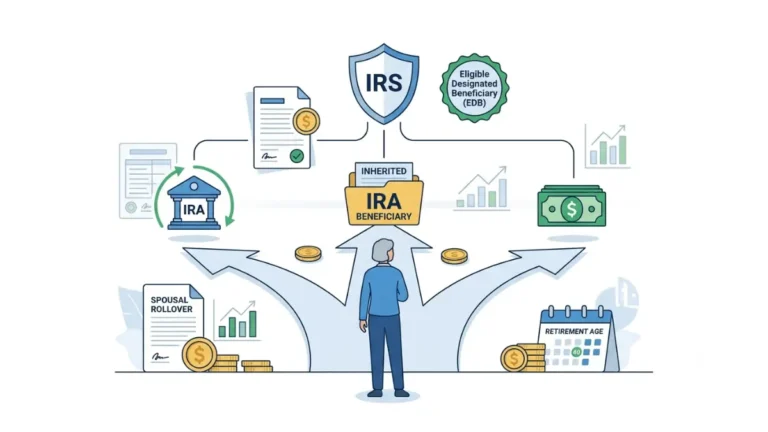
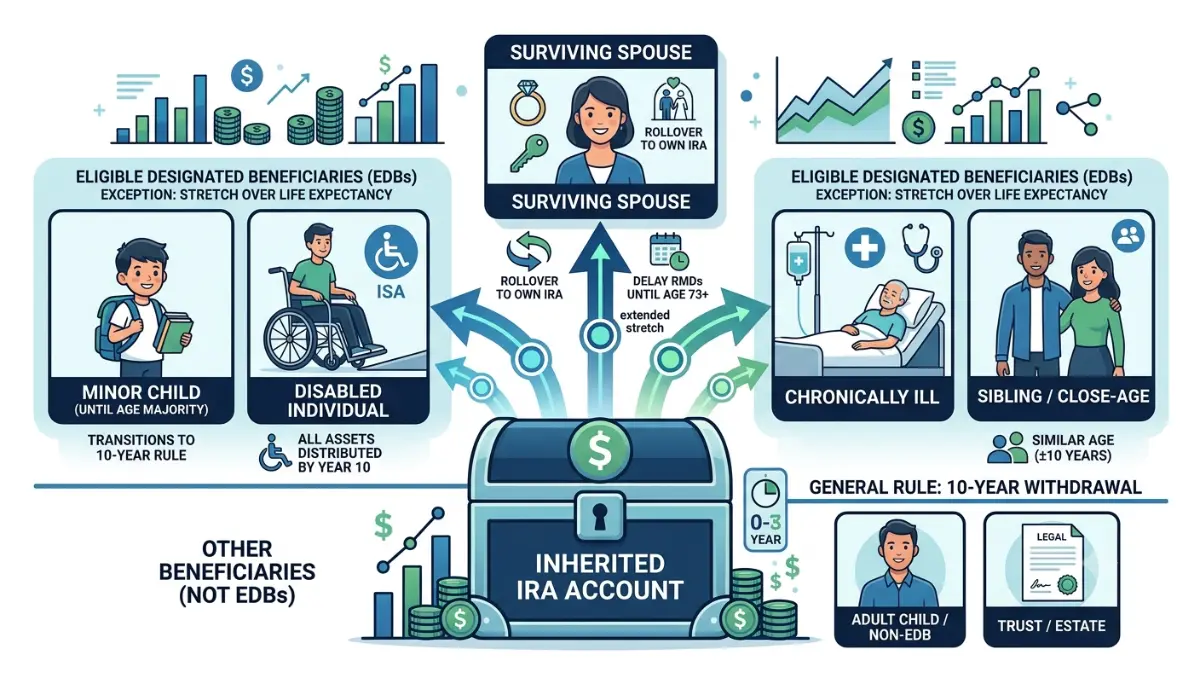
Some heirs skip the 10-year rule entirely and can still stretch withdrawals over their lifetime. The IRS calls them eligible designated beneficiaries, and there are five:
- A surviving spouse
- A minor child of the original owner — only until age 21, when the 10-year clock starts and the account must be empty by about age 31
- A person who is disabled, as defined by the IRS
- A person who is chronically ill, as defined by the IRS
- Anyone not more than 10 years younger than the owner — often a sibling, partner, or friend
You can see how the IRS classifies retirement-account beneficiaries for the full definitions. Grandchildren don’t count as minor-child EDBs.
Special rules for a surviving spouse
A surviving spouse has the most flexibility. You can treat the IRA as your own, or roll it into your own IRA, which sidesteps the inherited rules completely and lets you delay withdrawals until your own RMD age. Or you can stay a beneficiary — which can make sense if you’re under 59½ and might need the money, because keeping it as an inherited IRA lets you withdraw without the 10% early-withdrawal penalty.
Which choice fits depends on your age and cash needs, so it’s worth mapping with a fiduciary advisor before you act.
Taxes and the 25% penalty, explained
Two money questions follow every inherited IRA: how much tax you’ll owe, and what happens if you slip up. For a traditional account, every dollar you withdraw is taxed as ordinary income in the year you take it — so a large withdrawal can push you into a higher bracket.
It’s worth running the numbers first; you can estimate the tax a large withdrawal would add before you decide. Qualified withdrawals from an inherited Roth IRA, by contrast, are generally tax-free, covered just below.
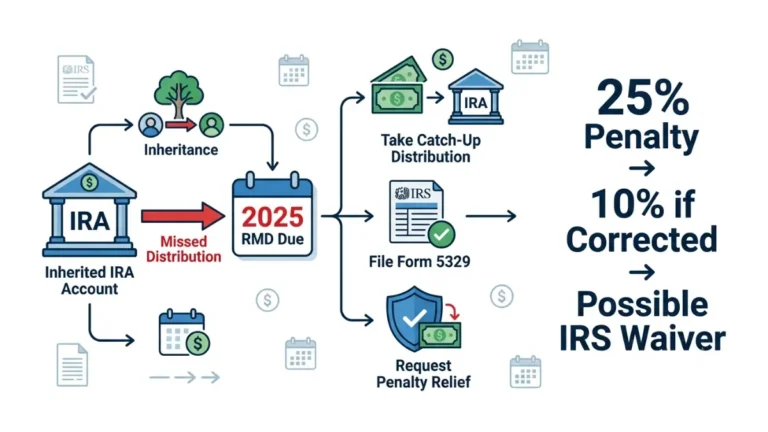
The penalty for missing a required withdrawal — an annual one or the final year-10 deadline — is a 25% excise tax on the amount you should have taken out but didn’t.
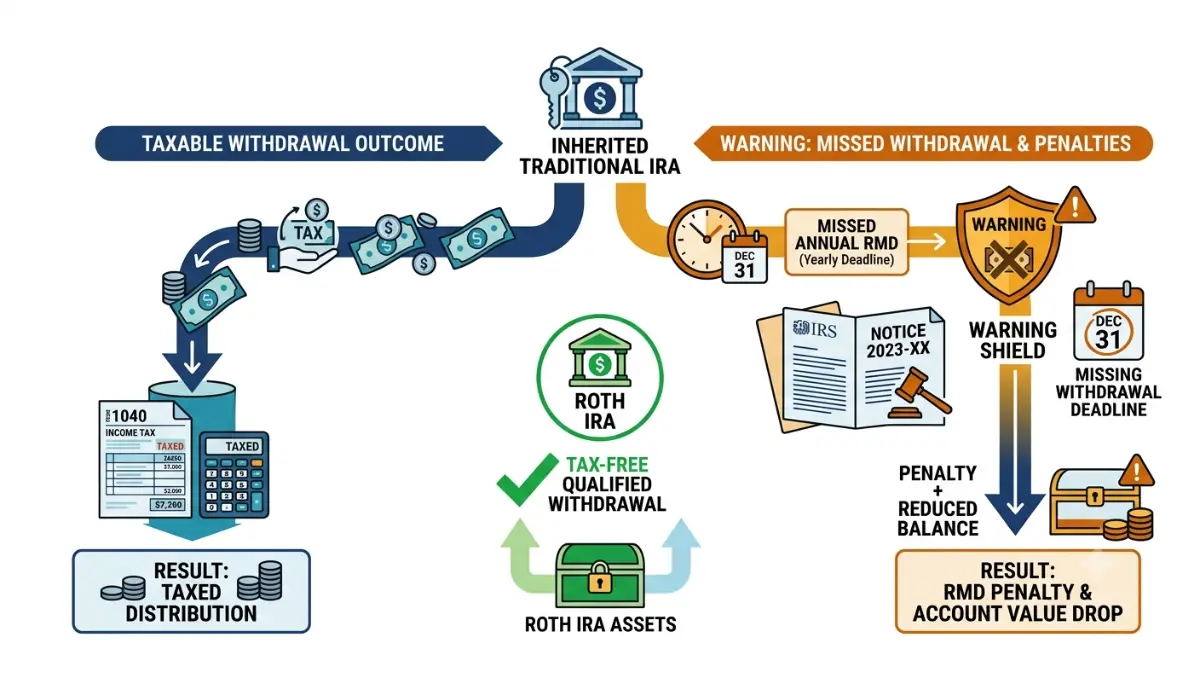
📊 Data Point: The excise tax on a missed RMD is 25% of the shortfall, dropping to 10% if you correct it within about two years — reduced from 50% by the SECURE 2.0 Act. Source: SECURE 2.0 Act / IRS Form 5329, 2025.
If you do miss one, act fast: take the withdrawal and file IRS Form 5329, which is also where you request a waiver for reasonable cause. There’s a full walkthrough of how to reduce that penalty from 25% to 10%.
✅ Action Step: If you’ve missed a withdrawal, ask a CPA or tax attorney: “How do I file Form 5329 to claim the reduced 10% rate or request a full waiver, and how should I time future withdrawals to manage my bracket?”
A year-by-year example — and the Roth twist
Numbers make this concrete. Say Sam’s father dies in 2025 at age 82 — well past his required beginning date, so he’d been taking RMDs — and leaves Sam, a non-spouse beneficiary, a $200,000 traditional IRA. Because his father died after starting RMDs, Sam owes a withdrawal in years 1 through 9 and must empty the account by December 31, 2035.
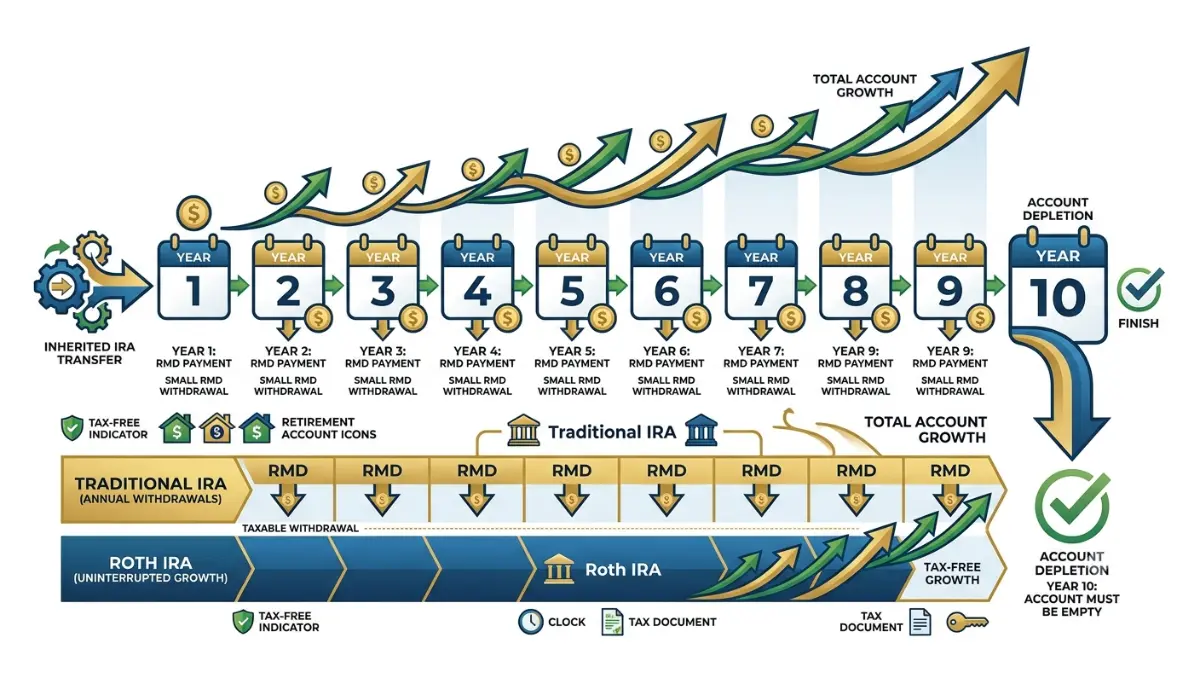
A 10-year timeline, step by step
Sam turns 55 in 2026, the first distribution year. The IRS Single Life Table life expectancy factor for age 55 is 31.6, so:
- 2026 (year 1): $200,000 ÷ 31.6 = about $6,329
- 2027 (year 2): balance ÷ 30.6 (the factor drops by 1.0)
- Each following year: subtract another 1.0 from the factor
- 2035 (year 10): whatever remains must come out by December 31
These figures are illustrative — your real balance shifts with each withdrawal and with market returns.
Why an inherited Roth IRA is different
An inherited Roth IRA follows the same 10-year deadline, but with two advantages: no annual withdrawals are required, and qualified distributions are generally tax-free. You can let it grow untouched and take it all in year 10. Whether it’s tax-free depends on the original owner’s five-year clock, not yours.
🔍 How It Works: A Roth owner never had to take lifetime withdrawals, so there’s no required beginning date for them to be “after.” The IRS treats every Roth owner as dying before that date — which is exactly why the yearly-withdrawal rule can’t apply to an inherited Roth.
Because the balance can compound tax-free the whole time, it’s worth using a tool to model how an untouched balance could grow over the decade.
Common mistakes that cost inherited-IRA heirs
A few avoidable errors trigger most of the penalties and surprise tax bills.
- Forgetting the annual withdrawal when the owner died on or after their required beginning date — this alone can trigger the 25% excise tax.
- Missing the final year-10 deadline, which the same penalty applies to for whatever’s left.
- Assuming the 10-year clock reset, when it still counts from the original owner’s year of death.
- Overlooking the owner’s final-year RMD: if they died after starting withdrawals but hadn’t taken that year’s, you must take it by December 31 of the year they died.
The tax trap is separate: emptying a large traditional account in one year can push you into a higher bracket and cost far more than spreading withdrawals across the decade would. Spreading isn’t always better — but it’s worth modeling before you decide.
✅ Action Step: Map your date of death to your year-10 deadline on a simple timeline, and have a CPA or fiduciary confirm you’re not missing an annual withdrawal this year.
Inherited IRA 10-year rule: frequently asked questions
1. What is the 10-year rule on an inherited IRA?
Most non-spouse beneficiaries who inherit an IRA from someone who died in 2020 or later must withdraw the entire balance by December 31 of the 10th year after the year of death. The account grows tax-deferred until then, but must be fully emptied by that deadline.
2. Do I have to withdraw from an inherited IRA every year?
Only if the original owner had already started their own required minimum distributions before dying. If so, you withdraw in years 1 through 9 and empty the account in year 10; if not, you can withdraw at any pace by then. Confirm your case with a CPA.
3. How do I know if the owner died before or after their required beginning date?
The required beginning date is April 1 of the year after the owner turned 73. If they were younger than that when they died, it was before; if older and already taking withdrawals, after. The deciding fact is whether they had started taking RMDs.
4. Who is exempt from the 10-year rule?
Five groups can still stretch withdrawals over their lifetime: a surviving spouse, a minor child of the owner (until age 21), a disabled person, a chronically ill person, and anyone not more than 10 years younger than the owner. Everyone else follows the 10-year rule.
5. What are the rules if a spouse inherits an IRA?
A spouse can treat the IRA as their own, roll it into their own IRA, or remain a beneficiary. Treating it as your own delays withdrawals until your own RMD age; staying a beneficiary can help if you’re under 59½. Which fits depends on your age — ask a fiduciary advisor.
6. How is an inherited IRA taxed?
Withdrawals from a traditional inherited IRA are taxed as ordinary income in the year you take them; qualified withdrawals from an inherited Roth IRA are generally tax-free. A large single-year withdrawal from a traditional account can raise your bracket, so weigh the timing with a CPA.
7. What’s the penalty for missing an inherited IRA RMD?
The excise tax is 25% of the amount you should have withdrawn but didn’t, dropping to 10% if you correct it within about two years. You can also request a full waiver for reasonable cause, reported on IRS Form 5329. Act fast, and consider a tax professional.
8. Do inherited Roth IRAs follow the 10-year rule?
Yes — the account must be empty by the end of year 10. But no annual withdrawals are required, because Roth owners never had lifetime RMDs and are treated as dying before their required beginning date. Qualified distributions are generally tax-free, so many heirs wait until year 10.
9. Does the 10-year clock reset if I inherited a few years ago?
No. The 10-year period always counts from the original owner’s year of death, not from when you start withdrawing. Inherit in 2022, and the account must be empty by the end of 2032 — even though annual-withdrawal penalties were paused through 2024.
10. Can I take the whole inherited IRA out at once?
Yes, anytime within the 10 years. But for a traditional account, the entire amount is taxed as ordinary income that year, which can raise your bracket. Spreading withdrawals often lowers the total tax, though not always — check the math or ask a CPA.
11. What happens to a minor child’s inherited IRA at 21?
A minor child of the original owner can stretch withdrawals only until age 21. Then the 10-year rule starts, so the account must be empty by about age 31. This applies to the owner’s own children — not grandchildren, who follow the standard 10-year rule.
Your next step with an inherited IRA
An inherited IRA feels complicated, but it usually comes down to confirming two things: whether you’re a spouse or other exempt beneficiary, and whether the original owner had started their own withdrawals before they died. Those two answers set your deadline and whether you owe anything yearly — the rest follows.
Start by calendaring your year-10 deadline and checking whether an annual withdrawal applies this year. Then, before you make a large withdrawal or a rollover decision, take your specific numbers to a fiduciary advisor or CPA — the tax stakes are real, and the right timing is personal. It can also help to see how the money fits your broader retirement plan.
Informational disclaimer
The content on Finance Authority Hub is provided for general informational and educational purposes only and should not be considered personalized financial, investment, tax, legal, or professional advice. Financial decisions depend on your individual goals, income, risk tolerance, location, and regulatory situation. Before acting on any information, strategy, estimate, or calculator result, consult a qualified licensed professional who can evaluate your specific circumstances.