Roth vs Traditional IRA in 2026 and How to Choose Well
Roth vs traditional IRA comes down to one question about taxes—now or later. See the 2026 income limits, who can still deduct, and the 4-question test.
In This Article
The choice between a Roth IRA and a traditional IRA confuses almost everyone, for one reason: on the surface they look nearly identical. Same contribution limit, same investments, same goal. The real difference is a single question — when you pay the tax.
If you’re early in your career and expect to earn more later, one answer usually fits. If you’re a higher earner watching your deduction shrink, another does. If you’re self-employed with no workplace plan, your options are wider than you think. And if you’re near retirement, required withdrawals and tax-free inheritance move to the center. Not sure which of the five IRA account types even fits your income? Start there.
This guide gives you a four-question test to settle it — no jargon, and no “it depends” without telling you exactly what it depends on. You’ll see the 2026 numbers, the income limits, and the actual dollar math.
First, the one mechanic that drives every other choice.
ℹ️ Financial Disclaimer: This article is educational and not personalized investment, tax, or legal advice. IRA rules and the 2026 figures cited here can change, and the right choice depends on your full financial picture. Before acting on a retirement or tax strategy — including a Roth conversion or a backdoor Roth — consult a fiduciary financial advisor, a CPA, or a qualified tax attorney.
How each IRA is taxed — the whole difference in one place
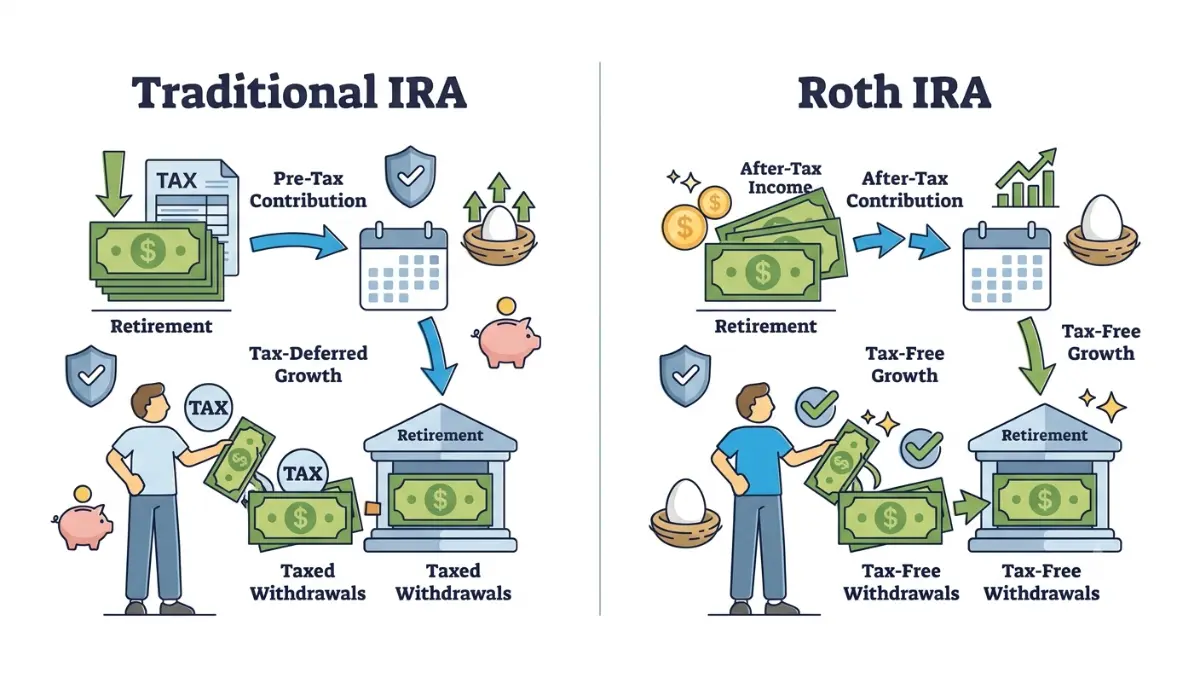
Every other decision flows from one mechanic: a traditional IRA gives you the tax break now, and a Roth IRA gives it to you later.
With a traditional IRA, your contribution may be tax-deductible in the year you make it, lowering your taxable income today. The money grows untouched, and you pay ordinary income tax on withdrawals in retirement. With a Roth IRA, you contribute after-tax dollars — no deduction now — but qualified withdrawals in retirement, including all growth, are completely tax-free.
🔍 How It Works: “Tax-deferred” and “tax-free” are not the same thing. A traditional IRA is tax-deferred — you postpone the bill to retirement. A Roth IRA is tax-free on qualified withdrawals — the tax is paid up front and never charged again on the growth.
Both accounts grow without a yearly tax drag on dividends or gains, which is what makes either one powerful. The IRS overview of traditional and Roth IRAs confirms the core split: deductible-now-and-taxed-later versus after-tax-now-and-tax-free-later.
So the whole question narrows to this: do you want your tax break now or in retirement? That depends on you — which the next section untangles.
The 4-question test: which IRA fits you
It comes down to four questions. Answer them in order and your lean becomes clear.
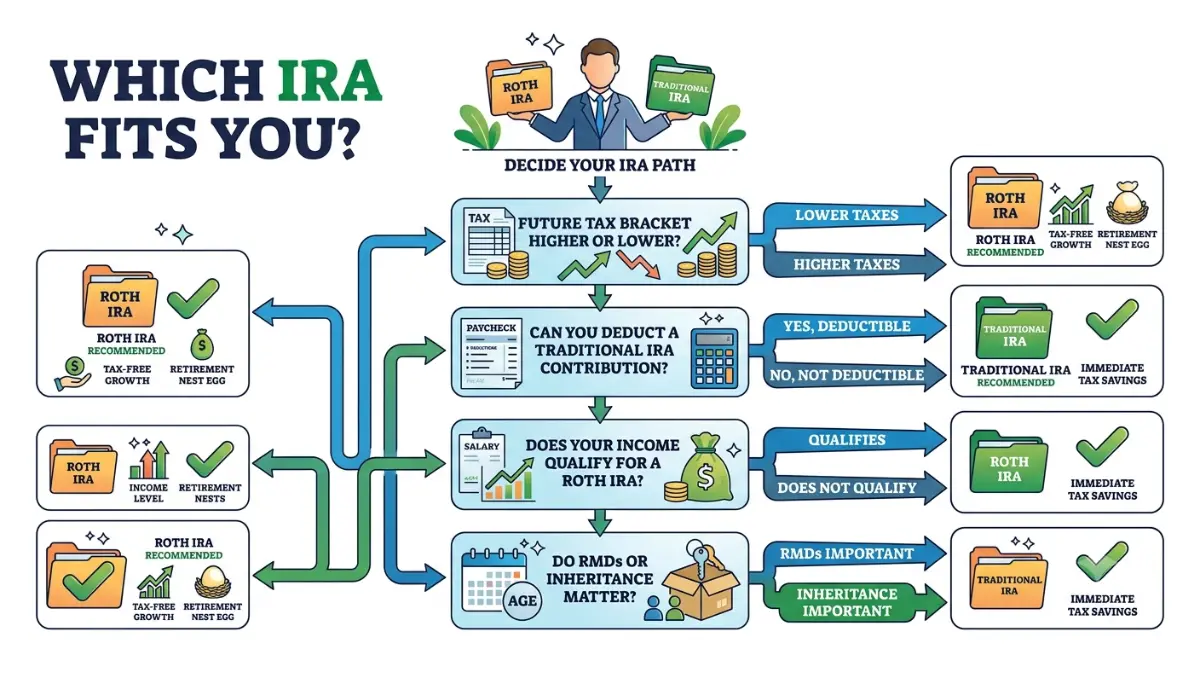
1. Will your tax rate be higher now or in retirement? This is the core. If you expect a lower tax bracket in retirement than today, the deduction now is worth more, so a traditional IRA leans ahead. If you expect a higher bracket later — common early in a career — paying tax now at a low rate points to a Roth.
2. Can you actually deduct a traditional contribution? If you or your spouse has a workplace plan, the deduction phases out at the income limits below. No deduction means the traditional IRA’s main advantage shrinks, nudging you toward a Roth.
3. Does your income even allow a Roth? Roth eligibility has its own income ceiling (also below). Above it, a direct Roth is off the table — though a backdoor route may exist.
4. Do RMDs, flexibility, or heirs matter? A Roth IRA has no required withdrawals in your lifetime and passes to heirs tax-free; a traditional IRA forces withdrawals starting at age 73.
✅ Action Step: Before you decide, ask a CPA or fiduciary advisor one specific question: “Given my expected retirement income, which tax bracket am I likely to be in when I withdraw?” Your answer to Question 1 is a forecast, not a fact — worth pressure-testing.
Two of these questions turn on exact 2026 figures. Here they are.
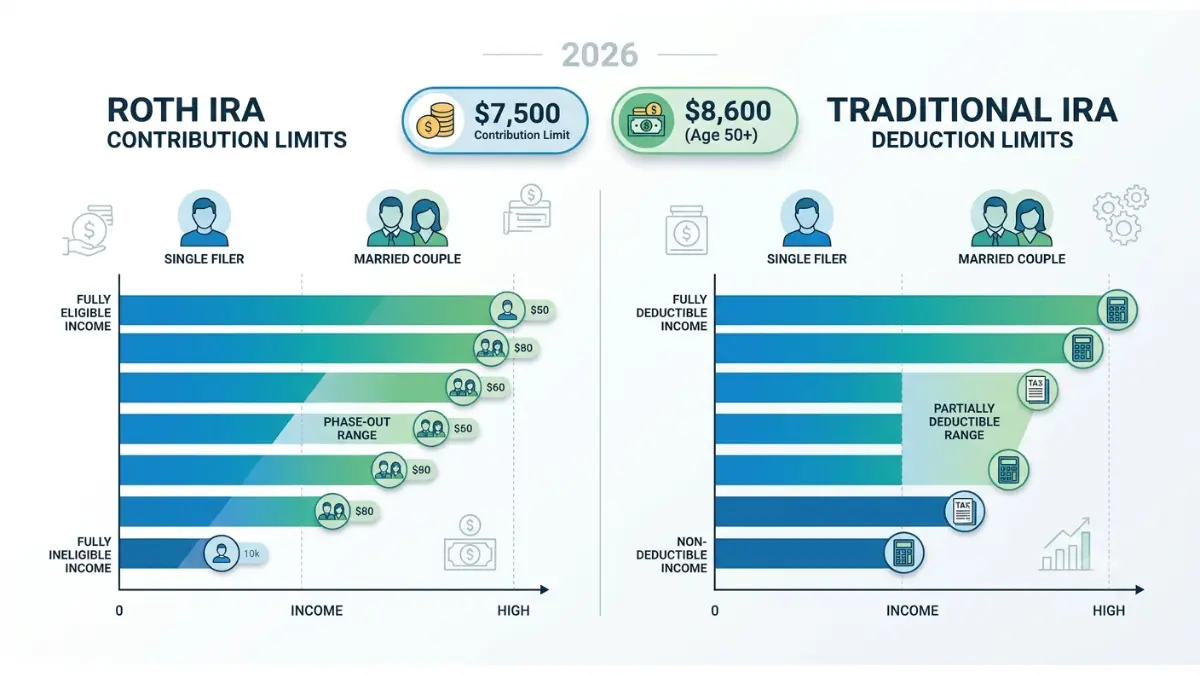
2026 IRA limits and income gates, side by side
For 2026, you can contribute $7,500 total across all your IRAs, or $8,600 if you’re 50 or older — a combined cap, not one per account.
That part is simple. The confusion starts with two different income limits people constantly mix up: one controls whether you can deduct a traditional contribution, the other controls whether you can contribute to a Roth at all. They are not the same numbers.
📊 Data Point: 2026 IRA contribution limit — $7,500 (under 50) / $8,600 (50+). Roth contributions phase out starting at $153,000 (single) and $242,000 (married filing jointly). — Source: IRS, Notice 2025-67 (Nov. 2025).
2026 income limits (by modified adjusted gross income)
| Rule | Single / Head of Household | Married Filing Jointly | Key detail |
|---|---|---|---|
| Roth contribution phases out | $153,000 – $168,000 | $242,000 – $252,000 | Above the top figure, no direct Roth |
| Traditional deduction — you have a workplace plan | $81,000 – $91,000 | $129,000 – $149,000 | Above the top figure, no deduction |
| Traditional deduction — only your spouse has a plan | — | $242,000 – $252,000 | Higher ceiling for the non-covered spouse |
Source: IRS, “401(k) limit increases to $24,500 for 2026, IRA limit increases to $7,500” (IR-2025-111 / Notice 2025-67).
Notice the gap for single filers: Roth eligibility runs to $168,000, but the traditional deduction (if you have a 401(k)) is gone at $91,000. Plenty of earners are too well-paid to deduct a traditional IRA yet fully eligible for a Roth. And if neither you nor your spouse has a workplace plan, a traditional contribution is fully deductible at any income.
For the full 2026 IRA contribution limits and the Roth income limits in more detail, each is broken down separately. If your income lands inside a phase-out range, the IRS worksheet in Publication 590-A computes your exact partial amount — a figure a CPA can confirm.
Roth vs. traditional in dollars: the break-even tax rate
Here’s the math the “it depends on your bracket” advice hides. Take the same $7,500 contribution in two scenarios.
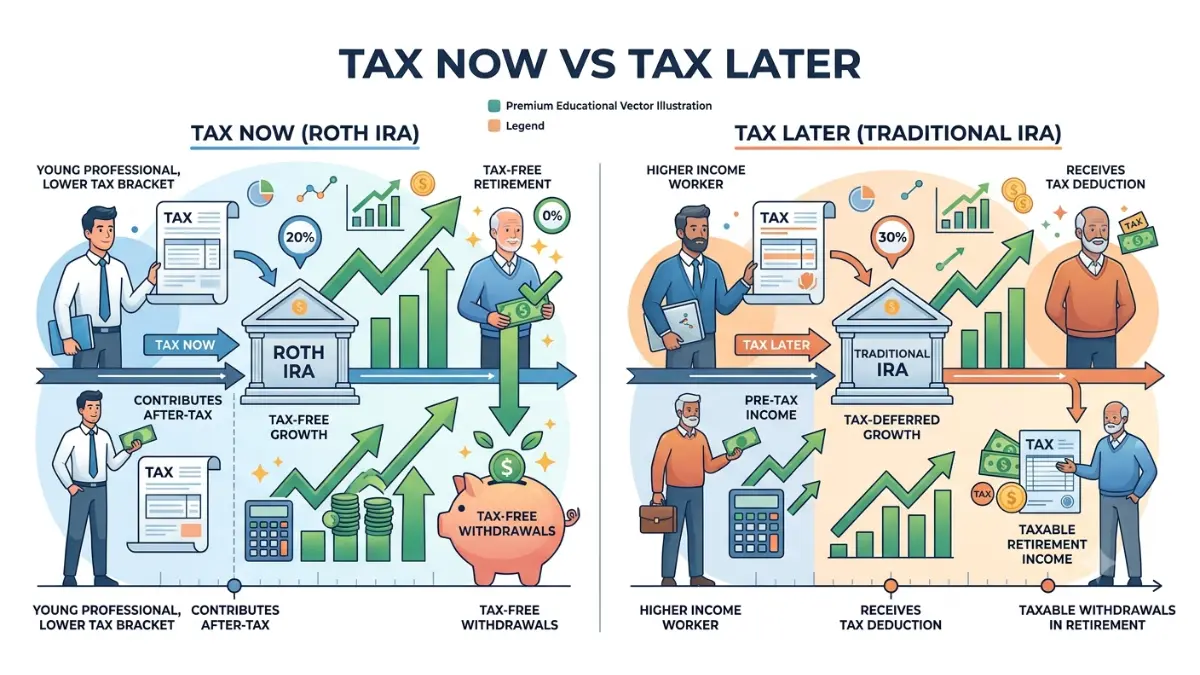
Scenario A — higher now, lower later. You’re in the 22% bracket today and expect the 12% bracket in retirement. A traditional deduction saves you $1,650 now (22% of $7,500), and you’ll later withdraw at 12%. Deducting at 22% and paying at 12% wins, so a traditional IRA leans ahead.
Scenario B — lower now, higher later. You’re in the 12% bracket today (early career) and expect 22% later. Skipping a $900 deduction now to withdraw everything tax-free at 22% wins, so a Roth leans ahead.
🔍 How It Works: If your tax rate is identical now and in retirement, a Roth and a traditional IRA produce the exact same after-tax result on the same contribution. The winner is decided entirely by which rate is lower — now or later.
💡 Expert Note: The 2026 federal brackets (10% to 37%) were made permanent by the One Big Beautiful Bill Act of July 2025, so older guidance claiming rates “expire” at the end of 2025 is out of date. The current federal tax brackets are the reference point for any projection.
These rates are illustrative, not a recommendation. To model your own, estimate your Roth IRA growth or run full retirement numbers — then confirm your bracket outlook with a CPA.
Special cases: high earners, doing both, and RMDs
A few situations sit outside the simple test.
Too high-income for a Roth? Above the Roth ceiling, a backdoor Roth may still work: contribute to a traditional IRA (nondeductible), then convert it to a Roth, reporting both steps on IRS Form 8606.
⚠️ Costly Mistake: The backdoor Roth’s pro-rata rule trips people up. If you already hold pre-tax money in any traditional IRA, the IRS treats your conversion as partly taxable across all your IRA balances — you can’t cherry-pick the after-tax portion. Have a CPA run the numbers before you convert.
Want both? You can split one year’s contribution between a Roth and a traditional IRA, but the combined total still can’t exceed $7,500 (or $8,600 at 50+). Some savers split deliberately to hedge against uncertainty about their future tax rate.
RMDs. A traditional IRA forces required minimum distributions starting at age 73 (rising to 75 in 2033); a Roth IRA has none during your lifetime, which is why it’s favored for leaving tax-free money to heirs. See how required minimum distributions work for the full schedule.
For high earners weighing the Roth catch-up rules alongside this decision, the deduction almost always disappears long before Roth eligibility does.
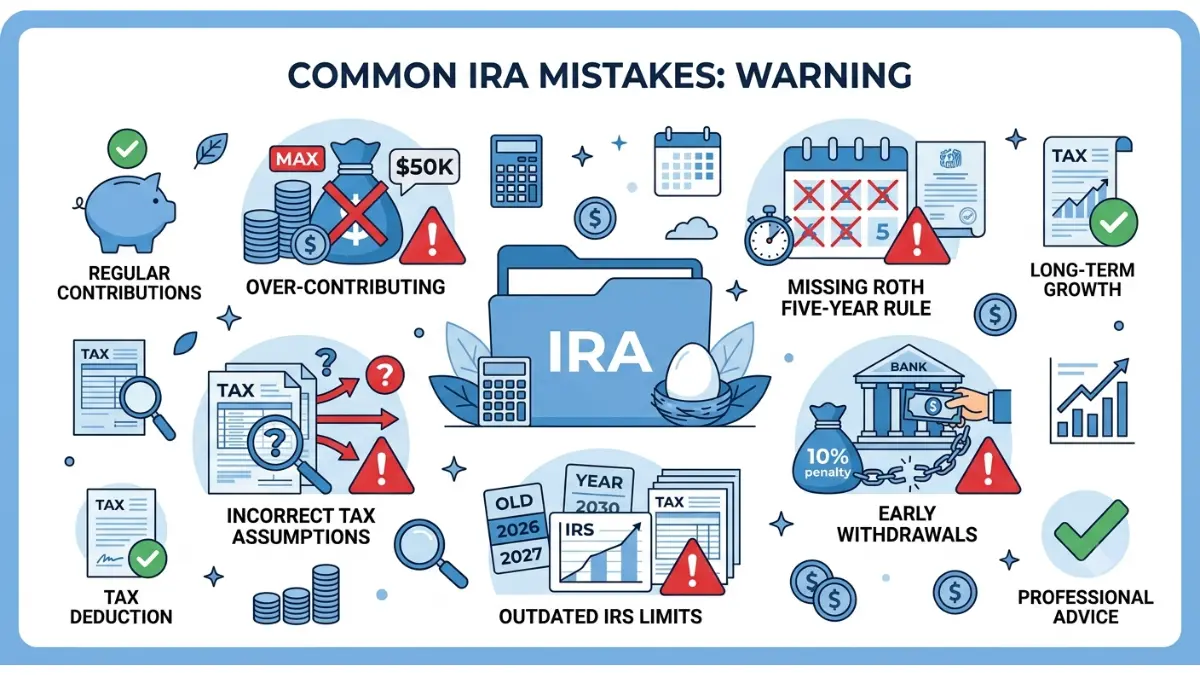
5 mistakes people make choosing between the two
A handful of errors cost real money. Avoid these.
- “I earn too much for an IRA.” Usually false. High income can block the traditional deduction and a direct Roth contribution — but almost anyone with earned income can still contribute to a traditional IRA, just without the write-off.
- Forgetting the Roth 5-year rule. Roth earnings are tax- and penalty-free only after age 59½ and five years since your first Roth contribution. Your contributions, though, can come out anytime, tax-free.
- Ignoring the early-withdrawal penalty. Pulling earnings before 59½ generally triggers a 10% penalty plus tax, with narrow exceptions such as up to $10,000 for a first home.
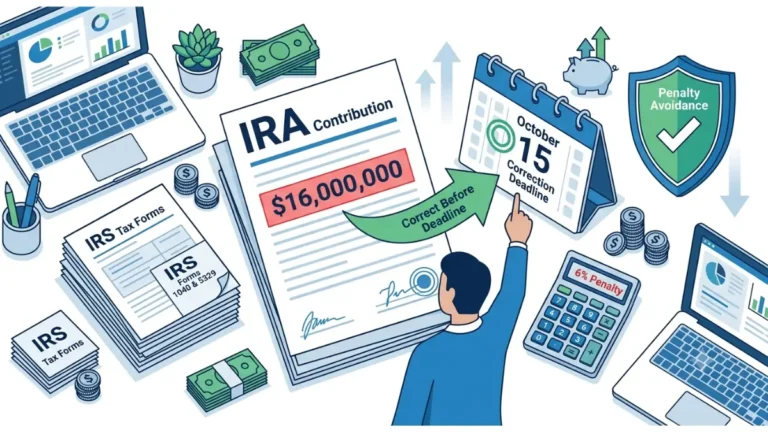
- Over-contributing. Exceeding the limit triggers a 6% excise tax each year until you fix it — remove the excess before your filing deadline.
- Trusting stale advice. Limits and brackets shift yearly; a 2024 figure quoted as current is a real error on a money decision.
✅ Action Step: If you’ve over-contributed or aren’t sure your Roth five-year clock has started, ask a CPA to help you correct it before your tax-filing deadline and avoid the recurring penalty.
Roth vs traditional IRA: frequently asked questions
1. Is it better to have a Roth or traditional IRA?
Neither is universally better. A traditional IRA wins if your tax rate is higher now than it will be in retirement; a Roth IRA wins if your rate will be higher later. If the two rates match, the accounts are equivalent. Confirm your bracket outlook with a CPA.
2. What is the Roth IRA income limit in 2026?
For 2026, Roth IRA contributions phase out between $153,000 and $168,000 of modified adjusted gross income for single filers, and between $242,000 and $252,000 for married couples filing jointly. Above the top figure, you cannot contribute directly, though a backdoor route may apply.
3. Can I deduct a traditional IRA if I have a 401(k)?
Partly, depending on income. With a workplace plan, the traditional IRA deduction phases out between $81,000 and $91,000 (single) or $129,000 and $149,000 (married filing jointly) for 2026. Above those, you can still contribute — just without the deduction. A CPA can confirm your exact figure.
4. Can I contribute to both a Roth and a traditional IRA?
Yes. You can split one year’s contribution between a Roth IRA and a traditional IRA, but the combined total can’t exceed $7,500 for 2026 (or $8,600 if you’re 50 or older). Some savers split deliberately to hedge against uncertainty about their future tax rate.
5. What is a backdoor Roth IRA?
A backdoor Roth IRA lets high earners get around the Roth income limit: contribute to a traditional IRA (nondeductible), then convert it to a Roth, reporting both on Form 8606. The pro-rata rule can make it partly taxable if you hold other pre-tax IRA money — check with a CPA first.
6. Do Roth IRAs have required minimum distributions?
No. A Roth IRA has no required minimum distributions during the original owner’s lifetime, so the money can keep growing untouched. A traditional IRA forces required minimum distributions starting at age 73 (rising to 75 in 2033), whether or not you need the money.
7. Can I withdraw from a Roth IRA before retirement?
Your Roth IRA contributions can be withdrawn anytime, tax- and penalty-free, because you already paid tax on them. Earnings are different: withdrawing them before age 59½ and before five years have passed generally triggers a 10% penalty plus tax, with limited exceptions like a first-home purchase.
8. Which IRA is best for a young saver or beginner?
Early in a career, income and tax rates are often low, so paying tax now and withdrawing tax-free later usually favors a Roth IRA. Decades of tax-free growth compound the advantage. Still, your own bracket forecast matters — a fiduciary advisor can help you weigh it.
9. What happens if I contribute too much to an IRA?
Excess IRA contributions are taxed at 6% per year for every year the extra money stays in the account. To avoid it, withdraw the excess (and any earnings on it) before your tax-filing deadline. Both Roth IRA and traditional IRA over-contributions carry the same penalty.
10. Roth vs. traditional IRA if I’m self-employed?
If neither you nor a spouse has a workplace plan, your traditional IRA contribution is fully deductible at any income — a real advantage for the self-employed. Many also use a SEP or solo 401(k) to contribute far more. A CPA can match the account to your income.
11. Should high earners choose Roth or traditional?
For high earners with a workplace plan, the traditional IRA deduction usually disappears first (by $91,000 single in 2026), while Roth eligibility runs higher (to $168,000). Above both, a backdoor Roth may be the only route. Given the tax stakes, confirm the approach with a CPA.
Your next step
The whole decision reduces to one variable: whether your tax rate is lower now or in retirement. A traditional IRA rewards a high rate today; a Roth rewards a high rate later — and if the two are equal, so are the accounts.
Run the four questions against your own situation, check where you fall on the 2026 income limits, and remember this is general education, not a personalized recommendation — your bracket forecast is worth confirming with a CPA.
Your next step is simple: pick the account that fits, then fund it. If you’re still weighing the bigger picture, see which of the five IRA account types fits your income and whether to max an IRA or a 401(k) first.

Informational disclaimer
The content on Finance Authority Hub is provided for general informational and educational purposes only and should not be considered personalized financial, investment, tax, legal, or professional advice. Financial decisions depend on your individual goals, income, risk tolerance, location, and regulatory situation. Before acting on any information, strategy, estimate, or calculator result, consult a qualified licensed professional who can evaluate your specific circumstances.