Rolling Over Your 401(k) to an IRA the Right Way
Rolling over a 401(k) to an IRA is simple as a direct transfer—but one wrong move triggers a 20% withholding and a 60-day scramble to get it back.
In This Article
You left a job — or you’re about to — and an old 401(k) sits with a former employer. Moving it into an IRA buys a wider investment menu and one account to track, but a wrong step can trigger an unexpected tax bill.
Where you stand decides what you need. For the mechanics, the five-step direct rollover below keeps the move tax-free. Choosing between a traditional and Roth IRA? See the tax section. Already took a check? The 60-day rules protect the money. Not sure you should roll over at all? The trade-offs are near the end.
One principle runs through it all: as a direct, account-to-account transfer, a rollover isn’t taxable. The balance keeps compounding tax-deferred once it lands — a compound interest calculator shows what’s at stake.
ℹ️ Financial Disclaimer: This is educational, not personalized investment, tax, or legal advice. Rollovers, conversions, and withdrawals carry tax consequences that depend on your income, age, and account types. Consult a CPA, fiduciary advisor, or tax attorney before acting, and verify current figures with the IRS.
What a 401(k)-to-IRA rollover is (and your 4 options)
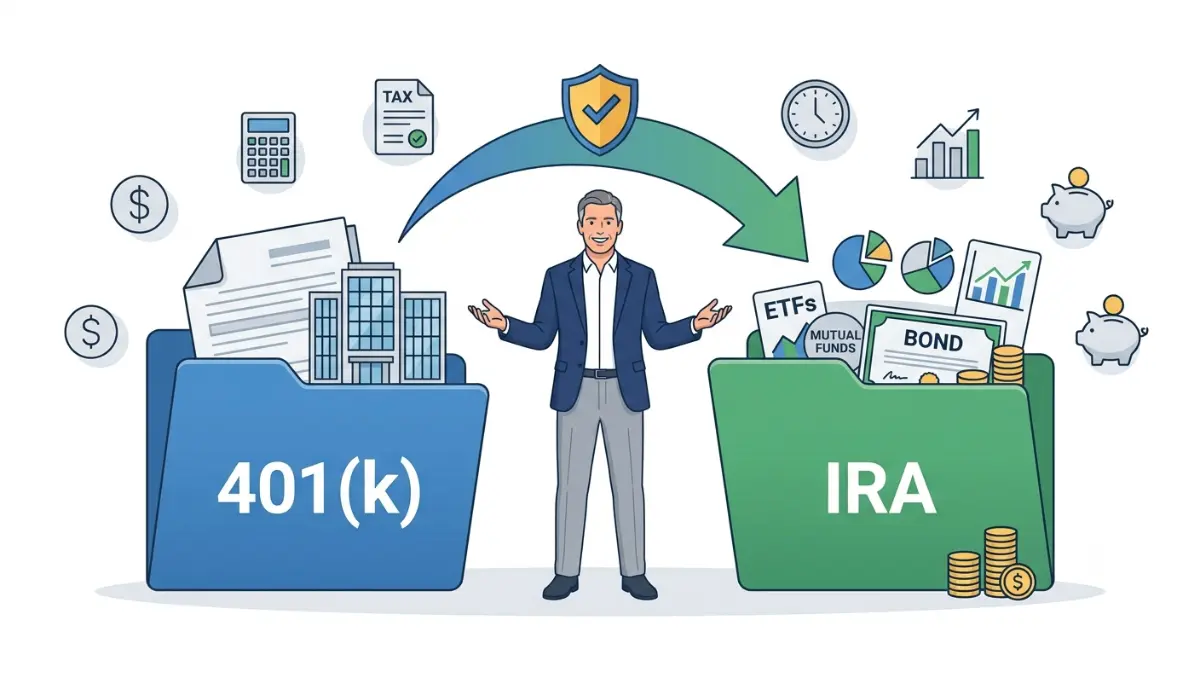
A rollover moves retirement money from an employer-sponsored plan into another qualified account without cashing it out. Your old 401(k) doesn’t have to stay put, but it isn’t moved automatically.
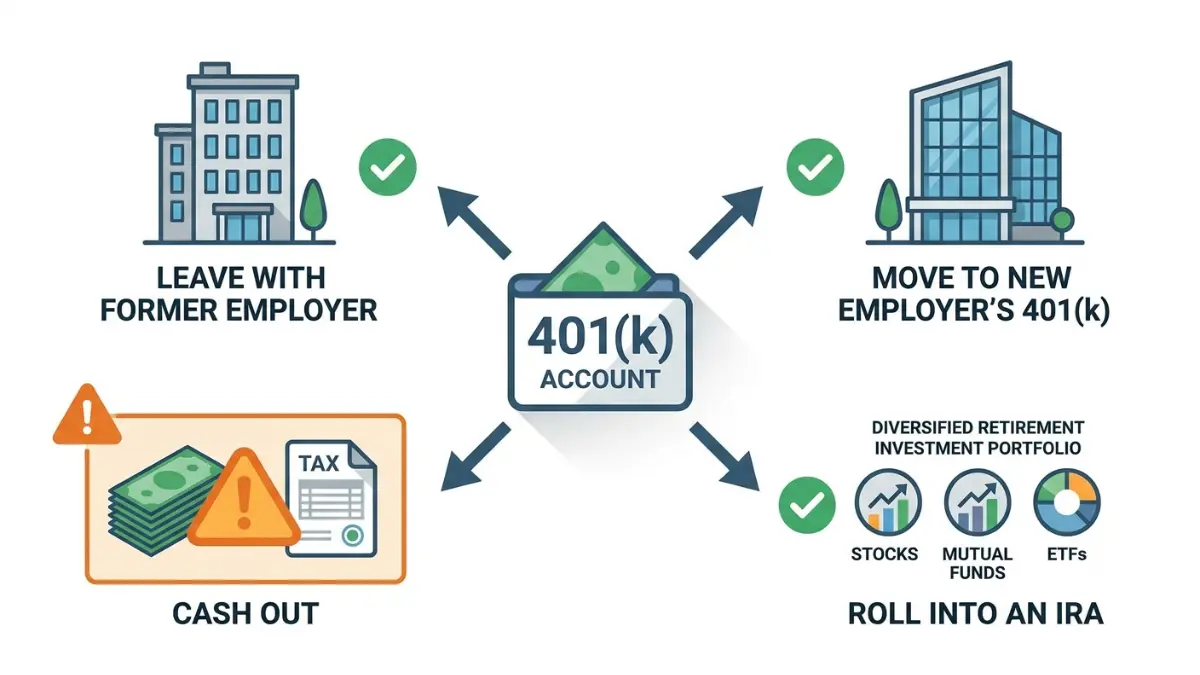
Your 4 options for an old 401(k)
Each choice has a different tax result:
- Leave it in the old plan, if allowed — no tax, no new contributions.
- Roll it into a new employer’s 401(k), if accepted — no tax.
- Roll it into an IRA — no tax on a direct rollover, wider investment menu.
- Cash it out — taxable, plus a 10% penalty if under 59½.
Weighing where to save next? See whether to max your 401(k) or IRA first. Since only vested money is yours to move, it helps to know how employer matching works.
Direct vs. indirect rollover
A direct rollover (a trustee-to-trustee transfer) sends money straight from your old plan to the new account, with nothing withheld. The IRS rollover overview confirms which accounts can move into which; the indirect route is covered next.
How to roll over a 401(k) to an IRA in 5 steps
To roll over a 401(k) to an IRA: open the IRA, choose a direct rollover, request it from your old plan, confirm the deposit, then report it at tax time.
Step 1: Choose your IRA type and open the account
Pick a traditional or Roth IRA (the tax section explains the difference) and open it anywhere. A traditional IRA takes a traditional 401(k) tax-free; a Roth IRA triggers a taxable conversion.
Step 2: Choose a direct rollover, not indirect
Request a direct rollover so funds move straight to your IRA, avoiding the withholding and 60-day deadline that come with taking a check.
Step 3: Contact your old plan administrator
Call the plan administrator on your latest statement and request the direct rollover. Ask that the check be payable to your new custodian “for benefit of” (FBO) your name — not to you.
Step 4: Confirm the deposit and invest
Cash usually isn’t invested automatically, so once it lands, choose investments that fit your plan.
Step 5: Report it at tax time
Your plan sends Form 1099-R; a direct rollover shows code “G” in Box 7. Report the amount on Form 1040 line 5a, with 5b as the taxable portion (usually $0) and “rollover” beside it.
✅ Action Step: On the call, confirm who the check is payable to, whether forms are needed, and whether you hold employer stock (which changes the tax math).
⚠️ Costly Mistake: If the check is payable to you rather than your custodian, you’ve triggered an indirect rollover — 20% withheld, 60-day clock started — even if you meant a direct transfer.
Direct vs. indirect rollover: the 20% withholding trap
The most expensive rollover mistake is taking the check yourself. Here’s what the two methods do:
| Method | Who gets the funds | Withholding | Key detail |
|---|---|---|---|
| Direct rollover | Your IRA custodian | None | No 60-day clock |
| Indirect rollover | You (paid by check) | 20% mandatory | Redeposit the full amount in 60 days |
Source: IRS Topic No. 413, 2026.
When an employer plan pays a rollover-eligible distribution to you, it must withhold 20% for federal taxes — even if you plan to roll it over.
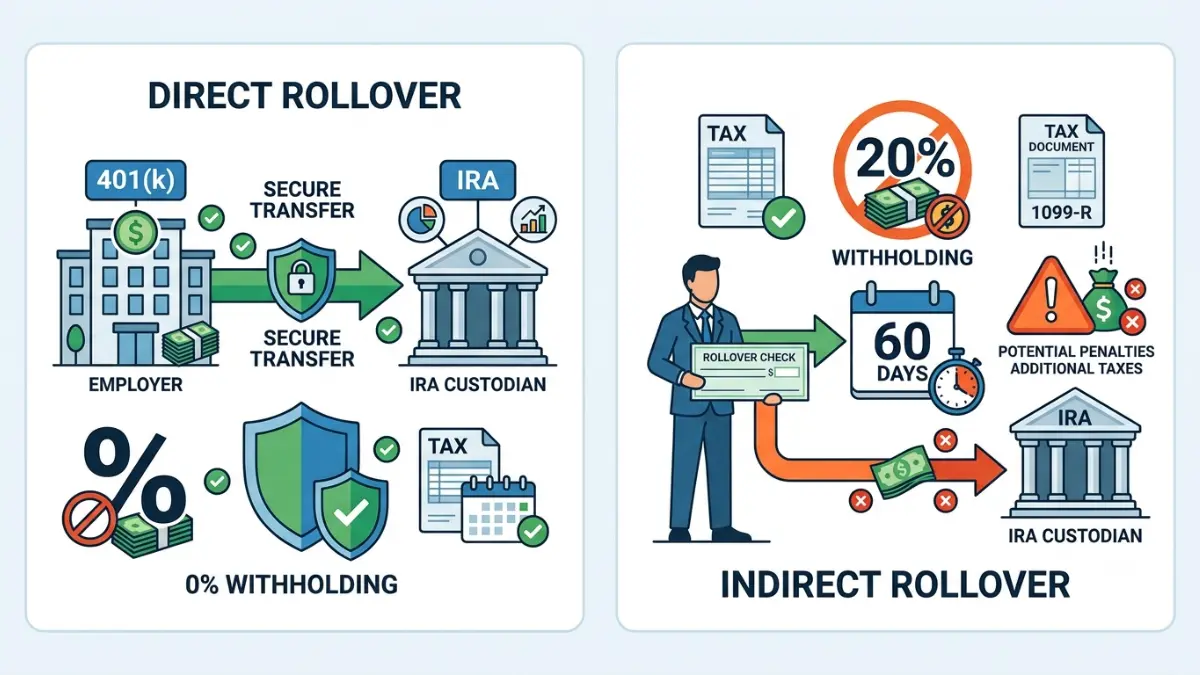
🔍 How It Works: That 20% isn’t a tax you owe; it’s a prepayment. You settle up at filing — but to roll over the full balance, you must replace the withheld 20% from other cash.
You have 60 days to redeposit the money, or it becomes taxable — plus a 10% early withdrawal penalty under 59½.
Worked example: a $50,000 indirect rollover
Using only the IRS figures above:
- The plan withholds 20% ($10,000) and sends you $40,000.
- To roll over tax-free, deposit the full $50,000 within 60 days — adding $10,000 from savings.
- The withheld $10,000 is credited on your return and may be refunded.
- Deposit only $40,000 and the missing $10,000 is taxed — plus a $1,000 penalty under 59½.
A direct rollover avoids this. The IRS’s rollover rules spell out the withholding, the 60-day window, and the penalty.
Traditional IRA or Roth IRA? Match the rollover to your taxes
Whether you owe tax depends on the account types. A direct rollover to a traditional IRA isn’t taxable; rolling a traditional 401(k) into a Roth IRA is a taxable Roth conversion.
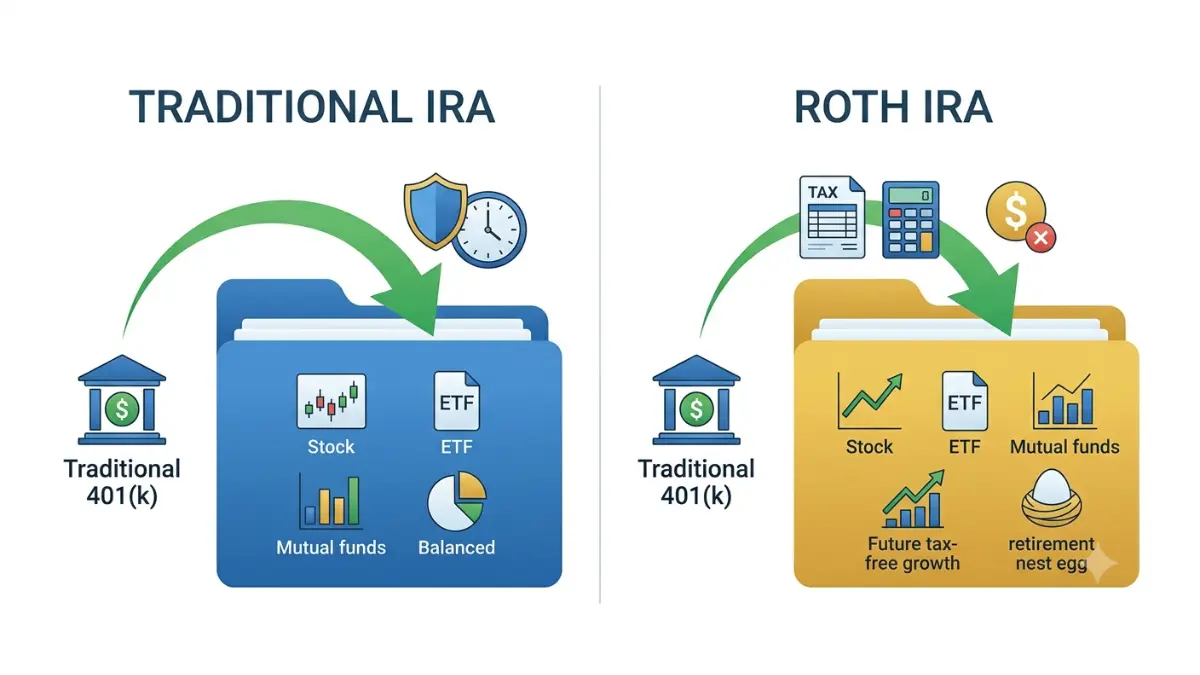
Traditional 401(k) → traditional IRA
The standard tax-deferred move: pre-tax money lands in a traditional IRA, untaxed until you withdraw it in retirement.
Traditional 401(k) → Roth IRA
You pay ordinary income tax on the converted amount now, for tax-free growth and qualified withdrawals later. The logic of Roth versus traditional 401(k) and how a Roth IRA builds tax-free carries over to IRAs.
Roth 401(k) → Roth IRA
Tax-free, since both hold after-tax money.
💡 Expert Note: A common approach is to roll pre-tax money into a traditional IRA first, then convert to Roth over several years — spreading the tax rather than taking it in one lump.
✅ Action Step: Before converting, ask a CPA or fiduciary advisor to model the tax on a partial conversion across your bracket, and compare outcomes with a Roth IRA calculator. A conversion is a specific tax strategy.
Rules that affect your rollover: 2026 limits and RMDs
A few IRS rules shape what happens after the money lands. None tax a properly executed direct rollover.
Does a rollover count as a contribution?
No. A direct rollover isn’t taxable income, and rollover money doesn’t count against your annual IRA contribution limit — you can still contribute separately if eligible.
2026 contribution limits
The standard annual limits apply only to new contributions:
| Account | 2026 limit | Catch-up (age 50+) |
|---|---|---|
| IRA (traditional + Roth) | $7,500 | +$1,100 |
| 401(k) elective deferral | $24,500 | +$8,000 |
📊 Data Point: The 2026 IRA limit is $7,500 and the 401(k) elective deferral limit is $24,500 — Source: IRS Notice 2025-67, 2026.
See the full 2026 401(k) contribution limits and how catch-up contributions add room at 50 or older.
When RMDs start
Under SECURE 2.0, required minimum distributions from a traditional IRA begin at age 73 — age 75 for those born in 1960 or later. A Roth IRA has no lifetime RMDs for the original owner, per the IRS’s RMD rules.
When rolling over is the wrong move (and mistakes to avoid)
Most rollover guides are written by firms that want your assets, so they rarely say when keeping the 401(k) is smarter.
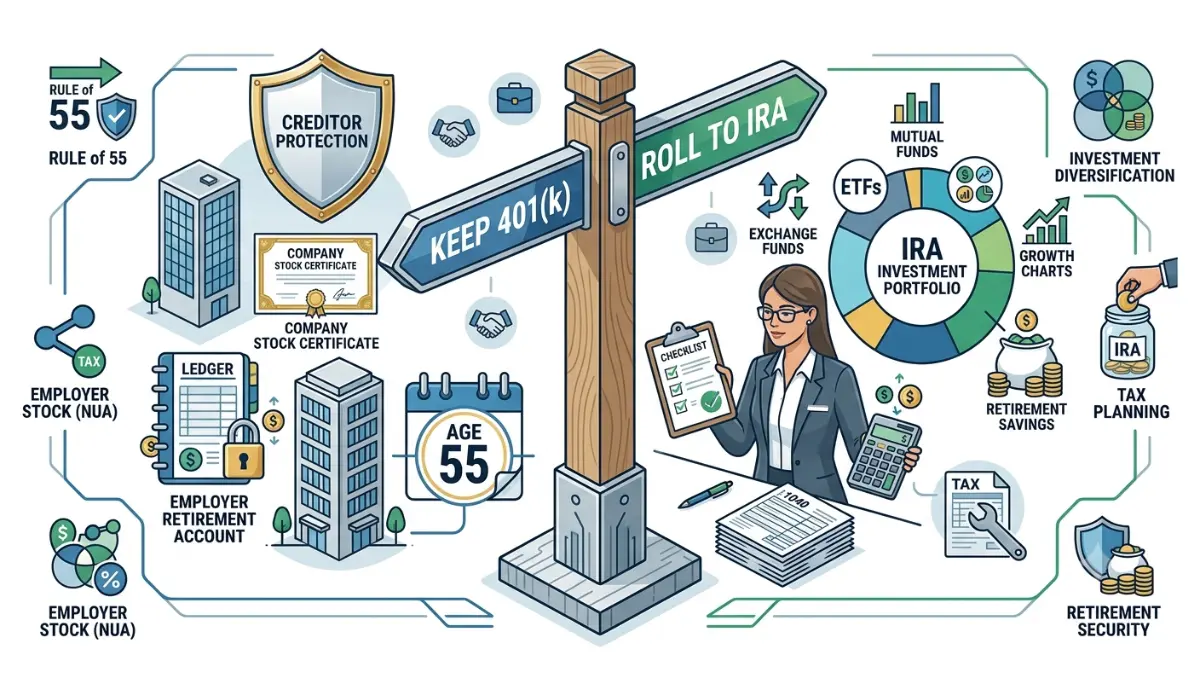
Reasons to keep the 401(k)
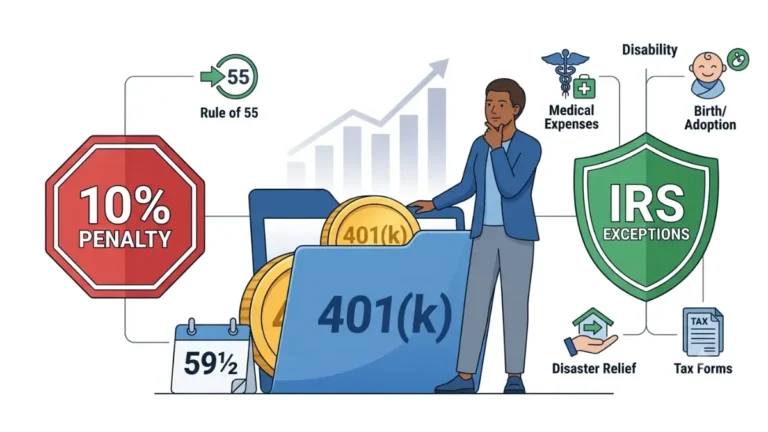
- The rule of 55. Separate from your employer in or after the year you turn 55 and you can take penalty-free withdrawals from that 401(k) before 59½. Roll it into an IRA and you lose that access.
- Company stock (NUA). Rolling appreciated employer stock into an IRA can permanently forfeit net unrealized appreciation, which taxes the growth at lower capital gains rates.
- Creditor protection. Employer 401(k)s carry broad federal protection from creditors; IRA protection is more limited and varies by state.
Mistakes that trigger taxes or penalties
- Assuming a rollover cap: the once-per-12-month rule applies only to IRA-to-IRA rollovers, not to a 401(k)-to-IRA transfer.
- Moving an IRA into a product you don’t understand — read moving an IRA into an annuity first. Only your vested balance is yours to roll.
✅ Action Step: If you separated at 55 or later, or hold company stock, ask a CPA or fiduciary advisor: “Will moving this money cost me the rule of 55 or NUA treatment?” The IRS’s early-distribution rules list the age-55 exception.
401(k)-to-IRA rollover FAQs
1. How do I roll over a 401(k) to an IRA?
Open an IRA, request a direct rollover from your plan administrator, confirm the money lands, invest it, and report it via Form 1099-R at tax time. A direct rollover stays tax-free because funds go to your custodian, not you.
2. How long do I have to complete a 401(k) rollover?
With an indirect rollover — money paid to you — you have 60 days to deposit it into an IRA. A direct rollover has no deadline, since the funds move between institutions and never reach you.
3. Do I pay taxes on a 401(k)-to-IRA rollover?
A direct rollover from a traditional 401(k) to a traditional IRA isn’t taxable. Rolling a traditional 401(k) into a Roth IRA is a conversion, so you owe ordinary income tax. Confirm the impact with a CPA before converting.
4. What’s the difference between a direct and indirect rollover?
A direct rollover sends your 401(k) funds to your new IRA custodian with no withholding. An indirect rollover pays you, withholds 20%, and starts a 60-day redeposit clock. Direct is almost always safer.
5. Can I roll over a 401(k) to a Roth IRA?
Yes, but rolling a pre-tax 401(k) into a Roth IRA is a conversion, so you’ll owe ordinary income tax this year. A Roth 401(k) rolls into a Roth IRA tax-free. A CPA can help you time it.
6. Does a 401(k) rollover count as income or a contribution?
No. A direct rollover isn’t taxable income, and it doesn’t count toward your annual IRA contribution limit. You can still make separate IRA contributions the same year if you’re eligible under the 2026 limits.
7. How much does it cost to roll over a 401(k)?
The IRS charges nothing to roll over a 401(k) to an IRA. Costs come from the new account — watch IRA account fees and the expense ratios of the funds you pick, which vary widely by provider.
8. Can I roll over my 401(k) while still working?
Usually only if your plan allows in-service distributions, and many don’t before you separate or turn 59½. Once you’ve left, you can roll the old 401(k) into an IRA anytime.
9. What happens if I miss the 60-day rollover deadline?
The distribution generally becomes taxable, plus a 10% penalty if you’re under 59½. The IRS allows limited waivers and self-certification for delays beyond your control, like a bank error. A tax professional can confirm whether you qualify.
10. Is there a limit on how many 401(k) rollovers I can do?
No. The once-per-12-month limit applies only to IRA-to-IRA rollovers, not to moving a 401(k) into an IRA or to any direct rollover. You can roll over multiple old 401(k)s without hitting it.
11. Should I roll over my 401(k) or leave it?
It depends on fees, investment menu, and specific factors: the rule of 55, creditor protection, and any company stock (NUA). If you separated at 55 or later or hold employer stock, weigh those first. A fiduciary advisor can help.
Your next step
Moving an old 401(k) into an IRA is straightforward as a direct transfer: open the IRA, ask your former plan to send the money straight to your new custodian, and report it correctly at tax time. That single choice — direct, not a check to you — keeps the rollover tax-free and penalty-free.
If a rollover fits, open the account, then start the request with your old plan. To project the balance once invested, run a retirement calculator — and revisit the disclaimer above first.

Informational disclaimer
The content on Finance Authority Hub is provided for general informational and educational purposes only and should not be considered personalized financial, investment, tax, legal, or professional advice. Financial decisions depend on your individual goals, income, risk tolerance, location, and regulatory situation. Before acting on any information, strategy, estimate, or calculator result, consult a qualified licensed professional who can evaluate your specific circumstances.