How to Decide Between Roth vs Traditional 401(k)
Roth vs traditional 401(k) is one question: pay tax now or later? Both cap at $24,500 in 2026, so it’s about timing — plus a new high-earner Roth rule.
In This Article
Your enrollment screen asks one question that stops a lot of people cold: Roth or pre-tax? Both boxes fund the same 401(k), hold the same investments, and earn the same returns. The only real difference is when you pay tax — and that single fact decides which leaves you with more money.
Route yourself first. If you’re early-career and expect to earn more later, the tax-rate rule below is your answer. If you’re a high earner told you make too much for a Roth IRA, jump ahead — a Roth 401(k) has no income limit. If you’re 50 or older, a new 2026 rule may push part of your contribution into Roth automatically. And if you just want the math, the worked example uses the actual 2026 brackets.
None of this needs a finance degree — just your tax rate today versus your likely rate in retirement.
ℹ️ Financial Disclaimer: This article is educational only and is not personalized investment, tax, or retirement advice. Contribution limits, tax brackets, and account rules change and depend on your income, filing status, and state. Before choosing between a Roth and traditional 401(k) or acting on any strategy here, consult a fiduciary financial advisor or a CPA who can review your full situation.
How each 401(k) taxes your money
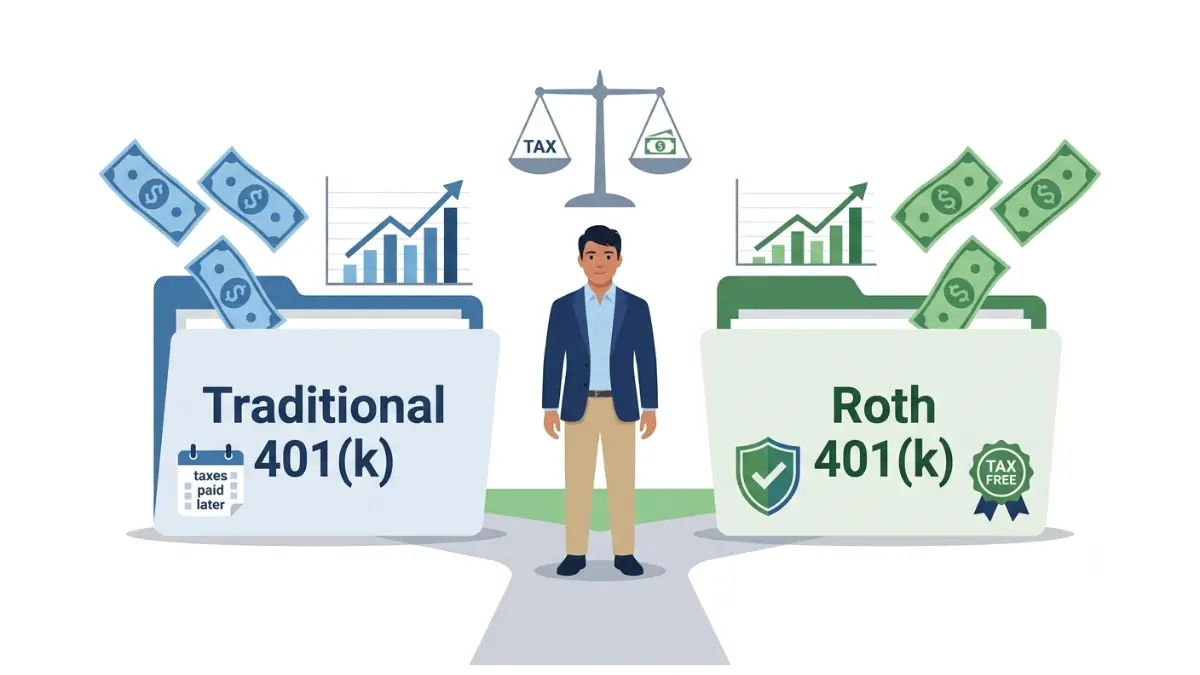
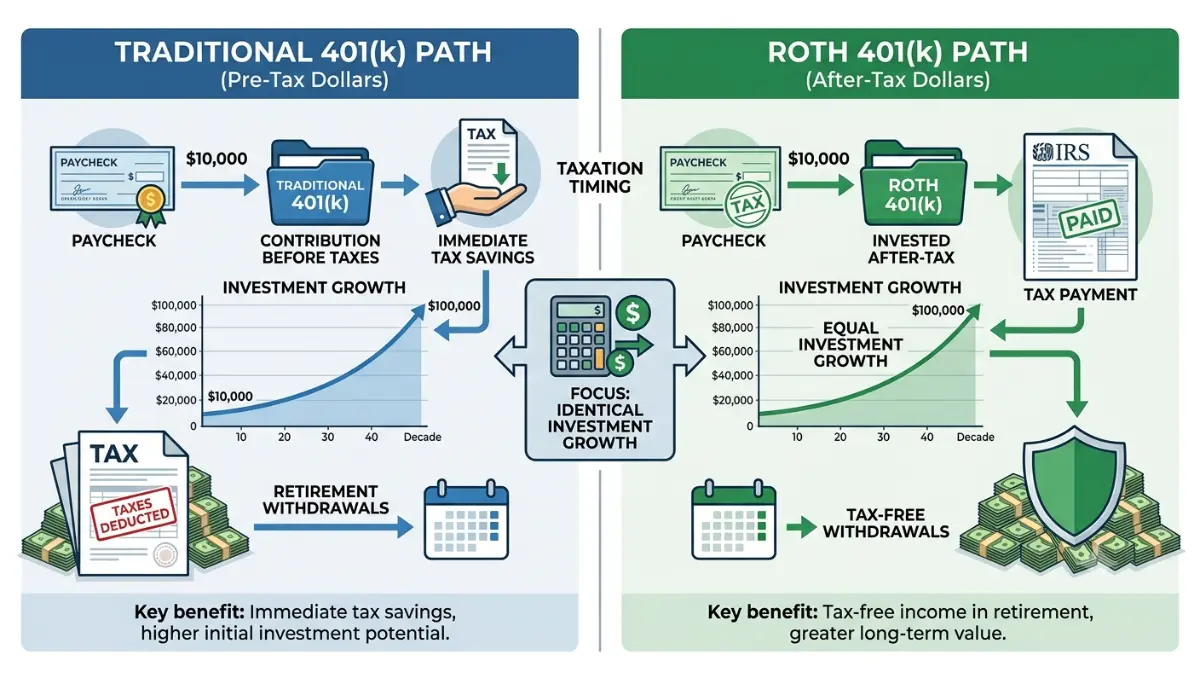
The choice between a traditional 401(k) and a Roth is one trade: pay tax now, or pay it later. Everything else is identical.
Traditional: deduction now, tax later
Money goes in pre-tax, before income tax is withheld, lowering your taxable income this year. The trade-off comes in retirement, when every dollar you withdraw — contributions and decades of growth — is taxed as ordinary income.
Roth: tax now, tax-free later
Roth contributions are after-tax. You get no deduction today, so your paycheck takes a slightly bigger hit than the same pre-tax amount. In exchange, qualified withdrawals in retirement — including all growth — are completely tax-free.
🔍 How It Works: A pre-tax dollar and a Roth dollar are taxed at different points on the timeline. Pre-tax skips tax going in and pays coming out; Roth pays going in and skips coming out. If your tax rate never changed, both would land in the same place — which is why your future rate is the deciding factor.
Curious about the paycheck impact? A take-home pay calculator shows how each election changes what reaches your bank account.
The one question that decides it: your tax rate now vs. later
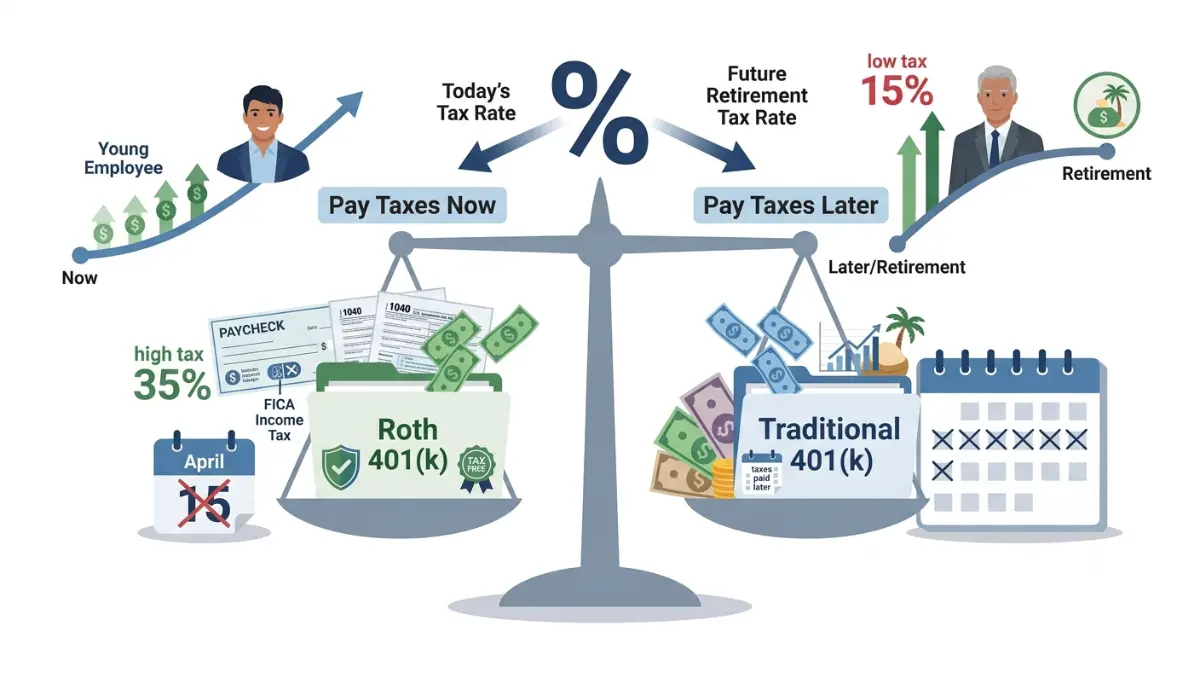
The rule that settles most cases: compare your marginal tax rate today with the rate you expect in retirement.
When Roth usually wins
Roth comes out ahead when your retirement rate will match or exceed today’s. That fits many early-career savers in the 12% or 22% bracket now who may earn — and be taxed — more later. Paying a known lower rate now to lock in tax-free withdrawals is the logic.
When traditional usually wins
Traditional wins when you expect a lower rate later. A high earner in the 32% or 35% bracket now, planning a more modest taxable income in retirement, gets more from the deduction today. Unsure of your bracket? An income tax calculator estimates your 2026 marginal rate.
When it’s close: split the difference
No one can reliably predict future rates, even with the current bracket structure recently made permanent under 2025 legislation. When today’s rate and your expected retirement rate look similar, funding both is legitimate — a form of tax diversification that hedges against guessing wrong.
✅ Action Step: Ask a fiduciary advisor or CPA one specific question before setting your election: “Given my income trajectory and the state I’ll retire in, is my marginal tax rate likely higher or lower than today?”
2026 contribution limits — and the new Roth catch-up rule
Both accounts share one contribution limit, so your choice is about tax timing, not how much you can save.
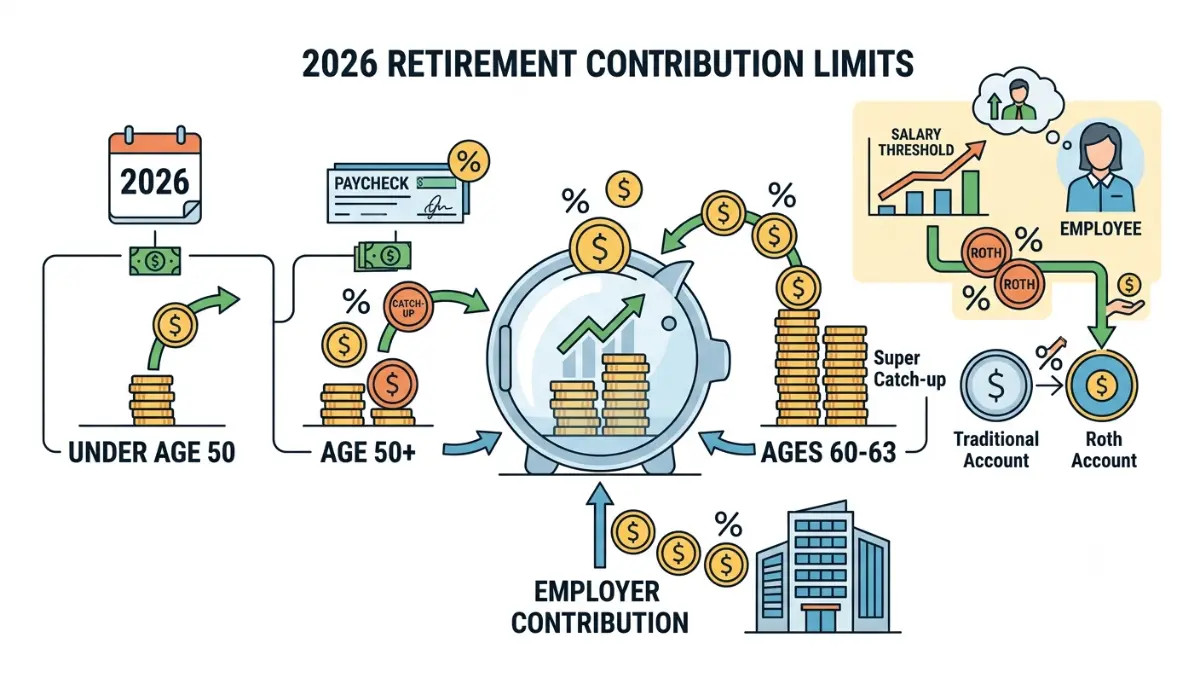
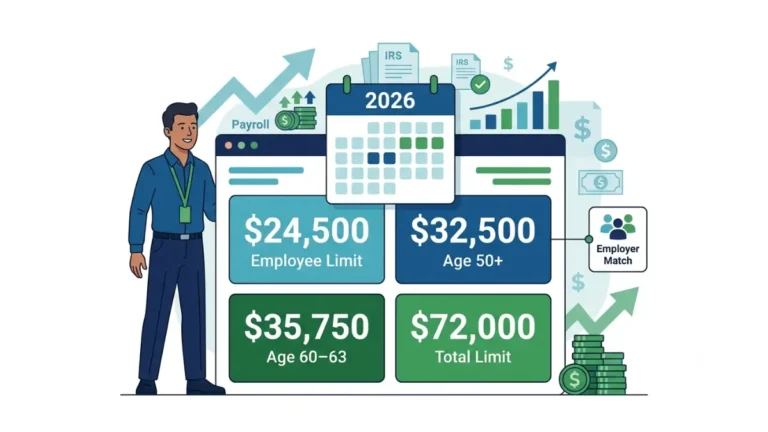
📊 Data Point: For 2026, the employee 401(k) contribution limit is $24,500, up from $23,500 in 2025 — Source: IRS Notice 2025-67 (IR-2025-103).
| Contribution type (2026) | Limit | Key detail |
|---|---|---|
| Employee (under 50) | $24,500 | Roth and pre-tax combined |
| Age 50+ catch-up | +$8,000 | Total $32,500 |
| Age 60–63 super catch-up | +$11,250 | Total $35,750 |
| Employee + employer | $72,000 | All sources, under 50 |
Verified against IRS Notice 2025-67 (IR-2025-103), November 2025.
One shared limit
All Roth, all pre-tax, or split — your combined employee contributions can’t top $24,500 in 2026. Full detail is in our pillar guide to 2026 401(k) contribution limits, citing the IRS 2026 limits.
Catch-up contributions at 50 and 60–63
At 50+, you can add a catch-up on top of the standard limit; a larger “super catch-up” applies only in the ages 60–63 window. See how 401(k) catch-up contributions work.
New for 2026: the $150,000 Roth catch-up rule
This one catches high earners off guard. Beginning in 2026, if your prior-year wages with your employer exceeded $150,000 in 2025, any catch-up must go into a Roth account — the pre-tax option is gone for that portion. It’s based on W-2 (FICA) wages, not AGI, and applies only to workplace plans. The IRS catch-up contribution rules spell it out; our Roth catch-up rule for high earners guide explains who it hits.
⚠️ Costly Mistake: If your plan has no Roth option and you’re subject to this rule, you could lose catch-up contributions entirely. Confirm a Roth 401(k) is available with your plan administrator before counting on catch-up savings for 2026.
Roth 401(k)’s two quiet advantages: no income limit, no RMDs
Two structural perks tip the decision for specific savers.
No income limit (unlike a Roth IRA)
A Roth IRA phases out at higher incomes — for 2026, single filers between $153,000 and $168,000, and married couples filing jointly between $242,000 and $252,000. A Roth 401(k) has no cap. If you earn too much for a Roth IRA directly, the Roth side of your workplace plan may be your only direct route to tax-free retirement money.
No lifetime RMDs since 2024
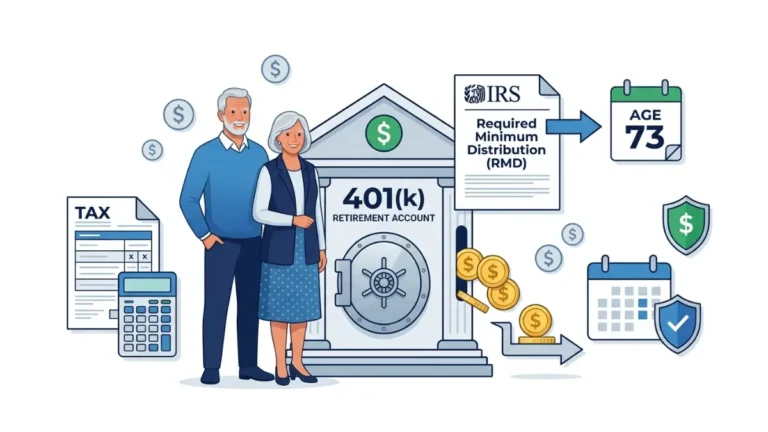
Required minimum distributions are mandatory yearly withdrawals — and a tax bill — that a traditional 401(k) triggers at age 73. Since 2024, Roth 401(k)s are exempt from lifetime RMDs, matching Roth IRAs, so your balance keeps compounding on your timeline. The IRS RMD rules confirm the exemption applies while the owner is alive.
Your employer match is still pre-tax
One catch: the employer match almost always lands in a pre-tax bucket by default, even if all your contributions go to Roth. Some plans now allow a Roth match, but it’s taxable to you in the year made. See how your employer match is treated.
💡 Expert Note: A common confusion is assuming an all-Roth election makes the whole account tax-free. Unless you elect a Roth match and your plan supports it, employer contributions and their growth stay taxable in retirement — so most savers end up with a blend.
Worked example: $10,000 to each, on real 2026 brackets
Here’s a like-for-like comparison using the actual 2026 federal brackets — an illustration, not a recommendation for your situation.
The setup
A single filer earning $100,000 in 2026 has about $83,900 in taxable income after the $16,100 standard deduction — inside the 22% tax bracket (which runs $50,400 to $105,700 for single filers). A $10,000 contribution stays entirely within that band.
🔍 How It Works: Traditional: the $10,000 goes in pre-tax and cuts this year’s federal tax by 22% — a $2,200 saving now. Roth: you contribute the same $10,000 after paying that $2,200, so it costs more today but grows and withdraws tax-free.
How each plays out
| Retirement tax rate | Better account | Why |
|---|---|---|
| 12% (lower than today) | Traditional | Deducted at 22%, taxed at 12% |
| 22% (same) | Tie | Same rate in and out |
| 24%+ (higher) | Roth | You’d pay more later than you saved now |
Based on the 2026 federal tax brackets. Excludes state taxes and individual circumstances.
Why maxing Roth shelters more
A subtler point for those who can afford it: maxing the $24,500 limit in Roth puts $24,500 of after-tax money inside the shelter. Maxing it pre-tax saves about $5,390 at 22% — but unless you also invest that saving, it sits in a taxable account. At the same limit, Roth shelters more real value. Model it with a 401(k) growth calculator or see how tax-free compounding pulls ahead over decades.
✅ Action Step: Before committing, ask a CPA or fiduciary advisor to run this on your real income, state taxes, and expected retirement bracket: “At my numbers, does the deduction now or the tax-free withdrawal later leave me with more after-tax income?”
Common mistakes when choosing between them
Assuming a lower retirement bracket without checking
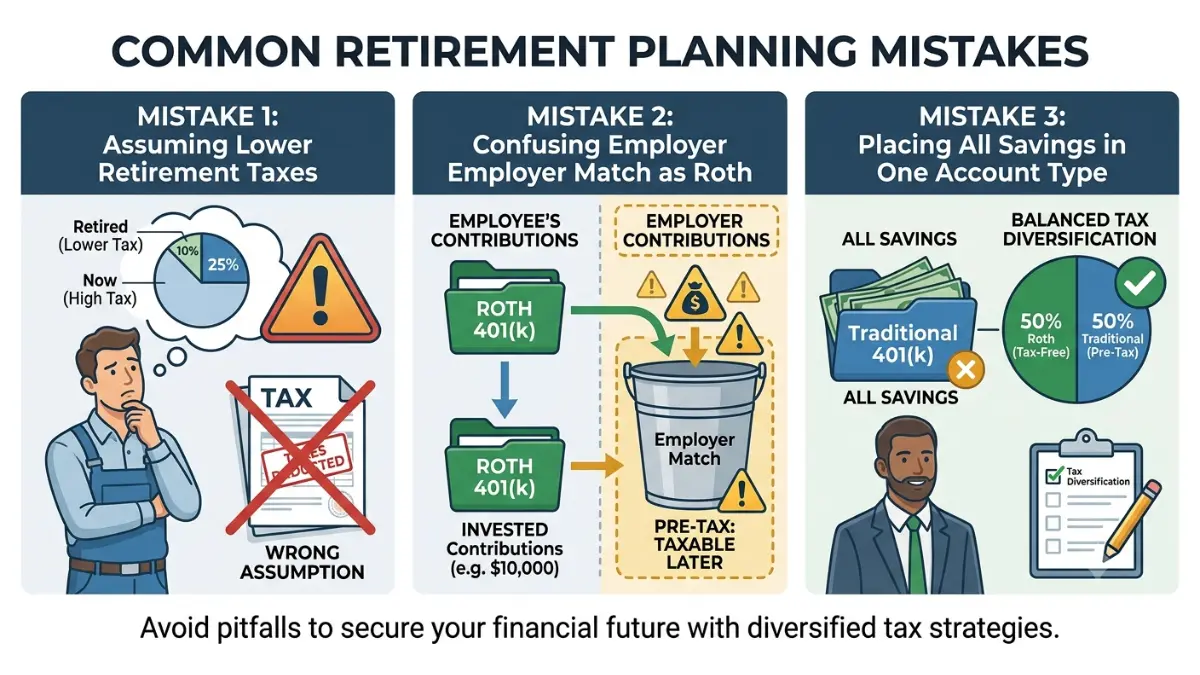
Many default to traditional believing they’ll be taxed less later — but Social Security, pensions, RMDs, and recently-permanent tax rates land plenty of retirees in the same bracket or higher. Estimate before you assume.
Forgetting the match is pre-tax
An all-Roth election doesn’t make the whole account tax-free, because the employer match is typically pre-tax. Plan for that taxable bucket rather than being surprised by it.
Going all-in when a split would serve better
Choosing 100% one way bets on future rates you can’t see; contributing to both keeps options open. Also mind the five-year rule: withdrawing Roth 401(k) earnings tax-free generally requires the account be open five years and that you be at least 59½.
⚠️ Costly Mistake: Pulling Roth earnings before meeting both the five-year holding period and age 59½ can make the earnings taxable and penalized. If you might need money early, confirm with your plan administrator which dollars are contributions (accessible) versus earnings (restricted).
Roth vs traditional 401(k): frequently asked questions
1. Is a Roth or traditional 401(k) better?
Neither is universally better. A Roth 401(k) wins if your retirement tax rate matches or exceeds today’s; traditional wins if you’ll be taxed less later. Compare your 2026 marginal bracket to your expected retirement rate, and confirm the call with a CPA or fiduciary advisor.
2. What’s the difference between them?
When you pay tax. Traditional contributions are pre-tax and lower this year’s taxable income, but withdrawals are taxed in retirement. Roth contributions are after-tax with no deduction now, but qualified withdrawals — including growth — are tax-free later. The accounts are otherwise identical.
3. Do they have the same contribution limit?
Yes. For 2026, combined employee contributions to Roth and traditional 401(k)s can’t exceed $24,500, however you split them. Savers 50 and older add an $8,000 catch-up; those aged 60 to 63 add $11,250 instead.
4. Does a Roth 401(k) have income limits?
No. Unlike a Roth IRA — which phases out between $153,000 and $168,000 for single filers in 2026 — a Roth 401(k) has no income limit. High earners locked out of a Roth IRA can still use the Roth side of a workplace plan, if offered.
5. Are Roth 401(k)s subject to RMDs?
No. Since 2024, Roth 401(k)s are exempt from lifetime required minimum distributions, matching Roth IRAs. A traditional 401(k) requires distributions starting at age 73. This lets your Roth balance keep compounding on your own timeline rather than a mandated one.
6. Is my employer match Roth or pre-tax?
Pre-tax by default, even if your own contributions go entirely to Roth. Some plans now permit a Roth match, but it’s taxable to you in the year made. Check your plan’s rules, and expect a taxable bucket in retirement regardless of your election.
7. What’s the new 2026 Roth catch-up rule?
Beginning in 2026, if your prior-year wages with your employer topped $150,000, any 401(k) catch-up must be Roth — the pre-tax option no longer applies to that portion. It’s based on W-2 wages, not AGI, and affects only workplace plans. Ask your plan administrator whether it applies.
8. Can I contribute to both?
Yes, and many do. Split contributions in any proportion, as long as total employee contributions stay within the $24,500 limit for 2026. Splitting is a common way to hedge against uncertain future tax rates.
9. Is a Roth 401(k) better for young workers?
Often. Early-career workers are frequently in lower brackets, like 12% or 22%, than they’ll reach later, so paying tax now at a known lower rate for tax-free withdrawals can pay off. It depends on expected income growth; a CPA can help you weigh it.
10. How do I switch between Roth and pre-tax?
Change your deferral election through your plan’s portal or HR team, usually with no limit on frequency. It applies to future contributions only; money already contributed stays in its bucket. Converting existing traditional funds to Roth is possible in some plans and is a taxable event.
11. What’s the five-year rule for a Roth 401(k)?
To withdraw Roth 401(k) earnings tax-free, you generally must be at least 59½ and have held the account five years, counted from January 1 of your first Roth contribution year. Your own contributions are more flexible; the rule applies to the growth.
The bottom line: match the account to your tax future
The choice isn’t about which account grows faster — they grow identically. It’s whether paying tax now or later leaves you with more, and that turns on your marginal rate today versus in retirement.
Expect higher or equal taxes later? Roth’s tax-free withdrawals are compelling. In peak earning years expecting a lower retirement bracket? The traditional deduction has the edge. When the two look close, splitting is a sound hedge, not indecision. Whatever you choose, run your own retirement numbers and check how your balance compares by age.
Because this decision compounds for decades, have a CPA or fiduciary advisor confirm the call against your full financial picture before finalizing a large or long-term election.
Informational disclaimer
The content on Finance Authority Hub is provided for general informational and educational purposes only and should not be considered personalized financial, investment, tax, legal, or professional advice. Financial decisions depend on your individual goals, income, risk tolerance, location, and regulatory situation. Before acting on any information, strategy, estimate, or calculator result, consult a qualified licensed professional who can evaluate your specific circumstances.