Deciding How Much to Contribute to Your 401(k)
How much to contribute to a 401(k)? Most workers defer just 7.6% of pay—under the 15% research suggests. Here’s how to set the right rate for you.
In This Article
The short answer: contribute at least enough to capture your full employer match, then work toward saving 15% of your pay — including that match — over time. That covers most people, but the right number depends on where you are right now.
Just enrolled and staring at a blank deferral box? Start with the match, then read Section 3. Carrying high-interest credit card debt? The order matters more than the amount — also Section 3. Mid-career and wondering whether your current percentage is “enough”? The by-age benchmarks in Section 5 show where you stand. Age 50 or older and trying to catch up? The 2026 limits in Section 6 are written for you.
Figuring out how much to contribute to 401k plans comes down to two numbers — your contribution rate and the IRS dollar cap — and knowing which to focus on first. This guide walks through both, with every figure tied to its source so you can act with confidence today.
ℹ️ Financial Disclaimer: This article is for general educational purposes only and is not personalized investment, tax, lending, or debt-relief advice. Contribution limits, tax rules, and the value of any investment depend on your individual circumstances and can change. Before acting on retirement, tax, or debt-payoff decisions, consult a fiduciary financial advisor, a CPA, or a qualified attorney about your specific situation.
Start with your contribution rate, not the dollar limit
The biggest source of confusion is treating your 401(k) like a single number, when really there are two. Your contribution rate is the percentage of each paycheck you direct into the plan; the IRS dollar cap is the most you can put in across the whole year.
Most people never come close to the annual cap, so the real decision is the percentage. If you earn $60,000 and set your rate to 10%, that’s $6,000 a year — comfortably under the 2026 employee limit of $24,500 confirmed by the IRS.
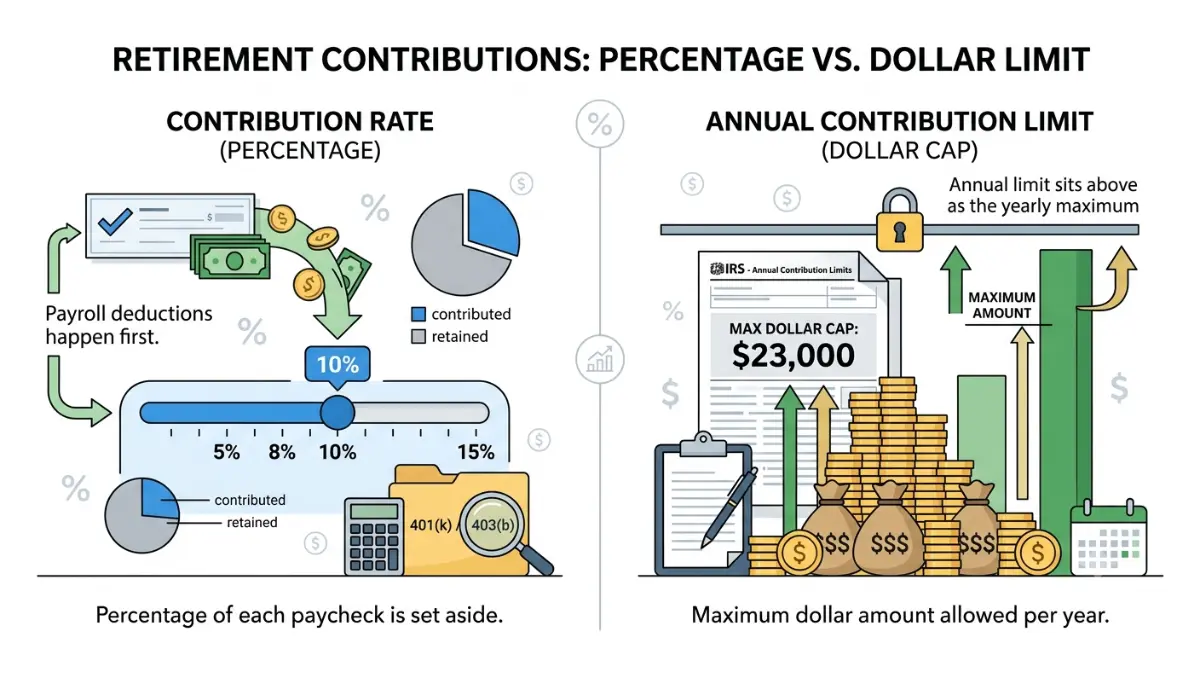
🔍 How It Works: When you choose, say, 8%, your employer’s payroll system withholds 8% of each gross paycheck before you ever see it and sends it to your 401(k). With traditional (pre-tax) contributions, that money isn’t counted in your taxable income for the year; with Roth 401(k) contributions, you pay tax now and qualified withdrawals later are tax-free. Either way, the percentage — not a dollar target — is what you actually set.
Because the money comes out before it hits your bank account, a contribution feels smaller than it looks on paper. You can preview the real effect with a take-home pay calculator before you change your rate.
How much to contribute, step by step
When people ask how much to put in, they usually want a number — but the smarter answer is an order. Follow this priority sequence and the right percentage falls out of your own situation:
- Contribute enough to get your full employer match. This is the highest-priority dollar you can save, because it’s an immediate, guaranteed addition to your money that no other account offers.
- Build a starter emergency fund and attack high-interest debt. A credit card charging 20%+ typically costs you more than a 401(k) is likely to earn, so clearing it can take priority over saving above the match.
- Return to your 401(k) and build toward 15% of pay, counting the employer match toward that 15%.
- If you have room, push toward the annual maximum — $24,500 in 2026, per the IRS.
- Still saving more? Consider an IRA, or after-tax 401(k) contributions if your plan allows — but get a professional’s read first, since the tax treatment is easy to get wrong.
⚠️ Costly Mistake: Setting your rate below the match threshold. If your employer matches up to 6% and you contribute 3%, you forfeit half the match every single paycheck — money you can never recover for that year.
Step 2 is the one that genuinely depends on your numbers. Use a 50-30-20 budget planner to see how much room you actually have, and if you’re torn between maxing the 401(k) and funding an IRA, our guide on whether to max a 401(k) or IRA first breaks down the trade-offs.
✅ Action Step: If you’re weighing debt payoff against contributing above your match, write down each debt’s APR and compare it to a conservative long-run return estimate. A fiduciary financial advisor or a nonprofit credit counselor (you can find one through the National Foundation for Credit Counseling) can help you decide which dollar to prioritize first.
Always contribute enough to get the full match
The single most expensive mistake in retirement saving is skipping the employer match, because it’s effectively free compensation you’ve already earned.
📊 Data Point: The average employer match is about 4.7% of pay — a record high — Source: Vanguard, How America Saves (2026 edition).
Match formulas vary, but two common ones are “50% of contributions up to 6% of pay” and “100% up to 3–4%.” What matters is contributing at least enough to trigger the full match.
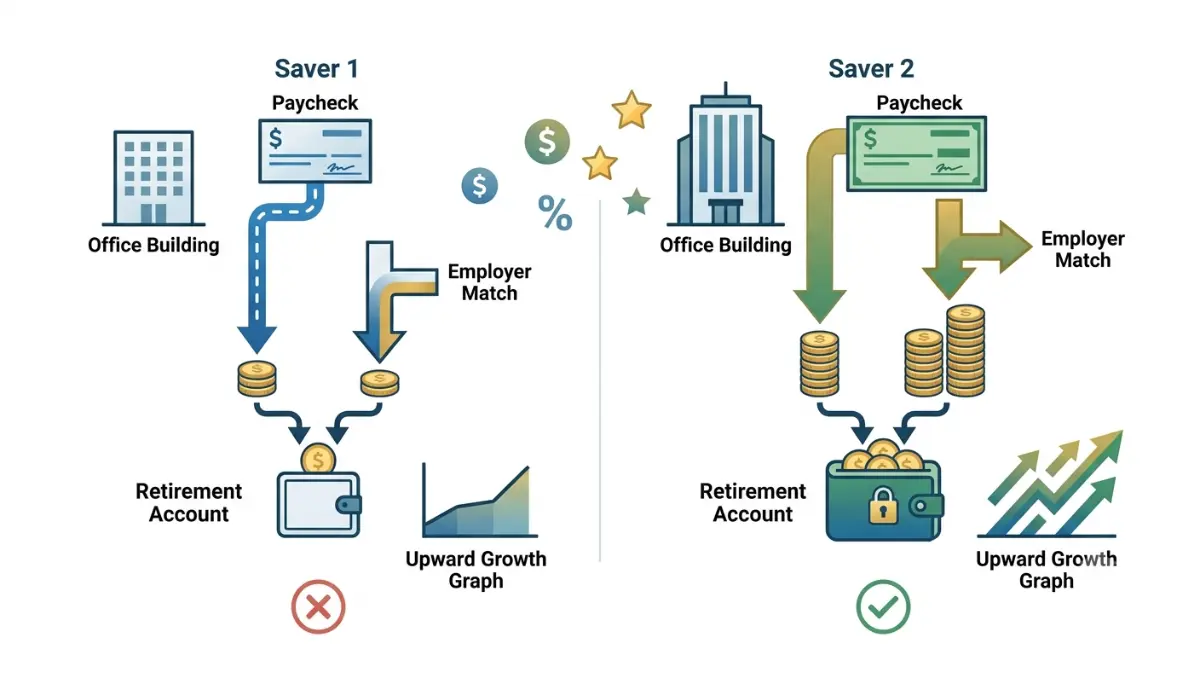
🔍 How It Works: Say you earn $60,000 and your plan matches 50% up to 6%. To capture the full match, you contribute 6% ($3,600), and your employer adds $1,800. Contribute only 3% ($1,800), and the employer adds just $900 — leaving $900 on the table that year, plus decades of growth on it.
If your employer offers no match, there’s no free-money floor to hit, so your starting point becomes the 15% target in the next section. For a deeper look at why the match is worth chasing first, see our explainer on avoiding leaving 401(k) free money behind, and run your own formula through the 401(k) calculator to see the match in dollars.
How much to save by age (and the 15% guideline)
A widely used savings rate target comes from Fidelity: aim to save about 15% of your pre-tax pay each year, including any employer match, which its research links to replacing roughly 45% of your pre-retirement income. To translate that into a running scorecard, Fidelity also publishes age-based milestones:
| By age | Target saved (× your salary) | Key detail |
|---|---|---|
| 30 | 1× | Roughly one year’s salary banked |
| 40 | 3× | The compounding curve steepens here |
| 50 | 6× | Catch-up contributions become available |
| 60 | 8× | Final stretch before typical retirement |
| 67 | 10× | Full Social Security retirement age |
Source: Fidelity retirement savings guidelines. Milestones assume saving 15% from age 25, a mix weighted toward stocks, and retirement at 67; if you start later, the required rate rises — closer to 18% starting at 30.
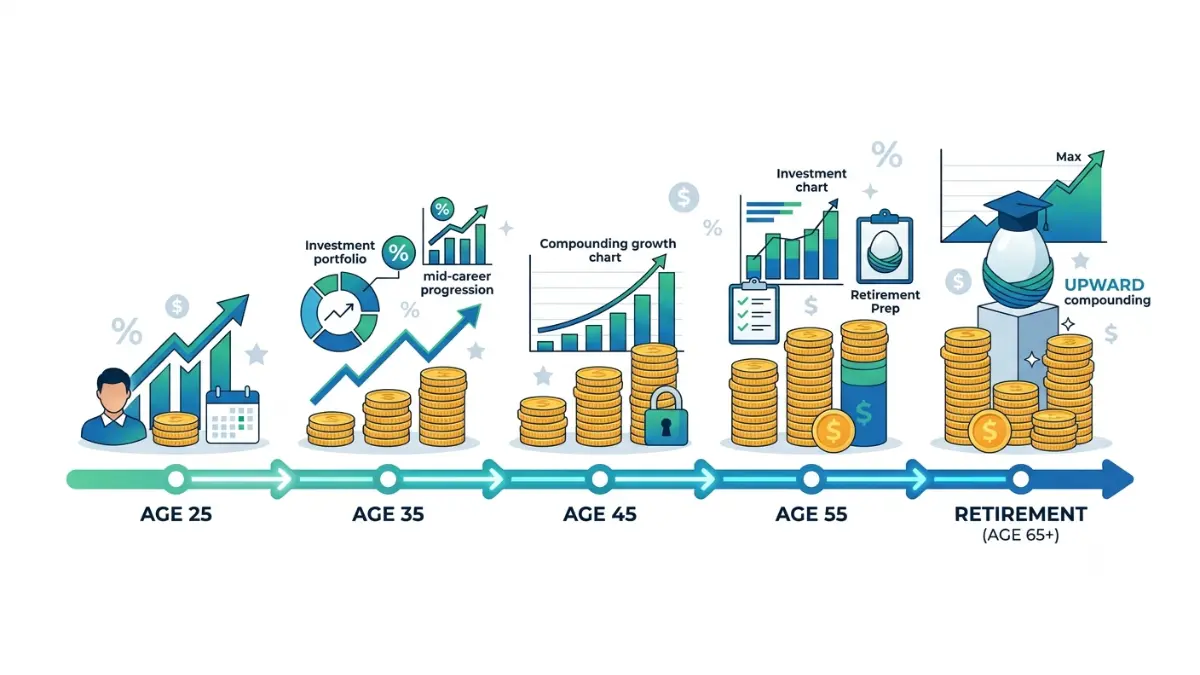
📊 Data Point: The average worker actually defers 7.6% of pay, or about 12.1% counting the employer match — short of the 15% target — Source: Vanguard, How America Saves (2026 edition). Verified.
That gap is the real story: most people aren’t “behind” because they’re careless, but because their default rate was never raised. If you’re not at your target, our guide to retirement savings benchmarks by age and a compound interest calculator can show how a few extra points today compound over decades.
2026 contribution limits and whether to max out
If you’re aiming higher than the match, the IRS sets a firm ceiling on how much you can contribute. Here are the verified 2026 contribution limit figures:
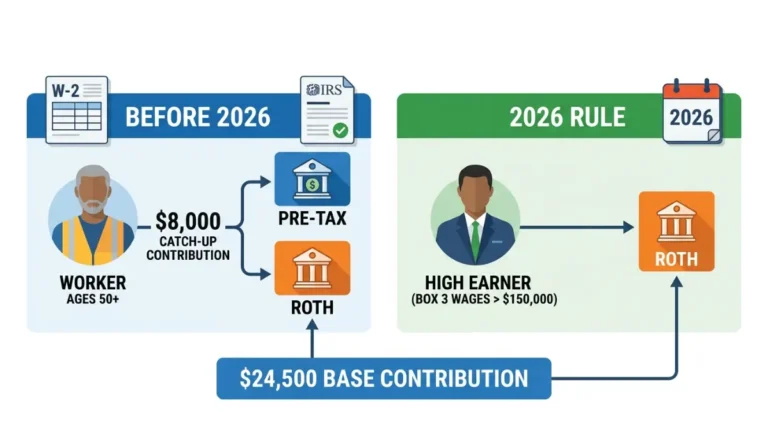
- Employee contributions: $24,500
- Age 50+ catch-up: +$8,000, for a total of $32,500
- Ages 60–63 “super” catch-up: +$11,250, for a total of $35,750 (if your plan allows)
- Combined employee + employer cap: $72,000 ($80,000 with the 50+ catch-up; $83,250 at 60–63)
- Pay counted toward the plan: capped at $360,000
📊 Data Point: 2026 employee limit $24,500; age 50+ catch-up $8,000; ages 60–63 catch-up $11,250; combined annual additions limit $72,000 — Source: IRS (IR-2025-111 / Notice 2025-67). Verified.
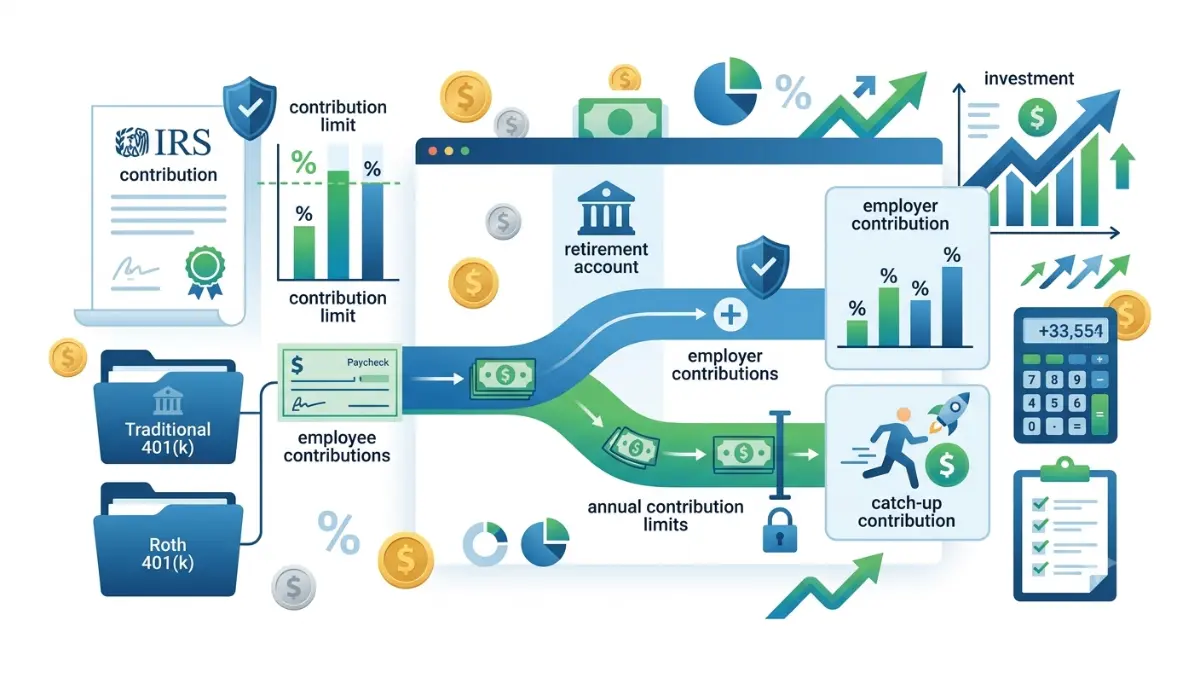
One 2026 change matters for higher earners: if your prior-year wages with that employer topped $150,000, your catch-up contributions must now be made on a Roth basis. The full caps and payout rules live in our 2026 401(k) contribution limits pillar, the age-based detail in our guide to catch-up contributions, and the high-earner rule in Roth catch-up rules for high earners. You can confirm the figures directly against the IRS’s 2026 contribution limits, the IRS catch-up contribution rules, and the combined employer-and-employee limit.
⚠️ Costly Mistake: Over-contributing across two jobs. The $24,500 employee limit applies to you, not to each plan — exceed it by switching employers mid-year and the excess can be taxed twice unless you fix it by your plan’s deadline.
Whether maxing out is right for you depends on your full financial picture, not a rule of thumb. Maxing while carrying high-interest debt or with no emergency fund usually isn’t the strongest move.
✅ Action Step: Before pushing toward the maximum — or making after-tax or “mega backdoor” Roth contributions — ask a CPA or fiduciary advisor: “Given my tax bracket, debts, and other goals, does maxing my 401(k) make sense before I fund anything else this year?”
Common 401(k) contribution mistakes to avoid
Most contribution mistakes aren’t dramatic — they’re small settings nobody revisited, quietly costing years of growth.
The first is contributing below the match, which forfeits guaranteed employer money every paycheck, as Section 4 showed. The second catches high earners off guard.
⚠️ Costly Mistake: Front-loading without a true-up. If you max out early in the year and your plan matches per paycheck without a year-end “true-up,” you can stop earning the match the moment your contributions stop — losing employer dollars you’d have gotten by spreading contributions evenly. Check whether your plan offers a true-up before front-loading.
💡 Expert Note: Many plans now include automatic escalation, which nudges your rate up by a point each year. Vanguard reports this feature is a major reason participants raise their savings over time — but you can opt out, so it’s worth confirming yours is switched on rather than assuming.
The quietest mistake is leaving your rate flat for years. When you get a raise, bumping your contribution by even one point lets you save more without feeling a pinch in your take-home pay.
Frequently asked questions about 401(k) contributions
1. How much should I put in my 401(k) per paycheck?
Set a percentage, not a dollar amount. At minimum, choose a rate high enough to earn your full employer match; from there, work toward 15% of pay (including the match) over time. The 2026 annual employee cap is $24,500.
2. Is 15% enough for a 401(k)?
For many people starting around age 25, Fidelity’s research suggests 15% of pay — including the employer match — is a reasonable target to replace roughly 45% of pre-retirement income. Start later and you may need closer to 18%. Confirm your number with a fiduciary advisor.
3. How much do I need to contribute to get the full match?
It depends on your plan’s formula. With a common “50% up to 6%” match, you contribute 6% of pay to capture every available dollar; contributing less leaves part of the match unclaimed. Check your plan document for the exact match rate.
4. Should I max out my 401(k)?
Maxing at $24,500 (2026) can make sense once you’ve cleared high-interest debt and built an emergency fund — but not always before. The right call depends on your tax bracket and competing goals, so confirm it with a CPA or fiduciary advisor.
5. What’s a good 401(k) contribution percentage by age?
Rather than a fixed percentage, Fidelity frames progress as savings milestones: roughly 1× your salary saved by 30, 3× by 40, 6× by 50, 8× by 60, and 10× by 67. Falling short signals raising your rate, not panic.
6. Is it better to contribute to a 401(k) or pay off debt?
Capture your full match first — it’s guaranteed money. Beyond that, compare each debt’s APR to a conservative expected return: high-interest debt above ~20% usually wins. A nonprofit credit counselor can help you sequence this.
7. Can I contribute too much to my 401(k)?
Yes. Exceed the $24,500 employee limit for 2026 — easy to do across two employers in one year — and the excess deferrals can be taxed twice unless corrected by your plan’s deadline. Most single-employer plans block over-contributions automatically.
8. How much should I contribute if my employer doesn’t match?
Without a match, there’s no free-money floor, so aim toward the 15% savings target instead. Many savers also compare a 401(k) against an IRA in this situation, since both offer tax advantages. A fiduciary advisor can help you choose.
9. What happens if I only contribute 3%?
If your match requires 6%, contributing 3% likely forfeits part of your employer’s money, and 3% alone falls well short of the 15% guideline. It’s a fine starting point — just plan to escalate it as your budget allows.
10. Does the employer match count toward the contribution limit?
The $24,500 employee limit (2026) applies only to your own contributions. The match counts toward the separate combined cap of $72,000, so an employer match never reduces how much you can personally defer. High earners should confirm specifics with a CPA.
11. How much will my 401(k) grow if I raise my contribution?
It depends on your rate, returns, and time horizon, so exact figures aren’t guaranteed. Even one extra percentage point, compounded over decades, can add substantially — modeling it in a 401(k) calculator shows the effect for your own numbers.
Your next step
How much to contribute isn’t really one number — it’s an order: match first, then high-interest debt and a cash cushion, then build toward 15%, then push to the cap if you can.
The most valuable thing you can do right now is concrete. Log into your plan portal and either set your deferral to at least your full match, or bump an existing rate up by one point. For a fuller picture of where that puts you, the retirement calculator projects your balance over time. And for a plan tailored to your numbers, a fiduciary advisor can map the trade-offs that a general guide can’t.

Informational disclaimer
The content on Finance Authority Hub is provided for general informational and educational purposes only and should not be considered personalized financial, investment, tax, legal, or professional advice. Financial decisions depend on your individual goals, income, risk tolerance, location, and regulatory situation. Before acting on any information, strategy, estimate, or calculator result, consult a qualified licensed professional who can evaluate your specific circumstances.