What Is the 401(k) Employer Contribution Limit?
The 401(k) employer contribution limit isn’t a separate number. It’s what’s left of a shared $72,000 cap after your deferral — here’s how to find it.
In This Article
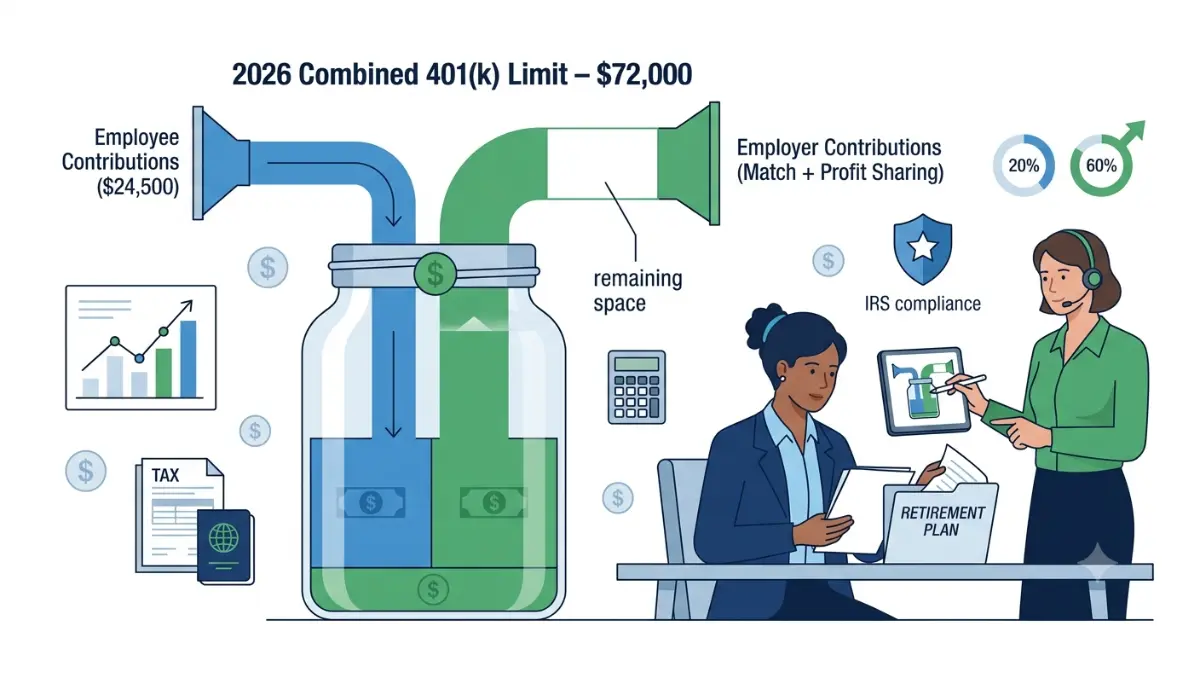
If you’re asking about the 401(k) employer contribution limit for 2026, here’s the honest answer most pages skip: there is no separate dollar cap that applies only to your employer. Employer money — matching, profit sharing, and other contributions — counts toward a single combined ceiling of $72,000 that you and your employer share, set by the IRS under Section 415(c).
Your employer’s room is whatever is left of that $72,000 after your own salary deferrals. So the real question isn’t “what’s the employer limit” — it’s “how much of the $72,000 is still open once I’ve contributed.”
This guide routes you by situation. If you’re a salaried employee with a match, sections two through four show how the shared cap works and how to find the room left. If you’re self-employed with a solo 401(k), section five covers the 25% rule that usually caps you first. If you’re 50 or older, section six covers catch-up contributions, which sit on top of the $72,000. And if you think you’ve over-contributed, section seven explains the fix. For every 2026 limit in one place, see the full 2026 401(k) contribution limits.
ℹ️ Financial Disclaimer: This article is for general educational purposes only and is not personalized investment, tax, or retirement advice. Contribution limits, deduction rules, and tax treatment depend on your specific plan, income, and filing status. Before making decisions about your 401(k), after-tax contributions, or a solo 401(k), consult a fiduciary financial advisor or a CPA, and confirm your plan’s rules with your plan administrator.
There’s no separate employer-only limit — here’s the rule that applies
Two different IRS limits govern a 401(k), and confusing them is the most common mistake readers make. There is no standalone employer-only dollar limit. Instead, employer contributions count toward a shared combined contribution limit — the annual additions cap of $72,000 for 2026 under Internal Revenue Code Section 415(c).
The other limit, Section 402(g), caps only what you defer from your paycheck: $24,500 for 2026. Your employer’s contributions don’t count against that $24,500 — they count against the larger $72,000 total.
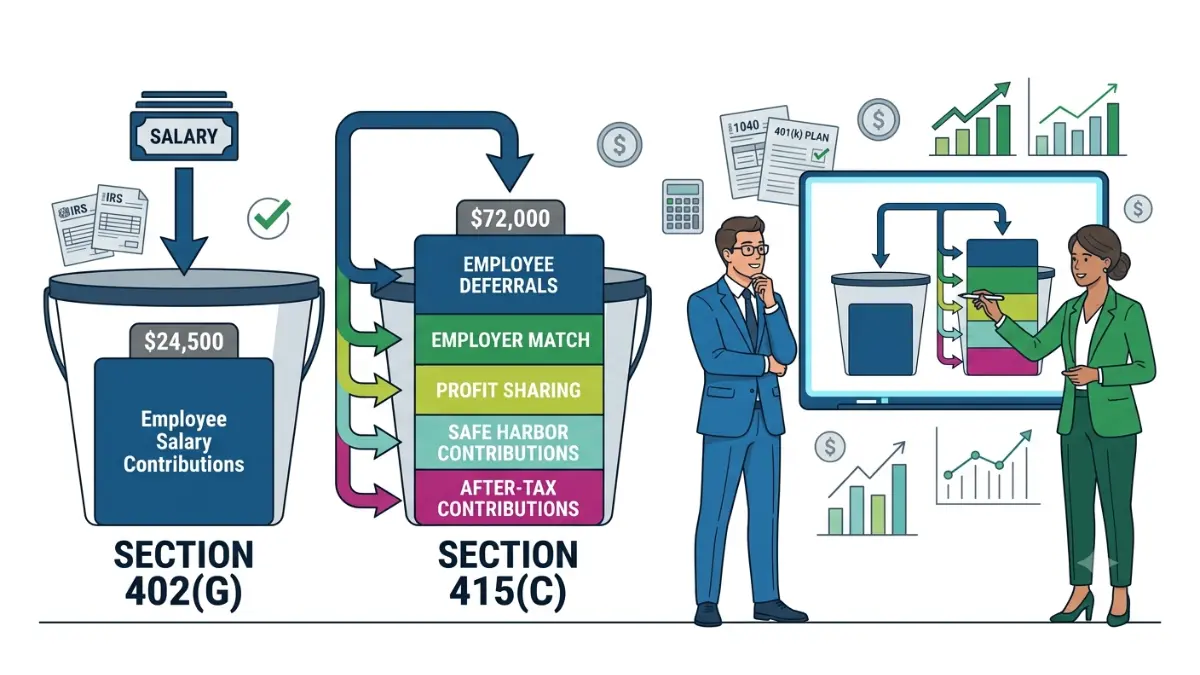
🔍 How It Works: Picture two buckets. The §402(g) bucket holds only your salary deferrals and tops out at $24,500. The §415(c) bucket holds everything — your deferrals plus all employer money plus any after-tax contributions — and tops out at $72,000. Employer dollars fill the big bucket, not the small one.
Does the employer match count against your $24,500 limit?
No. A common point of confusion is assuming the match eats into your personal deferral limit. It doesn’t. You can defer the full $24,500 yourself, and your employer’s match and other contributions stack on top, up to the $72,000 combined ceiling. If you’re unsure how matching is structured, see how 401(k) employer matching works.
What counts as an employer contribution?
Employer contributions include matching contributions, profit-sharing contributions, nonelective contributions, and safe harbor contributions. All of them count toward the $72,000 §415(c) limit, and none count toward your $24,500 deferral limit. After-tax (non-Roth) contributions you make also count toward the $72,000 — which matters in section four.
The 2026 numbers: $24,500, $72,000, and what’s left for your employer
For 2026, the combined employee-plus-employer 401(k) limit is $72,000, and the most you can defer from your own paycheck is $24,500. Here is every figure that defines the employer side, with the 2025 numbers where they changed.
| 401(k) Limit (2026) | 2026 | 2025 | Key Detail |
|---|---|---|---|
| Your salary deferral (§402(g)) | $24,500 | $23,500 | The most you can put in from pay |
| Combined employee + employer (§415(c)) | $72,000 | $70,000 | Shared ceiling for all contributions |
| Compensation counted (§401(a)(17)) | $360,000 | — | Pay above this is ignored for the plan |
| Catch-up, age 50+ (§414(v)) | $8,000 | $7,500 | Sits on top of $72,000 |
| Super catch-up, age 60–63 | $11,250 | — | Replaces the $8,000 in those years |
Source: IRS, 2026. Figures verified against IRS Notice 2025-67 and the IRS 401(k) and profit-sharing plan contribution limits page.
📊 Data Point: The §415(c) combined limit rose from $70,000 in 2025 to $72,000 in 2026 — a $2,000 increase. Source: IRS, 2026.
2026 vs. 2025 at a glance
Three numbers moved for 2026. The salary deferral limit rose $1,000 to $24,500, the combined limit rose $2,000 to $72,000, and the age-50 catch-up rose $500 to $8,000. These cost-of-living adjustments are set out in IRS Notice 2025-67. For a fuller breakdown of each limit, see how the 401(k) contribution limits break down.
The catch-up-inclusive maximums ($80,000 and $83,250)
Because catch-up contributions sit on top of the §415(c) cap, the effective maximum is higher for older workers. The IRS lists the catch-up-inclusive total as $80,000 for those 50 and older and up to $83,250 for those age 60 to 63, on its page for the IRS 401(k) and profit-sharing plan contribution limits.
How to calculate your employer’s 401(k) contribution room
Turning the $72,000 cap into your employer’s actual room takes one subtraction. The combined limit minus your own salary deferrals equals the space left for employer contributions and after-tax dollars.
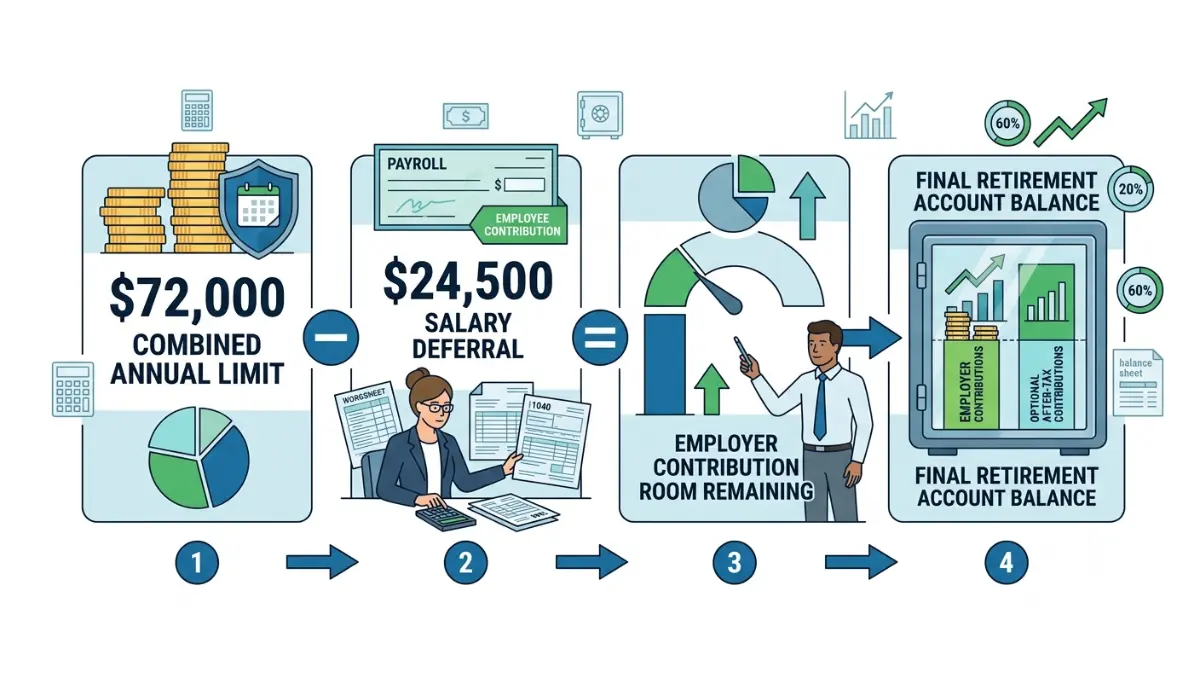
Step-by-step: employee deferral to employer room
- Start with the 2026 combined limit: $72,000.
- Subtract your own salary deferrals for the year (up to $24,500).
- The result is the maximum that employer contributions plus any after-tax contributions can add.
🔍 How It Works: The §415(c) limit is a ceiling on total “annual additions” to your account in one year — your deferrals, all employer contributions, and after-tax contributions combined. It does not include age-50+ catch-up contributions, which are tracked separately (see section six).
Worked example: $200,000 salary, $24,500 deferred
Suppose you earn $200,000 and defer the full $24,500. That leaves $72,000 − $24,500 = $47,500 of room. If your employer matches and profit-shares a total of $20,000, your account holds $44,500 in annual additions — still $27,500 below the cap. You can model your own numbers with the 401(k) calculator.
Using after-tax contributions to reach $72,000 (if your plan allows)
If your plan permits after-tax (non-Roth) contributions, you can fill the remaining gap up to $72,000. In the example above, that final $27,500 could go in as after-tax contributions — but only if your plan offers the feature, and many don’t.
✅ Action Step: Before counting on after-tax contributions, ask your plan administrator one question: “Does our plan allow employee after-tax contributions beyond the $24,500 deferral limit, and does it allow in-plan Roth conversions?” The answer decides whether the fill-to-$72,000 path is even available to you. Over time the extra room compounds, and a compound interest calculator shows what it’s worth at an assumed return.
The 25% deduction limit: the real ceiling for small business and solo 401(k)s
For small businesses and the self-employed, a second limit usually bites before the $72,000 cap does. Under Internal Revenue Code Section 404, an employer’s deductible contribution is generally capped at 25% of eligible compensation.
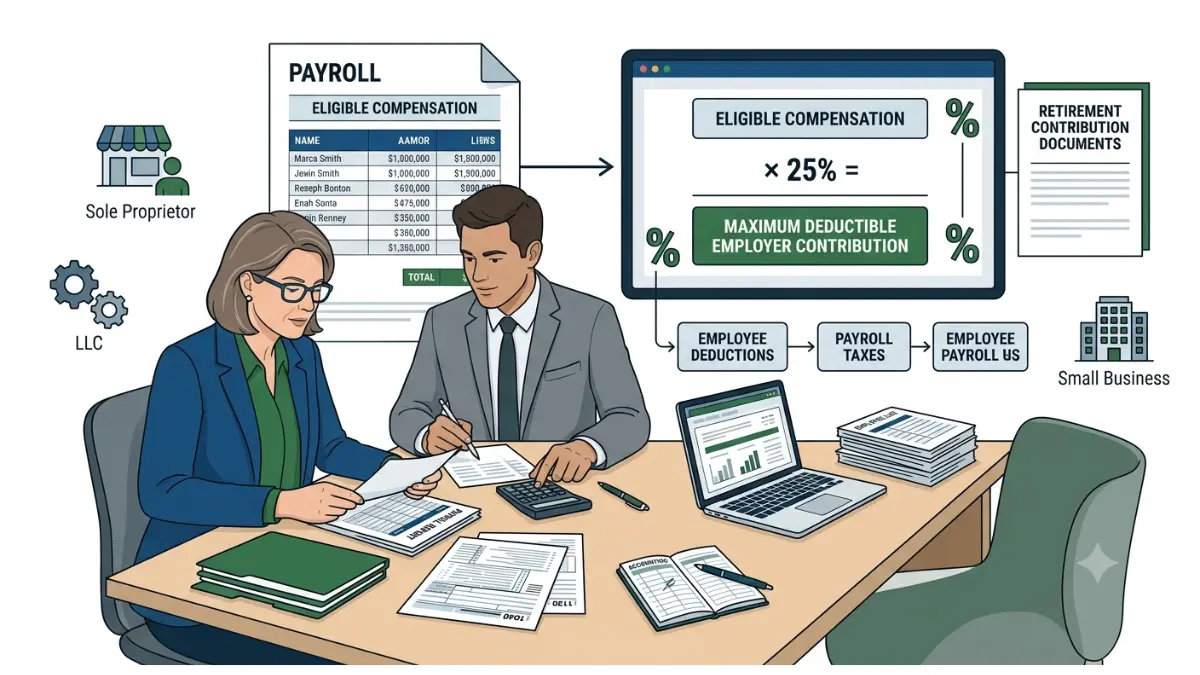
Why 25% often caps employer contributions before $72,000 does
If a business pays $200,000 in eligible wages, 25% is $50,000 — so the employer can’t deduct more than that, even though the §415(c) cap is $72,000. Only the first $360,000 of any individual’s pay counts toward this math for 2026. For most W-2 employees with a normal match, neither limit is close; for owners trying to maximize, the 25% rule is the binding one.
Solo 401(k): you’re both employee and employer
In a solo 401(k) you wear both hats — you make the employee deferral (up to $24,500) and the employer contribution. For an unincorporated owner, the effective employer rate is lower than a flat 25% once self-employment tax is accounted for, and the calculation is circular. The IRS explains the reduced-rate method on its page for calculating your own retirement plan contribution and deduction.
⚠️ Costly Mistake: Solo 401(k) owners often assume they can contribute a flat 25% of gross income as the employer. The deductible amount is based on net self-employment earnings using a reduced rate, so contributing the higher figure can create an excess contribution you later have to unwind.
✅ Action Step: If you run a solo 401(k), ask a CPA: “Given my net self-employment income for 2026, what is my maximum deductible employer contribution after the self-employment-tax adjustment?” The flat 25% figure overstates what an unincorporated owner can actually contribute.
Catch-up contributions, the new Roth rule, and what changed for 2026
Catch-up contributions change the math for older workers, and 2026 brings a rule that catches high earners off guard. Catch-ups are excluded from the $72,000 cap — they raise the effective maximum rather than fitting inside it.
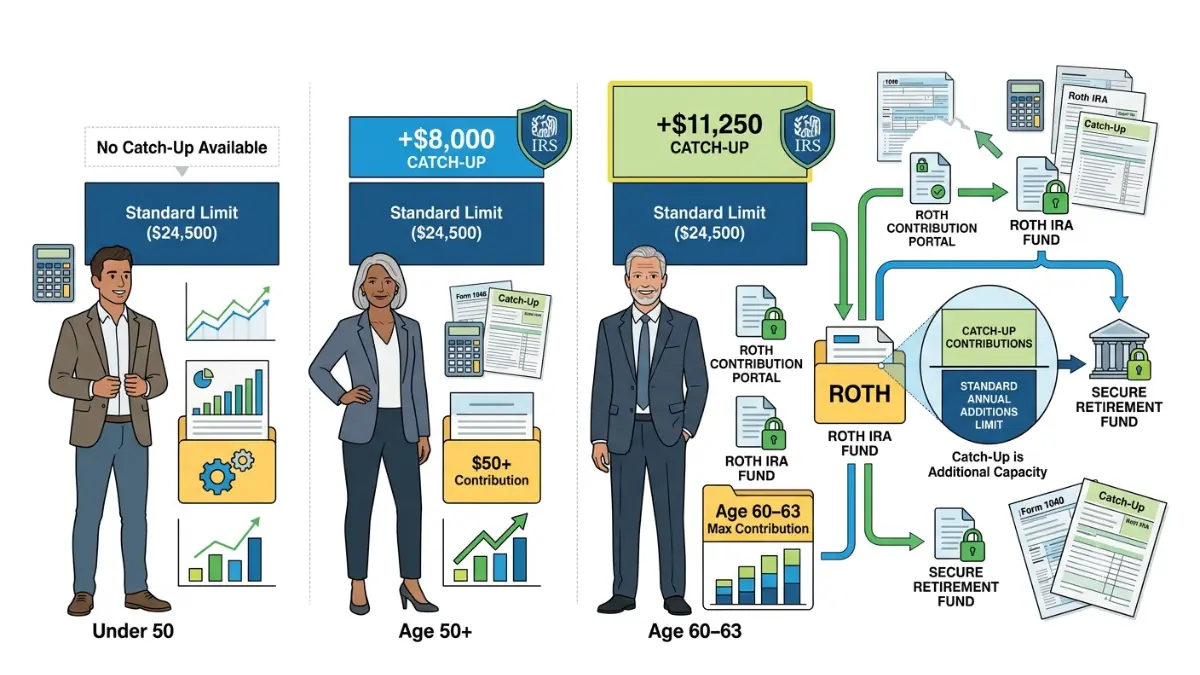
Catch-ups don’t count toward $72,000 — they sit on top
If you’re 50 or older, you can add an extra $8,000 in 2026 on top of your $24,500 deferral, for $32,500 in total salary deferrals. If you’re 60 to 63, the catch-up rises to $11,250, for $35,750 in deferrals. Because these sit outside §415(c), the effective annual-additions maximum becomes $80,000 at 50-plus and $83,250 at 60–63. More detail is in how catch-up contributions work for 2026.
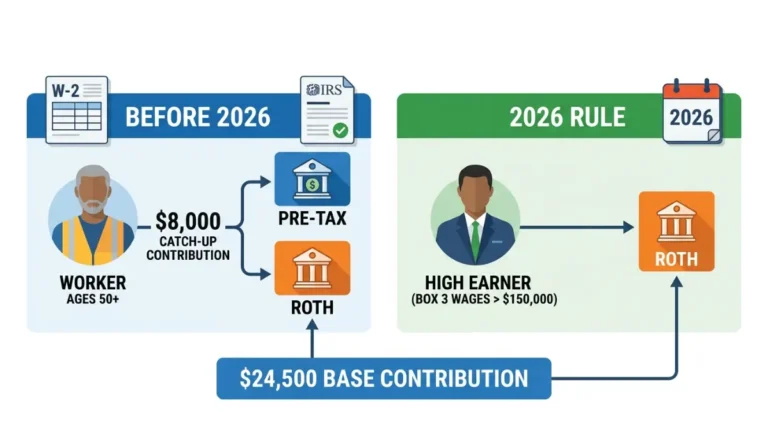
New for 2026: high earners must make catch-ups as Roth
Starting in 2026, a SECURE 2.0 provision requires catch-up contributions to be made on a Roth (after-tax) basis if your FICA wages from the plan sponsor exceeded $150,000 the prior year. Regular deferrals up to $24,500 can still be pre-tax — only the catch-up portion is affected. If your plan has no Roth option, it may have to block catch-ups for affected employees until it adds one, as covered in the new Roth catch-up rule for high earners.
💡 Expert Note: A common point of confusion is assuming the Roth catch-up rule changes how much you can contribute. It doesn’t change the dollar amounts — only whether the catch-up portion is pre-tax or Roth. Whether Roth is better for you depends on your tax bracket now versus in retirement, which a CPA or fiduciary advisor can model both ways.
What happens if your 401(k) contributions go over the limit
Going over a 401(k) limit is common and fixable — but mainly if you catch it in time. The fix differs depending on which limit you crossed.
Over-deferring across two employers (the $24,500 trap)
The $24,500 deferral limit is yours as an individual, not per job. If you switch employers mid-year or hold two jobs, your deferrals to both plans count together toward one $24,500 limit — not $24,500 each. If you go over, the excess plus earnings must be returned to you by April 15 of the following year, or the same dollars are taxed twice. The IRS explains the participant’s side in how excess 401(k) deferrals are corrected.
Exceeding $72,000 (excess annual additions)
Crossing the §415(c) cap is called an excess annual addition, and it’s usually corrected through the IRS’s plan-correction programs — handled by your plan, not by you alone.
⚠️ Costly Mistake: Missing the April 15 deadline to remove an excess deferral means the same dollars are taxed twice: once in the year you earned them, and again when they’re eventually distributed. The deadline isn’t extended by filing a tax extension, so flag any over-contribution to your plan administrator early.
✅ Action Step: If you think you over-contributed, contact your plan administrator first and ask: “What’s the deadline to request a corrective distribution for my excess, and can you process it before April 15?” Then confirm the year-by-year tax reporting with a CPA.
401(k) employer contribution limit: frequently asked questions
1. Is the $72,000 limit per employer or combined?
The $72,000 401(k) limit for 2026 is combined, not per employer. It covers your salary deferrals, all employer contributions, and any after-tax contributions added to your account in one year under §415(c). Your employer’s room is whatever remains after your own deferrals. Confirm how your specific plan applies it with your plan administrator.
2. Does the employer match count toward the $24,500 limit?
No. The employer match counts toward the combined $72,000 annual additions limit, not your $24,500 salary deferral limit. You can defer the full $24,500 yourself and still receive the match on top, up to the $72,000 ceiling. This is one of the most common 401(k) employer contribution limit misunderstandings.
3. How much can my employer contribute to my 401(k) in 2026?
Your employer can contribute up to the $72,000 combined limit minus your own salary deferrals for 2026. If you defer the full $24,500, that leaves $47,500 for employer contributions and after-tax dollars combined. For small businesses, the 25% deduction limit may cap the employer amount even lower, so check both ceilings.
4. Do catch-up contributions count toward the $72,000 cap?
No. Catch-up contributions are excluded from the $72,000 §415(c) cap and sit on top of it. For 2026, that raises the effective maximum to $80,000 for those 50 and older and up to $83,250 for those age 60 to 63. The catch-up amounts are $8,000 and $11,250 respectively.
5. What is the 25% employer 401(k) contribution limit?
Under §404, an employer’s deductible 401(k) contribution is generally limited to 25% of total eligible compensation. For small businesses and solo 401(k) owners, this often caps the employer amount before the $72,000 limit does. For unincorporated owners the effective rate is lower, so confirm your figure with a CPA.
6. Can I contribute after-tax to reach $72,000?
Sometimes. If your plan allows employee after-tax (non-Roth) contributions, you can fill the gap between your deferrals plus employer contributions and the $72,000 limit. Many plans don’t offer this feature, so confirm with your plan administrator before relying on it. This strategy has specific tax implications worth reviewing with a CPA.
7. What’s the combined limit if I’m 50 or older? Age 60 to 63?
For 2026, the effective combined maximum is $80,000 if you’re 50 or older and up to $83,250 if you’re age 60 to 63, because catch-up contributions stack on top of the $72,000 base. The catch-up portion is $8,000 at 50-plus and $11,250 at 60–63.
8. What happens if total contributions exceed $72,000?
Exceeding the $72,000 limit creates an excess annual addition, usually corrected through IRS plan-correction programs handled by your plan administrator. Excess salary deferrals over $24,500 must instead be returned to you by April 15 of the following year to avoid double taxation. Contact your plan administrator promptly and confirm tax reporting with a CPA.
9. How much can a self-employed person contribute as employer?
A self-employed owner can contribute as employer up to 25% of eligible compensation under §404, within the $72,000 combined limit. For unincorporated owners the effective rate is lower than 25% once self-employment tax is factored in, using an IRS reduced-rate calculation. Ask a CPA for your exact 2026 maximum deductible amount.
10. Is there a compensation limit that caps employer contributions?
Yes. For 2026, only the first $360,000 of an individual’s compensation counts when calculating 401(k) contributions and the 25% employer deduction limit. Pay above $360,000 is ignored for plan purposes. This compensation cap mainly affects high earners and business owners rather than typical employees.
11. Did the 401(k) employer and combined limit go up for 2026?
Yes. The combined §415(c) limit rose from $70,000 in 2025 to $72,000 in 2026, and the salary deferral limit rose from $23,500 to $24,500. The age-50 catch-up also increased from $7,500 to $8,000. These are IRS cost-of-living adjustments for the 2026 tax year.
The bottom line on your employer’s contribution room
The 401(k) employer contribution limit isn’t a separate number — it’s whatever remains of the $72,000 combined cap after your own deferrals, and for small businesses, often the lower 25% deduction limit. Knowing both ceilings tells you exactly how much room your account has this year.
Run your projection with the retirement calculator, and if you’re deciding where to direct savings first, see whether to max your 401(k) or IRA first. To benchmark your progress, compare retirement savings by age.
Informational disclaimer
The content on Finance Authority Hub is provided for general informational and educational purposes only and should not be considered personalized financial, investment, tax, legal, or professional advice. Financial decisions depend on your individual goals, income, risk tolerance, location, and regulatory situation. Before acting on any information, strategy, estimate, or calculator result, consult a qualified licensed professional who can evaluate your specific circumstances.