How the 2026 Roth Catch-Up Rule Affects 401(k) High Earners
401(k) Roth catch-up rules changed in 2026: above $150,000 in 2025 wages, your catch-up must go Roth. Here’s how to tell if the line reaches you.
In This Article
Starting January 1, 2026, a long-delayed retirement rule took effect. If you’re 50 or older and earn six figures, it may change how your 401(k) catch-up contributions work: certain high earners can no longer make them pre-tax, and those dollars must now go into a Roth (after-tax) account.
Here’s how to tell if it reaches you: if your Social Security wages from your employer topped $150,000 in 2025 and you’ll be 50 or older during 2026, the rule applies; below that, your choices are unchanged. Self-employed, a partner, or a 2025 job change adds a twist worth checking.
These catch-up dollars sit on top of the standard 2026 401(k) contribution limits, and every figure below ties to its IRS source.
ℹ️ Financial Disclaimer: This is general educational information about a 2026 tax-law change, not investment, tax, or legal advice. Whether the rule reaches you, and whether after-tax Roth contributions fit your finances, depends on details no article can see — confirm specifics with a CPA, a tax attorney, or a fee-only fiduciary advisor before acting.
What the new Roth catch-up rule actually changes — and what it doesn’t
The rule comes from Section 603 of the SECURE 2.0 Act and touches only one slice of your savings. The IRS spelled out the details in its final regulations on the Roth catch-up rule.
The change: high-earner catch-ups must now be Roth
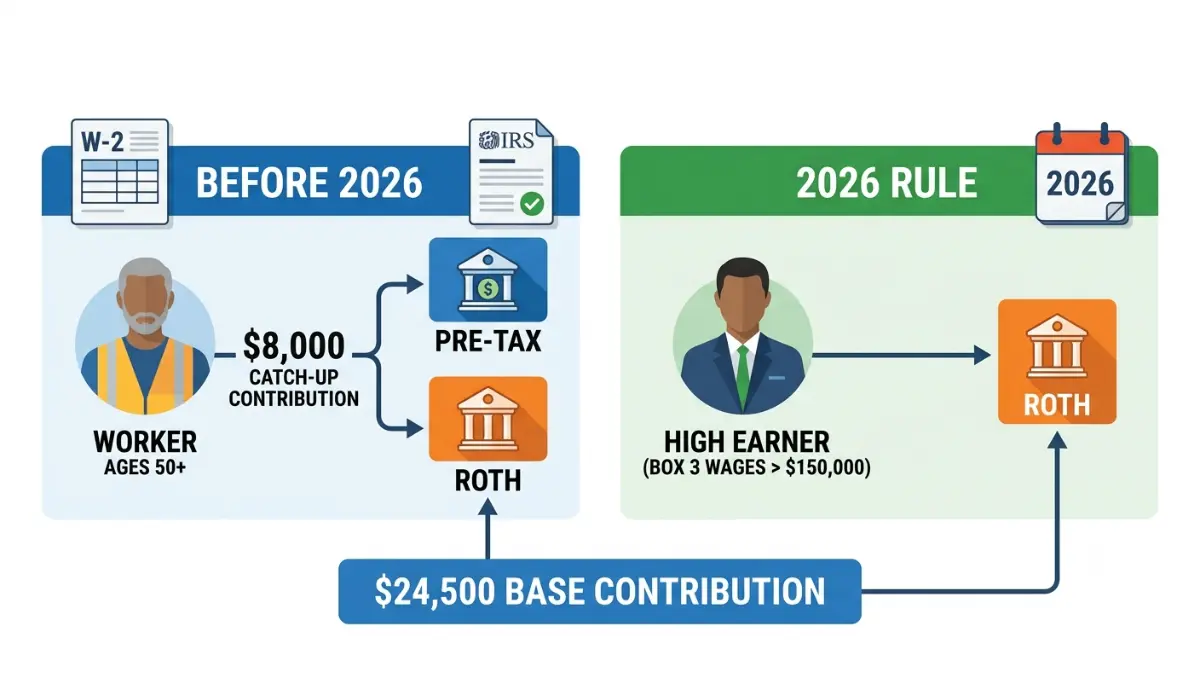
A catch-up contribution is the extra amount workers 50 and older add beyond the standard limit; see how 401(k) catch-up contributions work. Before 2026 you could make it pre-tax or Roth, but for high earners that choice is gone — the catch-up must be Roth, so you pay tax now and qualified withdrawals come out tax-free later.
What’s not changing: your base contribution can still be pre-tax
Your regular elective deferral, up to $24,500 in 2026, can still go in pre-tax — only catch-up dollars are touched.
Why 2026, after years of delay
Congress passed this in 2022 for a 2024 start, but an IRS transition period that ended December 31, 2025 pushed it to 2026, the first year it applies.
Who counts as a ‘high earner’: the $150,000 line, measured exactly
You’re subject for 2026 if both are true: you’ll be 50 or older during 2026, and your prior-year Social Security wages from your plan’s employer topped $150,000. The wage half is where the confusion lives.
The number: $150,000 for 2026 (not $145,000)
The law sets a base threshold of $145,000, but it’s indexed for inflation, and for 2026 — based on 2025 wages — the IRS raised it to $150,000 in Notice 2025-67. The $145,000 you may see elsewhere is the un-indexed base, not the 2026 number.
📊 Data Point: The 2026 Roth catch-up wage threshold is $150,000 in 2025 Social Security wages, up from the $145,000 statutory base — Source: IRS Notice 2025-67.
How it’s measured: Box 3, prior year, one employer
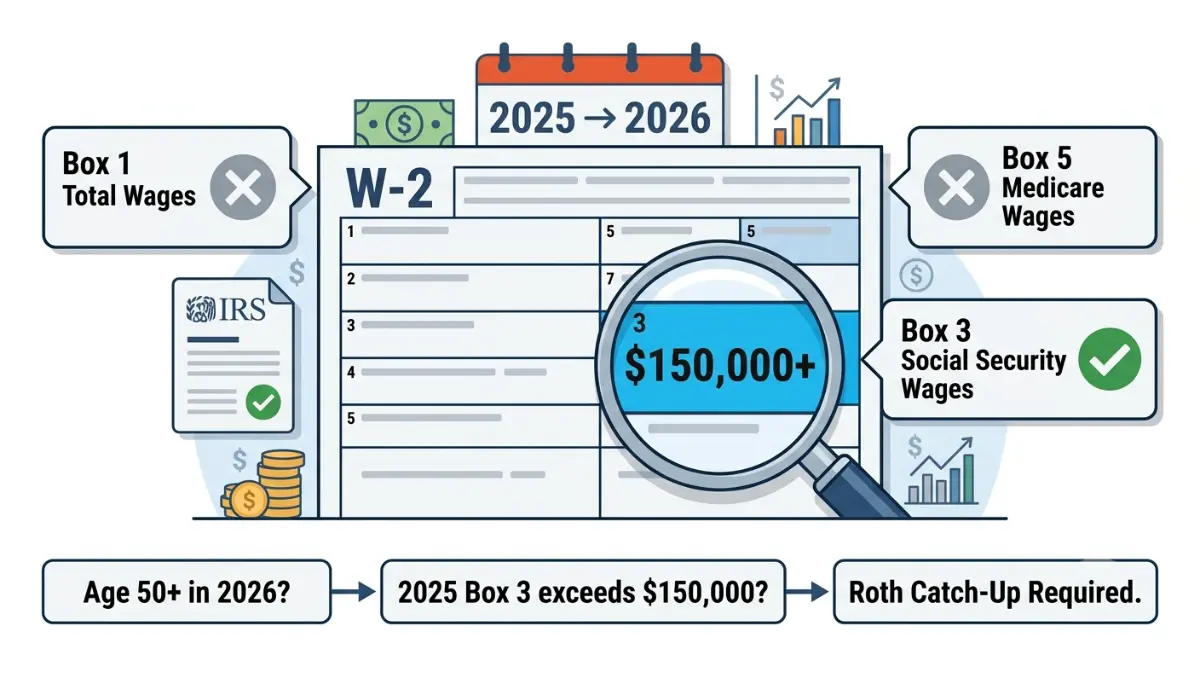
This uses FICA wages — the Social Security wages in Box 3 of your W-2 — from the single employer sponsoring your plan, not total compensation, Box 1, or the Box 5 Medicare figure. The final regulations specify Box 3, so a source pointing you to Medicare wages is wrong; this guide to the 2026 W-2 boxes breaks them down.
🔍 How It Works: The plan looks back at last year’s W-2. If Box 3 from your sponsoring employer topped $150,000 in 2025, your 2026 catch-up must be Roth — even if your income drops this year, because the test is backward-looking.
Edge cases: new jobs, job changes, and the self-employed
A few situations flip the answer: start a job in 2025 and you may have no qualifying prior-year wages there yet, and a partner taking only K-1 income — with no FICA wages from the sponsoring employer — isn’t subject. The threshold is tested per employer, not combined across jobs.
✅ Action Step: Pull your 2025 W-2 and check Box 3 against $150,000. If your status changed mid-2025 — you became a partner or worked for several participating employers — ask a CPA whether your wages cross the line.
The 2026 numbers: what must be Roth, and what can still be pre-tax
Here are the exact 2026 figures and which dollars the Roth rule touches. The base limit and the catch-up are separate buckets, and only the catch-up is affected.
| Contribution type | 2026 limit | Pre-tax allowed? | Key detail |
|---|---|---|---|
| Base elective deferral | $24,500 | Yes, for any earner | Standard cap, up from $23,500 in 2025 |
| Age 50+ catch-up | $8,000 | No, if a high earner | Must be Roth above the $150,000 line |
| Ages 60–63 catch-up | $11,250 | No, if a high earner | “Super” catch-up; replaces the $8,000 |
Source: IRS Notice 2025-67 and IRS 2026 contribution-limit guidance.
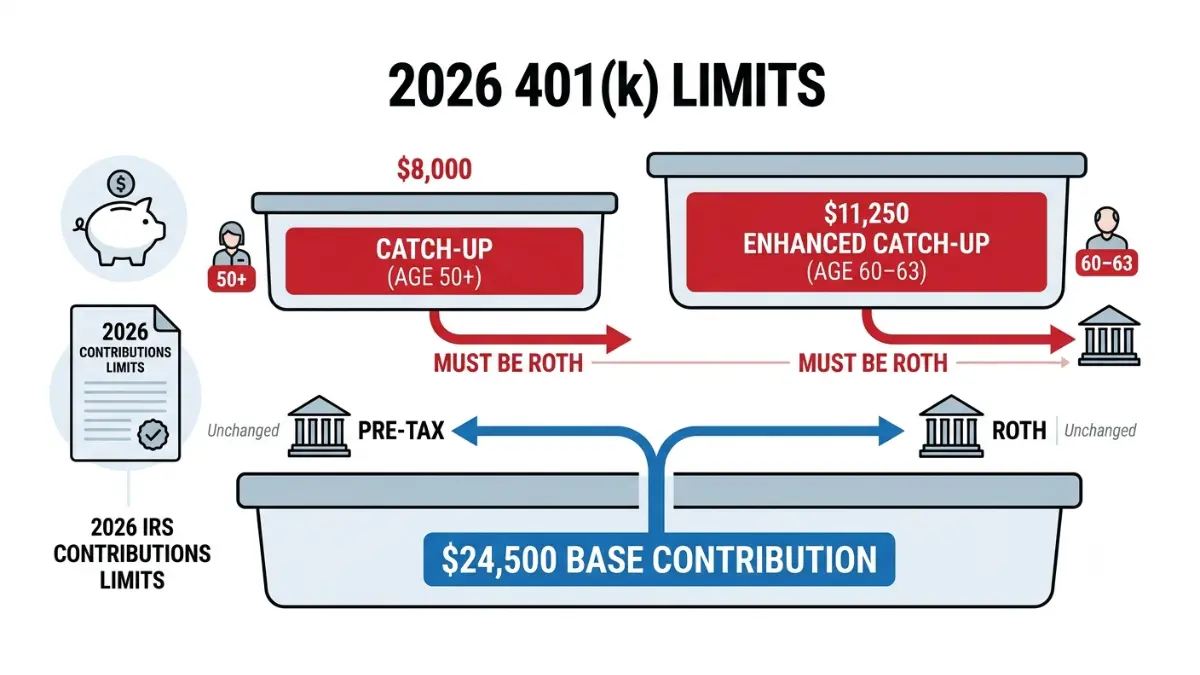
The IRS’s 2026 contribution-limit announcement confirms these amounts, and the IRS catch-up contribution rules cover the mechanics.
Standard catch-up (ages 50–59 and 64+): $8,000
The full $8,000 catch-up must be Roth while your $24,500 base stays pre-tax — a $32,500 total.
Enhanced catch-up (ages 60–63): $11,250
The larger $11,250 catch-up must all be Roth — a $35,750 total — replacing the $8,000 for these ages rather than stacking on it.
What still goes pre-tax: the $24,500 base
Your standard deferral is untouched; estimate your 2026 split with a 401(k) calculator to see the math on your numbers.
What to do if your 401(k) plan doesn’t offer a Roth option
There’s a trap here that catches people through no fault of their own. If your plan has no designated Roth account and you’re a high earner, you may lose the ability to make catch-up contributions entirely.
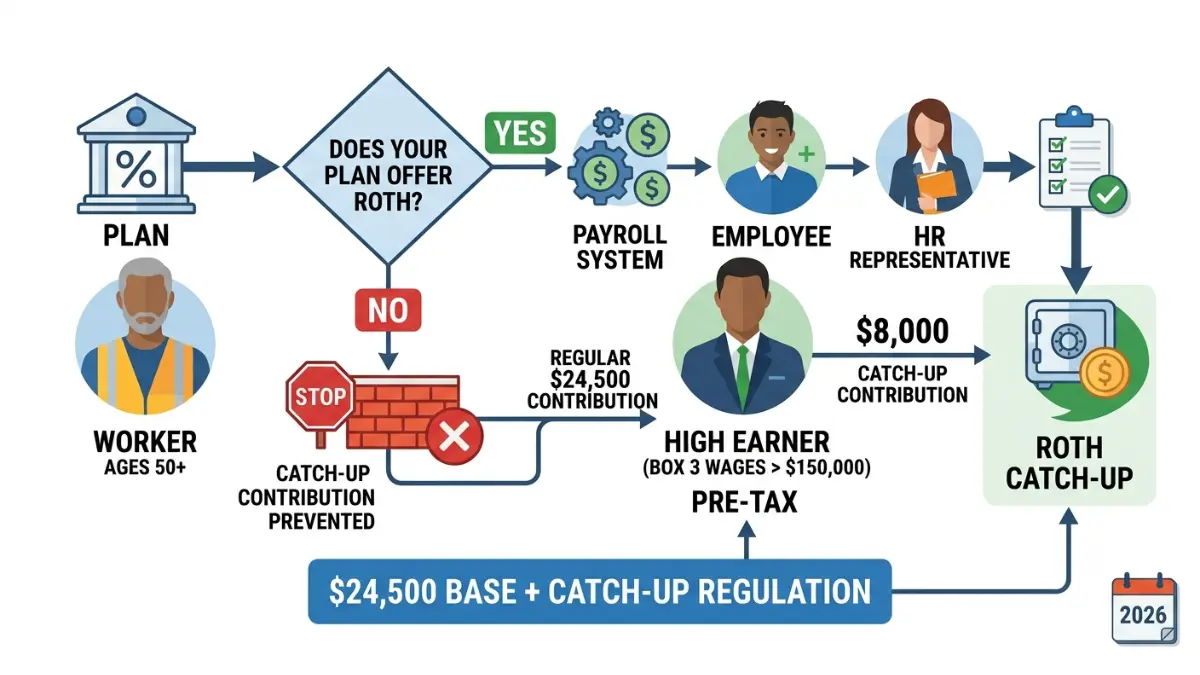
Why this matters: no Roth option can mean no catch-up at all
If your catch-up must be Roth but your plan has no Roth feature to receive it, there’s nowhere for the money to go — and plans aren’t required to add a Roth option, so some won’t.
⚠️ Costly Mistake: Assuming your catch-up will post pre-tax because it always has. If you’re over the threshold and your plan lacks a Roth feature, the catch-up may be blocked for the year — confirm your plan’s status before assuming it will process.
How to confirm your plan is ready
Ask HR or benefits whether the plan offers designated Roth contributions and whether Roth catch-up is operational for 2026 — and if not, when that changes.
Your options if it isn’t
Max your pre-tax base deferral, use other tax-advantaged accounts you qualify for, and press your employer on a timeline. For high earners who valued the pre-tax break, an HSA’s triple tax advantage is one alternative worth weighing with a tax professional.
Pre-tax vs. Roth: does losing the upfront deduction actually hurt you?
Losing a deduction sounds like bad news, but the picture is more balanced — and the honest answer depends on factors only you and a professional can weigh. What follows is general education, not a recommendation.
The case for Roth catch-up (it isn’t all downside)
Forced Roth treatment carries real advantages: qualified withdrawals of contributions and growth come out tax-free, and Roth 401(k) balances no longer face lifetime required minimum distributions under SECURE 2.0. For high earners locked out of a Roth IRA by income — the 2026 phase-out runs to $168,000 (single) and $252,000 (joint) — a Roth catch-up opens a door that was closed.
When the lost deduction matters most
Giving up this year’s deduction stings most if you expect a lower tax bracket in retirement than today (where the 2026 brackets fall); it hurts less, or even helps, if you expect similar or higher rates later or hold large pre-tax balances that inflate future required distributions.
Why this is a conversation for a CPA or fee-only advisor
There’s no universal answer; the math turns on your bracket, projected retirement income, and balances this article can’t see.
✅ Action Step: Before changing your mix, model it with a CPA or fee-only (fiduciary) advisor and ask: given my bracket and projected retirement income, does paying tax now on my catch-up beat deferring it? You can also compare how pre-tax and after-tax dollars hit your paycheck.
Four mistakes high earners make with the new Roth catch-up rule
A handful of predictable errors trip up careful savers in the rule’s first year.
Mistake 1: Assuming you’re under the line because your salary ‘feels’ lower
The threshold counts Box 3 wages including bonuses and commissions, so a $135,000 salary plus a $20,000 bonus clears $150,000 — check the W-2 figure, not your sense of your pay.
Mistake 2: Thinking a job change automatically exempts you
The test runs per sponsoring employer, so a job change doesn’t reset your status if prior-year wages there were high — though starting somewhere new can mean you’re not subject there yet.
Two more worth a glance
Letting a pre-tax catch-up post when it should be Roth is correctable — plans reclassify before your W-2 issues or use an in-plan Roth rollover after, and errors of $250 or less need none — and the fourth mistake is never confirming your plan added a Roth feature.
401(k) Roth catch-up for high earners: frequently asked questions
1. What is the new 2026 Roth catch-up rule for high earners?
From January 1, 2026, SECURE 2.0 requires high earners 50 and older to make 401(k) catch-up contributions on a Roth (after-tax) basis, not pre-tax. It applies only to catch-up dollars, not your base contribution, and is judged on prior-year Social Security wages.
2. What income makes you a high earner under this rule?
For 2026, your 2025 Social Security wages from your plan’s sponsoring employer must exceed $150,000 — the inflation-indexed version of the law’s $145,000 base, set by IRS Notice 2025-67. At or below $150,000, the Roth requirement doesn’t reach your catch-up.
3. Is the threshold based on total salary or something else?
It’s FICA wages — Social Security wages in Box 3 of your W-2 — from your sponsoring employer, not total compensation, Box 1, or Box 5 Medicare wages. The IRS final regulations specify Box 3, so any source pointing to Medicare wages is wrong here.
4. Does the Roth requirement apply to my regular 401(k) contributions too?
No — it reaches only catch-up contributions. Your standard elective deferral, up to $24,500 in 2026, can still be pre-tax, Roth, or split. Only the catch-up on top, and only for high earners, must be Roth.
5. How much of my 2026 catch-up has to be Roth?
All of it, if you’re over the $150,000 threshold. For ages 50 to 59 and 64-plus, that’s the full $8,000 catch-up; for ages 60 to 63, the entire $11,250 enhanced catch-up. None of it can be pre-tax.
6. What if my 401(k) plan doesn’t offer a Roth option?
Then high earners subject to the rule generally can’t make catch-up contributions at all — there’s no Roth account to receive them, and plans aren’t required to add one. Your base deferral still works. Ask HR whether your plan is Roth-ready for 2026.
7. I changed jobs in 2025 — am I subject to the rule in 2026?
It depends on your 2025 Social Security wages from the specific employer sponsoring each plan. Starting somewhere new with no 2025 wages there may leave you not subject, while a former employer’s high 2025 wages could still affect that plan’s catch-up.
8. Are self-employed people or partners subject to this rule?
Generally no, if you have no FICA wages from the plan’s sponsoring employer. A partner taking only K-1 self-employment income isn’t captured by the Box 3 test. Because business structures vary, confirm your own situation with a CPA.
9. Do I lose the tax deduction on my catch-up contributions?
Yes — Roth catch-up contributions are after-tax, so you forgo this year’s deduction and your taxable income is higher now. The offset is tax-free qualified withdrawals, including growth, later. Whether the trade favors you depends on your situation; review it with a CPA or fee-only advisor.
10. Is being forced into Roth catch-up good or bad for me?
It depends on your expected tax rate in retirement versus today. Roth tends to help if you expect similar or higher rates later, or hold large pre-tax balances; the lost deduction stings most if you expect a lower bracket. Model your specifics with a fiduciary advisor first.
11. When did this rule take effect and why was it delayed?
It took effect January 1, 2026. SECURE 2.0 passed in 2022 with an original 2024 start, but the IRS granted a transition period that ended December 31, 2025. Final regulations issued in September 2025 confirmed 2026 as the first year.
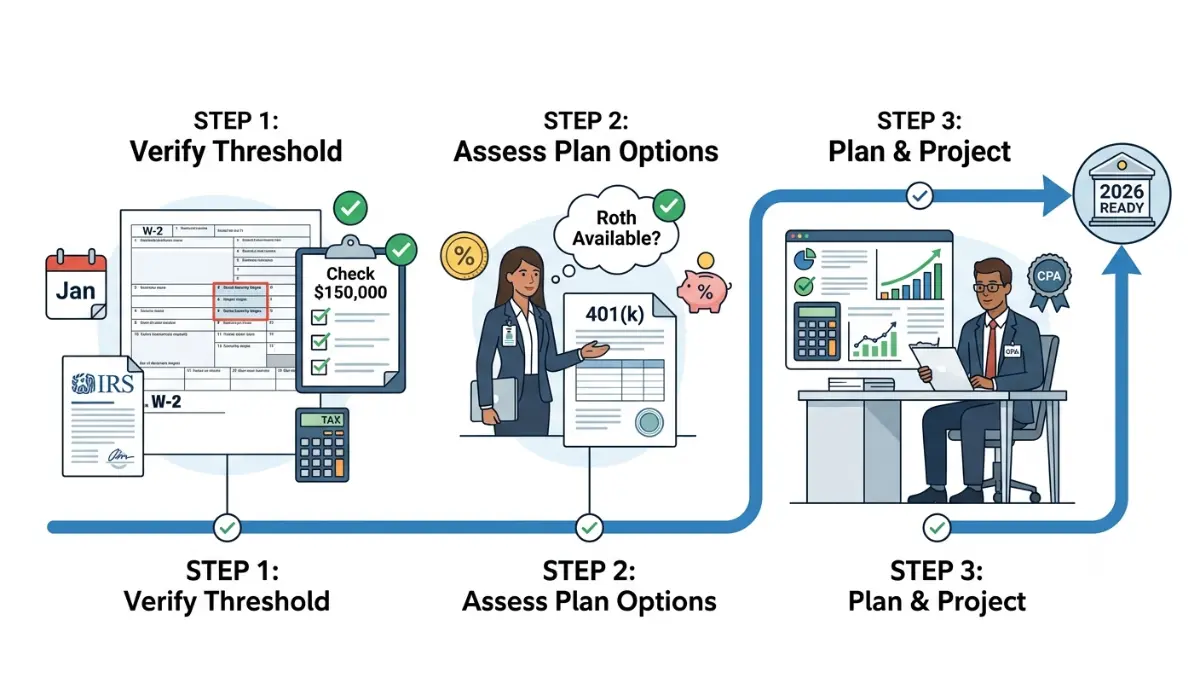
The 2026 Roth catch-up rule, in three actions
The change is narrower than the headlines: for high earners 50 and up, only the catch-up portion — $8,000, or $11,250 at ages 60 to 63 — must go Roth, while the $24,500 base stays pre-tax-eligible.
First, pull your 2025 W-2 and compare Box 3 against $150,000 to confirm the rule reaches you. Second, ask your benefits team whether your plan offers Roth catch-up for 2026. Third, if the pre-tax-versus-Roth question matters to your bigger picture, take it to a CPA or fee-only advisor rather than guessing.
For the full landscape, see the 2026 401(k) contribution limits; if you’re weighing accounts, read whether to max your 401(k) or an IRA first.
Informational disclaimer
The content on Finance Authority Hub is provided for general informational and educational purposes only and should not be considered personalized financial, investment, tax, legal, or professional advice. Financial decisions depend on your individual goals, income, risk tolerance, location, and regulatory situation. Before acting on any information, strategy, estimate, or calculator result, consult a qualified licensed professional who can evaluate your specific circumstances.