A Clear Guide to RILA Annuity Buffers and Caps
A RILA annuity limits losses with a buffer, but a cap limits your gains in return—and you can still lose money beyond the buffer. Here’s the honest math.

In This Article
A RILA annuity offers a middle path for money you can’t afford to gamble but don’t want sitting idle: your growth is tied to a market index, while a built-in buffer absorbs part of any loss. It isn’t a savings account, and it isn’t the full stock market — it’s a trade, and this article shows both sides of it. If these products are new to you, our guide to what an annuity is and how it fits a retirement plan covers the basics; this piece zooms in on the buffered version.
Where you go next depends on your question. If you’re facing market volatility close to retirement and want to know whether you can actually lose money, jump to how a buffer limits your loss. If an advisor already pitched you one and you’re asking “what’s the catch,” the section on caps and participation rates is for you. If you’re weighing it against a fixed indexed annuity or a CD, the comparison lays them side by side — every figure traced to the SEC, IRS, FINRA, or LIMRA, with no sales pitch.
ℹ️ Financial Disclaimer: This article is general educational information about registered index-linked annuities — not investment, tax, insurance, or legal advice. RILAs are complex securities that can lose value; the figures and examples shown are illustrative and current as of the last-reviewed date, and contract terms vary and change over time. Before buying, surrendering, or withdrawing from any annuity, consult a fiduciary financial advisor, a CPA, or a qualified attorney, and read the product prospectus.
What is a RILA annuity, and who regulates it?
A registered index-linked annuity is a contract between you and an insurance company whose return is tied, in part, to a market index like the S&P 500 over a set term. The SEC’s definition notes it also goes by structured annuity, index-linked variable annuity, or buffered annuity — you can read the SEC’s plain-language definition of a RILA for the regulator’s own wording.
A contract linked to an index, not invested in it
You never own the index or any fund. At the end of each term, the insurer credits a positive or negative return based on how the index moved and the limits you selected. It sits between two cousins among the main types of annuities: a fixed indexed annuity that can’t lose principal, and a variable annuity that’s fully exposed.
Why “registered” matters
“Registered” is your cue that this is a security — your principal is genuinely at risk, unlike a bank CD. RILAs register with the SEC under a tailored Form N-4 disclosure regime adopted in 2024, and any broker recommending one must meet FINRA’s Regulation Best Interest standard, which can’t be met through disclosure alone.
📊 Data Point: RILA sales hit a record $79.5 billion in 2025 — up 20% year over year and roughly ten times the total a decade ago. Indexed annuities now account for about 45% of all annuity sales. Source: LIMRA, U.S. Individual Annuity Sales Survey (full-year 2025 results).
How a buffer limits your loss (and how a floor differs)
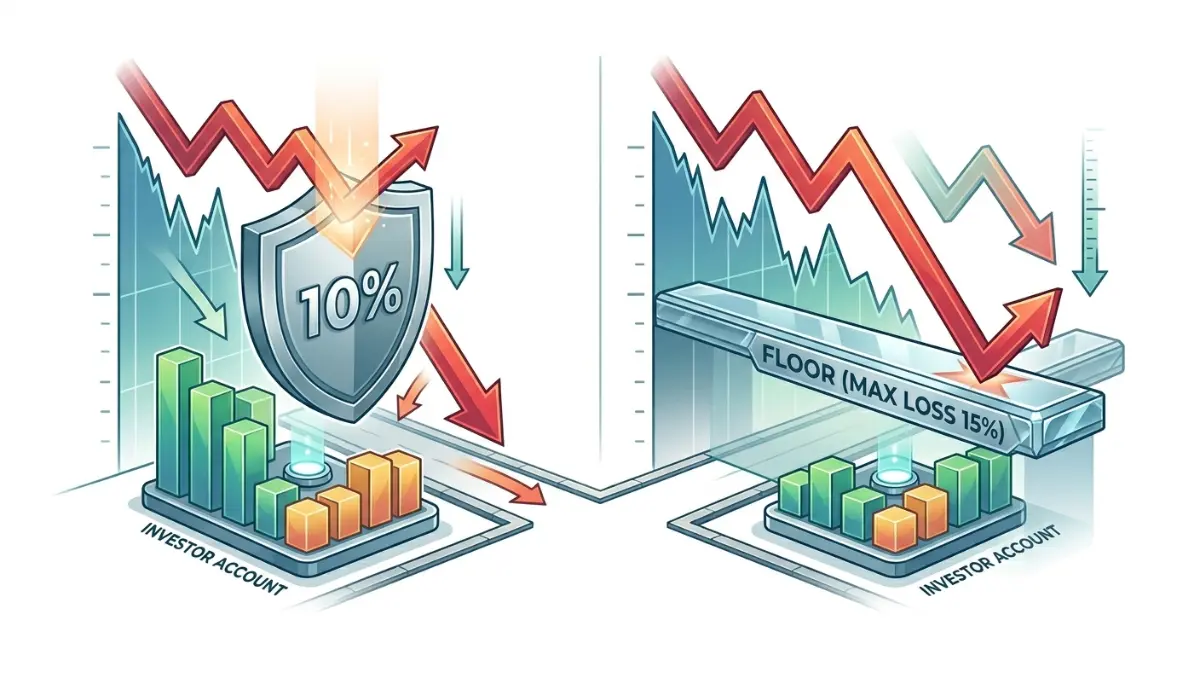
A buffer limits your loss by having the insurer absorb the first slice of an index decline; you absorb only what falls beyond it.
🔍 How It Works: Picture a 10% buffer over a one-year term. If the index drops 15%, the insurer eats the first 10% and you take the remaining 5%. If it drops only 8%, you lose nothing — the buffer covers it entirely.
How a buffer works
That first-loss cushion is the whole point of a buffer annuity, and it’s why these products draw nervous pre-retirees seeking downside protection. But a buffer is not a guarantee: beyond it, the loss is yours. Carrier disclosures confirm that in an index-linked segment, a severe enough drop can cost a meaningful share of your money — a total loss is possible.
Buffer vs floor: same drop, different outcome
A floor works the opposite way. You absorb losses down to a set limit, and the insurer covers everything past it. Run the same numbers and the difference is stark:
| Protection (set at 10%) | Index falls 15% | Index falls 25% | Key detail |
|---|---|---|---|
| 10% buffer | You lose 5% | You lose 15% | Protects the first 10%; deeper drops cost more |
| 10% floor | You lose 10% | You lose 10% | Caps your maximum loss at 10% |
Illustrative, based on standard buffer and floor mechanics in carrier disclosures (Brighthouse, Guardian). Actual terms vary by contract.
What happens at the end of the term
At term’s end, any gain locks in and a new term begins with fresh rates and protection — often 1, 3, or 6 years long. A buffer behaves more like a fixed indexed annuity’s caps and floors than like owning stocks outright, but with real downside the floor-protected FIA doesn’t carry.
The trade-off: how caps and participation rates limit your upside
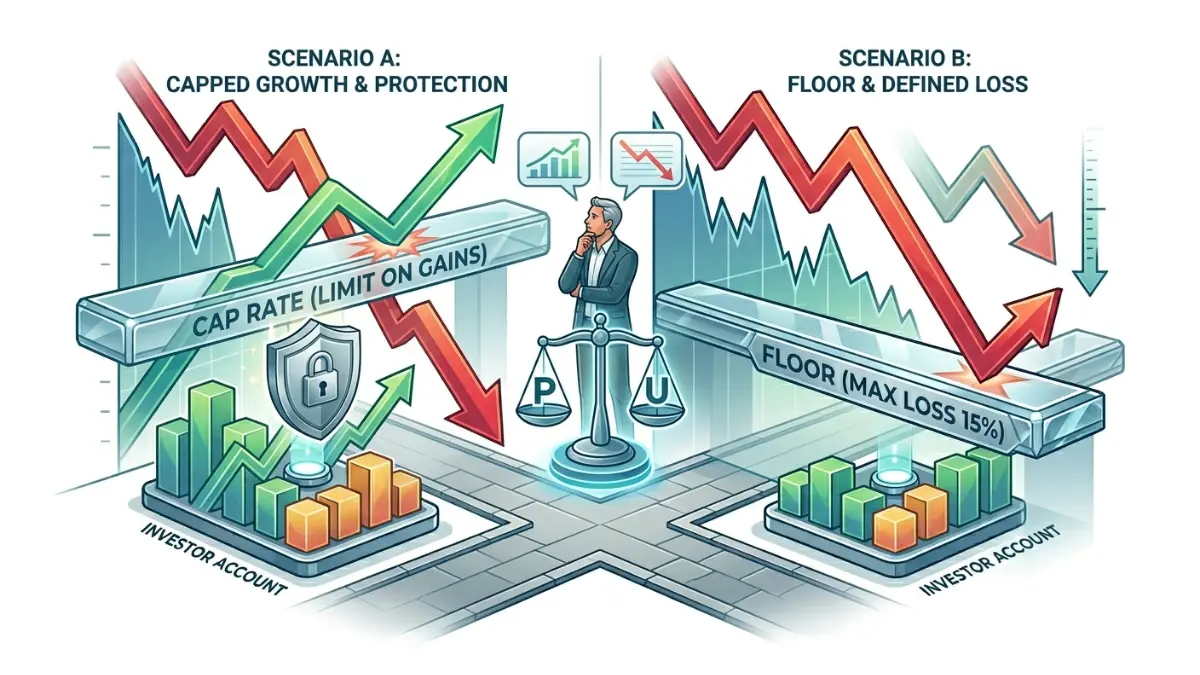
The buffer isn’t free — you pay for it with a ceiling on your gains, set as a cap rate or a participation rate.
Cap rate: a ceiling on your gain
A cap is the most you can earn in a term. With a 10% cap, an index gain of 15% still credits you 10%; a gain of 7% credits the full 7%.
Participation rate: a slice of the gain
A participation rate gives you a percentage of the index’s gain instead of a hard ceiling. At 80% participation, a 10% index gain credits 8%.
| Upside method | Index gains 10% | Index gains 25% | Key detail |
|---|---|---|---|
| 10% cap | You earn 10% | You earn 10% | Hard ceiling; gains above 10% are forfeited |
| 80% participation | You earn 8% | You earn 20% | No ceiling, but you keep only 80% of each gain |
Illustrative, based on standard crediting mechanics in carrier disclosures. Rates shown are examples, not current offers.
🔍 How It Works: Caps and participation rates are set by the insurer and reset every term — they can fall, especially when interest rates fall. The current fed funds target range of 3.50%–3.75% (as of June 2026) is part of what lets insurers offer the caps they do; a lower-rate environment generally squeezes them.
Why more protection usually means a lower cap
The two dials are linked: choose a bigger buffer and your cap typically drops, because the insurer is taking on more risk. Before committing a lump sum, it helps to model how that money might grow over a multi-year term under different assumptions.
What a RILA costs you: taxes, surrender charges, and liquidity
A RILA grows tax-deferred, but how it’s taxed on the way out surprises people: gains come out as ordinary income, not lower-taxed capital gains.

How RILA gains are taxed
For a non-qualified RILA (bought with after-tax money), the IRS treats withdrawals as earnings-first — your gains are taxed before your original principal returns tax-free. That last-in, first-out rule and the broader treatment of how annuity withdrawals work are spelled out in the IRS rules on pension and annuity income.
Surrender charges and the free-withdrawal window
Pull money out early and the insurer applies a surrender charge — commonly starting around 7%–10% and declining each year over a roughly six-year schedule. Most contracts let you take about 10% of your value per year penalty-free, but exceed that during the surrender period and the charge bites.
The 10% penalty before 59½
Separately, the IRS adds a 10% penalty on the taxable portion of withdrawals before age 59½, on top of ordinary income tax (limited exceptions apply, such as death or disability).
⚠️ Costly Mistake: The surrender charge and the 10% IRS penalty are two separate costs — a buyer under 59½ who cashes out early can owe both at once, plus income tax on the gain.
✅ Action Step: Before withdrawing, ask a CPA: “In my situation, will this withdrawal be taxed last-in, first-out, and will the 10% penalty apply?” Then weigh the money against your retirement timeline.
RILA vs fixed indexed vs variable annuity: which fits whom?
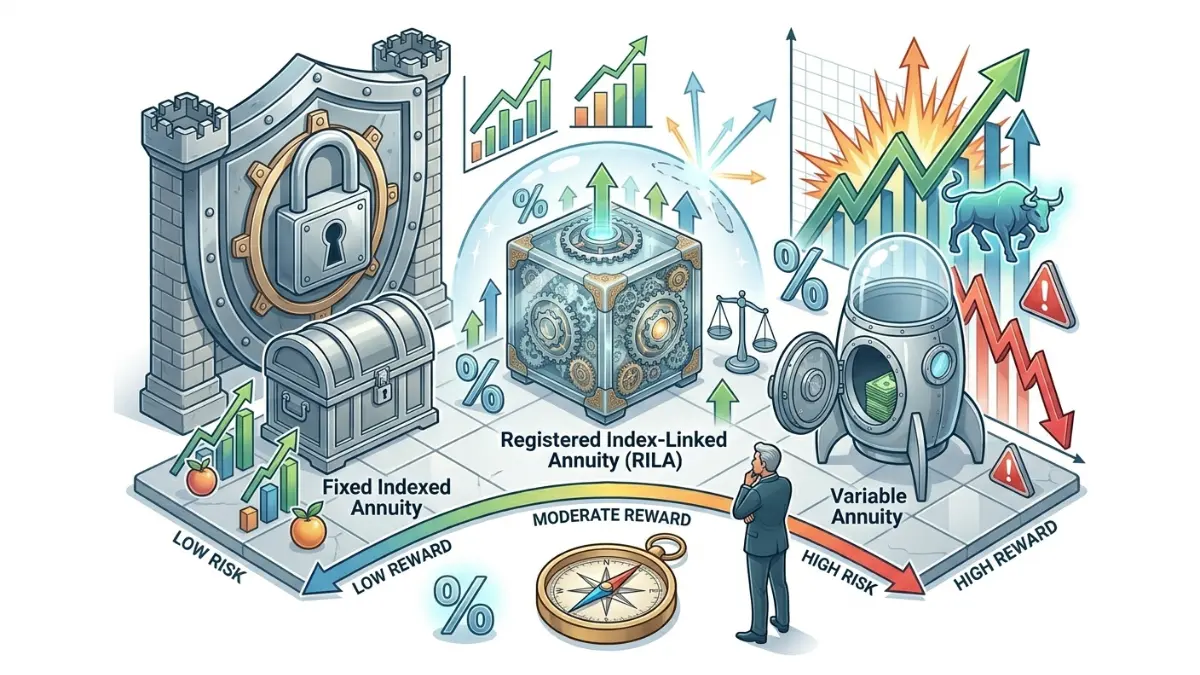
A RILA sits between its two cousins on a single spectrum — how much loss you’ll accept in exchange for upside.
| Product | Loss protection | Upside | Principal risk | Best for |
|---|---|---|---|---|
| Fixed indexed annuity | 0% floor — no index loss | Lowest (capped) | Protected from market loss | Someone who can’t accept any principal loss |
| RILA (buffer annuity) | Partial (buffer or floor) | Higher than an FIA | Real — loss past the buffer is yours | Someone wanting more growth, accepting some loss |
| Variable annuity | None | Full market upside | Full market risk + fees | Someone wanting maximum growth and full exposure |
General comparison of product structures per SEC and carrier descriptions. Specific terms, caps, and fees vary by contract.
RILA vs fixed indexed annuity (FIA)
A fixed indexed annuity sets a 0% floor — you can’t lose principal to the index — but its caps run lower. A RILA accepts some downside to chase more upside.
RILA vs variable annuity (VA)
A traditional variable annuity puts you directly in the market with no buffer and typical annual fees of 1%–3%. A RILA caps both your loss and your gain. If guaranteed safety is the goal, a fixed annuity or MYGA — or even a CD — may fit better; you can compare a CD’s guaranteed return before deciding.
Questions to ask before you buy
Product selection is personal, and a fiduciary advisor — one legally required to act in your interest — should confirm fit. FINRA’s Regulation Best Interest holds brokers to a best-interest standard, but the burden is still on you to ask why.
✅ Action Step: Ask a fiduciary advisor: “Why is a RILA the best-interest choice for me versus an FIA, a CD, or a low-cost index fund?” See FINRA’s standards for annuity recommendations for the conduct rules brokers must follow.
Common RILA mistakes (and how to avoid them)
Most RILA regret traces back to a handful of avoidable misunderstandings — here are the ones that cost people the most.
Mistaking a buffer for a guarantee
A buffer softens losses; it doesn’t erase them. Treating “protected” as “safe” is the core error — beyond the buffer (or below the floor), the loss is yours, and carrier disclosures confirm a segment loss can reach 100%.
Buying without checking the surrender period
Money in a RILA is committed. If you might need the cash within the roughly six-year surrender window, the early-exit charges and the possible 10% IRS penalty can erase the protection you paid for.
Forgetting the cap can reset lower
The cap or participation rate you start with isn’t locked for life — it resets each term and can drop. Read the renewal terms, not just the first-year rate.
💡 Expert Note: The SEC flags RILAs as complex products and stresses reading the prospectus before buying. With sales at a record $79.5 billion in 2025 and more carriers entering the space, product designs vary widely — the headline rate rarely tells the whole story.
⚠️ Costly Mistake: Chasing the highest cap without noticing it comes paired with a smaller buffer (or a floor instead) means quietly taking on more downside than you realized.
RILA annuity FAQ
1. What is a RILA annuity?
A RILA annuity is a contract between you and an insurance company whose return is linked to a market index over a set term, with partial downside protection. The SEC regulates it as a security — also called a buffer, structured, or index-linked variable annuity — so your principal is genuinely at risk, unlike a bank CD.
2. How does a buffer protect against loss?
A buffer has the insurer absorb the first portion of an index decline. With a 10% buffer, if the index falls 15%, the insurer covers the first 10% and you absorb 5%; if it falls 8%, you lose nothing. Any loss deeper than the buffer is still yours to bear.
3. What’s the difference between a buffer and a floor?
A buffer protects the first slice of loss; a floor caps your maximum loss. With a 10% buffer, a 25% index drop costs you 15%. With a 10% floor, that same 25% drop costs you only 10% — the floor limits the worst case, while the buffer limits the first hit.
4. Can you lose money in a RILA annuity?
Yes. A RILA can lose principal — any loss beyond your buffer, or below your floor, is yours, and carrier disclosures confirm a segment loss can reach 100%. The protection is partial, not a guarantee. Because product terms vary widely, confirm the specifics with a fiduciary advisor before buying.
5. What is a cap rate versus a participation rate?
Both limit your upside. A cap is a hard ceiling: a 10% cap credits 10% even if the index gains 15%. A participation rate gives you a percentage of the gain — 80% participation on a 10% gain credits 8%. Insurers set and reset these each term, and they can fall.
6. How is a RILA different from a fixed indexed annuity?
A fixed indexed annuity sets a 0% floor, so you can’t lose principal to the index — but its caps are lower. A RILA accepts partial loss, through a buffer or floor, in exchange for higher growth potential. A fiduciary advisor can help you weigh which trade-off fits your timeline.
7. How is a RILA annuity taxed?
A RILA grows tax-deferred. Withdrawals of gains are taxed as ordinary income, not capital gains. For a non-qualified RILA, the IRS uses last-in, first-out — earnings come out first and are taxable, then your principal returns tax-free. Confirm your situation with a CPA before withdrawing.
8. What are RILA surrender charges?
A surrender charge is the insurer’s fee for pulling money out early, commonly starting around 7%–10% and declining over a roughly six-year schedule. Most contracts allow about 10% of your value withdrawn penalty-free each year; exceeding that during the surrender period triggers the charge.
9. Is a RILA annuity a good investment?
It hinges on one thing: whether you want market-linked growth but can’t accept a full market loss. A RILA may suit someone with that goal and a multi-year horizon; it fits poorly anyone who may need the cash soon or wants guaranteed safety. A fiduciary advisor can confirm fit.
10. Are RILAs regulated and safe?
RILAs are regulated by the SEC as securities, and brokers recommending them must meet FINRA’s Regulation Best Interest standard. But “regulated” doesn’t mean “risk-free” — a RILA can lose principal. Regulation governs disclosure and conduct, not your outcome. Read the prospectus and consult a fiduciary advisor.
11. What happens at the end of a RILA term?
At term’s end, any gain is locked in and can’t be lost in a later downturn. A new term then begins — often 1, 3, or 6 years — with fresh caps, participation rates, and protection levels set by the insurer, which may differ from your starting terms.
The bottom line on RILAs
A RILA is a deliberate trade: you give up some of the market’s upside through a cap, and in return a buffer cushions — but does not erase — the downside, all inside a tax-deferred wrapper you can’t easily exit for several years. That trade fits some people near retirement and fits others poorly. The way to know is to read the prospectus, run your own numbers, and ask a fiduciary the best-interest question — not to take any rate at face value. If a RILA is part of your retirement thinking, model it alongside your 401(k) so you see the whole picture before committing a dollar.
Informational disclaimer
The content on Finance Authority Hub is provided for general informational and educational purposes only and should not be considered personalized financial, investment, tax, legal, or professional advice. Financial decisions depend on your individual goals, income, risk tolerance, location, and regulatory situation. Before acting on any information, strategy, estimate, or calculator result, consult a qualified licensed professional who can evaluate your specific circumstances.