
Insurance: Stop Overpaying for What You Don’t Need
Premiums are up 26% in 2026. Millions overpay for insurance they don’t need — or miss coverage that could save them thousands. Here’s the expert fix.

In This Article
Insurance protects you from financial ruin — you pay a regular premium, and your insurer covers specified losses. Simple concept. Brutal reality: ACA health premiums surged 26% on average in 2026. Auto insurance costs hit $1,993/year nationally. Millions of Americans are covered for the wrong things, missing what they actually need, and bleeding money every single month.
This guide — reviewed by 30 credentialed financial experts — tells you exactly what insurance you need, what to cut, and how to stop overpaying today.
What Is Insurance and How Does It Actually Work?
Insurance is a legal contract between you and an insurer. You pay a recurring premium, and the insurer agrees to cover defined financial losses — whether that’s a car accident, a hospital stay, or a house fire. The insurer pools premiums from thousands of policyholders to pay claims when they arise.
Three core terms you must understand before buying any insurance policy:
- Premium — your recurring cost (monthly or annually) to keep coverage active
- Deductible — what you pay out-of-pocket before your insurer pays anything
- Coverage limit — the maximum your insurer will pay per claim or per year
Understanding the deductible-premium relationship alone can save you hundreds per year. A higher deductible almost always lowers your monthly premium — but only works if your emergency fund can absorb the out-of-pocket cost. If you’re still building that cushion, check our Emergency Fund Calculator to set the right target before adjusting your deductibles.
According to the Insurance Information Institute (iii.org), insurance coverages are priced individually — meaning you can and should customize your coverage amounts rather than accept default bundles.
Key Takeaway: Insurance is not one-size-fits-all. Every dollar of premium should be buying protection you actually face a real risk of needing.
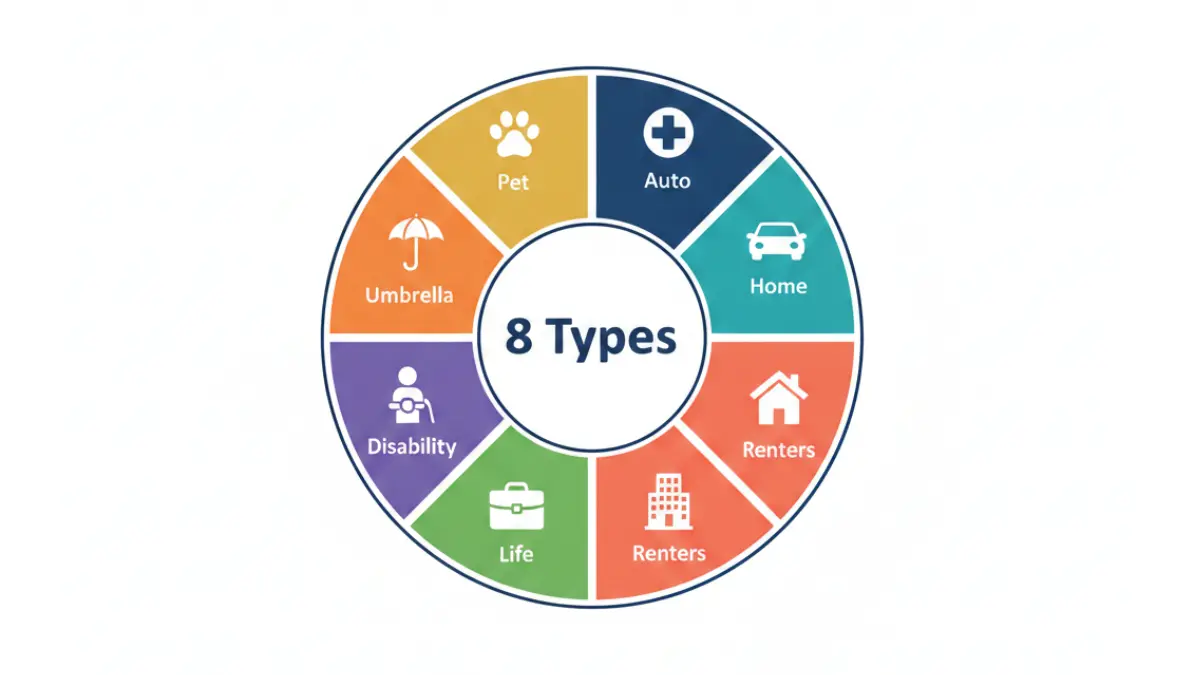
The 8 Types of Insurance — With Real 2026 Costs
This is what separates this guide from every competitor. Investopedia gives you a dictionary definition. NerdWallet sells you products. We give you every insurance type, who needs it, and what it actually costs in 2026 — in one place.
🏥 1. Health Insurance
Average 2026 cost: $752/month (ACA marketplace Silver plan, up 21% YoY)
Health insurance is non-negotiable for nearly every American adult. A single emergency room visit without coverage can cost $30,000+. ACA premiums exploded in 2026 as federal subsidies expired — marketplace enrollees saw average increases of 114% in their out-of-pocket premiums, per KFF. Employer-sponsored plans cost individuals an average of $1,440/year — significantly cheaper if available to you.
What to do: If you’re self-employed or uninsured, compare Silver and Bronze tier plans on Healthcare.gov. Understand your subsidy eligibility before selecting a plan. Our Health Insurance Expert Math guide breaks down exactly how to calculate your actual cost after tax credits.
🚗 2. Auto Insurance
Average 2026 cost: $1,993/year (Federal Reserve data)
Auto insurance is legally required in 49 states plus Washington D.C. — only New Hampshire allows drivers to waive it under specific conditions. Per the Insurance Information Institute, most policies cover liability, medical payments, collision, and comprehensive.
Most drivers are underinsured at the state minimum. A serious accident with injuries can exceed $100,000 in damages — far above the typical 25/50/25 state minimum. The Insurance Information Institute recommends at least $100,000 bodily injury per person and $300,000 per accident.
If you’re overpaying on auto, our dedicated Car Insurance Cost-Cutting Guide shows how Americans are slashing 34% off their auto premiums legally.
🏠 3. Homeowners Insurance
Average 2026 cost: $2,110/year for $300,000 in dwelling coverage
Your mortgage lender will require homeowners insurance — but the real goal is protecting your largest asset at the right coverage limit. Standard policies (HO-3) cover your structure, personal property, and liability, but not flooding or earthquakes. Those require separate policies.
Before factoring insurance into your homebuying budget, use our Home Affordability Calculator to model the full true cost of ownership including annual premiums.
🏢 4. Renters Insurance
Average 2026 cost: $15–$30/month
One of the most underutilized policies in America. Your landlord’s insurance covers the building — not your belongings. Renters insurance covers personal property (up to $30,000 typically), liability, and temporary housing if your unit becomes uninhabitable. Cost: around $180–$360/year. At that price, it’s one of the highest-value policies available.
💼 5. Life Insurance
Average 2026 cost: $564/year for a healthy 30-year-old male ($1M, 20-year term)
Life insurance exists for one reason: to replace your income for the people who depend on it. If no one relies on your income, you likely don’t need it yet. Term life is the right choice for most Americans — it’s 5–15x cheaper than whole life for the same death benefit.
Our Term Life Insurance Rates & Calculator and Life Insurance Complete Guide show current rates by age and health profile. Don’t let an agent sell you whole life when term is all you need.
🦽 6. Disability Insurance
Average cost: 1–3% of your annual income
This is the most overlooked policy in America. The Social Security Administration estimates that 1 in 4 workers will become disabled before reaching retirement age. Disability insurance replaces 60–70% of your income if you can’t work due to illness or injury.
Short-term covers 3–12 months. Long-term covers years or until retirement. If you have dependents and no disability coverage, this is your most urgent insurance gap.
☂️ 7. Umbrella Insurance
Average cost: $150–$300/year for $1 million in extra coverage
Umbrella insurance kicks in when your auto or home policy limits are exhausted. For someone with significant assets — home equity, investments, retirement savings — umbrella coverage is one of the most cost-effective ways to protect everything. If your net worth exceeds $300,000, talk to your insurer about umbrella coverage today.
🐾 8. Pet Insurance
Average cost: $62/month (dogs), $32/month (cats)
Optional but increasingly valuable. A single surgery for a dog can run $3,000–$8,000. Pet insurance makes sense if you have a young pet or a breed prone to health issues. Evaluate based on your pet’s risk profile and your financial capacity to absorb an unexpected vet bill.
2026 Insurance Cost Summary Table
| Insurance Type | Avg. 2026 Annual Cost | Legally Required? | Priority |
|---|---|---|---|
| Health | $9,024/yr (marketplace) | Recommended | 🔴 Critical |
| Auto | $1,993/yr | Yes (49 states) | 🔴 Critical |
| Homeowners | $2,110/yr | Required by lender | 🔴 Critical |
| Renters | $240/yr avg | No | 🔴 High value |
| Life (term) | $564/yr | No | 🟠 High (dependents) |
| Disability | 1–3% of income | No | 🟠 Underused |
| Umbrella | $225/yr avg | No | 🟡 Assets > $300K |
| Pet | $744/yr (dogs) | No | 🟡 Situational |
Which Insurance Do YOU Actually Need? (Life-Stage Framework)
No competitor has built this. NerdWallet sends you to a product page. Bankrate shows you rate tables. This is the only guide that tells you exactly what to prioritize based on where you are in life.

🎓 Single Adult (Ages 20–30)
Must have: Health insurance, renters insurance, auto insurance (if you drive) Skip for now: Life insurance (no dependents), umbrella insurance (limited assets)
Your single biggest insurance risk at this age is a medical emergency or car accident draining your savings. Renters insurance at ~$20/month is a no-brainer. If you’re in debt and building your foundation, see our Debt Types and Risk Guide before allocating money to optional insurance types.
💍 Married Without Kids
Must have: Health insurance, auto insurance, homeowners/renters insurance, starter life insurance Consider: Disability insurance, especially if you have a mortgage
If you recently bought a home, factor in the full insurance picture when running your numbers. Our Mortgage Calculator lets you model total monthly housing costs including insurance escrow.
👨👩👧 Young Family (Kids Under 18)
Must have: Health, auto, homeowners, term life (10–12x annual income), disability Consider: Umbrella if home equity + savings exceed $300K
This is your highest-risk life stage. Your family depends on your income — you must have term life and disability coverage. If you’re a homeowner, also check whether your home insurance covers replacement cost (not just market value). Use our Home Affordability Calculator if you’re considering a move-up purchase.
Expert Insight — FinanceAuthorityHub Panel: “The single most common mistake we see in young families: buying whole life insurance instead of term. That decision costs the average family $400–$600/month in unnecessary premium — money that should be going into a 401(k) or emergency fund.” — Expert Panel, FinanceAuthorityHub
🏡 Mid-Life Homeowner (Ages 40–55)
Must have: Health, auto, home, life, disability, umbrella Review: Whether your life insurance death benefit still matches income × 10–12x formula
This is when umbrella insurance earns its place. You likely have meaningful home equity, retirement savings, and assets worth protecting. $225/year for $1 million in umbrella coverage is one of the best risk-adjusted decisions you can make.
If you’re thinking about using home equity as part of your financial strategy, our Home Equity Guide outlines how rate cuts in 2026 affect your options.
👴 Pre-Retirement (Ages 55–65)
Must have: Health (critical), Medicare supplement planning, auto, homeowners Review: Whether you still need life insurance (your kids are likely independent) Consider: Long-term care insurance before premiums spike at 65
At this stage, your term life policy may be expiring — and that’s often fine if your kids are grown and your retirement is funded. Shift your premium budget toward Medicare supplement planning and long-term care. Our Retirement Savings by Age Guide helps you see if your financial base is solid enough to reduce coverage.
7 Insurance Mistakes Draining Your Wallet in 2026
This is the section your competitors refuse to write. These seven mistakes are costing American households thousands of dollars per year in overpaid premiums and uncovered losses.

❌ Mistake 1: Buying Whole Life When You Need Term Life
Whole life insurance costs 5–15x more than term for the same death benefit. Most financial experts — including our 30-member panel — agree that the cash value component of whole life rarely justifies the cost for the average American household. Buy a 20-year term policy and invest the difference in a Roth IRA or your 401(k).
❌ Mistake 2: Choosing the Lowest Deductible “To Be Safe”
A $500 deductible vs. a $1,000 deductible on auto insurance can save you $200–$400/year in premium. The math only works against you if you file multiple claims per year — which most people don’t. Match your deductible to what’s sitting in your emergency fund, not to your anxiety level.
❌ Mistake 3: Not Shopping Your Insurance Every Year
Insurance rates change constantly. Insurers actively reprice risk annually — and they don’t volunteer discounts to existing customers. Setting a calendar reminder to get 3 competing quotes at every renewal cycle is one of the highest-ROI habits in personal finance. Rate differences between insurers for identical coverage can exceed $600/year.
❌ Mistake 4: Missing Bundle Discounts
Bundling your home and auto insurance with one insurer typically saves 5–25% on both policies. That’s $300–$800/year for doing nothing more than making one phone call. Most insurers don’t proactively offer this — you have to ask.
❌ Mistake 5: Over-Insuring Low-Value Assets
If your car is worth $5,000, paying for comprehensive and collision coverage may cost more than the car is worth. A general rule: when your annual premium for collision and comprehensive exceeds 10% of the vehicle’s market value, it’s time to drop it. Run the numbers honestly.
❌ Mistake 6: Paying Monthly Instead of Annually
Most insurers charge a 3–8% fee for monthly payment installments. On a $2,000 annual auto premium, that’s $60–$160 in pure surcharge fees per year. If your cash flow allows, paying annually is an instant, risk-free return.
❌ Mistake 7: Never Reviewing After a Life Event
Getting married, having a child, buying a home, getting a raise, getting divorced — each of these events changes your optimal insurance stack. Most people set their coverage once and forget it for a decade. An annual 30-minute insurance review is one of the highest-leverage personal finance habits that exists.
2026 Alert: If you’re carrying significant debt alongside your insurance premiums, it may be worth using our Debt Consolidation Calculator to see whether consolidating at a lower rate frees up premium budget for better coverage.
How to Stop Overpaying — Your 2026 Insurance Savings Playbook
Step 1: Audit Every Active Policy You Hold
List every insurance policy, its premium, deductible, coverage limit, and renewal date. Most people are surprised to find overlapping coverage — for example, rental car coverage through both an auto policy and a credit card benefit.
Step 2: Apply the 3-Quote Rule at Every Renewal
Get a minimum of three competing quotes for each policy type before renewing. Use independent insurance brokers where possible — they access multiple carriers simultaneously. According to NAIC data, consumers who actively shop their coverage save an average of $400–$900 annually across their policy portfolio.
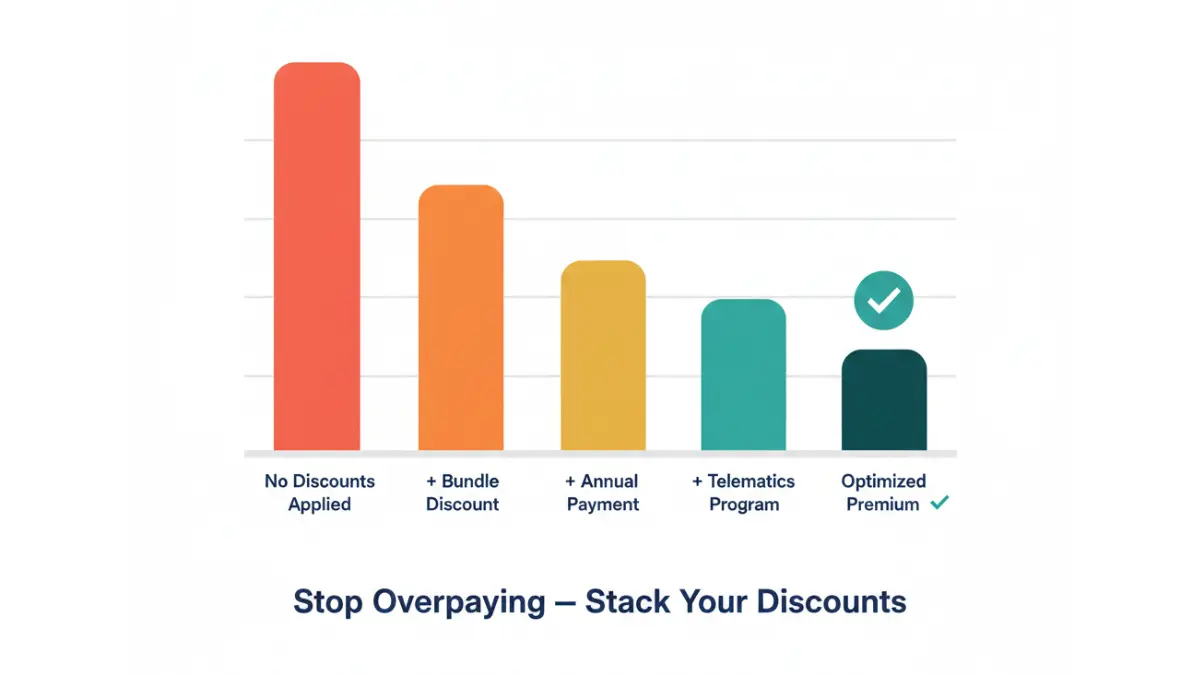
Step 3: Stack Every Legal Discount
| Discount Type | Avg. Savings |
|---|---|
| Bundle home + auto | 5–25% on both |
| Telematics / good driver program | Up to 30% on auto |
| Increase deductible ($500 → $1,000) | 10–20% on premium |
| Pay annually (eliminate monthly fee) | 3–8% saved |
| Security/smart home devices | 2–10% on home |
| Non-smoker status | Up to 20% on life/health |
| Loyalty discount (2+ years) | 5–10% with same insurer |
Step 4: Know When Your Umbrella Belongs
Once your net worth — including home equity and retirement accounts — exceeds $300,000, the math on umbrella insurance becomes undeniable. For $150–$300/year, you get $1 million in additional liability protection above your auto and home policy limits. It is genuinely one of the best deals in the entire insurance market.
Step 5: Reassess Annually and After Every Life Event
Put this in your calendar now: annual insurance audit. Compare your current coverage to your current life circumstances. A policy that was perfect at 30 may be both over-covering and under-covering you at 40. This is the single most impactful habit you can build around your insurance coverage.
Frequently Asked Questions about Insurance
Q1: What is insurance in simple terms?
Insurance is a financial contract where you pay regular premiums to an insurer, who agrees to cover specified financial losses. It transfers your financial risk to a larger pool.
Q2: What types of insurance do I actually need?
For most American adults: health insurance, auto insurance (if you drive), renters or homeowners insurance, and term life insurance if anyone depends on your income. Disability insurance is critically underowned.
Q3: How much does insurance cost per month in 2026?
Combined averages for a typical American: health ($752/mo marketplace), auto ($166/mo), homeowners ($176/mo), life/term ($47/mo). Total: roughly $1,141/month — but costs vary dramatically by state, age, and coverage level.
Q4: Am I overpaying for insurance?
If you haven’t compared quotes in the last 12 months, you very possibly are. Rates shift constantly. Run 3 competing quotes at your next renewal for every policy you hold. Even a 10–15% saving on a $3,000 combined premium portfolio is $300–$450 back in your pocket.
Q5: Is health insurance legally required in 2026?
Not federally — the individual mandate penalty was eliminated in 2019. However, Massachusetts, New Jersey, California, Rhode Island, and Washington D.C. have their own state mandates with penalties. Even where not required, going uninsured is one of the most dangerous financial risks you can take.
Q6: Does my credit score affect my insurance premium?
Yes — in most states, insurers use credit-based insurance scores to price auto and home policies. Improving your credit score directly lowers your insurance costs. Our Credit Score Complete Guide shows how to move your score into the range that unlocks better rates.
Q7: What is the difference between term and whole life insurance?
Term life covers a fixed period (10–30 years) at a low cost — right for most people. Whole life is permanent with a cash value component but costs 5–15x more annually. For the vast majority of Americans, term life provides better value. See our Life Insurance Rates, Types & Savings Guide for a full comparison.
Q8: Should I bundle my home and auto insurance?
Usually yes — bundling typically saves 5–25% on both policies. But always get separate quotes too. In some cases, specialist carriers can beat a bundled price. Compare both options before deciding.
Q9: What happens if I don’t have auto insurance?
Driving uninsured is illegal in 49 states. Penalties include fines ($200–$5,000+), license suspension, vehicle impoundment, and personal liability for any accident damages — which can run into tens of thousands of dollars. The risk far exceeds the cost of a basic policy.
Q10: How do I file an insurance claim?
Document the loss immediately (photos, police report if applicable). Contact your insurer within their required timeframe — check your policy. Submit required forms and evidence. Work with the assigned adjuster. Keep records of every communication and expense related to the claim.
Q11: How much life insurance do I actually need?
Industry consensus: 10–12x your annual gross income in term life coverage. A household earning $80,000/year needs $800,000–$960,000 in coverage. This replaces lost income, pays off debts, and provides a cushion for surviving family members. Use our Term Life Insurance Calculator to get a specific number for your situation.
Expert Panel & Verified Sources
This article was reviewed by the FinanceAuthorityHub Expert Panel — 30 internationally credentialed financial experts including Certified Financial Planners (CFPs), Chartered Financial Analysts (CFAs), and licensed insurance advisors across the USA, UK, Canada, and Australia.
Related Reading on FinanceAuthorityHub
Deepen your financial protection strategy with these guides:
- How to Buy Your First Home in 2026 — full cost breakdown including insurance
- Retirement Planning in Your 30s — where insurance fits in your long-term plan
- 401(k) vs IRA: Which to Max First — before overspending on insurance, maximize free money
- Capital Gains Tax 2026 — insurance and tax strategy work together
- Debt Consolidation: Save $3,500 — free up budget for better coverage

Informational disclaimer
The content on Finance Authority Hub is provided for general informational and educational purposes only and should not be considered personalized financial, investment, tax, legal, or professional advice. Financial decisions depend on your individual goals, income, risk tolerance, location, and regulatory situation. Before acting on any information, strategy, estimate, or calculator result, consult a qualified licensed professional who can evaluate your specific circumstances.