
2026 Tax Brackets and the $32,200 Standard Deduction
The 2026 tax brackets for all four filing statuses, the $16,100 single deduction, and the tax on three sample households before credits.
In This Article
Rates and limits checked on November 13, 2026.
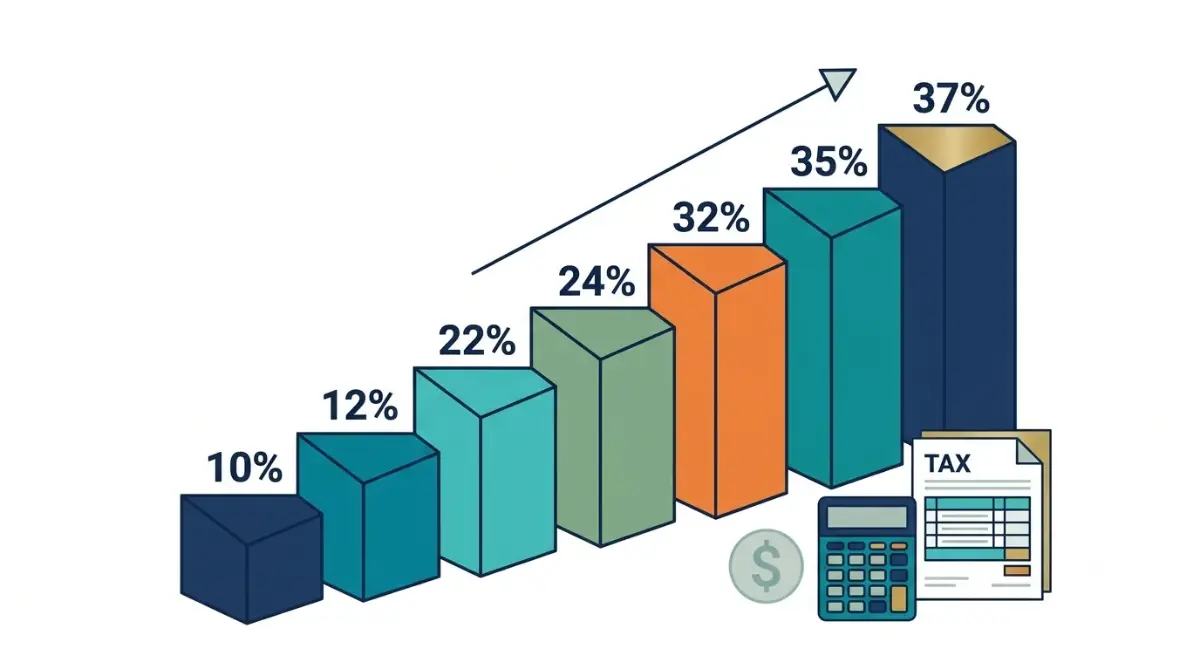
For tax year 2026, the return filed in 2027, the federal tax runs at seven rates from 10% to 37%, and the standard deduction is $32,200 for married couples filing jointly. Single filers get $16,100 and heads of household get $24,150.
You subtract the deduction from your income first. The brackets then apply to what is left, one band at a time, so a couple with $120,000 in wages owes $10,040 before credits.
2026 federal income tax brackets by filing status
The 2026 schedule keeps seven rates, with every income band raised for inflation (IRS). Find your filing status, then the row where your taxable income lands.
| Rate | Single | Married filing jointly | Head of household | Married filing separately |
|---|---|---|---|---|
| 10% | $0 to $12,400 | $0 to $24,800 | $0 to $17,700 | $0 to $12,400 |
| 12% | $12,401 to $50,400 | $24,801 to $100,800 | $17,701 to $67,450 | $12,401 to $50,400 |
| 22% | $50,401 to $105,700 | $100,801 to $211,400 | $67,451 to $105,700 | $50,401 to $105,700 |
| 24% | $105,701 to $201,775 | $211,401 to $403,550 | $105,701 to $201,750 | $105,701 to $201,775 |
| 32% | $201,776 to $256,225 | $403,551 to $512,450 | $201,751 to $256,200 | $201,776 to $256,225 |
| 35% | $256,226 to $640,600 | $512,451 to $768,700 | $256,201 to $640,600 | $256,226 to $384,350 |
| 37% | Over $640,600 | Over $768,700 | Over $640,600 | Over $384,350 |
Taxable income, tax year 2026. Source: IRS 2026 Form 1040-ES, tax rate schedules.
A married person filing a separate return follows the single column until the 35% band, which stops at $384,350. A qualifying surviving spouse uses the joint column.
The same IRS schedules list the tax already owed when each band starts. For a single filer that is $1,240 at $12,400, $5,800 at $50,400 and $17,966 at $105,700; for a joint return, $2,480 at $24,800 and $11,600 at $100,800.
$32,200 is the joint standard deduction for 2026
$32,200 comes off a joint return before any bracket applies, up from $31,500 for 2025.
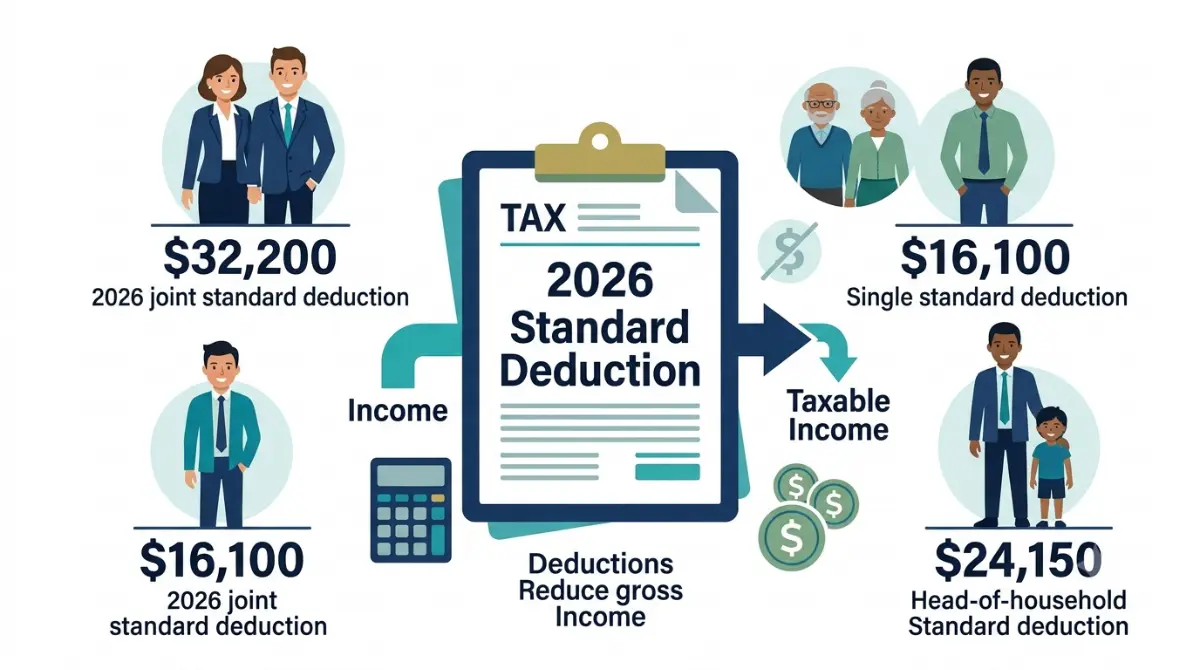
| Filing status | 2026 standard deduction | Added at 65 or older, or blind (each) |
|---|---|---|
| Single | $16,100 | $2,050 |
| Married filing jointly | $32,200 | $1,650 per spouse |
| Head of household | $24,150 | $2,050 |
| Married filing separately | $16,100 | $1,650 |
Tax year 2026. Sources: IRS 2026 Form 1040-ES and the IRS 2026 adjustments release.
Someone who can be claimed as a dependent gets the larger of $1,350 or earned income plus $450, capped at the regular amount for their filing status.
A second break for older filers sits outside that table. The enhanced deduction for seniors adds up to $6,000 per person age 65 or older, or $12,000 when both spouses qualify, for tax years 2025 through 2028 (IRS). It starts to shrink once modified adjusted gross income (MAGI) passes $75,000, or $150,000 on a joint return. Married couples must file jointly to claim it, and each claimant needs a valid Social Security number.
Only the dollars inside each band pay its rate
A single filer whose taxable income rises from $50,400 to $51,400 pays $220 more, because only that last $1,000 crosses into the 22% band. Everything below it keeps its 10% or 12% rate.
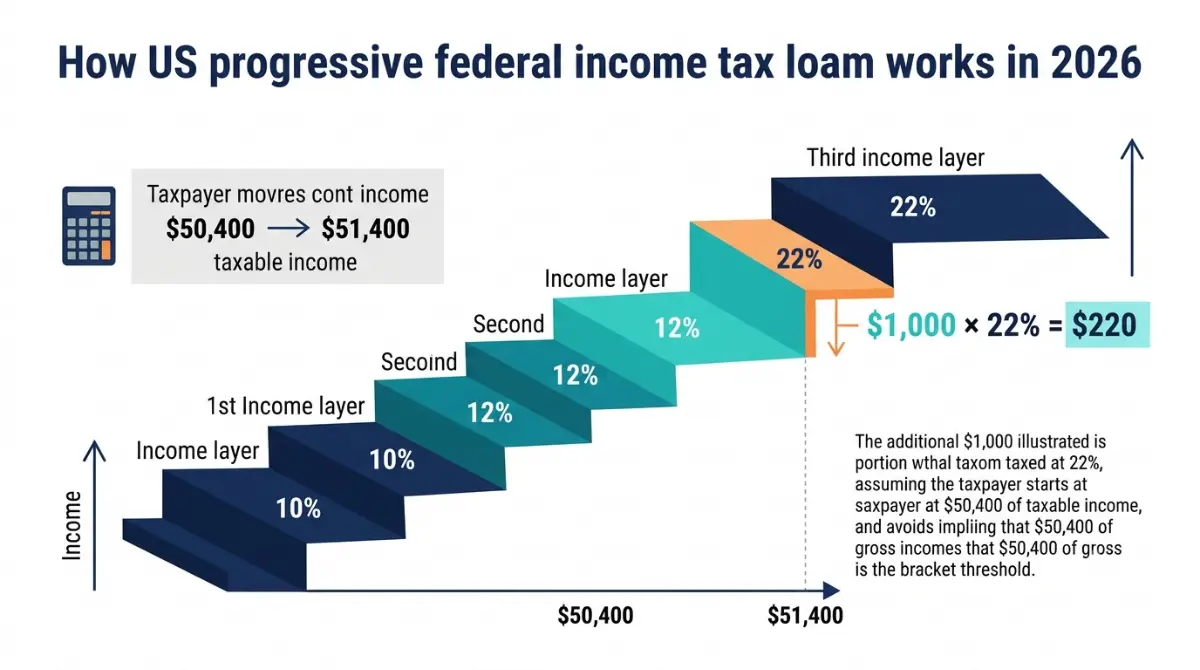
That is why your top bracket, the marginal rate, is never lower than your effective rate, which is total tax divided by income. The return reaches taxable income in four steps:
- Start with total income and subtract adjustments, such as deductible IRA contributions. The result is adjusted gross income (AGI).
- Subtract your standard or itemized deduction, whichever is larger, plus any of the newer deductions for seniors, qualified tips and overtime or car loan interest that apply to you.
- Run the remaining taxable income through the bracket table for your filing status.
- Subtract credits, such as the child tax credit, from the tax that step 3 produced.
Long-term capital gains and qualified dividends are taxed on their own 0%, 15% and 20% schedule, explained in capital gains tax rates for 2026.
$10,040 in tax on $120,000 for a married couple
Example: a married couple filing jointly, both under 65, with $120,000 in wages, no other income and no itemized deductions. Their taxable income is $87,800. The first $24,800 is taxed at 10%, which is $2,480, and the remaining $63,000 at 12%, which is $7,560. Total tax: $10,040, or 8.4% of wages, although their top bracket is 12%.
The same steps for two other households:
| Household | Standard deduction | Taxable income | 2026 tax | Share of wages |
|---|---|---|---|---|
| Couple filing jointly, $120,000 wages | $32,200 | $87,800 | $10,040 | 8.4% |
| Single, $75,000 wages | $16,100 | $58,900 | $7,670 | 10.2% |
| Head of household, $60,000 wages | $24,150 | $35,850 | $3,948 | 6.6% |
Tax before credits, tax year 2026, figured from the IRS 2026 tax rate schedules. Share of wages is rounded to one decimal place.
Change one input and the result moves. If both spouses in the first household are at least 65, their deduction grows by $1,650 each to $35,500, and the senior deduction removes another $12,000, since $120,000 is under the $150,000 joint limit. Taxable income drops to $72,500 and the tax to $8,204, which is $1,836 less.
To rerun this with your own figures, open the income tax calculator, choose the joint filing status and enter $120,000, leaving deductions at the standard amount. The result should match the $10,040 above.
The 2027 figures are already out
On November 5, 2026, the IRS published the 2027 adjustments, which apply to returns filed in 2028 (IRS). The 2027 standard deduction is $33,200 for joint filers, $16,600 for single filers and $24,925 for heads of household. The return you file in 2027 still uses the 2026 tables above.
Questions about the 2026 tax brackets
What tax bracket is $100,000 in for 2026?
It depends on filing status. After the 2026 deduction, $100,000 of income leaves $83,900 taxable for single filers and $75,850 for a head of household, both in the 22% band. A couple filing jointly has $67,800 taxable, which stays in the 12% band.
Is the standard deduction per person?
No. The $32,200 covers the whole joint return. The add-ons for age 65 and blindness, and the senior deduction, are counted for each qualifying person.
At what age do you stop paying federal income tax?
No age ends the tax. From 65, the deduction gets the $1,650 or $2,050 add-on, and through 2028 the senior deduction can remove up to $6,000 more per person, so more retirement income falls below the taxable line.
Check your 2026 withholding with the income tax calculator
Your most recent 2026 pay stub shows the federal tax withheld for the year so far. Compare that figure with the tax the calculator gives for your full-year income.
If withholding falls short, a new Form W-4 raises it for the paychecks left in the year, and adjusting your W-4 covers which lines to change. The tax refund formula with worked examples shows how the gap between tax and withholding becomes a refund or a balance due, and estimating your refund before you file uses the same numbers.
If you are 65 or older with MAGI near $75,000, or $150,000 on a joint return, ask a CPA or enrolled agent: “How much of the $6,000 senior deduction do I keep at my expected 2026 income?”
Found this helpful? See more of our guides on Google.
Want to see our guides first on Google?
Informational disclaimer
The content on Finance Authority Hub is provided for general informational and educational purposes only and should not be considered personalized financial, investment, tax, legal, or professional advice. Financial decisions depend on your individual goals, income, risk tolerance, location, and regulatory situation. Before acting on any information, strategy, estimate, or calculator result, consult a qualified licensed professional who can evaluate your specific circumstances.
