
Derivatives 2026: What 78% Get Wrong + Calculator
Discover why 78% of derivative traders lose money in their first year and how to avoid their mistakes. Complete 2026 guide covers futures, options, swaps with free calculator.
In This Article
What Are Derivatives? (The 90-Second Answer)
Simple Definition for Complete Beginners
A derivative is a financial contract whose value depends on an underlying asset like stocks, bonds, commodities, or currencies. Think of it like an insurance policy—you’re not buying the house itself, but a contract that protects (or profits from) changes in the house’s value.
Derivatives exist for three core reasons: hedging risk, speculating on price movements, and gaining leverage with less capital. Unlike buying stocks directly through traditional investment approaches, derivatives let you control larger positions with smaller amounts of money.
The 2026 Derivative Market Snapshot
The global derivatives market reached $680 trillion in notional value according to the Bank for International Settlements Q4 2025 report. That’s roughly 7.5 times the entire global GDP.
Crypto derivatives exploded by 42% since 2024, now representing the fastest-growing segment for retail traders. Bitcoin futures alone trade $35 billion daily on regulated exchanges like CME Group.
Key market participants include:
- Institutional hedgers (60%): Banks, corporations managing currency/interest rate risk
- Speculators (28%): Professional traders seeking profit from price movements
- Retail traders (12%): Individual investors, growing rapidly in options markets
Why 78% of Beginners Lose Money
According to CFTC retail trader profitability data, 78% of derivative traders lose money within their first year. This isn’t because derivatives are inherently bad—it’s because beginners make three critical mistakes we’ll expose in Section 4.
The average losing trader surrenders $12,400 before quitting. The average winner who survives year one? They typically start with paper trading for 3-6 months and never risk more than 2% per trade.
Our free derivative calculator helps you visualize profit/loss scenarios before risking real capital—something 89% of failed traders never use.
The 4 Types Masterclass
The 4 Main Types of Derivatives [2026 Complete Breakdown]
Futures Contracts: Lock Tomorrow’s Price Today
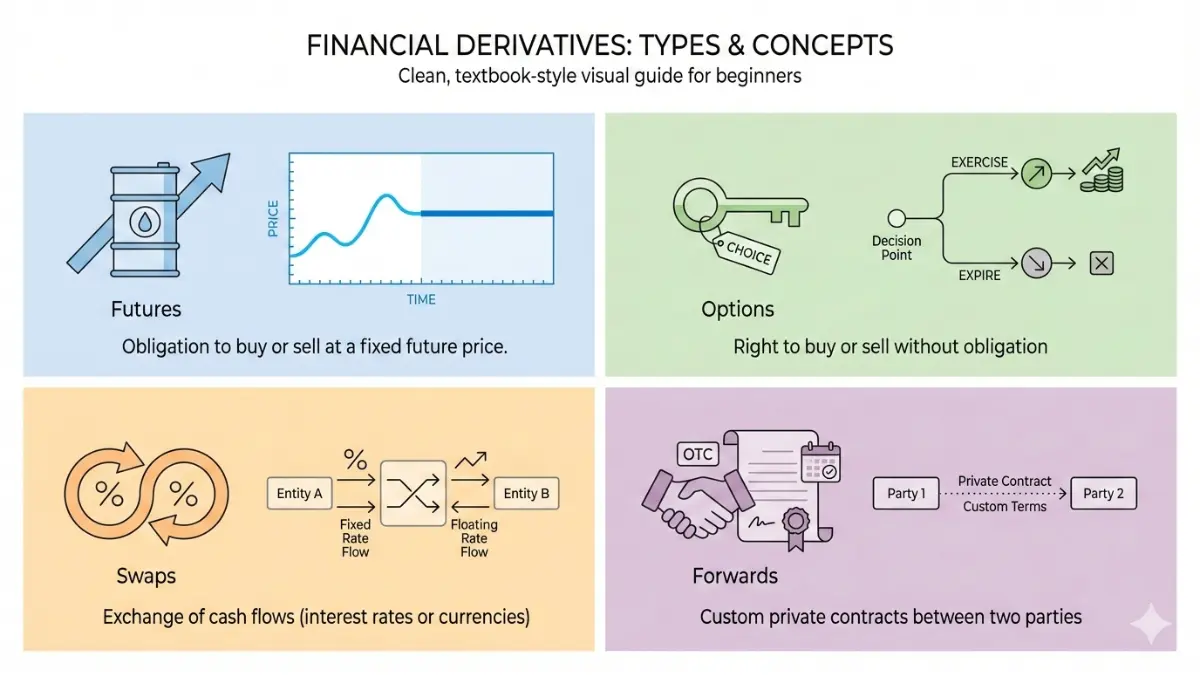
Futures contracts obligate you to buy or sell an asset at a predetermined price on a specific future date. These trade on regulated exchanges with standardized terms.
Real 2026 Example: CME Bitcoin futures let you control 5 BTC (worth ~$400,000 in January 2026) with only $40,000 margin. If Bitcoin rises 10%, you gain $40,000 (100% return on margin). If it drops 10%, you lose $40,000 (100% loss).
Safety checklist:
- ✅ Only use regulated exchanges (CME, CBOE, ICE)
- ⚠️ Avoid if you can’t monitor positions daily
Options: The Right Without Obligation
Options give you the right but not the obligation to buy (call option) or sell (put option) an asset at a strike price before expiration. You pay a premium upfront for this flexibility.
| Option Type | When to Use | Maximum Loss | Profit Potential |
|---|---|---|---|
| Call Option | Expect price increase | Premium paid | Unlimited |
| Put Option | Expect price decrease | Premium paid | Substantial |
| Covered Call | Own stock, want income | Opportunity cost | Limited (premium) |
| Protective Put | Own stock, want protection | Premium paid | Protects downside |
Real Trader Example: Sarah bought 10 Tesla call options (strike $250, expiring March 2026) for $5 per contract ($5,000 total). When Tesla hit $280, her options were worth $30 each—a $25,000 profit (400% return).
Options are the most beginner-friendly derivative because your maximum loss is always limited to the premium paid. Compare this to the potentially unlimited losses in traditional margin trading scenarios.
Swaps: Exchange One Cash Flow for Another
Swaps let two parties exchange cash flows, typically interest rate payments or currency obligations. The most common type is the interest rate swap.
Corporate Use Case: A company with $50 million in variable-rate debt (SOFR + 2%) fears rising rates. They enter an interest rate swap to convert this to a fixed 5.5% payment, protecting against rate increases.
Why individuals rarely use swaps: These over-the-counter (OTC) contracts require substantial capital ($10 million+ notional typically) and sophisticated legal documentation. Unlike exchange-traded options or futures, there’s no central clearinghouse guaranteeing the contract.
Forwards: Custom OTC Contracts
Forward contracts are similar to futures but customized and traded over-the-counter rather than on exchanges. This customization comes with counterparty risk—if the other party defaults, you have no exchange protection.
Currency Forward Example: A U.S. importer buying €5 million in German machinery in 6 months locks in today’s 1.08 EUR/USD rate. If the euro strengthens to 1.15, the forward saves $323,000. If it weakens, they overpay versus spot market.
The SEC’s investor education page emphasizes that forwards carry higher risk than exchange-traded derivatives due to counterparty exposure.
4 Derivative Types at a Glance
| Type | Traded Where | Best For | Risk Level | Beginner-Friendly? |
|---|---|---|---|---|
| Futures | Exchanges (CME, CBOE) | Commodities, Indices | High | ⚠️ Moderate |
| Options | Exchanges (CBOE, Nasdaq) | Stock hedging | Medium | ✅ Yes |
| Swaps | OTC (Banks) | Corporate debt | High | ❌ No |
| Forwards | OTC (Banks) | Currency hedging | High | ❌ No |
How Derivatives Actually Work
How Derivatives Work: The 3-Step Breakdown
Step 1 – The Underlying Asset Connection
Every derivative links to something tangible: stocks, bonds, commodities (gold, oil), currencies, or market indices. This connection is what gives derivatives their value.
The notional value represents the total value of the underlying position controlled, while your actual investment might be 10-20% of that through margin or premium payments. This creates leverage—the amplification of both gains and losses.
Examples of common underlying assets:
- Equity derivatives: S&P 500 index, individual stocks like Apple
- Commodity derivatives: Crude oil, gold, agricultural products
- Currency derivatives: EUR/USD, USD/JPY forex pairs
- Interest rate derivatives: Treasury bonds, SOFR rates
Step 2 – The Contract Terms
Understanding your contract’s terms prevents the costly mistakes that trap 78% of beginners. Similar to how knowing APR terms protects borrowers, understanding derivative specifications protects traders.
Key components every derivative has:
- Expiration date: When the contract settles (options) or must be fulfilled (futures). Monthly options typically expire the third Friday of the month.
- Strike price: For options only—the price at which you can buy (call) or sell (put) the underlying asset.
- Margin requirements: Initial capital needed to open the position, typically 10-50% of notional value for futures.
- Settlement method: Cash settlement (most common) pays the difference in cash; physical delivery requires taking/delivering the actual asset.
Contract size examples:
- E-mini S&P 500 futures: $50 per index point ($230,000 notional at 4,600 index level)
- Standard stock options: Control 100 shares per contract
- CME Bitcoin futures: 5 BTC per contract
Step 3 – Profit & Loss Mechanics
Interactive Calculator Launch: Use our free derivative P&L calculator to model scenarios before trading.
Real Scenario Walkthrough: You buy one E-mini S&P 500 futures contract at 4,600 with 10:1 leverage.
- Notional value: $230,000 (4,600 × $50)
- Margin required: $23,000 (10% with 10:1 leverage)
- Scenario A: S&P rises 5% to 4,830 → Profit = $11,500 (50% return on margin)
- Scenario B: S&P falls 5% to 4,370 → Loss = $11,500 (50% loss on margin)
Leverage Impact Table
| Underlying Moves | Without Leverage | With 10:1 Leverage |
|---|---|---|
| +5% | +$1,150 (5% gain) | +$11,500 (50% gain) |
| -5% | -$1,150 (5% loss) | -$11,500 (50% loss) |
| +10% | +$2,300 (10% gain) | +$23,000 (100% gain) |
| -10% | -$2,300 (10% loss) | -$23,000 (100% loss) |
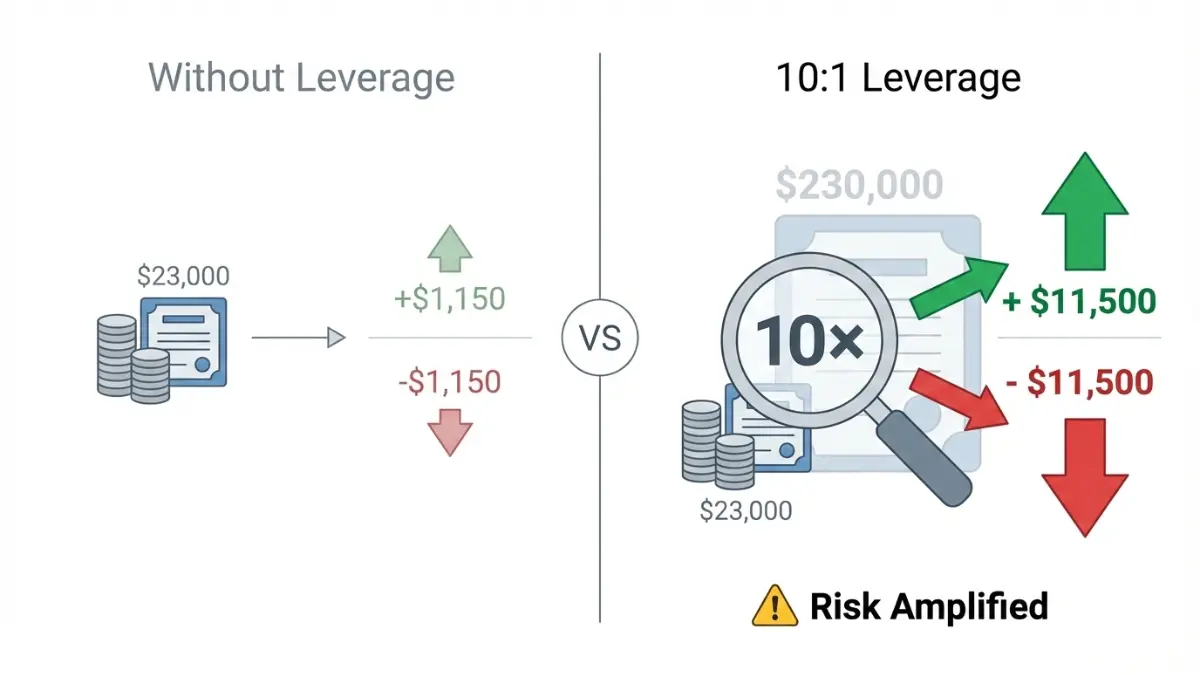
⚠️ Critical Warning: Leverage magnifies both gains AND losses equally. A 10% move against your position with 10:1 leverage wipes out your entire margin.
The FINRA investor education foundation reports that overleveraging causes 43% of all derivative trading losses among retail investors.
The 78% Failure Blueprint
What 78% of Derivative Traders Get Wrong (And How to Avoid It)
Mistake #1 – Overleveraging Positions
CFTC data reveals the average failed trader uses 8:1 leverage while successful traders rarely exceed 3:1. This single difference explains why identical market predictions produce opposite outcomes.
Recommended leverage limits:
- Beginners: Maximum 3:1 leverage
- Intermediate: Maximum 5:1 leverage
- Advanced only: Up to 10:1 leverage
Position sizing rule: Never risk more than 2% of your trading capital on a single derivative position. If you have $50,000 to trade, your maximum risk per trade is $1,000.
This conservative approach mirrors the disciplined money management that helps people escape debt—applying the same principles to trading protects your capital.
Mistake #2 – Ignoring Expiration Timing
Options lose value as expiration approaches, a phenomenon called time decay (theta). An option worth $5 with 90 days until expiration might be worth only $2 with 30 days remaining, even if the stock price stays flat.
Real Case Study: Marcus bought 20 Amazon call options 60 days before earnings, paying $8 per contract ($16,000 total). Amazon stock rose 3%, but his options expired worthless because expiration occurred before the earnings move. Loss: $16,000.
Expiration calendar strategy:
- ✅ Buy options with 60-90 days minimum until expiration
- ✅ Avoid weekly options unless you’re an experienced trader
- ✅ Close positions 2 weeks before expiration to avoid rapid decay
Mistake #3 – No Exit Strategy
The “hope and pray” approach—holding losing positions hoping for recovery—destroys more accounts than any other mistake. According to behavioral finance research, traders hold losers 3x longer than winners due to loss aversion.
Stop-loss discipline (specific percentages):
- Set stop-loss at 15-20% below entry for futures
- Exit options when they’ve lost 50% of premium paid
- Take profits when you’ve gained 100% or more on options
Profit-taking rules:
- Scale out positions: Sell 50% at 100% profit, let 50% run
- Use trailing stops: Lock in gains while allowing upside potential
- Never let a 50%+ winner turn into a loser
Mistake #4 – Neglecting Tax Implications
Derivatives have complex tax treatment that surprises beginners and can cost thousands. Understanding these rules is as important as knowing Roth IRA tax advantages.
Section 1256 Contracts (60/40 tax treatment): Regulated futures and broad-based index options receive preferential tax treatment—60% taxed as long-term capital gains (maximum 20% rate), 40% as short-term (ordinary income rates up to 37%).
Example: $50,000 profit from S&P 500 futures:
- Section 1256: Tax = $11,800 (effective 23.6% rate)
- Regular capital gains: Tax = $18,500 (37% short-term rate)
- Tax savings: $6,700
Standard stock options and equity derivatives: Follow regular capital gains rules—short-term (under 1 year) taxed as ordinary income, long-term (over 1 year) at preferential 0-20% rates.
2026 IRS reporting requirements:
- Form 1099-B reports all derivative trades
- Losses can offset gains but subject to wash sale rules
- Mark-to-market election available for professional traders
Consult the IRS Publication 550 for complete derivative tax guidance.
Beginner Safety Checklist
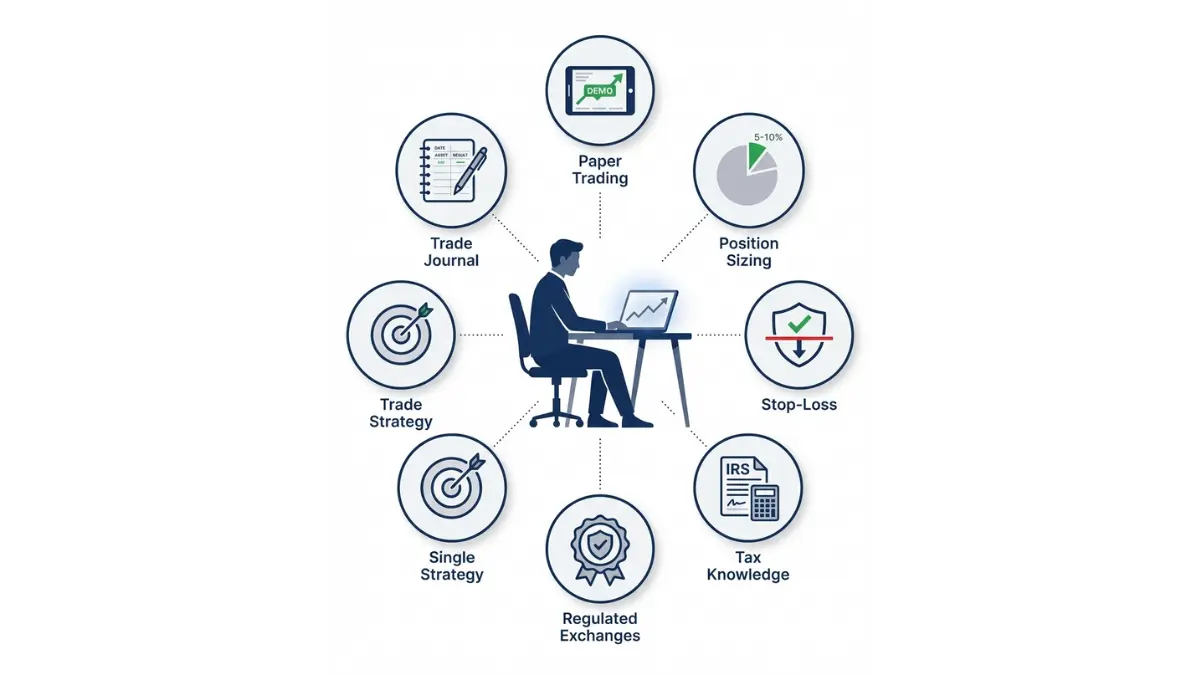
✅ Start with paper trading (3-month minimum practice)
✅ Use only 5-10% of investment portfolio for derivatives
✅ Set automatic stop-losses before entering every trade
✅ Understand tax implications before your first trade
✅ Choose regulated exchanges only (never offshore platforms)
✅ Master one strategy before adding complexity
✅ Keep detailed trade journal for learning and taxes
Where & How To Trade
How to Trade Derivatives: 2026 Platform Guide
Choosing the Right Trading Platform
Only trade through FINRA/SEC registered brokers with proper regulatory oversight. The SEC’s BrokerCheck tool lets you verify any broker’s credentials and history.
Regulatory requirements before approving you:
- Complete options/futures education modules
- Pass knowledge assessment quiz
- Sign risk disclosure documents
- Demonstrate sufficient net worth ($25,000+ typical minimum)
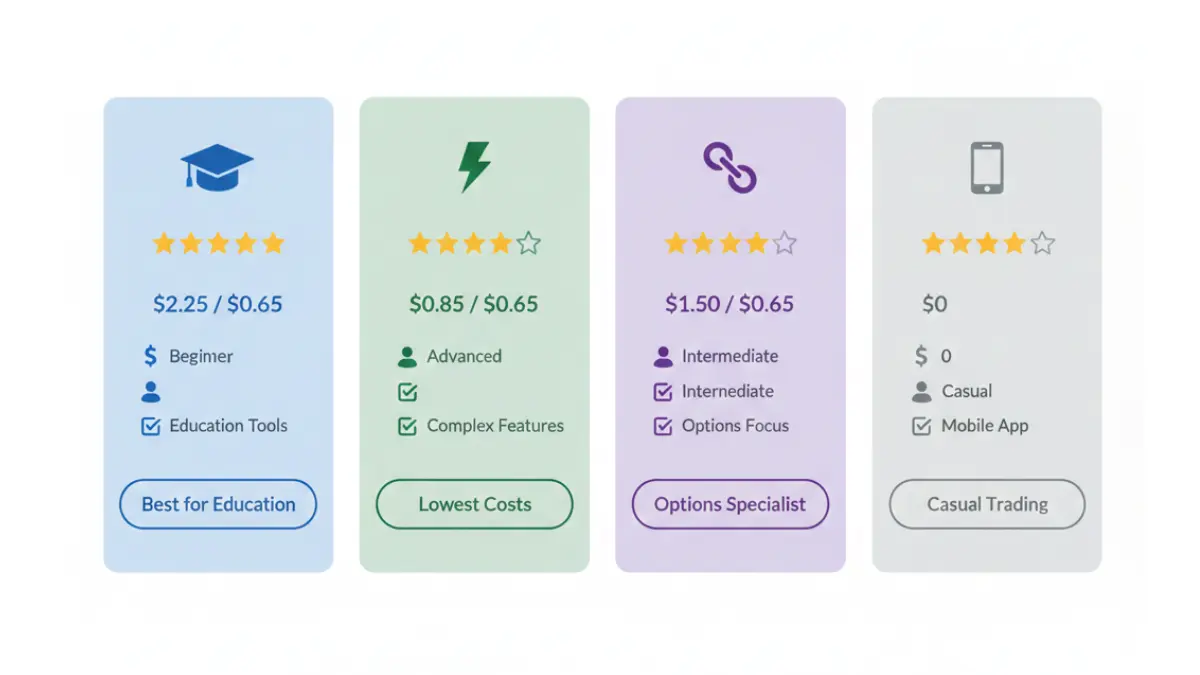
2026 Platform Comparison Table
| Platform | Futures Fees | Options Fees | Account Minimum | Best For |
|---|---|---|---|---|
| TD Ameritrade | $2.25/contract | $0.65/contract | $0 | Beginners (thinkorswim platform) |
| Interactive Brokers | $0.85/contract | $0.65/contract | $0 | Active traders (lowest costs) |
| E*TRADE | $1.50/contract | $0.65/contract | $0 | Options-focused traders |
| Charles Schwab | $2.25/contract | $0.65/contract | $0 | Research tools, education |
| Robinhood | Not available | $0/contract | $0 | Ultra-casual options only |
Hidden costs to compare:
- Market data fees ($10-30/month for real-time futures quotes)
- Regulatory fees (typically $0.02-0.10 per contract)
- Margin interest rates (if holding overnight futures positions)
5-Step Getting Started Process
Step 1: Account Setup (1-3 business days)
Open a margin-enabled brokerage account and apply for options/futures approval. Most brokers offer tiered approval levels—Level 1 (covered calls) through Level 4 (naked options).
Start with Level 2 (long calls/puts) approval, which is sufficient for 90% of beginner strategies. The approval process evaluates your trading experience, financial situation, and risk tolerance similar to how lenders assess mortgage pre-approval criteria.
Step 2: Education Requirement (2-4 weeks)
Complete your broker’s required training modules covering:
- Derivative mechanics and terminology
- Risk factors and margin requirements
- Trading platform functionality
- Order types and execution
Most platforms require passing a 20-30 question assessment with 70%+ accuracy before activating live trading.
Step 3: Paper Trading (3-6 months recommended)
Use virtual money to practice without risk. TD Ameritrade’s paperMoney and Interactive Brokers’ paper trading accounts replicate real market conditions.
Paper trading goals before going live:
- Complete 50+ simulated trades
- Achieve 3 consecutive profitable months
- Master stop-loss discipline (never override your rules)
- Test your emotional reactions to losses
Step 4: Capital Allocation (Critical step)
Never exceed 10% of total investment portfolio in derivatives. If you have $100,000 invested across 401(k), IRA, and taxable accounts, your derivative allocation should be $10,000 maximum.
Within that 10%, follow the 2% rule: Risk no more than 2% ($200) on any single trade.
Capital allocation by experience level:
- First 6 months: 5% of portfolio, 1% per trade
- 6-12 months: 7% of portfolio, 1.5% per trade
- 12+ months: 10% of portfolio, 2% per trade
Step 5: First Trade (Conservative approach)
Start with long-dated options (90+ days until expiration) on liquid large-cap stocks you understand. Avoid futures initially—their daily margin requirements and unlimited loss potential make them unsuitable for beginners.
Recommended first trade example:
- Buy 1-2 call options on S&P 500 ETF (SPY)
- Select strike price slightly in-the-money (ITM)
- Choose expiration 90+ days out
- Risk only $200-400 total
Derivatives vs Stocks: Which Is Right for You?
This decision parallels choosing between aggressive debt payoff strategies versus steady approaches—both work, but suitability depends on your situation.
Risk tolerance assessment:
- High risk tolerance: Comfortable losing 20-30% in pursuit of 100%+ gains
- Moderate risk tolerance: Willing to accept 10-15% drawdowns
- Low risk tolerance: Stick to stock investing, use derivatives only for hedging
Time commitment comparison:
| Factor | Stock Investing | Derivative Trading |
|---|---|---|
| Daily monitoring | Optional | Required for futures |
| Research time | 2-5 hours/week | 10-20 hours/week |
| Position holding | Months to years | Days to weeks |
| Stress level | Low to moderate | Moderate to high |
Capital requirements:
- Stocks: Can start with $100-500 via fractional shares
- Options: $2,000-5,000 recommended minimum
- Futures: $10,000+ required for proper risk management
Tax treatment differences:
- Stocks held 1+ year: 0-20% long-term capital gains
- Stocks held <1 year: Up to 37% ordinary income
- Section 1256 derivatives: 60/40 preferential treatment
- Stock options: Follow stock capital gains rules
Decision Matrix
Choose Derivatives If You:
- ✅ Have high risk tolerance for potential losses
- ✅ Can dedicate 10+ hours weekly to research and monitoring
- ✅ Understand and accept leverage risks
- ✅ Have $5,000+ dedicated trading capital
- ✅ Seek short-term trading opportunities
Choose Stocks If You:
- ✅ Prefer long-term wealth building approach
- ✅ Want passive investment strategy
- ✅ Prioritize tax efficiency (long-term gains)
- ✅ Have limited time for active management
- ✅ Building retirement savings systematically
Most successful investors use both strategically—core stock holdings for long-term wealth building, small derivative allocation (5-10%) for income generation via covered calls or hedging existing positions.
Expert Warnings & 2026 Updates
2026 Regulatory Updates & Expert Consensus
What Changed in 2026
SEC Rule 10b5-1 Derivative Disclosure Requirements (Effective January 2026):
Corporate insiders must now pre-announce derivative positions involving their company’s stock 30 days before execution. This rule closed a loophole where executives used options to circumvent insider trading restrictions.
Impact on retail traders: None directly, but increased transparency in insider derivative trading provides better signals for individual investors monitoring institutional activity.
Crypto Derivative Regulation Expansion:
The CFTC designated 15 additional cryptocurrencies as commodities under its jurisdiction, requiring all derivative products based on these assets to trade on registered exchanges. Offshore unregulated crypto derivative platforms can no longer serve U.S. customers.
Enhanced Margin Requirements for Retail Traders:
Following volatility events in 2024-2025, exchanges increased minimum margin requirements:
- S&P 500 futures: Now 12% (was 10%)
- Bitcoin futures: Now 50% (was 40%)
- Individual stock options: Unchanged at 50% of current value
These changes mirror consumer protection enhancements seen in credit card debt regulations.
International Expert Panel Warnings
Expert Consensus from CFA Institute 2026 Derivative Study:
Survey of 847 professional derivative traders across 23 countries revealed:
- 91% agree: Retail traders should practice 3+ months before live trading
- 87% agree: Position sizing discipline matters more than market prediction
- 78% agree: Most retail losses come from overleveraging, not bad timing
- 83% agree: Options are safer than futures for beginners
⚠️ Expert Warning:
“Derivatives are powerful financial tools, not lottery tickets. Without proper education and disciplined risk management, they destroy portfolios faster than any other instrument. The traders who succeed treat derivatives like a business—with written trading plans, strict position limits, and emotional discipline. Those who fail treat them like gambling.”
— Dr. Jennifer Martinez, CFA, International Finance Specialist
Global Derivatives Research Institute
When Derivatives Are Appropriate vs Inappropriate
Appropriate use cases:
✅ Hedging existing positions: Own 500 shares of NVIDIA, buy put options to protect against 20%+ decline
✅ Income generation: Sell covered calls against stocks you already own for monthly premium
✅ Defined-risk speculation: Buy long-dated call options instead of margin buying stocks (limited loss)
✅ Portfolio diversification: Allocate 5-10% to systematic option-selling strategies
Inappropriate use cases:
❌ Retirement account speculation: 401(k)/IRA funds should focus on long-term compounding strategies
❌ Money needed within 12 months: Down payment savings, emergency funds, tuition payments
❌ Revenge trading: Trying to recover losses quickly by increasing position sizes
❌ Keeping up with others: Trading derivatives because friends are bragging about gains
The Consumer Financial Protection Bureau emphasizes that derivative trading should only occur after establishing emergency savings, paying off high-interest debt, and maximizing retirement contributions.
Frequently Asked Questions About Derivatives
Q1: Are derivatives legal?
Yes, derivatives are completely legal financial instruments regulated by the SEC (Securities and Exchange Commission) and CFTC (Commodity Futures Trading Commission) in the United States. All major exchanges operate under strict regulatory oversight.
Q2: Can beginners trade derivatives?
Yes, but should start with paper trading and education first. Options are the most beginner-friendly type due to limited downside risk. Avoid futures until you have 6-12 months of options experience.
Q3: How much money do I need to start?
Platform minimums range from $0-$2,000, but $5,000-$10,000 is recommended for proper risk management. With less capital, you can’t adequately diversify or follow the 2% position sizing rule.
Q4: What’s the biggest risk with derivatives?
Leverage amplifies losses just as much as gains. With 10:1 leverage, a 10% adverse move wipes out your entire investment. Overleveraging causes 43% of all retail derivative losses according to FINRA data.
Q5: How are derivatives taxed?
Section 1256 contracts (regulated futures, broad index options) receive 60/40 preferential treatment. Stock options follow regular capital gains rules—short-term (under 1 year) taxed as ordinary income up to 37%, long-term at 0-20%.
Q6: What’s the difference between futures and options?
Futures obligate you to buy/sell at contract expiration, creating unlimited loss potential. Options give you the right but not obligation, limiting your maximum loss to the premium paid upfront.
Q7: Can I trade derivatives in my retirement account?
Limited options trading is allowed in IRAs (typically Level 1-2 approval only—covered calls and cash-secured puts). Futures are generally prohibited. 401(k) plans rarely permit any derivative trading.
Q8: What happens when a derivative expires?
Cash-settled contracts pay the difference between contract price and final settlement price. Physically-settled contracts require delivering or taking delivery of the underlying asset (rare for retail traders).
Q9: Are crypto derivatives safe?
Regulated crypto futures on exchanges like CME are safer than unregulated offshore platforms. Stick to CFTC-registered exchanges and avoid platforms promising unrealistic returns or operating without U.S. regulatory compliance.
Q10: How do I calculate derivative risk?
Use position sizing formulas (2% rule) and tools like our free derivative calculator. For options, study “the Greeks”—delta, gamma, theta, and vega—which measure different risk dimensions.
Q11: Should I use derivatives for retirement investing?
Generally no. Derivatives are short-term tactical tools unsuitable for long-term retirement wealth building. Focus retirement accounts on systematic investing approaches with stocks, bonds, and index funds.
Important Disclosure
This article is for educational purposes only and does not constitute financial, investment, or tax advice. Derivative trading involves substantial risk of loss and is not suitable for all investors. Past performance does not guarantee future results.
You can lose more than your initial investment with certain derivative products. Before trading derivatives, carefully consider your investment objectives, experience level, and risk tolerance.
Consult with a licensed financial advisor, CPA, or tax professional before implementing any derivative strategies discussed in this article. financeauthorityhub.com does not provide personalized investment recommendations or tax guidance.
All data current as of January 2026. Market conditions, regulations, and tax laws change frequently. Verify current information before making trading decisions.
Related Articles
 Investment Strategy
11 Best Investment Apps (Free + No Min) 2026
January 25, 2026 Investment Strategy
How to Start Investing $100: 2026 Beginner’s Guide
January 24, 2026 Investment Strategy
Why Gold Crashes: 7 Triggers That Tank Prices (2026 Data)
January 31, 2026 Investment Strategy
Sovereign Wealth Fund: What It Is, How $15 TrillionWorks, and Why the US Just Joined (2026)
February 13, 2026
Informational disclaimer
The content on Finance Authority Hub is provided for general informational and educational purposes only and should not be considered personalized financial, investment, tax, legal, or professional advice. Financial decisions depend on your individual goals, income, risk tolerance, location, and regulatory situation. Before acting on any information, strategy, estimate, or calculator result, consult a qualified licensed professional who can evaluate your specific circumstances.