Sovereign Wealth Fund: What It Is, How $15 TrillionWorks, and Why the US Just Joined (2026)
Global sovereign wealth funds now control a record $15 trillion. Discover how governments invest trillions, the top 10 ranked funds, and what the US SWF means for American investors in 2026.

In This Article
Quick Answer: A sovereign wealth fund (SWF) is a government-owned investment fund that pools a nation’s surplus money — from oil revenues, trade surpluses, or budget reserves — and invests it globally in stocks, bonds, real estate, and infrastructure to generate long-term returns for future generations.
In 2026, the world’s sovereign wealth funds now control a record $15 trillion in assets. Norway’s fund alone earned $247 billion in profit in 2025. And in February 2025, the United States created its first-ever federal SWF. Here’s everything you need to know.
What Is a Sovereign Wealth Fund?
The Clearest Definition You’ll Find
A sovereign wealth fund (SWF) is a state-owned investment vehicle funded by a country’s financial surplus. The government deposits excess money — earned from oil exports, trade surpluses, or budget savings — into this fund, which then invests in global markets to grow that wealth over time.
Think of it as a national savings account that invests in Apple stock, Manhattan real estate, and AI startups instead of sitting idle.
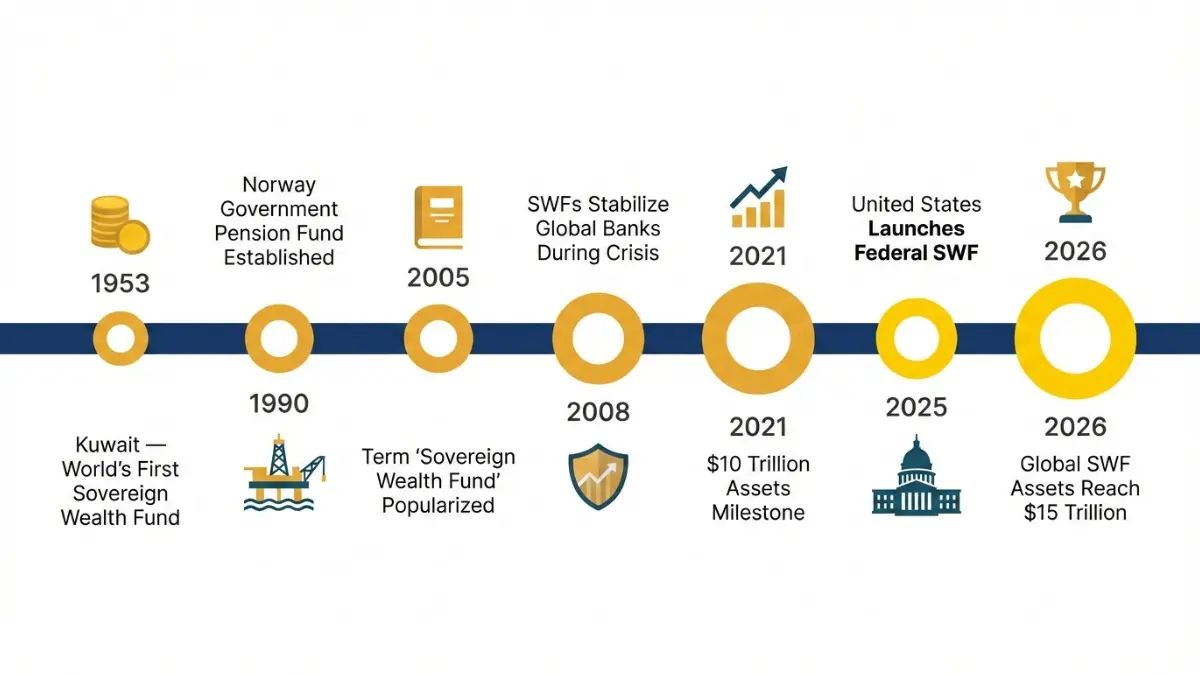
The term “sovereign wealth fund” was first coined in 2005 by economist Andrew Rozanov in the Central Banking Journal, though these funds have existed since 1953 when Kuwait established the world’s first one. According to the International Forum of Sovereign Wealth Funds (IFSWF), there are now over 90 active SWFs globally.
SWF vs. Other Investment Vehicles: Key Differences
| Feature | Sovereign Wealth Fund | Pension Fund | Hedge Fund | Central Bank Reserve |
|---|---|---|---|---|
| Owner | National government | Workers/employers | Private investors | Central bank |
| Purpose | National wealth growth | Retirement income | Maximum returns | Currency stability |
| Risk appetite | Medium-to-high | Conservative | High | Very low |
| Transparency | Varies widely | High | Low | High |
| Time horizon | Decades | 20–40 years | Short-to-medium | Short-term |
A Brief History: From $0 to $15 Trillion
- 1953: Kuwait Investment Authority founded — the world’s first SWF
- 1990: Norway creates its Government Pension Fund Global (GPFG), funded by North Sea oil
- 2005: The term “sovereign wealth fund” officially enters financial vocabulary
- 2007: China’s SWFs enter global markets for the first time
- 2008: SWFs collectively help stabilize global banks during the financial crisis
- 2021: Global AUM crosses $10 trillion
- February 2025: US President Trump signs executive order creating America’s first federal SWF
- January 2026: Global SWF assets hit a record $15 trillion (Bloomberg)
💡 What This Means For You: These funds own shares in thousands of companies — including the ones inside your 401(k) or retirement plan. Their trillion-dollar decisions directly impact stock prices you see in your portfolio today.
How Does a Sovereign Wealth Fund Work?
Where Does the Money Come From?
SWFs are funded through several channels:
- Commodity revenues — Oil, gas, and minerals (most common in the Middle East and Norway)
- Foreign exchange reserves surplus — Excess currency reserves beyond what’s needed for stability
- Government budget surpluses — Annual spending below revenues
- Privatization proceeds — Money raised from selling state-owned enterprises
- Trade surpluses — More exports than imports (common in Singapore and China)
The IMF explains sovereign debt and reserves management in detail — when countries accumulate excess reserves, channeling them into a sovereign wealth fund generates far higher returns than leaving them idle in a central bank.
What Do Sovereign Wealth Funds Actually Invest In?
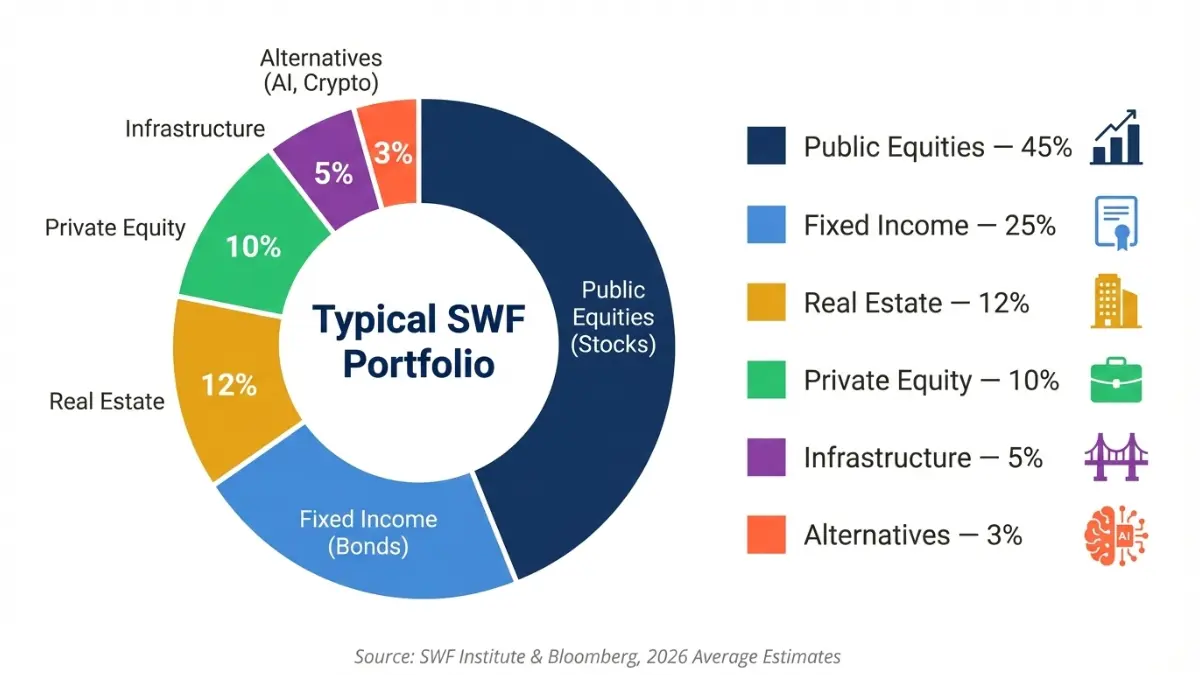
| Asset Class | Typical SWF Allocation | Real Example |
|---|---|---|
| Public Equities (Stocks) | 40–50% | Norway GPFG owns Apple, Nvidia, JPMorgan |
| Fixed Income (Bonds) | 20–30% | US Treasuries, corporate bonds |
| Real Estate | 10–15% | Manhattan offices, London Regent Street |
| Private Equity | 10–15% | VC funds, buyout deals |
| Infrastructure | 5–10% | Airports, toll roads, pipelines |
| Alternatives (AI, crypto) | 2–5% | Gulf SWFs backed OpenAI, Anthropic, xAI |
SWFs invest more like a sovereign version of an index fund — patient, diversified, long-horizon. If you understand how index funds vs. mutual funds work, SWF strategy follows similar diversification logic, just at a national scale.
Who Manages a Sovereign Wealth Fund?
- A Ministry of Finance or Central Bank provides oversight
- An independent board of directors sets investment strategy
- External fund managers (like BlackRock or Goldman Sachs) often handle specific asset classes
- Internal professional teams manage direct investments in real estate and private equity
💡 What This Means For You: When a sovereign wealth fund buys shares in a company, it becomes a major shareholder — which can influence executive pay, ESG policies, and corporate strategy. Norway’s GPFG has even voted against CEO compensation packages at US companies, directly affecting shareholder returns.
Types of Sovereign Wealth Funds + The Top 10 Ranked (2026)
The 5 Main Types of Sovereign Wealth Funds
Understanding the type of SWF tells you its risk appetite, purpose, and how it affects global markets:
- Stabilization Fund — Acts as a “rainy day buffer” against commodity price crashes. When oil prices collapse, this fund fills the government budget gap. Example: Russia’s National Wealth Fund
- Savings / Future Generation Fund — Converts today’s finite resource wealth into permanent financial capital for future citizens. These are the largest and most powerful SWFs. Example: Norway’s Government Pension Fund Global
- Reserve Investment Fund — Earns higher returns on foreign exchange reserves that exceed a country’s stability needs. Example: Singapore’s GIC Private Limited
- Development Fund — Deploys capital strategically into domestic economic sectors — technology, infrastructure, healthcare. Example: UAE’s Mubadala Investment Company
- Pension Reserve Fund — Pre-funds a country’s future pension obligations. Example: New Zealand Superannuation Fund
The 10 Largest Sovereign Wealth Funds in the World (2026)
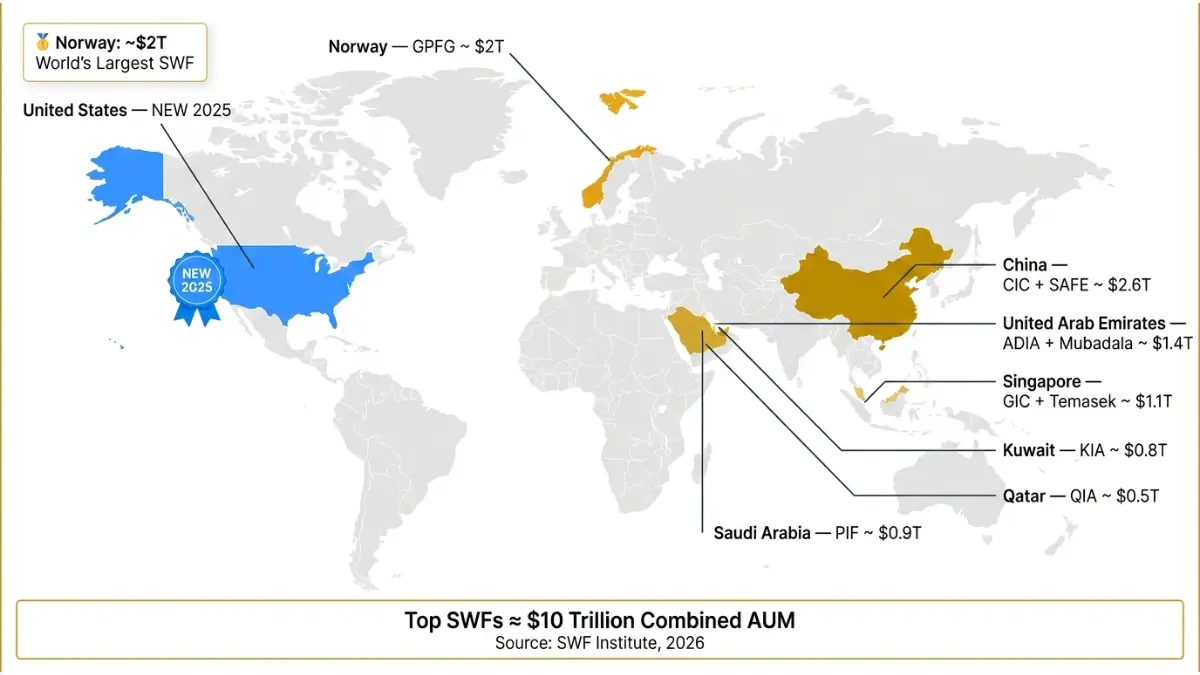
Source: SWF Institute, Bloomberg — January 2026
| Rank | Fund | Country | AUM (2026 Est.) | Founded | Type |
|---|---|---|---|---|---|
| 🥇 1 | Norway Government Pension Fund Global (GPFG) | 🇺🇸🇳🇴 Norway | ~$2.0T | 1990 | Savings |
| 🥈 2 | China Investment Corporation (CIC) | 🇨🇳 China | ~$1.35T | 2007 | Reserve |
| 🥉 3 | SAFE Investment Company | 🇨🇳 China | ~$1.25T | 1997 | Reserve |
| 4 | Abu Dhabi Investment Authority (ADIA) | 🇦🇪 UAE | ~$1.1T | 1976 | Savings |
| 5 | Saudi Public Investment Fund (PIF) | 🇸🇦 Saudi Arabia | ~$0.9T | 1971 | Development |
| 6 | Kuwait Investment Authority (KIA) | 🇰🇼 Kuwait | ~$0.8T | 1953 | Savings |
| 7 | GIC Private Limited | 🇸🇬 Singapore | ~$0.77T | 1981 | Reserve |
| 8 | Qatar Investment Authority (QIA) | 🇶🇦 Qatar | ~$0.5T | 2005 | Development |
| 9 | Mubadala Investment Company | 🇦🇪 UAE | ~$0.33T | 2002 | Development |
| 10 | Temasek Holdings | 🇸🇬 Singapore | ~$0.31T | 1974 | Strategic |
Combined Top 10 AUM: approximately $10 trillion
🔥 What Competitors Never Tell You: Norway’s Record-Breaking 2025
Norway’s GPFG posted a $247 billion profit in 2025 — its highest annual return since the fund’s creation in the 1990s, driven by surging technology and financial stocks. The fund now holds stakes in over 8,500 companies across 70+ countries, including Apple, Nvidia, and JPMorgan Chase. That’s one fund owning a piece of nearly every major corporation on Earth.
The SWF Institute’s global rankings database tracks all major funds in real time and is the most cited source for institutional AUM data.
💡 If you’re building long-term wealth like a sovereign fund does — patient, diversified, compound-driven — start with our compound interest guide to understand the math that makes trillion-dollar growth possible.
The US Sovereign Wealth Fund + 2026 Global Trends
Does the US Have a Sovereign Wealth Fund? Yes — As of 2025.
The short answer: Yes, as of February 2025. On February 3, 2025, President Trump signed an executive order directing the creation of the first US federal sovereign wealth fund. As of early 2026, the fund is still in its formation and initial funding phase.
This was a historic shift. The US had long resisted creating a federal SWF — unlike most oil-rich nations — because the federal government typically runs deficits rather than surpluses.
What Is the US SWF Designed to Do?
According to the executive order, the fund’s stated goals are:
- Promote fiscal sustainability and reduce the tax burden on Americans
- Create economic security for future generations
- Advance US economic and strategic leadership internationally
- Explore strategic investments (including a potential stake in TikTok)
- Fund infrastructure, medical research, and AI development
Proposed funding sources include:
- Tariff revenues
- Federal asset transfers
- Potential sovereign bond issuance
How the US SWF Compares to Norway’s Model
| Feature | Norway GPFG (World’s Largest) | US SWF (2025 EO) |
|---|---|---|
| Funding source | North Sea oil revenues | Tariffs + federal assets |
| Primary goal | Intergenerational savings | Strategic investment |
| Governance | Fully independent | Government-directed |
| Transparency | Highest globally | TBD — not yet established |
| AUM | ~$2 trillion | Not yet funded |
| Santiago Principles | Fully compliant | Not yet applicable |
The IMF’s sovereign debt and fiscal policy framework outlines the governance standards that well-run SWFs should follow — standards the US fund will need to establish to earn international credibility.
2026 Global SWF Trends You Need to Know
- 🤖 AI Investment Surge: Gulf SWFs invested over $15 billion into AI in 2025 alone — backing OpenAI, Anthropic, and xAI
- 📈 Saudi PIF expansion: On track to reach $2 trillion AUM by 2030
- 🇮🇩 Indonesia’s Danantara: Launched February 2025, targeting $900 billion in assets
- ⚠️ Transparency gap: 31% of SWFs still don’t fully disclose holdings or strategies
- 🌱 ESG pressure: Only 65% of SWFs meet basic ESG compliance standards
The Harvard International Review’s analysis on SWF growth trajectories and geopolitical challenges shows how these funds are increasingly blending economic and foreign policy objectives.
💡 What This Means For US Investors: A US SWF investing in tech and infrastructure could move stock valuations and influence interest rates — affecting your mortgage rate and retirement savings outlook. Use our debt consolidation calculator to stress-test your finances against potential rate shifts.
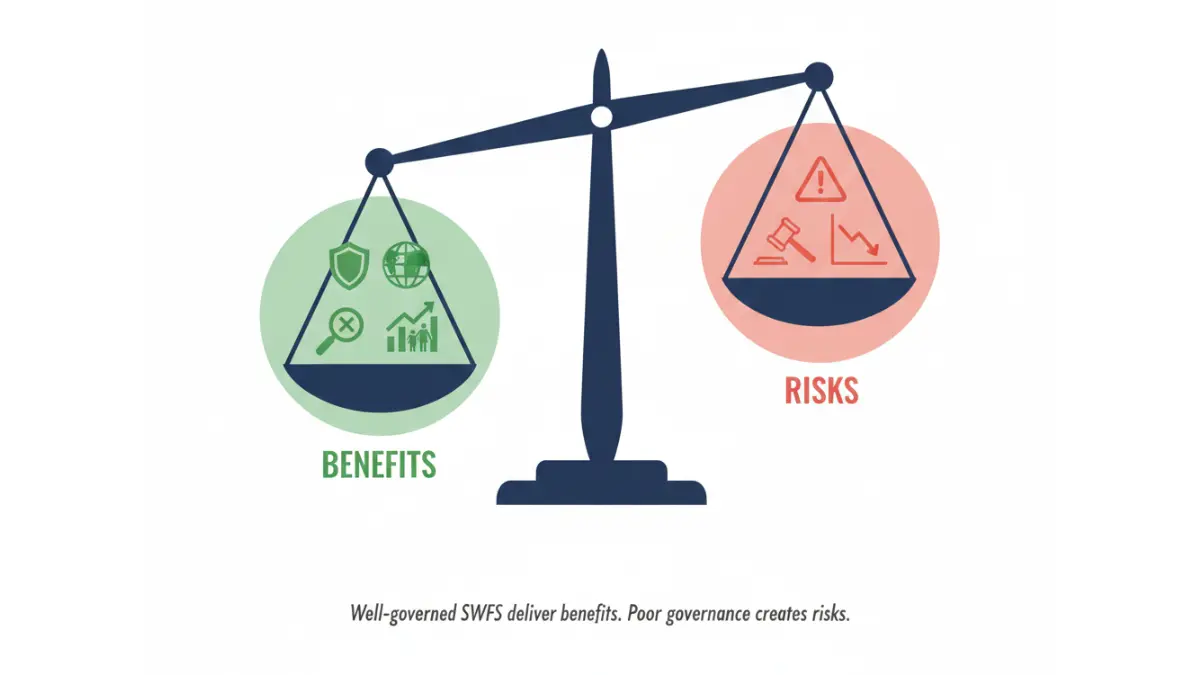
Sovereign Wealth Fund Pros, Cons, Real Risks & Notable Failures
Advantages of Sovereign Wealth Funds
- ✅ Economic stabilization — Provides a buffer when oil prices crash or recessions hit. Norway’s SWF was deployed during the 2008 financial crisis to prevent economic collapse.
- ✅ Intergenerational wealth — Converts finite natural resources into permanent financial assets for future citizens. Norway’s citizens will benefit from North Sea oil wealth long after the last barrel is pumped.
- ✅ Market diversification — Reduces national overdependence on a single commodity or sector.
- ✅ Strategic investment power — Funds domestic infrastructure, healthcare, AI research, and job creation.
- ✅ Crisis buffer — Gulf SWFs injected capital into Citigroup and other banks during 2008, stabilizing global credit markets.
Risks and Criticisms
- ⚠️ Lack of transparency — 31% of SWFs in 2025 disclosed no detailed holdings or investment strategies
- ⚠️ Political interference — SWF decisions can prioritize geopolitical goals over financial returns, distorting markets
- ⚠️ Corruption vulnerability — The 1MDB scandal in Malaysia resulted in $4.5 billion stolen from public funds
- ⚠️ Market distortion — Mega-funds buying large stakes can artificially inflate asset prices in target sectors
- ⚠️ Sovereign risk exposure — Oil price swings cause revenue fluctuations of up to ±20% for commodity-backed SWFs
Real SWF Failures: What Competitors Don’t Cover
1. Malaysia’s 1MDB (2009–2015) Malaysia’s state development fund, 1MDB, became one of the largest financial scandals in history. Over $4.5 billion was embezzled through shell companies, luxury assets, and bribes. The scandal implicated Goldman Sachs advisors, Prime Minister Najib Razak (later convicted), and financier Jho Low. It remains the clearest case study in what happens when SWF governance fails completely.
2. Venezuela’s FONDEN Venezuela’s development fund was systematically drained through political mismanagement and redirected into unsustainable social spending. When oil prices collapsed in 2014–2016, there was no financial cushion remaining — contributing to Venezuela’s complete economic collapse.
3. Algeria’s FRR Stabilization Fund Algeria’s rainy-day fund was depleted by prolonged low oil prices. When COVID-19 hit in 2020, the country had zero fiscal buffer remaining — forcing emergency borrowing and severe austerity measures.
Pros vs. Cons Quick Reference
| ✅ Advantage | ❌ Risk |
|---|---|
| Generational wealth preservation | Transparency and disclosure gaps |
| Economic shock buffer | Political interference and misuse |
| Long-term high returns | Corruption and embezzlement risk |
| Global diversification | Market distortion from mega-buys |
| Strategic national investment | Governance structure failures |
Understanding capital gains tax implications is critical for US investors who hold assets in sectors that SWFs actively target — because large SWF entries into a sector can dramatically change valuations and your tax exposure.
Frequently Asked Questions: Sovereign Wealth Fund
1: What is a sovereign wealth fund in simple terms?
A sovereign wealth fund (SWF) is a government-owned investment pool. Countries deposit surplus money from oil revenues, trade surpluses, or budget reserves and invest it globally to generate long-term returns for the nation.
2: Which is the world’s largest sovereign wealth fund in 2026?
Norway’s Government Pension Fund Global (GPFG) is the largest, managing approximately $2 trillion in assets as of 2026. It earned a record $247 billion profit in 2025, driven by tech and financial stocks.
3: Does the United States have a sovereign wealth fund?
Yes — as of February 2025, President Trump signed an executive order establishing the first US federal sovereign wealth fund. As of early 2026, it remains in its formation and funding stage with no formal AUM yet established.
4: How does a sovereign wealth fund make money?
SWFs invest in global equities, bonds, real estate, private equity, infrastructure, and increasingly AI. Norway’s fund returned approximately 13.5% in 2025, its highest annual return on record.
5: What is the difference between a sovereign wealth fund and a pension fund?
A pension fund provides retirement income to specific contributing workers. A sovereign wealth fund invests a nation’s surplus wealth for broader goals — future generations, economic stabilization, or strategic investment — with no specific liability to individual beneficiaries.
6: What are the 5 types of sovereign wealth funds?
The five types are: stabilization funds, savings/future generation funds, reserve investment funds, development funds, and pension reserve funds. Each has a distinct risk profile and investment mandate.
7: Why do countries create sovereign wealth funds?
To preserve windfall revenues from oil or trade surpluses, diversify national income sources, stabilize the economy during downturns, and build intergenerational financial security for citizens.
8: Are sovereign wealth funds transparent?
Transparency varies dramatically. Norway’s GPFG publishes every holding publicly. Qatar’s QIA is among the least transparent globally. The Santiago Principles — 24 governance standards drafted in 2008 under IMF guidance — set the international benchmark for SWF accountability.
9: Can a sovereign wealth fund fail or go bankrupt?
Yes. Notable failures include Malaysia’s 1MDB ($4.5B embezzled), Venezuela’s FONDEN (politically depleted), and Algeria’s FRR (exhausted by oil price crashes). Poor governance is the single most common cause of SWF failure.
10: How do sovereign wealth funds affect US investors?
SWFs are major shareholders in global companies. Their buying and selling decisions move stock prices, affect bond yields, and indirectly impact your 401(k), IRA, or investment portfolio. Gulf SWFs invested $15 billion in AI companies in 2025 — influencing tech valuations in portfolios worldwide.
11: What does the $15 trillion figure mean for the global economy?
As of January 2026, sovereign wealth funds collectively manage a record $15 trillion in assets — up 14%+ year-on-year. This makes SWFs one of the most powerful institutional investor classes on Earth, surpassing many national GDPs and capable of moving entire markets with a single allocation decision.
Expert Summary
“Sovereign wealth funds have evolved from niche oil savings vehicles into $15 trillion global powerhouses that shape financial markets, geopolitics, and even the AI investment landscape. Understanding how they work is no longer optional for any serious investor — because these funds already own a piece of the companies inside your portfolio.”
Understanding SWF mechanics is foundational to smart investing. Pair this knowledge with our retirement planning guide for your 30s and explore our full suite of financial tools to build your own long-horizon wealth strategy.
⚠️ Disclaimer: This article is for educational and informational purposes only and does not constitute financial, investment, or legal advice. Data is sourced from Bloomberg, IMF, CNBC, SWF Institute, and publicly available government records. Always consult a qualified, licensed financial advisor before making investment decisions. Past fund performance does not guarantee future results.

Informational disclaimer
The content on Finance Authority Hub is provided for general informational and educational purposes only and should not be considered personalized financial, investment, tax, legal, or professional advice. Financial decisions depend on your individual goals, income, risk tolerance, location, and regulatory situation. Before acting on any information, strategy, estimate, or calculator result, consult a qualified licensed professional who can evaluate your specific circumstances.