Here’s What Really Happens to Your 401(k) After a Layoff
When you’re laid off, your 401(k) doesn’t disappear—but one wrong move can cost you a 10% penalty plus 20% withholding. Here’s what to do first.
In This Article
Getting laid off is stressful enough without wondering whether your retirement savings vanished. The reassurance first: when you’re laid off, the money in your 401(k) is still yours. You don’t lose your vested savings — you just decide where that money goes next.
What happens next depends mostly on two things: how much is in the account, and how old you are. Small balances may be moved automatically by your former employer. At 55 or older, a special rule may let you tap the account without the usual penalty.
This guide is for the person who just got the news. Need cash now? Read what cashing out really costs before touching a dollar. Weighing options calmly? Start with the four-option breakdown. 55 or older? Skip to the Rule of 55.
ℹ️ Financial Disclaimer: This article is for educational purposes only and is not personalized investment, tax, or retirement advice. Decisions about withdrawing, rolling over, or investing 401(k) money — and their tax consequences — depend on your specific situation. Consult a fiduciary financial advisor or a CPA before you act.
Is your 401(k) money safe after a layoff?
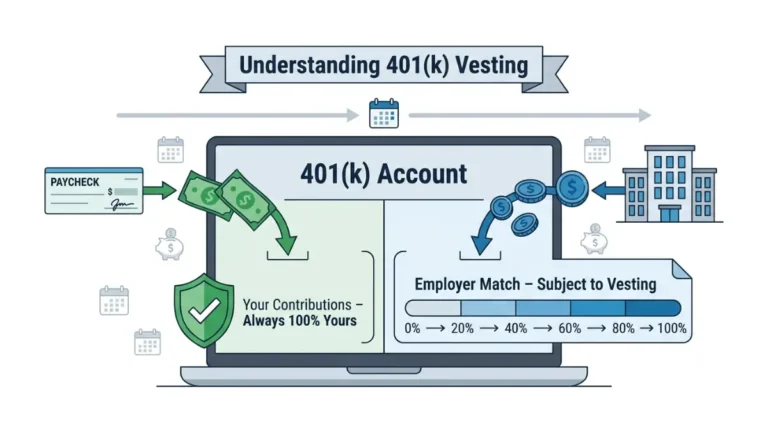
The money you personally contributed to your 401(k) is always 100% yours, however you leave. A layoff doesn’t touch your vested balance — it only changes what you can do with the account. What can be at risk is part of the employer match, and only if you haven’t fully vested.
What you always keep: your own contributions
Every dollar you contributed from your paycheck is fully vested from day one, and that portion plus its growth follows you out. Once you leave, you can’t contribute to that plan anymore, so the 2026 401(k) contribution limits no longer apply to your account there.
The employer match and vesting schedules
Employer contributions often come with a vesting schedule you work through before the money is fully yours.
🔍 How It Works: Cliff vesting gives you 100% of the match at once after a set period, and nothing if you leave earlier. Graded vesting hands you a rising percentage each year until you hit 100%.
If you left before fully vesting, you may forfeit part of the match — but never your own contributions. Your exact schedule is in your Summary Plan Description; our guide to how 401(k) vesting works covers the timelines.
Your four options for a 401(k) after being laid off
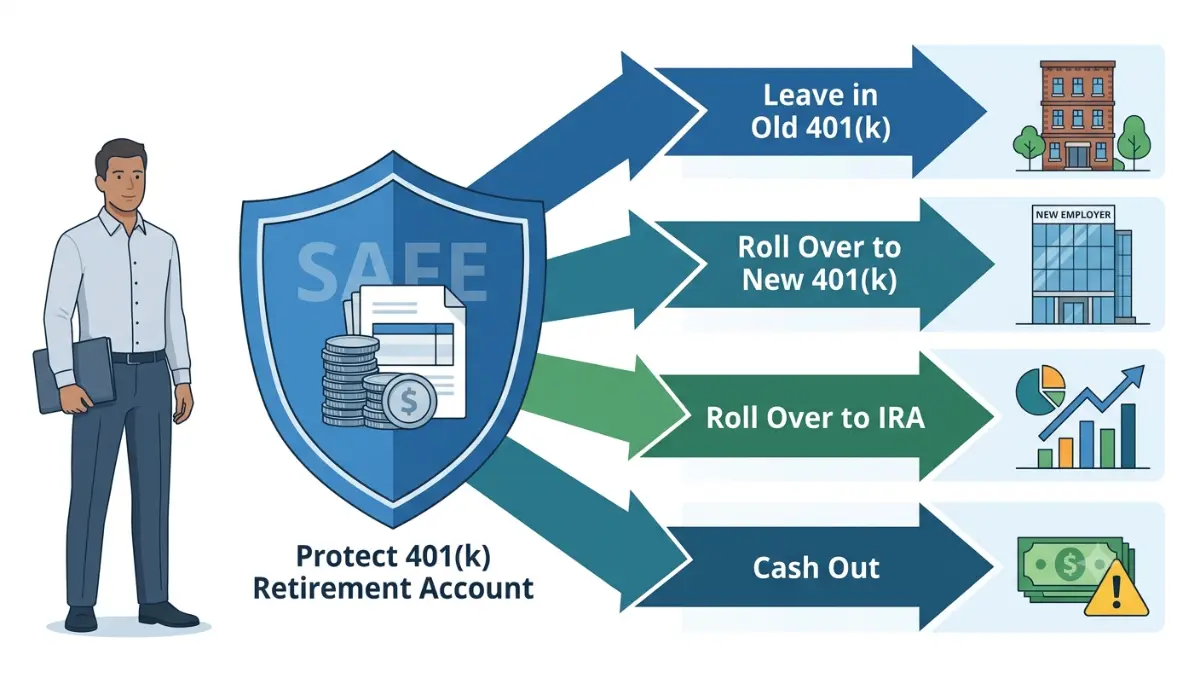
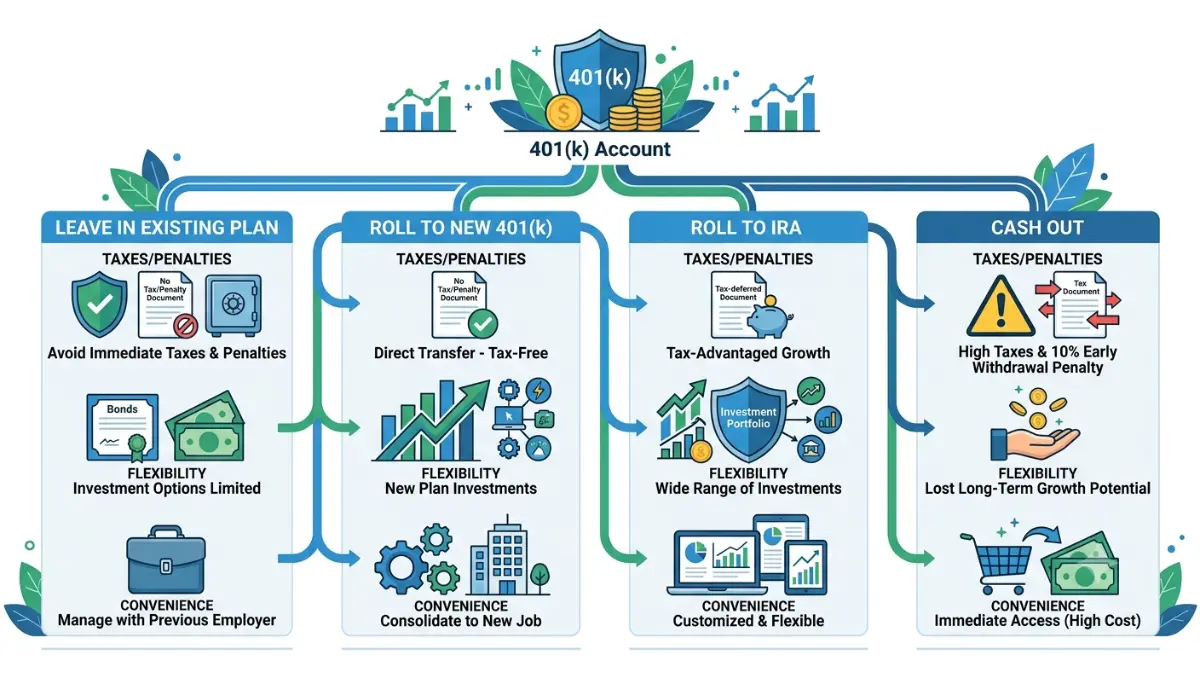
After a layoff you generally have four choices for your 401(k), plus one thing that can happen automatically if you do nothing. Each option carries a different tax consequence.
Per IRS distribution rules for 401(k) plans, most people leaving a job can leave the money, roll it to a new 401(k), roll it to an IRA, or cash it out. FINRA’s guidance on rollover choices notes that in the first three, your vested savings and earnings stay intact.
| Option | What it means | Tax impact | Best for |
|---|---|---|---|
| Leave it in the old plan | Keep your money in your former employer’s 401(k) | None now; grows tax-deferred | Balances over $7,000; you like the plan’s funds and fees |
| Roll to a new 401(k) | Move it into your current job’s plan | None, if done as a direct rollover | You have a new job with a plan that accepts rollovers |
| Roll to an IRA | Move it into an individual retirement account | None, if done as a direct rollover | You want more investment choices |
| Cash it out | Take the money as a check | Ordinary income tax + likely a 10% penalty | Rarely the best move before age 59½ |
Source: IRS 401(k) Resource Guide; FINRA. Assumes a traditional (pre-tax) 401(k).
Model how leaving the money invested compares with cashing out in our 401(k) growth calculator.
What happens if you do nothing: the small-balance cash-out
⚠️ Costly Mistake: If your vested balance is under $1,000, the plan may send you a check without your consent — and if you don’t redeposit it, you’ll owe tax and possibly a penalty. Between $1,000 and $7,000, the plan may auto-roll it into an IRA in your name (the threshold rose from $5,000 to $7,000 under SECURE 2.0). This force-out is optional, so check what your plan does.
What cashing out your 401(k) really costs
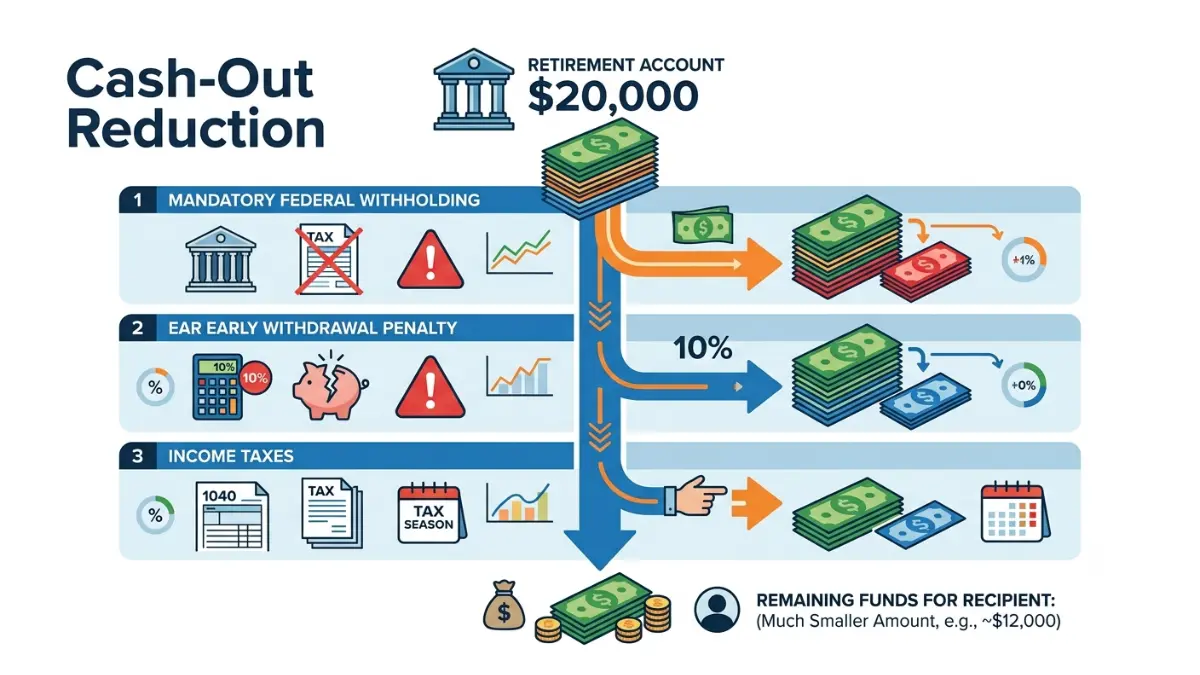
Cashing out a traditional 401(k) before age 59½ usually triggers three costs that stack on top of each other.
The three costs that stack up
First, the withdrawal is added to your ordinary income and taxed at your marginal rate. Second, under 59½, the IRS adds a 10% early withdrawal penalty, per the IRS’s early-distribution rules. Third, your plan withholds 20% before the check reaches you.
🔍 How It Works: The 20% withholding isn’t a fourth cost — it’s a prepayment toward the income tax you already owe. Above a 20% rate, you’ll owe more at filing; below it, some comes back.
A $20,000 cash-out, step by step
Illustrative example for someone under 59½ in a 22% federal bracket:
| Step | Amount |
|---|---|
| Gross 401(k) balance cashed out | $20,000 |
| 20% mandatory withholding (prepaid tax) | –$4,000 |
| Check you actually receive | $16,000 |
| 10% early withdrawal penalty | –$2,000 |
| Remaining income tax (22% = $4,400, minus $4,000 withheld) | –$400 |
| Estimated net after federal tax + penalty | ~$13,600 |
Illustrative only; excludes state tax. Source: IRS Topic 558; Topic 413. Your result depends on your bracket.
✅ Action Step: Before cashing out, ask a CPA: “What’s my real marginal rate on this money, and will the 20% withheld cover what I’ll owe?” See our guide to 401(k) early withdrawal penalties.
How to roll over your 401(k) without triggering taxes
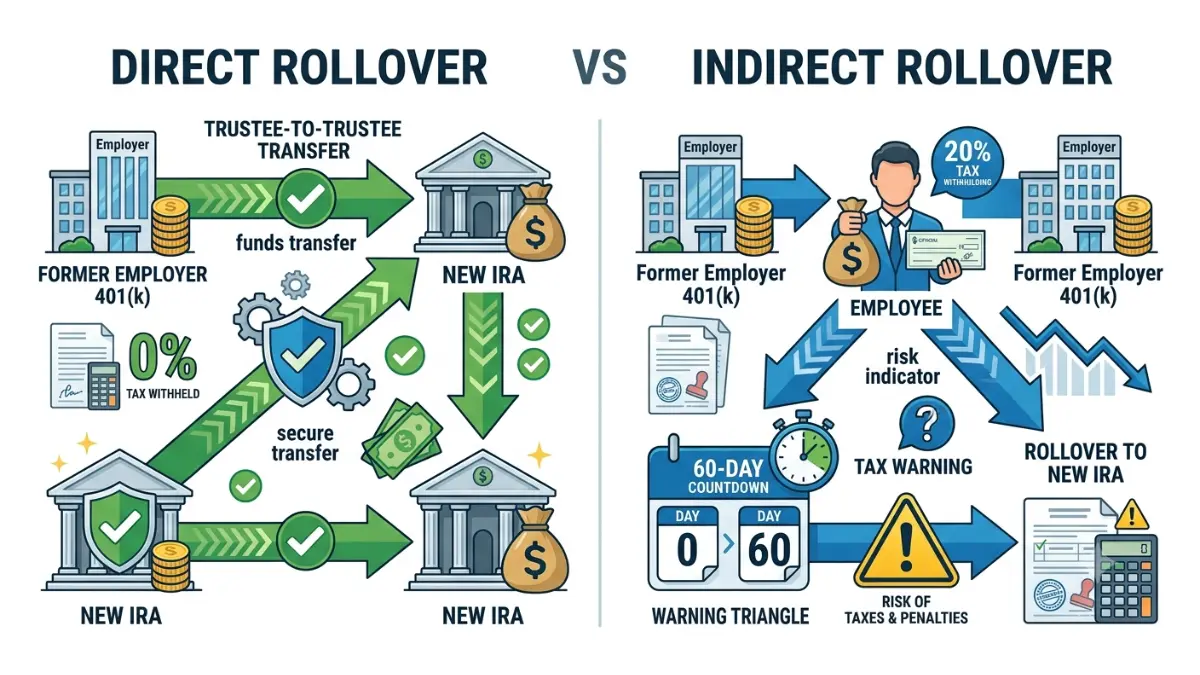
To keep your retirement money growing without owing tax, a rollover is the way — but the method matters. The safe path is a direct rollover; the risky one is an indirect rollover.
Direct rollover vs. indirect rollover
In a direct (trustee-to-trustee) rollover, your old plan sends the money straight to your new account. Per IRS rollover guidance, no tax is withheld and it isn’t taxable. In an indirect rollover, the check comes to you to redeposit yourself.
⚠️ Costly Mistake: With an indirect rollover, your plan withholds 20% — a $20,000 balance arrives as $16,000. To complete a full tax-free rollover you must deposit the entire $20,000 within 60 days, covering the missing $4,000 yourself. Miss the 60-day deadline and the shortfall becomes taxable, plus a possible penalty.
Step-by-step: a direct rollover
- Open the destination account first — a new employer’s 401(k) or a rollover IRA.
- Ask your old plan administrator for a direct (trustee-to-trustee) rollover.
- Make sure any check is payable to the receiving institution, not to you.
- Confirm the funds arrive and are actually invested.
Our full walkthrough covers every step in how to roll over a 401(k) to an IRA.
The Rule of 55: penalty-free access if you’re laid off at 55 or older
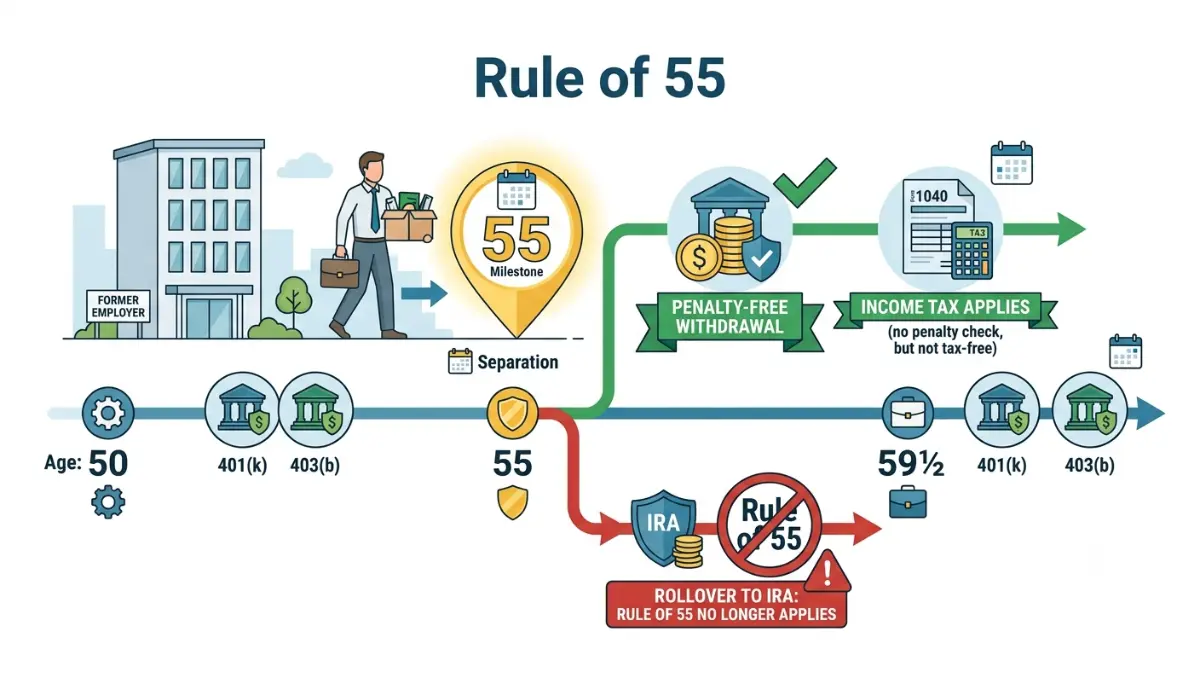
If your layoff happens in or after the calendar year you turn 55, you may withdraw from that employer’s 401(k) without the 10% penalty. This is the Rule of 55 — valuable, and often misunderstood.
How the Rule of 55 works
The rule waives the early withdrawal penalty on distributions from the plan of the employer you just left, if you separated in or after the year you turned 55.
🔍 How It Works: The reason for separation doesn’t matter — laid off, fired, or quit all qualify. Certain public safety workers (police, firefighters, EMTs, air traffic controllers) may qualify at 50. Income tax still applies; only the penalty is waived.
The mistake that forfeits it
⚠️ Costly Mistake: The Rule of 55 applies only to your former employer’s plan — not IRAs. Roll that 401(k) into an IRA and you permanently lose penalty-free access. If you might need the money before 59½, leaving it in the plan preserves that option.
Other exceptions if you’re unemployed
Other early withdrawal exceptions may apply — our guide to 401(k) early withdrawal exceptions lists them. The IRS’s list of penalty exceptions includes substantially equal periodic payments, total disability, and medical expenses above 7.5% of income.
💡 Expert Note: Commonly misapplied: the health-insurance-premium exception for the unemployed applies to IRA withdrawals, not 401(k) withdrawals. Don’t assume it covers money still in your workplace plan.
✅ Action Step: If you’re 55+ and may need this money before 59½, ask a fiduciary advisor: “Should I keep this in the plan to preserve Rule-of-55 access?” More in our guide to the Rule of 55.
Costly mistakes to avoid with your 401(k) after a layoff
You know your options — here’s how to avoid the expensive missteps people make after a layoff. Most come down to panic or forgetting the account exists.
Don’t cash out for a short-term crunch
Cashing out feels fast, but before 59½ it’s usually costliest — the penalty, the tax, and the growth you give up.
⚠️ Costly Mistake: A $20,000 cash-out costs more than today’s penalty and tax; it costs decades of compounding. Left invested, that balance could grow into far more by retirement. Run the numbers in our compound interest calculator before deciding the cash is worth it.
Don’t lose track of a small or old account
Small balances are easy to forget, especially once force-rolled into an IRA whose mail you never open.
✅ Action Step: List every retirement account you’ve held and where it sits now. If one has slipped off your radar, our guide on how to find an old 401(k) walks through the search.
401(k) after a layoff: frequently asked questions
1. Do I lose my 401(k) if I get laid off?
No. The money you contributed is always 100% yours, and any employer match is yours to the extent you’re vested. A layoff doesn’t erase your vested balance — it just means you choose what to do with the account next, whether that’s leaving it, rolling it over, or cashing it out.
2. Is my employer’s matching money safe if I’m laid off?
It depends on your vesting schedule. Fully vested, the match is yours. If you left partway through a cliff or graded schedule, you may forfeit some or all of the unvested match. Check your Summary Plan Description for your exact vested status before making any move.
3. What are my options for my 401(k) after a layoff?
Four: leave it in your former employer’s plan, roll it into your new 401(k), roll it into an IRA, or cash it out. Cashing out is usually the costliest choice before age 59½. If your balance is small and you do nothing, the plan may move it automatically.
4. How long do I have to move my 401(k) after being laid off?
If your vested balance is over $7,000, there’s generally no deadline to leave it in the plan. But if you take the money as a check through an indirect rollover, you have 60 days to redeposit it into another retirement account to avoid tax and a possible penalty.
5. How much tax do I pay if I cash out my 401(k)?
Before age 59½, a traditional-401(k) cash-out faces a 10% penalty plus ordinary income tax at your marginal rate, with 20% withheld upfront. The 20% is a prepayment toward what you owe, not an extra cost. Consult a CPA to estimate your specific bill.
6. What is the 20% withholding on a 401(k) distribution?
When a taxable distribution is paid directly to you, the IRS requires 20% federal withholding, even if you plan to roll it over. A direct (trustee-to-trustee) rollover avoids withholding entirely, which is a key reason it’s usually the better method for moving your money.
7. Can my old employer cash out my 401(k) without asking me?
Possibly, for small balances. If your vested balance is under $1,000, the plan may send you a check. Between $1,000 and $7,000, the plan may roll it into an IRA in your name. Over $7,000, you cannot be forced out and can leave it where it is.
8. Should I roll my 401(k) into an IRA or my new job’s plan?
Both avoid taxes when done as direct rollovers. An IRA usually offers more investment choices; a new 401(k) may offer lower fees, a loan option, and preserves Rule-of-55 access. If you’re 55+ and may need the money before 59½, weigh that carefully with a fiduciary advisor.
9. What is the Rule of 55?
It lets you take penalty-free withdrawals from the 401(k) of the employer you just left, if your separation happened in or after the calendar year you turn 55 (age 50 for qualifying public-safety workers). Income tax still applies. Rolling the money to an IRA permanently forfeits this benefit.
10. Can I withdraw from my 401(k) if I’m unemployed?
Yes, but before 59½ you’ll generally owe the 10% penalty unless an exception applies — such as the Rule of 55, substantially equal periodic payments, disability, or large medical expenses. The health-insurance-premium exception for the unemployed applies to IRAs, not 401(k)s. Consult a tax professional first.
11. What happens to my 401(k) loan if I get laid off?
An unpaid 401(k) loan is typically treated as a distribution (a “loan offset”) when you leave. You can usually avoid tax and penalty by depositing the offset amount into an IRA or new plan by your tax-filing due date, including extensions. Our guide on 401(k) loans vs. withdrawals explains the tradeoffs.
The bottom line on your 401(k) after a layoff
A layoff doesn’t cost you your retirement savings. Your own contributions are always yours, your vested match comes with you, and you have four paths: leave it, roll it to a new plan, roll it to an IRA, or cash it out. Cashing out before 59½ is usually the most expensive; a direct rollover moves your money tax-free. If you’re 55 or older, the Rule of 55 may give penalty-free access — just don’t roll to an IRA first if you’ll need it. For a personal decision, a fiduciary advisor or CPA can weigh the tradeoffs against your full financial picture.
Informational disclaimer
The content on Finance Authority Hub is provided for general informational and educational purposes only and should not be considered personalized financial, investment, tax, legal, or professional advice. Financial decisions depend on your individual goals, income, risk tolerance, location, and regulatory situation. Before acting on any information, strategy, estimate, or calculator result, consult a qualified licensed professional who can evaluate your specific circumstances.