Annuity vs. CD, Explained for the Money You Can’t Lose
Annuity vs. CD: a MYGA can pay 1–2 points more than a CD, but it locks up your money and isn’t FDIC-insured. Here’s how to weigh the higher yield.
In This Article
A bank just offered to renew your maturing CD at one rate, and an insurance agent is quoting an annuity paying noticeably more. The instinct to ask “what’s the catch?” is the right one.
This guide compares the two for a single job: where to park safe money you don’t want to lose. If your CD is coming due and you’re weighing whether to roll it over, start with the rate gap below. If an annuity pitch landed and you want the trade-offs before signing, the costs and safety sections are for you. If protecting your principal is the only thing that matters, read how the two safety nets differ.
A higher yield here is real — but it’s bought with your access to the money and a different kind of guarantee. By the end, you’ll have a clear rule for which fits your timeline. For the full picture of how annuities actually work and what they cost, see the pillar guide.
ℹ️ Financial Disclaimer: This article is for educational purposes only and is not investment, tax, insurance, or financial advice. Annuities and CDs carry investment, insurance, and tax considerations that vary by product, institution, and state, and rates and rules change frequently. Before moving any money, consult a fiduciary financial advisor and a CPA or tax professional about your specific situation.
What’s the real difference between a CD and an annuity?
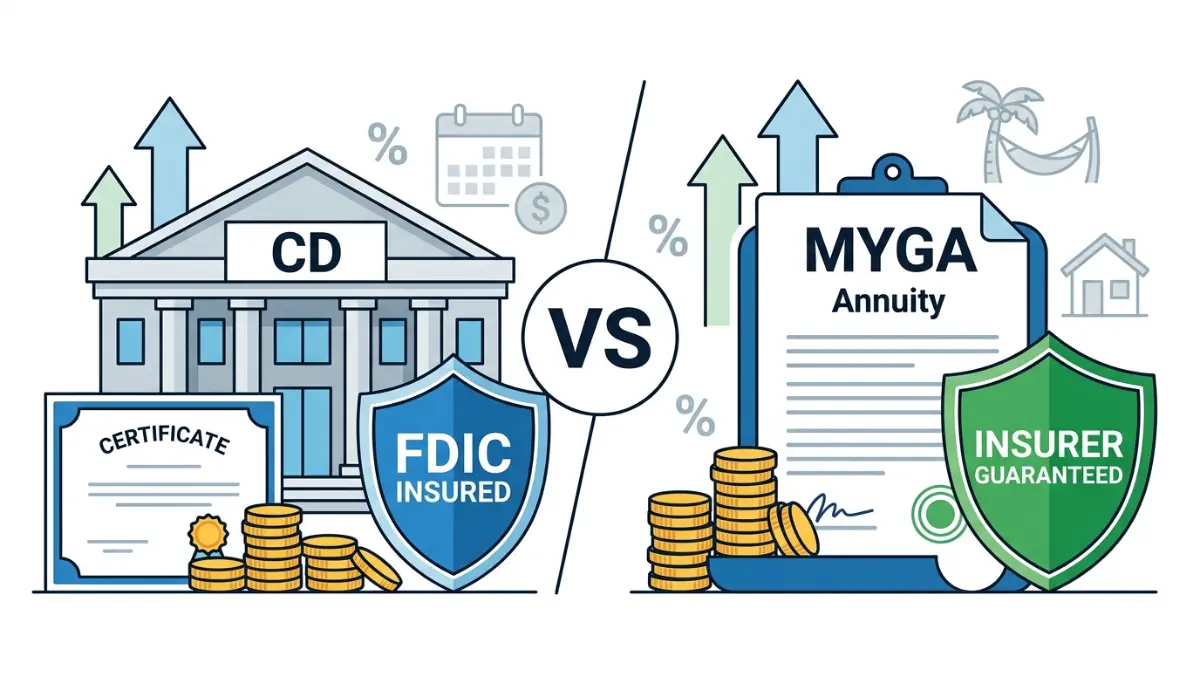
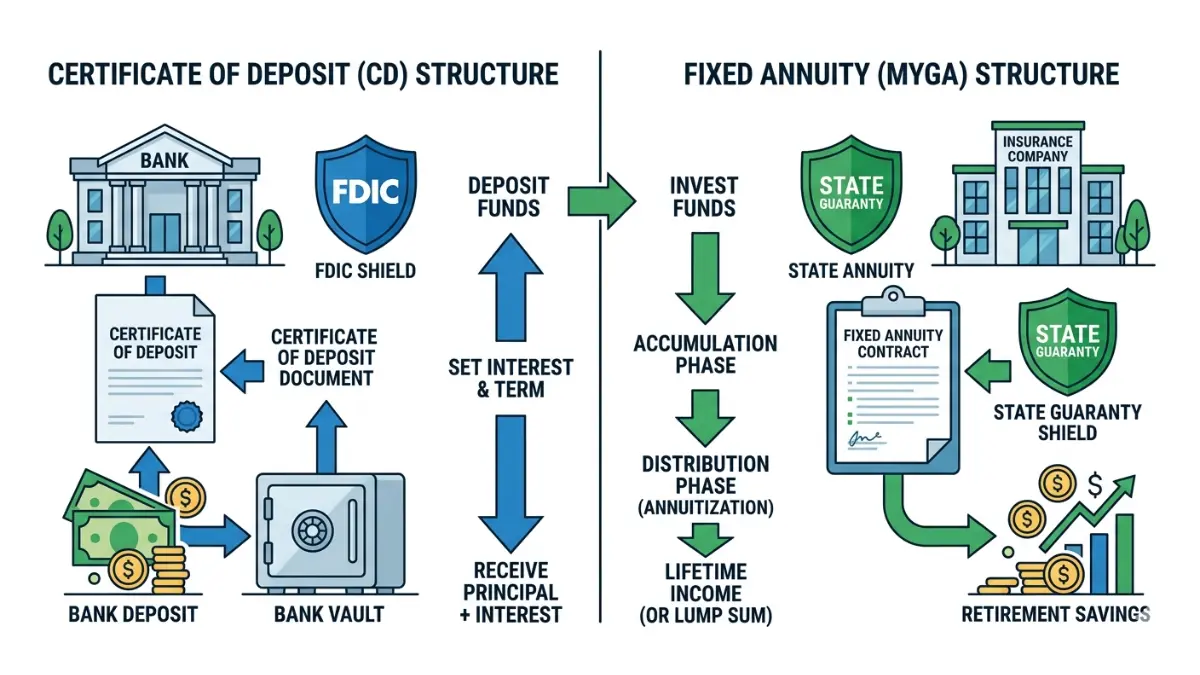
A certificate of deposit is a deposit account at a bank or credit union that pays a fixed rate for a set term. An annuity is a contract with an insurance company. That one difference — bank deposit versus insurance product — drives every advantage and drawback that follows.
A CD is a bank deposit
You hand a bank a lump sum, it pays a guaranteed rate for a chosen term (often three months to five years), and you collect your money plus interest at maturity. Withdraw early and you typically pay a penalty. Your deposit is insured by the FDIC at banks, or the NCUA at credit unions.
A MYGA is an insurance contract
The closest annuity to a CD is a multi-year guaranteed annuity (MYGA) — a fixed annuity that locks a guaranteed rate for a set term, usually three to ten years. It’s worth understanding how a fixed annuity (MYGA) works in detail, but the key point is that an insurance company, not a bank, stands behind the rate.
Why this compares CDs to fixed annuities
Annuities come in several forms — variable, indexed, immediate — with very different risk profiles. This comparison sticks to fixed annuities and MYGAs because they’re the apples-to-apples match for a CD. If you’re weighing other kinds, review the main types of annuities first.
Annuity vs. CD rates: how big is the gap right now?
As of mid-2026, top fixed annuities pay meaningfully more than top CDs — but the size of the gap depends on the term and the day you check.
| Safe-money option (mid-2026) | Recent rate | Backed by | Key detail |
|---|---|---|---|
| Top 1-year CD | ~4.00%–4.15% APY | FDIC / NCUA | Fully liquid at maturity |
| National average 1-year CD | 1.97% APY | FDIC / NCUA | What most savers actually earn |
| Top 5-year MYGA | ~5.00%–6.50% | Insurance company + state guaranty | Rate locked for the full term |
Rates as of mid-June 2026. CD figures: Bankrate and NerdWallet. MYGA range: multiple annuity marketplaces (Annuity.org, MyAnnuityStore, SafeMoney). Verify current rates before acting.
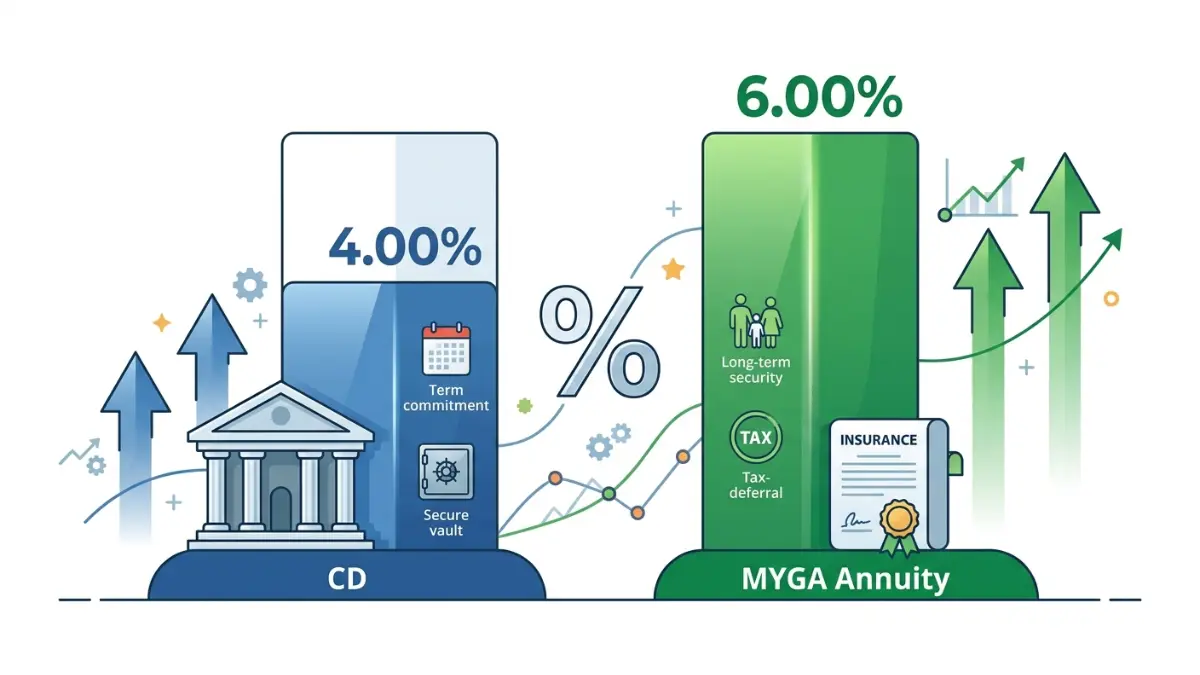
Across marketplaces, fixed annuities generally run about one to two percentage points above an equivalent-term CD. The dispersion is real: on a single day in June 2026, advertised top five-year MYGA rates ranged from roughly 5.00% to 6.50% depending on the carrier and your state. Treat any single number as a starting point and check current annuity rates by term length before deciding.
📊 Data Point: The Federal Reserve held its benchmark rate at a target range of 3.50%–3.75% on June 17, 2026 — Source: Federal Reserve, 2026. With short-term rates steady, CD and annuity yields have held near current levels rather than falling, per the Federal Reserve’s June 2026 policy statement.
Even a top CD only modestly outpaces recent inflation, which has run near 3.8% year over year, so it helps to see what inflation does to a fixed rate of return before locking in.
💡 Expert Note: A common point of confusion is treating a higher headline rate as a higher return. Until you account for taxes, liquidity, and the term length, the rate alone doesn’t tell you what you’ll actually keep.
What the higher yield actually nets you (a $100,000 example)
CD interest is taxed every year as ordinary income; a MYGA’s growth is tax-deferred until you withdraw. That difference, plus the rate gap, decides what you actually keep. The table below puts $100,000 in each for five years, using a representative top CD rate of 4.10% and a mid-range MYGA rate of 5.50%.
| $100,000 over 5 years | Top CD (~4.10%) | MYGA (~5.50%) | Key detail |
|---|---|---|---|
| Value at maturity (before tax) | ~$122,300 | ~$130,700 | The higher rate compounds |
| When the interest is taxed | Every year | At withdrawal | Deferral helps non-IRA money |
| Approx. after-tax gain | ~$17,000 | ~$24,000 | Gap narrows, MYGA still leads here |
Illustration computed by FinanceAuthorityHub from the mid-2026 rates above, compounded annually. Assumes a 22% federal bracket, no state tax, non-retirement-account money, and a holder age 59½ or older. Your bracket, state, and timing change these results.
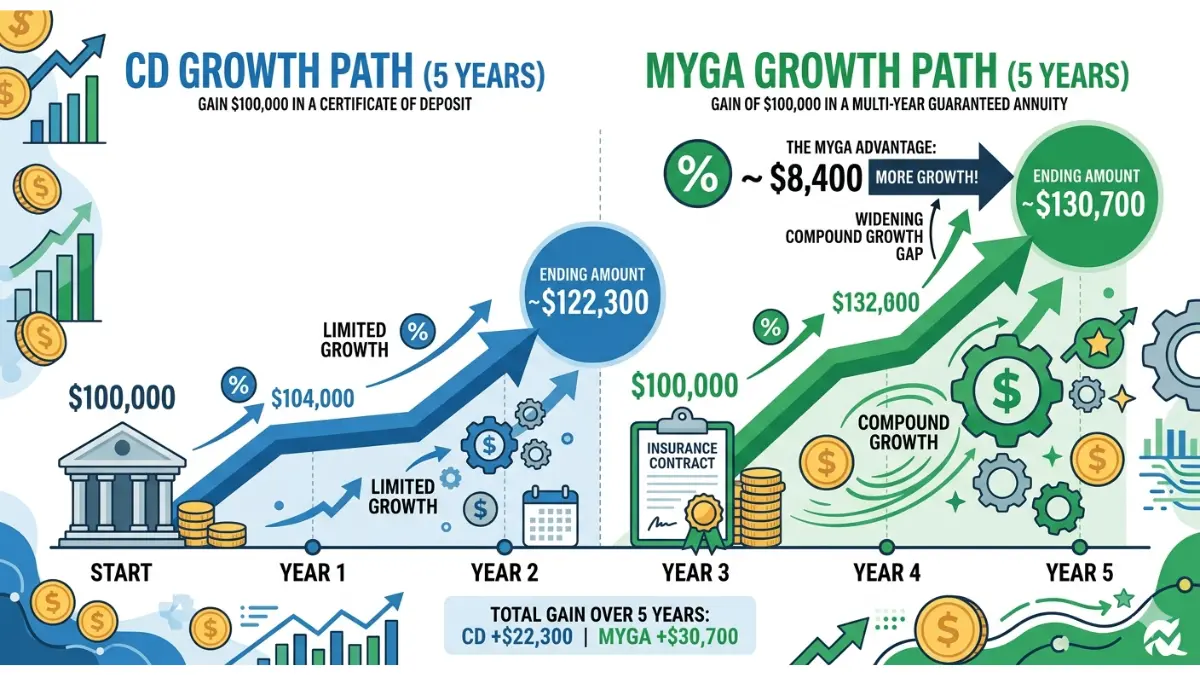
🔍 How It Works: Compounding means each year’s interest earns interest the next year. At 5.50%, year one on $100,000 adds $5,500; year two earns 5.50% on $105,500, and so on — which is why a small rate gap widens over five years. You can model the compounding yourself with different rates, or estimate a CD’s interest at maturity for the bank side.
Change one assumption and the math shifts. If you’re under 59½ and cash out the annuity early, the IRS adds a 10% penalty on the taxable portion (covered next), which can erase much of the edge — before any surrender charge. Deferral only helps if you hold non-retirement money and expect a similar or lower bracket later; inside an IRA both grow tax-deferred already, so how annuities are taxed compared with an IRA is worth a look.
CD interest is taxable in the year it’s credited, even if you don’t withdraw it, and you’ll receive a Form 1099-INT for $10 or more — see the IRS rule on interest you receive.
The real costs and trade-offs of choosing an annuity
Both protect your principal, but through different systems and with different strings. A CD is insured by the FDIC up to $250,000; an annuity is backed by your state’s insurance guaranty association, typically to $250,000 of present value.
Surrender charges and the market value adjustment
A MYGA usually lets you withdraw up to 10% per year without penalty, but taking more during the surrender period triggers a surrender charge — a declining fee that often starts around 7% in year one and steps down to zero by the end of the term. Some contracts add a market value adjustment that can raise or lower your payout based on rate moves since purchase. For the complete picture, see the full breakdown of annuity fees.
🔍 How It Works: A surrender charge exists because the insurer buys long-term bonds to back your rate; cashing out early forces it to unwind that position, so the fee — and any market value adjustment — passes that cost to you. Both disappear once the surrender period ends.
The 10% early-withdrawal penalty before 59½
Separate from any surrender charge, the IRS adds a 10% penalty on the taxable portion of an annuity withdrawal taken before age 59½ — see the IRS rule on early distributions. A CD has no age rule, but breaking it early costs an interest penalty, commonly a few months’ interest depending on the term.
⚠️ Costly Mistake: Buying a MYGA with money you might need before the term ends. If you’re under 59½ and withdraw early, you can face a surrender charge, a possible market value adjustment, and a 10% IRS penalty on the gain — three hits at once.
FDIC vs. state guaranty: a different kind of safety
This is the difference savers most often miss: an annuity is not FDIC-insured. The FDIC confirms that annuities and other insurance products are not covered by deposit insurance — see the FDIC’s coverage details. Instead, a state guaranty association covers annuities if the insurer fails, usually up to $250,000 of present value per owner, per insurer — though limits run from about $100,000 to $500,000 by state, and California, for example, covers 80% up to $250,000.
When a CD wins and when an annuity wins
A quick way to decide:
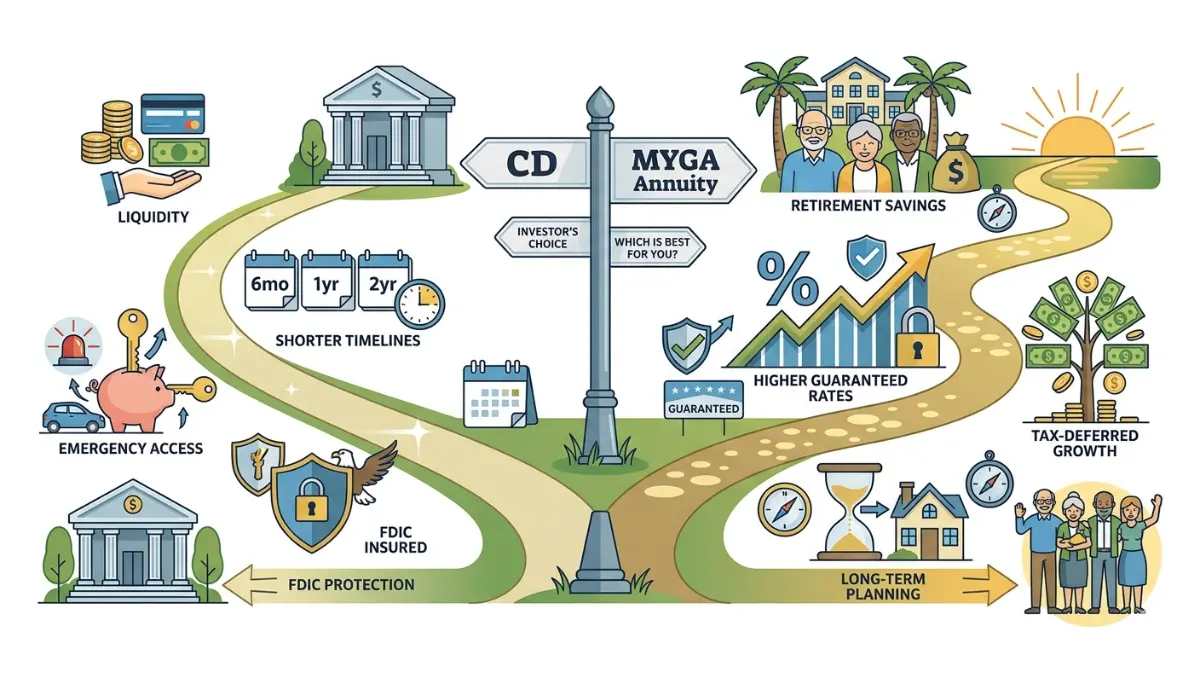
Choose a CD when:
- You may need the money within about one to five years.
- You want full access at maturity with no age rules.
- You’re holding it inside an IRA, where tax deferral adds nothing extra.
Consider a MYGA when:
- The money is earmarked for retirement and you won’t touch it before 59½.
- You want a higher locked rate and can commit for the full term.
- You’ve filled easier-access savings and want tax deferral on non-IRA money.
Age 59½ is the dividing line that does the most work. Money you might need before then generally belongs in a CD or a short CD ladder, where an early exit costs only interest, not a 10% IRS penalty. For a closer product-level comparison, see a closer look at MYGAs versus CDs; to size the decision against your broader plan, see how this fits your retirement income plan.
✅ Action Step: Ask a fee-only fiduciary advisor: “Given my income needs, timeline, and tax bracket, does locking this money in an annuity beat a CD or CD ladder for me?” A fiduciary is legally held to act in your interest.
Mistakes people make comparing annuities and CDs
The errors below all trace back to the same root: treating a higher rate as a higher return.
Chasing the rate without the math
A 6% headline can net less than a 4% CD once annual taxes, the term, and an early-exit penalty are counted — as the example above showed. Run your own numbers before you sign anything.
Assuming an annuity is FDIC-safe
An annuity’s guarantee comes from an insurance company and your state’s guaranty association, not the FDIC. Within those limits your principal is protected, but the safety net is different — which is why the insurer’s financial strength rating matters.
Locking up money you’ll need
The free-withdrawal allowance, often 10% a year, is the only easy access during the surrender period. Money for near-term needs shouldn’t go into a multi-year contract.
⚠️ Costly Mistake: Putting your emergency fund in either a long CD or an annuity. Both penalize early access; cash you may need quickly belongs in a liquid high-yield savings account instead.
Annuity vs. CD: frequently asked questions
1. Is an annuity better than a CD?
Neither is universally better in the annuity vs. CD decision — it depends on your timeline. A CD usually wins for money you may need within about one to five years; a fixed annuity (MYGA) can win for retirement money you won’t touch before 59½ and want to grow at a higher locked rate. Consult a fiduciary advisor about your situation.
2. Do annuities pay more than CDs?
Generally yes. As of mid-2026, top fixed annuities paid roughly one to two percentage points more than equivalent-term CDs, with top five-year MYGA rates ranging from about 5.00% to 6.50% versus top CDs near 4.00%–4.15%. Rates change often, so verify current figures before deciding.
3. Are annuities FDIC insured?
No. Annuities are insurance products, not bank deposits, so they aren’t covered by FDIC insurance. Instead, a state guaranty association protects them if the insurer fails — typically up to $250,000 of present value per owner, per insurer, though limits vary by state. Check your state’s limit and the insurer’s rating before buying.
4. How are annuities and CDs taxed differently?
CD interest is taxed every year as ordinary income and reported on Form 1099-INT, even if you don’t withdraw it. A MYGA’s growth is tax-deferred until you take money out, when it’s also taxed as ordinary income. Deferral mainly helps non-retirement-account money. Ask a CPA how this applies to your bracket.
5. What is a MYGA?
A multi-year guaranteed annuity (MYGA) is a fixed annuity that locks in a guaranteed interest rate for a set term, usually three to ten years. It’s the closest annuity to a CD, but an insurance company stands behind the rate instead of a bank, and the money is meant to stay put for the full term.
6. What’s the penalty for withdrawing from an annuity early?
If you withdraw before age 59½, the IRS adds a 10% penalty on the taxable portion, on top of ordinary income tax. Separately, taking more than the free-withdrawal amount during the surrender period triggers a surrender charge. Certain exceptions apply, so consult a tax professional before making an early withdrawal.
7. What is a CD early withdrawal penalty?
Breaking a CD before maturity usually costs a set amount of interest — commonly a few months’ worth, with longer terms carrying larger penalties. The exact amount varies by bank and is set in your account terms. The penalty is deductible on your tax return, which softens the cost slightly.
8. Can you lose money in an annuity or a CD?
Held to maturity, both protect your principal — a CD within FDIC limits, a MYGA within state guaranty limits. You can still lose value by exiting early: a CD charges an interest penalty, and an annuity can apply a surrender charge and market value adjustment. Staying within coverage limits and the term avoids losses.
9. Should a retiree choose an annuity or a CD?
It depends on when the money is needed. A retiree who wants liquidity within a few years may prefer a CD; one with funds set aside for later income who’s past 59½ may prefer a MYGA’s higher locked rate and tax deferral. A fiduciary advisor can match the choice to your income plan.
10. What is a surrender charge?
A surrender charge is a fee for withdrawing more than the allowed free amount during an annuity’s surrender period. It’s typically a declining percentage — often starting near 7% and dropping to zero by the end of the term, which usually matches the rate-guarantee period. After that, you can withdraw without the charge.
11. Is annuity interest tax-deferred?
Yes. A fixed annuity’s growth is tax-deferred, so you owe no tax on the interest until you withdraw it — unlike a CD, whose interest is taxed annually. When you do withdraw, the gains are taxed as ordinary income, not at lower capital-gains rates. Tax deferral is most useful for non-IRA money.
The bottom line
The annuity’s higher yield is real, not a gimmick — but you pay for it with access to your money and a different guarantee than a CD’s. For cash you may need soon, or money already inside an IRA, a CD’s simplicity and full FDIC backing are hard to beat. For retirement money you can lock away past 59½, a MYGA’s higher rate and tax deferral can come out ahead — as long as you respect the term and verify the insurer’s strength. A short checklist of questions to ask before buying — on the rate, surrender terms, and the insurer’s rating — keeps the comparison honest. Before you move anything, confirm today’s rates and talk with a fee-only fiduciary and a CPA about your situation.
Informational disclaimer
The content on Finance Authority Hub is provided for general informational and educational purposes only and should not be considered personalized financial, investment, tax, legal, or professional advice. Financial decisions depend on your individual goals, income, risk tolerance, location, and regulatory situation. Before acting on any information, strategy, estimate, or calculator result, consult a qualified licensed professional who can evaluate your specific circumstances.