How a Deferred Income Annuity Builds Your Own Pension
A deferred income annuity is the closest thing to a pension you can buy yourself, and a 2026 QLAC can hold up to $210,000. Here is how the math works.

In This Article
If you are heading toward retirement without a pension and wondering whether your savings will last into your 80s and 90s, that worry points you to the right question. A deferred income annuity turns part of your savings into a guaranteed paycheck that starts on a future date you choose and lasts as long as you live.
This guide serves three readers. Pre-retirees converting a 401(k) or IRA into lifetime income should focus on the QLAC and tax section. Self-employed savers with no pension should start with how it works. Anyone comparing it against an immediate annuity or a CD-style fixed annuity can jump to the comparison table.
📊 Data Point: More than 4 million Americans are turning 65 each year during the current “Peak 65” stretch, and U.S. deferred income annuity sales reached $4.8 billion in 2025 — Source: LIMRA, 2026.
ℹ️ Financial Disclaimer: This article is general education only, not personalized investment, tax, insurance, lending, or debt-relief advice. Annuities are irrevocable insurance contracts. Before acting, consult a fiduciary advisor for suitability and a CPA or tax attorney for tax questions, and read any contract closely.
What a deferred income annuity is and how it works
A deferred income annuity (DIA) is a contract with an insurer that turns a lump sum — or a series of payments — into guaranteed income beginning on a future date you choose and lasting for life. It is also called longevity insurance, because its job is protecting you from outliving your money.
Per FINRA’s investor guide to deferred income annuities, it works like an immediate annuity with a delayed payout: you pay now for a fixed stream that starts later.
The deferral period versus the income period
During the deferral period you take no payments; when your income start date arrives, payments begin and continue for your life, a spouse’s life, or a set term you select.

How you fund it
You can use a single premium or several deposits, and your locked-in income depends on the amount, your age and sex, how long you defer, and interest rates when you buy.
🔍 How It Works: A DIA pools your money with other buyers. Because some will not live to collect, survivors earn “mortality credits” on top of interest and returned principal — which is why payouts can beat interest alone, and why deferring longer raises each payment.
That is the trade: you give up access and any death benefit, unless you add one, for income you are unlikely to outlive. For context, see the pillar guide on what an annuity is and how annuities work.
How to set up a deferred income annuity
Buying a deferred income annuity follows a clear order, and the final step is the one buyers skip most.
- Choose your income start date — commonly ages 70 to 85; the further out, the higher each payment.
- Pick single life or joint life — single pays the most but stops at your death; joint continues for a surviving spouse at a lower amount.
- Decide how to fund it — a lump sum or staged deposits, using after-tax or qualified retirement money.
- Select optional features, and price them — a cash refund, period-certain, or inflation rider each protects something at the cost of lower income.
- Compare quotes from several insurers — income for the same premium varies by company.
- Vet insurer strength and your state guaranty coverage — this is an irrevocable promise, so the company’s ability to pay matters most.
Request quotes from at least three highly rated insurers and confirm each company’s financial-strength rating before signing. (Disclosure: FinanceAuthorityHub may earn a commission from annuity-comparison tools; a marketplace is a sales channel, not advice.)
How much income a deferred income annuity pays
The payout is calculated for you, not published as a single rate. Several factors move it:
- Your age and sex at purchase and at the income start date
- The length of the deferral — longer waits mean larger payments
- Single versus joint life — covering two lives lowers the amount
- Optional riders — refunds, period-certain terms, and inflation adjustments each reduce income
- Interest rates when you buy
🔍 How It Works: The insurer takes your premium, projects how long you are likely to live, layers in prevailing interest rates and mortality credits, and solves for a guaranteed monthly amount. Two people with the same premium can be quoted different income.
Rates matter because insurers back these guarantees largely with bonds, so payouts tend to rise when rates are higher; the Federal Reserve’s policy rate sat at 3.50%–3.75% after its April 2026 meeting. A DIA has no account value to withdraw — you are buying income, not a balance. Because exact dollars depend on current rates and your profile, get a dated quote, and use a compound-interest and investment-growth calculator to compare what that premium might earn if invested instead.
QLACs, taxes, and required minimum distributions
A qualified longevity annuity contract (QLAC) is the version you buy inside a traditional IRA or workplace plan, and for 2026 you can place up to $210,000 per person into one.
📊 Data Point: The QLAC premium limit is $210,000 per person for 2026, unchanged from 2025 and indexed for inflation — Source: IRS Notice 2025-67 (Treasury Regulation §1.401(a)(9)-6). A QLAC must be a fixed annuity, with income beginning no later than age 85.
What a QLAC is and the 2026 limit
SECURE 2.0 removed the old cap — the lesser of $145,000 or 25% of the account balance — and set the flat, indexed limit; the full mechanics are in the guide on how a QLAC can reduce your RMDs.
How a QLAC reduces required minimum distributions
QLAC money is excluded from the balance used to calculate your required minimum distributions, lowering forced withdrawals — and taxes — in earlier retirement; RMDs begin at age 73 and rise to 75 in 2033, per the IRS’s RMD rules.

How the income is taxed
🔍 How It Works: With qualified funds (a QLAC), every payment is taxed as ordinary income. With after-tax money, an exclusion ratio applies — part of each payment is a tax-free return of principal until your investment is recovered, then payments are fully taxable, per IRS Publication 575.
⚠️ Costly Mistake: Treating a QLAC like an after-tax annuity. QLAC payments get no tax-free portion, and withdrawing qualified funds before age 59½ can add a 10% federal penalty on top of income tax.
✅ Action Step: Ask a CPA: “Given my balances and RMD timeline, what would moving a portion into a QLAC do to my taxable income, and is the lost access worth it?” Run the numbers with a retirement and 401(k) calculator.
Deferred income annuity vs immediate and fixed-deferred annuities
The simplest way to place a deferred income annuity is by when income starts and whether you keep access to a balance — the two points buyers most often confuse.
| Product | When income starts | Cash value / access? | Key trait | Best for |
|---|---|---|---|---|
| Deferred income annuity (DIA) | A future date you pick (up to age 85 for a QLAC) | Generally none | Buys future lifetime income; longer waits raise the payment | A known income gap in later retirement |
| Immediate annuity (SPIA) | Within about a year of purchase | Generally none | Buys lifetime income that starts now | Income needed right away at retirement |
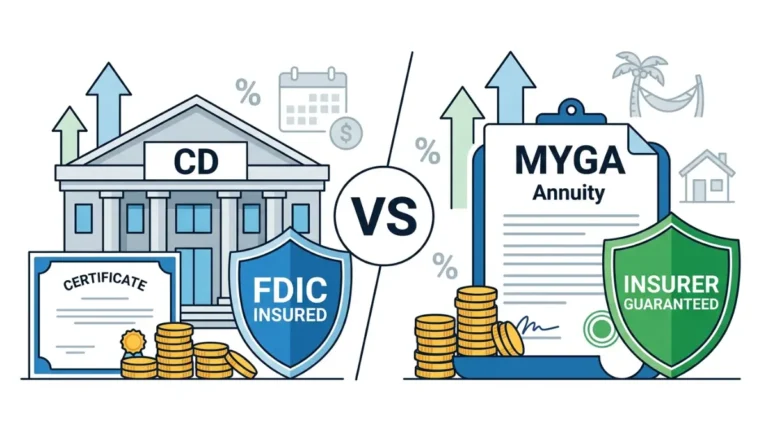
| Fixed-rate deferred (MYGA) | Not an income product unless annuitized | Yes — a growing account value | Fixed-rate accumulation, like a CD alternative | Safe, fixed growth with access to a balance |
Source: FINRA and the SEC’s Investor.gov, 2026.

DIA versus an immediate annuity (SPIA)
Both convert a premium into lifetime income; only timing differs — an immediate annuity (SPIA) starts paying almost at once, while a DIA delays the start to buy a larger future payment.
DIA versus a fixed-rate deferred annuity (MYGA)
This is the costly mix-up: a fixed-rate deferred annuity, or MYGA, builds an accessible account value often compared to a CD with a CD calculator, while a DIA has no balance and pays only future income.
💡 Expert Note: FINRA specifically cautions that deferred income annuities should not be confused with deferred fixed (accumulation) annuities — one buys income, the other builds a balance. The SEC’s overview is its investor glossary entry for longevity annuities.
When a DIA makes sense
A DIA fits when you want guaranteed income for a later stretch of retirement and can make that money illiquid; it is generally not a fit if you might need the funds or want to leave them to heirs. For the full menu, see the types of annuities.
Mistakes to avoid with a deferred income annuity
The risks of a deferred income annuity are not hidden — they are the flip side of the guarantee.
Locking up money you cannot get back
A DIA is generally irrevocable and illiquid, with no cash surrender value, so committing only a portion — and keeping separate, liquid emergency savings — keeps you from being rich in future income but short on cash today.
Dying early, and the riders that protect heirs
If you die before payments begin with no refund or period-certain feature, your beneficiaries may receive nothing; a cash-refund or period-certain rider protects them at the cost of lower income.
Inflation and insurer risk
A fixed payment loses purchasing power unless you add an inflation rider — see how prices erode value with an inflation calculator — and your income is only as reliable as the insurer, since state guaranty associations are a backstop but coverage varies by state and is not FDIC insurance.
✅ Action Step: Ask a fiduciary advisor: “What share of my assets is too much to make illiquid, and which riders are worth their reduction in income for my situation?”
Deferred income annuity FAQs
1. What is a deferred income annuity?
A deferred income annuity is a contract with an insurer that turns a lump sum or series of payments into guaranteed lifetime income starting on a future date you choose. Also called longevity insurance, it protects against outliving your savings and generally has no cash value once purchased.
2. How is a deferred income annuity different from an immediate annuity?
Both convert a premium into lifetime income; the difference is timing. An immediate annuity (SPIA) begins paying within about a year, while a deferred income annuity delays the start — often to ages 70 through 85 — to produce a larger future payment for the same premium.
3. What is a QLAC and how does it relate to a DIA?
A QLAC is a deferred income annuity held inside a traditional IRA or workplace plan. For 2026 you can place up to $210,000 per person into one, it must be a fixed annuity, and income must begin by age 85. Confirm the rules with a CPA before acting.
4. How much money do I need to buy a deferred income annuity?
There is no universal minimum, because each insurer sets its own and your income depends on age, sex, deferral length, and current rates. Since exact dollar amounts are quoted individually, request a dated quote from several insurers rather than relying on a single published figure.
5. When do payments from a deferred income annuity start?
You choose the income start date when you buy, commonly between ages 70 and 85, and for a QLAC income must begin no later than age 85. In general, the longer you defer, the higher each payment, because the insurer pays you over a shorter expected period.
6. Are deferred income annuity payments taxed?
Yes. Payments from a QLAC are taxed fully as ordinary income, while after-tax annuities use an exclusion ratio so part of each payment is a tax-free return of principal until your investment is recovered. Withdrawing qualified funds before 59½ can add a 10% penalty; ask a CPA.
7. What happens to my money if I die before payments begin?
Without a refund or period-certain feature, your beneficiaries may receive nothing if you die during the deferral period. Adding a cash-refund or period-certain rider returns unused premium or guarantees a minimum number of payments, though each option lowers your monthly income in exchange.
8. Can I get my money back — is a DIA liquid?
Generally no. A deferred income annuity is typically irrevocable and has no cash surrender value, so the premium is not available for emergencies once paid. This illiquidity is the main reason advisors suggest committing only a portion of your savings to one.
9. Is a deferred income annuity safe if the insurer fails?
Your income depends on the issuing insurer’s financial strength. State guaranty associations provide a backstop if a company fails, but coverage limits vary by state and differ from FDIC insurance, so check your state’s limit and the insurer’s rating first. Consider confirming suitability with a fiduciary advisor.
10. Does a deferred income annuity keep up with inflation?
Not unless you add an inflation-adjustment rider. A standard fixed payment stays the same in dollar terms, so its purchasing power erodes over a long retirement. The rider raises payments over time but reduces your starting income, so you weigh early income against later protection.
11. Who should consider a deferred income annuity?
It may suit someone who wants guaranteed income for a specific later stretch of retirement, has no pension, and can afford to make part of their savings illiquid. It is generally not a fit if you need access to the funds or want to leave them to heirs; confirm suitability with a fiduciary advisor.

Is a deferred income annuity right for you?
A deferred income annuity offers one clear thing — income you are unlikely to outlive — in exchange for two real ones: access to your money and flexibility. Whether that trade is worth it comes down to your situation, not a sales pitch.
Three questions cut to the heart of it: Do you genuinely fear running out of money in later retirement? Can you commit this portion of savings and not need it back? Have you compared quotes and checked the insurer’s strength and your state’s guaranty coverage?
If yes to the first two and you are working through the third, you are approaching this well. Review the full landscape in the guide to what an annuity is and how the costs work, then bring your numbers to a fiduciary advisor and a CPA before you sign.
Informational disclaimer
The content on Finance Authority Hub is provided for general informational and educational purposes only and should not be considered personalized financial, investment, tax, legal, or professional advice. Financial decisions depend on your individual goals, income, risk tolerance, location, and regulatory situation. Before acting on any information, strategy, estimate, or calculator result, consult a qualified licensed professional who can evaluate your specific circumstances.