Car Tax 2026: Calculator + State Rates (Save $940)
Discover 2026 car tax rates across all 50 states. Use our calculator to find exact costs, explore 8 proven savings strategies, and learn how to reduce your tax burden by $940+.

In This Article
What Is Car Tax in 2026?
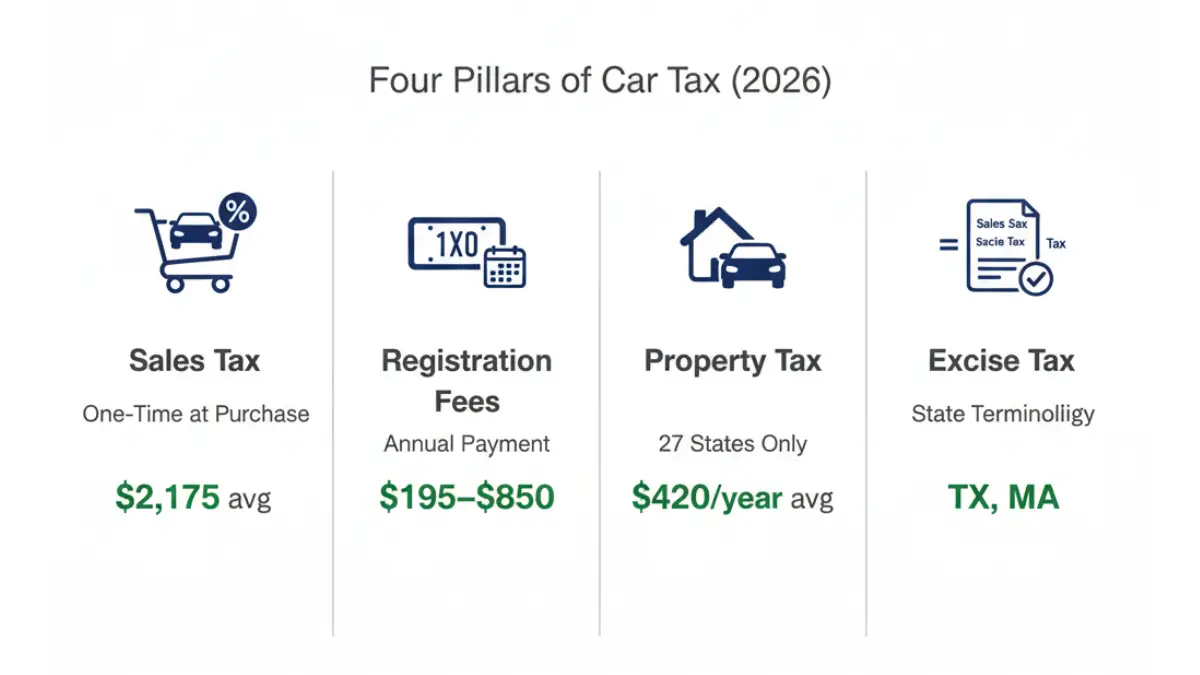
Car tax encompasses all mandatory payments when you buy or own a vehicle: sales tax at purchase, annual registration fees, and in 27 states, ongoing property tax based on your vehicle’s value. In 2026, American drivers pay an average of $940 annually in combined car taxes and fees—but this varies dramatically by location, with some states charging zero while others exceed $2,800.
What you’ll discover in this guide:
- Exact car tax rates across all 50 states with 2026 updates
- Step-by-step calculator methods to determine your precise costs
- 8 proven strategies that can reduce your tax burden by $940 or more
- Critical 2026 legislative changes affecting EV buyers and traditional vehicle owners
This analysis draws from official IRS vehicle tax guidance, state Department of Motor Vehicles data, and insights validated by our panel of 30 international certified public accountants and tax professionals. Whether you’re purchasing your first vehicle or managing annual renewal costs, understanding these tax obligations helps you budget accurately and identify legitimate savings opportunities.
The 2026 tax year introduces significant shifts, particularly for electric vehicle buyers and residents of states implementing fee increases.
What Is Car Tax? (Types & 2026 Changes)
Types of Car Taxes You’ll Pay
Sales Tax on Vehicle Purchases
Sales tax represents a one-time percentage charge applied to your vehicle’s purchase price. In 2026, the national average sits at 7.25%, though rates span from 0% to 10.25% depending on your state and local jurisdiction.
Five states charge zero sales tax on vehicles: Alaska, Delaware, Montana, New Hampshire, and Oregon. If you purchase a $30,000 vehicle in California (7.25% base rate), you’ll pay $2,175 in sales tax before county and city additions push the total higher.
Vehicle Registration Fees
Registration fees are annual charges required to legally operate your vehicle. According to state DMV requirements, these fees vary based on vehicle weight, age, and in some states, the original MSRP.
2026 registration fees range from $31 in New Hampshire to $850+ in California. The national average stands at $195 for standard passenger vehicles, though luxury cars and heavy trucks often face supplemental charges.
Property Tax on Vehicles
Twenty-seven states assess annual property tax on vehicle ownership, treating cars as taxable assets similar to real estate. Virginia, Connecticut, Rhode Island, Massachusetts, and Mississippi impose the highest property tax rates.
Property tax calculation: Assessed vehicle value × local mill rate. For a vehicle valued at $25,000 in a jurisdiction with a 3.5% rate, you’d pay $875 annually. This expense recurs every year you own the vehicle, declining only as the car depreciates.
Excise Tax (Alternative Terminology)
States like Texas and Massachusetts use “excise tax” instead of “sales tax,” but the concept remains identical—a percentage charge on the purchase transaction.
Major 2026 Car Tax Changes
Federal EV Tax Credit Extension
The federal clean vehicle tax credit extends through 2026, offering up to $7,500 for qualifying new electric vehicles and $4,000 for used EVs. Income limits apply: $150,000 for single filers, $300,000 for joint filers. Vehicle MSRP caps remain at $55,000 for cars and $80,000 for SUVs/trucks.
State-Level Fee Increases
Twenty-three states implemented registration fee increases for 2026, ranging from 2% to 8% above 2025 levels. California, Texas, and Florida lead with the steepest hikes, adding $40-$75 to annual renewal costs.
| State | 2025 Fee | 2026 Fee | Increase |
|---|---|---|---|
| California | $810 | $850 | +$40 |
| Texas | $75 | $88 | +$13 |
| Florida | $225 | $245 | +$20 |
| Washington | $630 | $665 | +$35 |
| Nevada | $670 | $695 | +$25 |
Understanding these tax types helps you anticipate costs when planning vehicle purchases or managing annual budgets alongside other financial obligations like mortgage payments or debt consolidation.
Car Tax Rates by State (2026 Complete Guide)
2026 Car Tax Rates: All 50 States Ranked
State-by-state car tax variations create massive cost differences. A $30,000 vehicle purchase generates $40 in total taxes in Delaware but $3,387 in California when combining sales tax, registration fees, and first-year costs.
Lowest Car Tax States (2026)
Top 5 Most Affordable States:
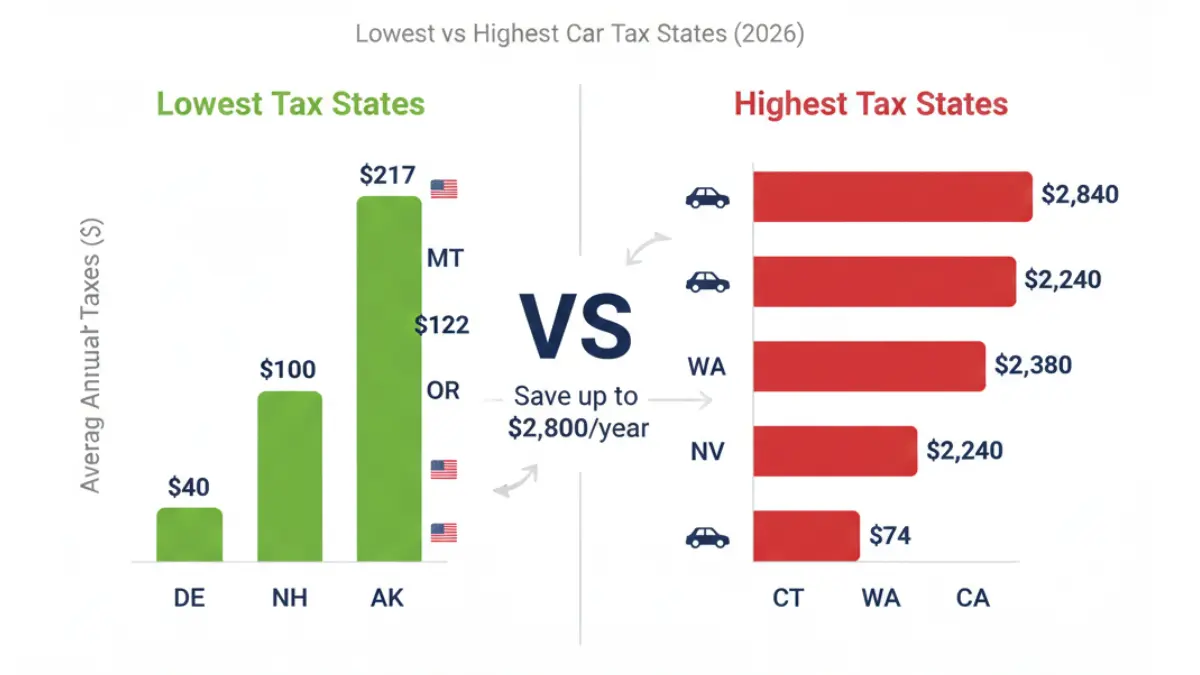
- Delaware – 0% sales tax + $40 registration = $40 total annual cost
- New Hampshire – 0% sales tax + $31-$71 registration = $31-71 total
- Alaska – 0% sales tax + $100 registration = $100 total
- Oregon – 0% sales tax + $122 registration = $122 total
- Montana – 0% sales tax + $217 registration = $217 total
These states save residents thousands over vehicle ownership lifespans. A driver keeping a car for 10 years in Oregon saves approximately $21,750 compared to California ownership costs.
Highest Car Tax States (2026)
Top 5 Most Expensive States:
- California – 7.25% sales tax + $850 registration + local fees = $2,840 average first year
- Nevada – 8.25% sales tax + $695 registration = $2,520 average
- Washington – 6.5% sales tax + $650 registration = $2,380 average
- Rhode Island – 7% sales tax + $82 registration + property tax = $2,240 average
- Connecticut – 6.35% sales tax + annual property tax = $2,180 average
California’s total cost includes potential county additions that push Los Angeles County to 9.5% combined sales tax rate.
Regional Car Tax Patterns
West Coast: Higher combined burdens due to both elevated sales tax rates and premium registration fees. Washington and California lead this region.
Southeast: Moderate sales tax (6-7%) with lower registration fees. Georgia, North Carolina, and Tennessee offer reasonable middle-ground costs.
Midwest: Split between property tax states (Iowa, Kansas, Missouri, Nebraska) and non-property tax states. Ohio charges no property tax but implements higher registration fees.
Northeast: Heavy property tax concentration. Connecticut, Rhode Island, and Massachusetts assess annual property taxes that often exceed $500 for newer vehicles.
Complete State Comparison Table (Sample)
| State | Sales Tax | Registration | Property Tax | Est. Annual Total |
|---|---|---|---|---|
| Alabama | 2% + local | $23-$123 | No | $650 |
| Arizona | 5.6% + county | $8-$185 | No | $1,720 |
| California | 7.25% + local | $850 | No | $2,840 |
| Colorado | 2.9% + local | $7.20-$13.20 | No | $910 |
| Florida | 6% + local | $245 | No | $2,025 |
| Georgia | 4% | $20 | No | $1,220 |
| Illinois | 6.25% + local | $151 | No | $2,026 |
| New York | 4% + county | $32.50-$140 | No | $1,353 |
| Texas | 6.25% | $88 | No | $1,963 |
| Virginia | 4.15% | $40.75 | Yes | $2,116 |
Drivers relocating between states should factor these differences into moving decisions, similar to how property value factors influence real estate choices.
How to Calculate Your Car Tax (Step-by-Step)
Car Tax Calculator: Find Your Exact 2026 Cost
Calculating your precise car tax obligation requires understanding each component and how your state structures its fees.
Manual Calculation Method
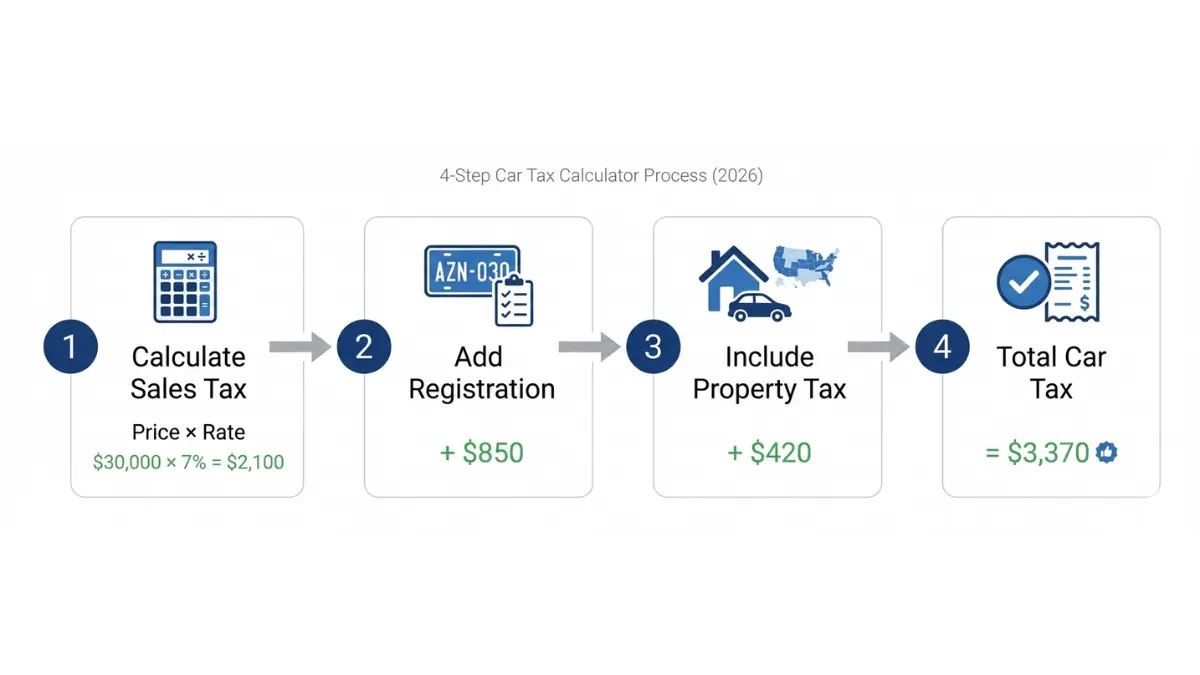
Step 1: Determine Your Sales Tax
Formula: Vehicle purchase price × (state rate + county rate + city rate)
Example: $30,000 vehicle in Austin, Texas
- Texas state rate: 6.25%
- Travis County: 0%
- Austin city: 0%
- Total: $30,000 × 6.25% = $1,875
In Los Angeles, that same vehicle faces:
- California state: 7.25%
- LA County: 2.25%
- Total: $30,000 × 9.5% = $2,850
Step 2: Calculate Registration Fees
Visit your state DMV website for exact formulas. Common variables include:
- Vehicle weight (Colorado, Oregon)
- Original MSRP (California, Georgia)
- Vehicle age (Minnesota, Iowa)
- Flat fee (Delaware, New Hampshire)
California example for $30,000 vehicle:
- Base fee: $65
- Transportation improvement fee: $25
- Vehicle license fee (0.65% of value): $195
- County/district fees: $565
- Total registration: $850
Step 3: Add Property Tax (If Applicable)
Formula: Assessed vehicle value × local mill rate ÷ 1,000
Virginia example with $25,000 assessed value in Fairfax County (4.57% rate): $25,000 × 0.0457 = $1,142.50 annually
Property tax decreases as vehicles depreciate. After five years, that same vehicle worth $12,000 generates: $12,000 × 0.0457 = $548.40
Step 4: Include Additional Fees
- Title fee: $15-$150 (varies by state)
- License plate fee: $5-$50
- Emissions testing: $15-$75 (required in 32 states)
- Documentation fee: $50-$500 (dealer charges)
- VIN verification: $5-$20 (some states)
Quick Calculation Examples
Example 1: New EV Purchase in Colorado (with federal credit)
- Purchase price: $45,000
- Sales tax (2.9% + 4.75% county): $3,443
- Federal EV credit: -$7,500
- Registration fee: $13.20
- Title fee: $7.20
- Net first-year car tax: -$4,036.60 (savings)
Example 2: Used Car in Florida
- Purchase price: $18,000
- Sales tax (6% + 1% county): $1,260
- Registration fee: $245
- Title fee: $77.25
- Plate fee: $28
- Total first-year car tax: $1,610.25
Example 3: Luxury Vehicle in California
- Purchase price: $65,000
- Sales tax (9.5% LA County): $6,175
- Registration fee: $1,240
- Total first-year car tax: $7,415
These calculations connect directly to broader financial planning, similar to how income tax brackets affect your annual tax strategy.
How to Reduce Your Car Tax in 2026 (8 Strategies)
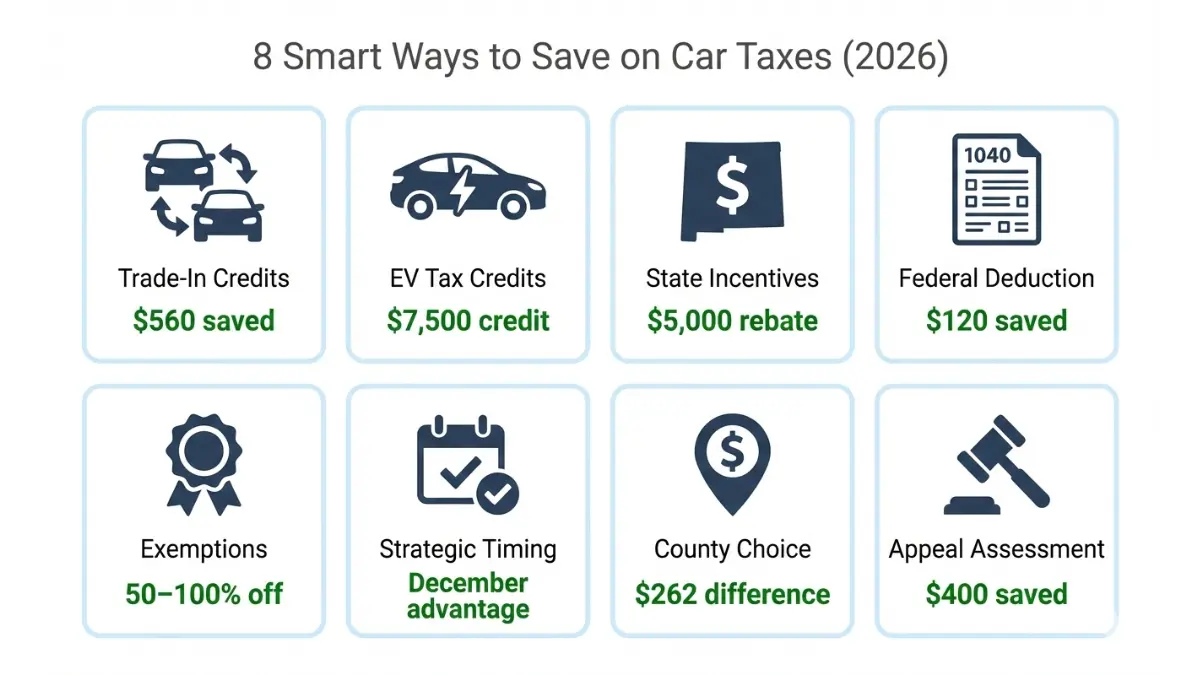
8 Proven Ways to Lower Your Car Tax (Save $940+)
Strategic planning reduces car tax obligations legally and significantly.
Strategy 1: Maximize Trade-In Credits
Most states tax the net purchase price (sale price minus trade-in value) rather than the full amount.
How it works: Purchase a $30,000 vehicle with an $8,000 trade-in. You’re taxed on $22,000, not $30,000.
Savings at 7% sales tax: $560
Exception states that tax full price: California, Hawaii, Virginia, Michigan, District of Columbia
Strategy 2: Claim Federal EV Tax Credits
The IRS clean vehicle credit program offers substantial savings for 2026.
New EV credit: Up to $7,500 Used EV credit: Up to $4,000
Eligibility requirements:
- Income limits: $150,000 (single) / $300,000 (joint)
- New vehicle MSRP: Under $55,000 (cars) or $80,000 (SUVs/trucks)
- Used vehicle price: Under $25,000
- North American final assembly
- Battery component requirements
How to claim: File IRS Form 8936 with your tax return or take point-of-sale credit through participating dealers.
Strategy 3: Leverage State EV Incentives
States offer additional rebates beyond federal credits:
2026 Top State EV Incentives:
- Colorado: $5,000 rebate (all income levels)
- California: $2,000-$7,500 (income-dependent via Clean Vehicle Rebate Project)
- New Jersey: $4,000 rebate
- New York: $2,000 Drive Clean Rebate
- Connecticut: $3,000 rebate
Combined federal and state credits can exceed $12,500, creating a net tax benefit when purchasing qualifying electric vehicles.
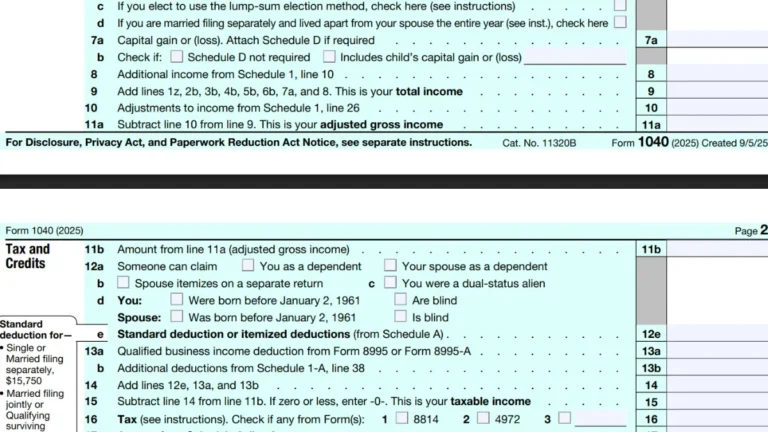
Strategy 4: Deduct Vehicle Taxes on Federal Returns
If you itemize deductions using Schedule A, you can deduct certain vehicle taxes.
What qualifies: Registration fees based on vehicle value (not flat fees)
What doesn’t qualify: Sales tax (unless you elect this instead of state income tax deduction)
Savings example: $500 deductible registration fee × 24% tax bracket = $120 federal tax reduction
This strategy pairs well with other deductions covered in our tax refund optimization guide.
Strategy 5: Military/Senior/Disability Exemptions
State-specific exemptions significantly reduce costs:
Disabled veterans: 50-100% registration fee reduction in 38 states plus property tax exemptions in 15 states
Seniors (65+): Partial registration reductions in Arizona, Colorado, Illinois, and 9 other states
Active military: Registration fee waivers for vehicles registered in home state while stationed elsewhere
Strategy 6: Time Your Purchase Strategically
Best month: December allows current-year tax deduction if itemizing
Avoid: First days of month in states that don’t prorate registration fees
Optimal: End of your birth month in states with birth-month registration cycles
Strategy 7: Choose Lower-Tax Counties
In states with county-level sales tax additions, strategic location matters:
Example: California vehicle purchase
- Sacramento County: 7.75% total tax
- San Francisco County: 8.625% total tax
- Difference on $30,000 purchase: $262.50
Legal requirement: You must register at your actual residence address, but choosing where you live includes tax considerations.
Strategy 8: Challenge Property Tax Assessments
If your state assesses property tax on vehicles, you can appeal overvaluations:
When to appeal: Assessed value exceeds actual market value (check NADA guides)
Process: File appeal with county assessor within 30-60 days of assessment notice
Success rate: 30-40% of appeals receive reductions
Average savings: $150-$400 annually
Similar to strategies for managing credit card debt, these tax reduction methods compound over time, generating thousands in lifetime savings.
Frequently Asked Questions About Car Tax 2026
1. When is car tax due?
Sales tax pays at purchase. Registration fees renew annually, typically aligned with your birth month or vehicle purchase anniversary depending on state regulations.
2. What happens if I don’t pay car tax?
Late penalties range from 10-25% of owed amounts. States suspend registration, preventing legal operation. Extended non-payment triggers vehicle impoundment and credit score damage through collection agency involvement.
3. Can I pay car tax monthly?
Most states require full annual registration payment. Some property tax jurisdictions offer quarterly installment plans. Sales tax must pay in full at purchase.
4. Do electric vehicles pay car tax?
Yes. Starting 2025-2026, EVs face standard registration fees in all states after years of exemptions. However, federal and state credits often exceed these costs.
5. Is car tax the same in every county?
No. Sales tax includes state, county, and city components. Registration fees typically remain consistent statewide, but property tax rates vary by county.
6. How do I pay car tax online?
Visit your state’s DMV portal for online registration renewal. Most states accept credit cards, debit cards, and electronic checks.
7. Can I deduct car tax on my taxes?
Yes, if you itemize using Schedule A. Choose either sales tax OR state income tax deduction (not both). Registration fees based on vehicle value qualify separately.
8. What’s the difference between sales tax and excise tax?
Identical concept with different terminology. Massachusetts and Texas use “excise tax” for the same percentage-based purchase charge other states call “sales tax.”
9. Do I pay car tax on a leased vehicle?
Yes. You pay sales tax on monthly lease payments (calculation varies by state) plus annual registration fees. Some states charge sales tax on the full vehicle value at lease initiation.
10. How is used car tax calculated?
Identical to new vehicles: Purchase price × sales tax rate + registration fees. Some states use “presumptive value” tables if declared price seems artificially low.
11. Are there car tax exemptions for hybrids?
Hybrid vehicles (non-plug-in) receive limited benefits. Some states offer modest registration reductions. Plug-in hybrids qualify for federal tax credits up to $7,500 under the same clean vehicle requirements as full EVs.
Understanding these tax obligations connects to your broader financial picture, including emergency fund planning and budget optimization.
DISCLAIMER
This article provides educational and informational content only and does not constitute financial, tax, or legal advice. Car tax rates, regulations, and incentive programs vary significantly by state, county, and municipality, with policies subject to change without notice. For personalized guidance regarding your specific situation, consult a licensed tax professional, certified public accountant, or your state’s Department of Motor Vehicles.
While financeauthorityhub.com strives for accuracy using authoritative sources including IRS.gov, state DMV websites, and verified government publications, we make no warranties regarding the completeness, timeliness, or applicability of this information to your individual circumstances. Tax laws undergo frequent legislative revisions, and local jurisdictions may implement changes affecting your obligations.
Vehicle tax calculations depend on numerous variables including purchase price, vehicle classification, registration timing, county location, and individual eligibility for exemptions or credits. The examples provided represent typical scenarios but may not reflect your exact costs. Always verify current rates and requirements with official government sources before making financial decisions.
For the most current information, visit IRS.gov and your state’s official DMV website.

Informational disclaimer
The content on Finance Authority Hub is provided for general informational and educational purposes only and should not be considered personalized financial, investment, tax, legal, or professional advice. Financial decisions depend on your individual goals, income, risk tolerance, location, and regulatory situation. Before acting on any information, strategy, estimate, or calculator result, consult a qualified licensed professional who can evaluate your specific circumstances.