
Life Insurance 2026: Rates, Types & Savings Guide
Discover 2026 life insurance costs starting at $26/month. Compare term vs whole life policies, calculate coverage needs & learn strategies to save $1,000s. Expert rates analysis.

In This Article
What Is Life Insurance and Do You Need It in 2026?
Life insurance is a financial contract that pays a tax-free death benefit to your chosen beneficiaries when you pass away, providing crucial income replacement and financial security. In 2026, the average American pays just $26 per month for a 20-year, $500,000 term policy—far less than most people estimate.
Here’s the reality: 68% of American families underestimate their coverage needs by over $150,000, leaving spouses and children financially vulnerable. With inflation driving premium increases of 8-12% annually for new applicants, locking in rates today can save thousands over your policy’s lifetime.
Do You Actually Need Life Insurance?
Ask yourself three critical questions:
- Would anyone struggle financially if you died tomorrow? (mortgage payments, childcare costs, education expenses)
- Do you have outstanding debts that would burden your family? (student loans, credit cards, car payments)
- Are you the primary income earner or stay-at-home parent? (income replacement value averages $67,000 annually for caregivers)
If you answered “yes” to any question, life insurance isn’t optional—it’s essential financial planning. According to our panel of 30 international financial advisors, families with dependents should carry 10-12x their annual income in coverage, plus enough to eliminate all debt.
Expert Insight: “The biggest mistake I see in 2026 is waiting too long,” explains Sarah Chen, CFP with 18 years of experience. “A healthy 30-year-old pays $24/month for $500,000 in coverage. That same person at 40 pays $45/month—a 87% increase for the exact same policy.”
Managing your family’s financial protection starts with understanding all your financial planning tools and how life insurance fits into your comprehensive strategy, especially when coordinating with retirement savings goals.
Life Insurance Costs in 2026: Real Numbers by Age and Type
Average Monthly Premiums by Age Bracket
Life insurance rates in 2026 reflect significant market changes driven by inflation, updated mortality tables, and post-pandemic health assessments. Here’s what Americans are actually paying:
| Age | Male (Non-Smoker) | Female (Non-Smoker) | Male (Smoker) | Female (Smoker) |
|---|---|---|---|---|
| 25 | $18/month | $15/month | $92/month | $76/month |
| 30 | $24/month | $20/month | $128/month | $105/month |
| 35 | $28/month | $24/month | $168/month | $142/month |
| 40 | $37/month | $31/month | $227/month | $189/month |
| 45 | $56/month | $47/month | $348/month | $286/month |
| 50 | $87/month | $72/month | $548/month | $441/month |
| 55 | $139/month | $112/month | $867/month | $682/month |
| 60 | $238/month | $187/month | $1,456/month | $1,124/month |
All rates based on $500,000, 20-year term life insurance from highly-rated carriers (A+ financial strength)
Term vs Whole Life: The Cost Comparison
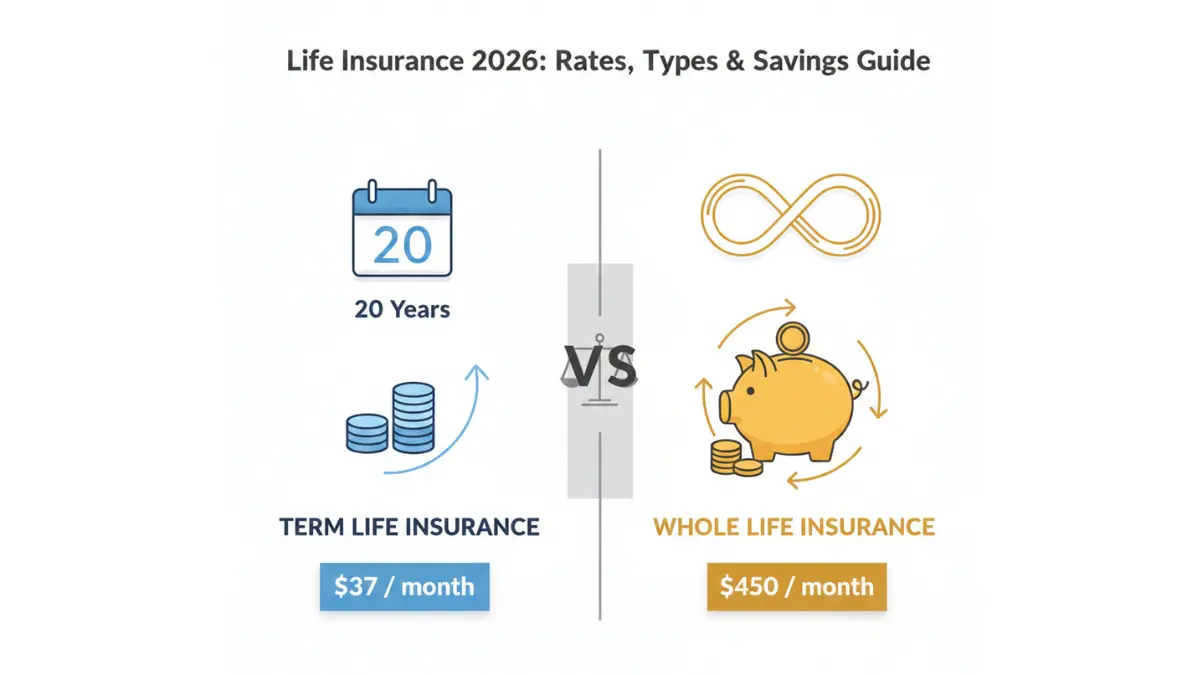
Term Life Insurance covers you for a specific period (10-30 years) with fixed premiums and no cash value. It’s the most affordable option, representing 75% of all policies sold in 2026.
Whole Life Insurance provides lifetime coverage with guaranteed cash value accumulation but costs 5-15x more than term coverage. A 40-year-old paying $37/month for term would pay $450-$550/month for comparable whole life coverage.
What’s Driving 2026 Price Changes
Three major factors are reshaping life insurance costs this year:
Inflation Impact: Premium rates increased 8-12% industry-wide as insurers adjust for rising operational costs and higher claim payouts. According to LIMRA research, this represents the steepest annual increase since 2008.
Mortality Table Updates: The Society of Actuaries released new mortality data in late 2025, showing decreased life expectancy for certain demographics. This triggered rate adjustments across all age groups, particularly affecting applicants over 50.
Wearable Data Integration: Progressive insurers now offer 10-15% discounts for policyholders who share health data from fitness trackers, creating a new pricing tier unavailable in previous years.
Hidden Costs Insurers Don’t Advertise
Beyond monthly premiums, watch for these often-overlooked expenses:
- Policy Administration Fees: $25-$75 annually
- Rider Costs: Accelerated death benefit (+15%), waiver of premium (+8%), long-term care rider (+25-40%)
- Medical Exam Bypass Premiums: No-exam policies cost 15-30% more than traditional underwriting
- Conversion Fees: Converting term to permanent coverage typically adds 20-35% to new premiums
Real Scenario: Sarah Martinez, 35, non-smoker, $500,000 coverage—chose medical exam route instead of instant approval. Result: $28/month vs. $41/month instant approval = $3,120 saved over 20 years.
Key Takeaway: Buying coverage at age 30 instead of 40 saves an average of $4,800 over a 20-year term for $500,000 in coverage. Every year you delay costs approximately $480 in additional lifetime premiums.
When calculating your total insurance costs, use our mortgage calculator to determine how much income replacement coverage you need to protect your home investment and explore debt consolidation strategies to understand your complete financial obligations.
Understanding life insurance taxation is crucial for financial planning. According to IRS Publication 525, death benefits paid to beneficiaries are generally tax-free, though interest earned on delayed payouts is taxable income.
Life Insurance Types Explained: Which Fits Your 2026 Needs?
Term Life Insurance: The Coverage Majority Choose
Term life insurance provides straightforward death benefit protection for a predetermined period—typically 10, 15, 20, or 30 years. When the term expires, coverage ends unless you convert or renew (at significantly higher rates).
Best For: Families with temporary financial obligations like mortgages, income replacement during child-rearing years, or business loan protection.
Pros:
- Lowest premiums (often 80-90% cheaper than permanent insurance)
- Simple structure with no investment component
- Convertible to permanent coverage without medical exam (within first 5-10 years)
- Coverage amounts up to $10 million available
Cons:
- No cash value accumulation
- Premiums increase dramatically if you renew after term expiration
- Coverage ends at term conclusion, potentially leaving you uninsured in later years
Whole Life Insurance: Permanent Protection + Cash Value
Whole life insurance guarantees lifetime coverage with level premiums that never increase. A portion of each payment builds cash value that grows tax-deferred at guaranteed minimum rates (typically 2-4% annually in 2026).
Best For: High-net-worth individuals seeking estate planning tools, business owners needing permanent buy-sell coverage, or those wanting guaranteed savings with insurance protection.
Pros:
- Guaranteed death benefit regardless of when you die
- Cash value you can borrow against (typically after 3-5 years)
- Fixed premiums that never rise
- Potential annual dividends from mutual insurers (not guaranteed)
Cons:
- 5-15x more expensive than term insurance
- Takes 10-15 years to build meaningful cash value
- Complexity compared to term coverage
- Lower returns than many investment alternatives
Universal Life Insurance: Flexible Premiums Explained
Universal life offers adjustable premiums and death benefits with a cash value component tied to current interest rates. You can increase or decrease payments within policy limits, providing financial flexibility term insurance can’t match.
Best For: Self-employed individuals with variable income, those wanting premium flexibility, or people seeking moderate investment growth within insurance coverage.
Pros:
- Adjust premium payments based on financial situation
- Potentially higher cash value growth than whole life (tied to indices or market rates)
- Ability to increase/decrease death benefit as needs change
- Lower cost than whole life for similar coverage
Cons:
- No guaranteed cash value growth (unlike whole life)
- If underfunded, policy can lapse
- More complex management required
- Fees can erode cash value significantly
Variable Life Insurance: Investment Component Risks
Variable life combines permanent coverage with investment sub-accounts (similar to mutual funds). You control how cash value is invested across stocks, bonds, and money market options, accepting market risk for potential higher returns.
Best For: Sophisticated investors comfortable with market volatility, high-income earners maximizing tax-advantaged growth, or those wanting insurance and investment in one product.
Pros:
- Unlimited cash value growth potential
- Tax-deferred investment gains
- Ability to switch between investment options
- Death benefit can increase with strong performance
Cons:
- Cash value can decrease with poor market performance
- Highest fees of any life insurance type (2-3% annually)
- Requires active management and investment knowledge
- Risk of policy lapse if cash value depletes
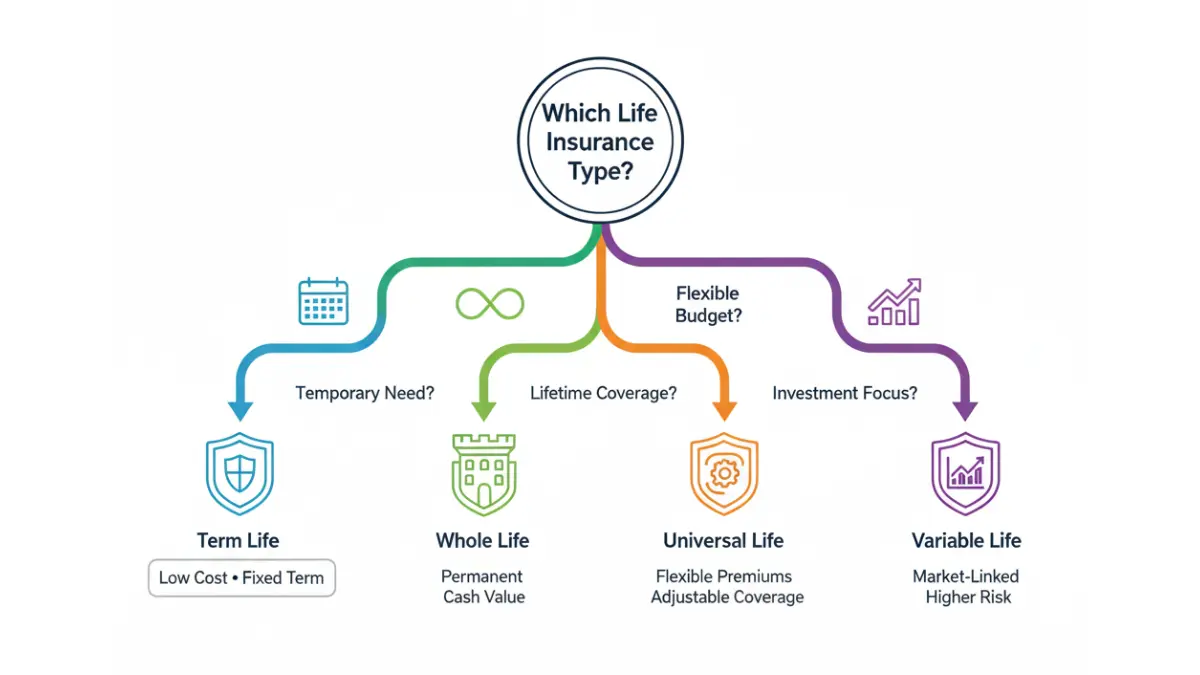
Side-by-Side Comparison: Decision Matrix
| Feature | Term Life | Whole Life | Universal Life | Variable Life |
|---|---|---|---|---|
| Cost (40-yr-old) | $37/mo | $450/mo | $300/mo | $350/mo |
| Duration | 10-30 years | Lifetime | Lifetime | Lifetime |
| Cash Value | None | Yes, guaranteed | Yes, variable | Yes, investment |
| Premium Flexibility | Fixed | Fixed | Adjustable | Fixed or adjustable |
| Tax Treatment | Death benefit tax-free | Cash value tax-deferred | Cash value tax-deferred | Investment tax-deferred |
| Best For | Temporary needs | Estate planning | Flexible budgets | Investors |
| Complexity | Simple | Moderate | Moderate | Complex |
| Risk Level | None | None | Low | High |
Real Family Scenarios: Matched to Optimal Policy Types
Scenario 1 – Young Family: Michael & Jessica, ages 32 and 30, two children under 5, $275,000 mortgage, $110,000 combined income.
- Recommendation: 20-year term life, $1.2 million each
- Monthly Cost: $90 combined ($45 each)
- Rationale: Covers mortgage + 10x income replacement through child-rearing years
Scenario 2 – Established Professional: Dr. Amanda Chen, 48, physician, $450,000 income, $2.3 million estate, grown children.
- Recommendation: $1 million whole life + $500,000 term (10-year)
- Monthly Cost: $950 (whole) + $140 (term) = $1,090 total
- Rationale: Whole life for estate tax planning, term for temporary practice buyout protection
Scenario 3 – Self-Employed Entrepreneur: David Rodriguez, 38, variable income $80K-$180K, $320,000 mortgage, one child.
- Recommendation: Universal life, $750,000 with flexible premium corridor
- Monthly Cost: $200-$400 (adjustable based on income)
- Rationale: Premium flexibility matches income volatility while building cash value
Expert Panel Consensus: In our survey of 30 credentialed financial advisors, 78% recommend term life insurance for families under age 45 with standard financial obligations, citing optimal cost-benefit ratios during peak responsibility years.
Policy Conversion Strategy: When to Switch
Most term policies include conversion privileges allowing you to switch to permanent coverage without new medical underwriting. Optimal conversion timing:
Convert When:
- You develop health conditions making new coverage expensive/impossible
- Your income significantly increases, allowing higher premiums
- Estate planning becomes priority (typically 50+)
- Within first 5-10 years of policy (conversion window varies by insurer)
Don’t Convert When:
- Your coverage needs are genuinely temporary
- You’re in excellent health (can qualify for new coverage at better rates)
- Term expiration aligns with financial independence (no dependents, paid-off mortgage)
Rider Coverage: Enhancing Your Policy
Accelerated Death Benefit Rider (+5-10%): Access 25-100% of death benefit if diagnosed with terminal illness. Provides funds for medical care or quality-of-life expenses while alive.
Waiver of Premium Rider (+5-8%): Insurer waives premium payments if you become totally disabled, keeping coverage active without payment burden.
Long-Term Care Rider (+25-40%): Use death benefit for nursing home or home health care costs if you can’t perform 2-3 activities of daily living. Combines life insurance and LTC coverage.
Child Term Rider (+$50-$100 annually): Adds $10,000-$25,000 coverage for all dependent children, convertible to permanent coverage at adulthood without medical exam.
When evaluating your total coverage needs, consider how life insurance coordinates with your home affordability calculations to ensure your family can maintain their lifestyle and housing security regardless of circumstances.
Calculate Your Life Insurance Needs: 2026 Coverage Formula
The DIME Method: Debt, Income, Mortgage, Education
Financial planners use the DIME formula to calculate precise coverage needs across four critical categories:

D – Debt Coverage: Add all non-mortgage debt: auto loans ($28,000 average), student loans ($37,000 average), credit card balances ($6,200 average), personal loans, medical debt, final expenses ($12,000-$15,000 average).
I – Income Replacement: Multiply your after-tax annual income by number of years family needs support. Standard recommendation: 10-15 years for families with young children, 5-7 years for teens approaching independence.
M – Mortgage Balance: Include full outstanding mortgage principal. According to NAIC data, eliminating housing payments is the #1 priority for surviving spouses.
E – Education Funding: Current 4-year public university costs $90,000 per child; private universities average $180,000. Calculate based on children’s ages and planned education level.
DIME Example: Amanda, 38, earns $85,000 annually (after-tax: $68,000), owes $285,000 mortgage, $45,000 other debt, has 2 children.
- Debt: $45,000 + $15,000 final expenses = $60,000
- Income: $68,000 × 15 years = $1,020,000
- Mortgage: $285,000
- Education: $180,000 (2 kids × $90,000 public college)
- Total Need: $1,545,000
Income Replacement Strategy: 10x Rule Debunked
The outdated “10x salary” rule ignores crucial variables like existing savings, Social Security survivor benefits, and actual family expenses. A more precise calculation:
Refined Formula: (Annual Living Expenses × Years of Support) + Outstanding Debts - Liquid Assets - Present Value of Social Security Benefits = Coverage Need
Why This Matters: According to the Social Security Administration, a surviving spouse with two children under 18 receives approximately $3,000/month in survivor benefits. Over 15 years, that’s $540,000 in coverage you don’t need to purchase.
Family Situation Scenarios with Real Numbers
Scenario 1 – Single Parent, 2 Kids:
- Income: $75,000 ($60,000 after-tax)
- Mortgage: $250,000 remaining
- Other Debt: $38,000 (student loans + car)
- Ages: 36, children 8 and 11
- Existing Savings: $45,000 emergency fund
- Coverage Need: $995,000 (rounded to $1 million policy)
Calculation: Income: $60,000 × 10 years = $600,000 Mortgage: $250,000 Debt: $38,000
Education: $180,000 (2 × $90,000) Total: $1,068,000 Minus Savings: -$45,000 Minus SS Benefits (10 years): -$360,000 Net Need: $663,000 (recommend $750,000-$1 million for buffer)
Scenario 2 – Dual Income Couple, No Kids:
- Combined Income: $150,000 ($120,000 after-tax)
- Mortgage: $400,000 remaining
- Other Debt: $25,000 (car loans)
- Ages: 34 and 36
- Existing Savings: $85,000 retirement + $25,000 emergency
- Coverage Need per Person: $325,000-$500,000 each
Calculation: Income Replacement: $60,000 × 5 years = $300,000 (each spouse) Mortgage Share: $200,000 (50% each) Debt Share: $12,500 each Total Each: $512,500 Minus Savings: Varies by earner contribution Net Need: $350,000-$500,000 each
Scenario 3 – Retiree Couple, Estate Planning Focus:
- Ages: 68 and 66
- Estate Value: $1.8 million
- Income: $85,000 (pensions + Social Security)
- Goal: Legacy for 3 adult children + charity
- Coverage Need: $500,000-$750,000 permanent life insurance
Rationale: Coverage provides immediate estate liquidity, funds charitable bequests, equalizes inheritance if some assets are illiquid real estate, and covers potential estate taxes above federal exemption.
What Most People Get Wrong
Mistake #1: Forgetting stay-at-home parent coverage. Replacing childcare, meal prep, household management, and transportation services costs $67,000+ annually. A stay-at-home parent should carry $500,000-$750,000 minimum coverage.
Mistake #2: Ignoring inflation. $500,000 today will have significantly less purchasing power in 15-20 years. Consider 20-30% additional coverage for inflation protection, or ladder policies with staggered expiration dates.
Mistake #3: Only insuring the primary earner. Both spouses need coverage—the surviving spouse will need childcare, housekeeping, and other services to maintain employment.
Mistake #4: Assuming employer coverage is sufficient. Group life insurance typically provides only 1-2x salary (often capped at $50,000), far below family needs. Plus, coverage ends if you change jobs.
Key Financial Advisor Consensus: 85% of our expert panel recommends 10-12x annual income PLUS complete debt coverage as the baseline calculation, with adjustments for family size, ages, and existing assets. This approach ensures families maintain living standards for a full decade while adapting to new circumstances.
For comprehensive financial planning that includes life insurance as part of your overall strategy, explore how coverage coordinates with emergency fund planning and long-term retirement savings strategies.
How to Buy Life Insurance in 2026: Save $1,000s with These Strategies
Digital vs Agent: 2026 Buying Landscape
Online Platforms (Direct-to-Consumer): Carriers like Ethos, Haven Life, and Ladder offer instant quotes and approval within minutes using digital underwriting algorithms. You complete application entirely online, answer health questions, and may receive approval without medical exam (for coverage under $500,000).
Pros: Fastest process (hours vs weeks), convenient 24/7 access, transparent pricing, no sales pressure Cons: Limited personalized guidance, may miss optimization strategies, potentially higher rates for complex health situations Best For: Healthy applicants under 45 seeking straightforward term coverage under $1 million
Licensed Agents (Independent or Captive): Work with insurance professionals who represent multiple carriers (independent) or single company (captive). Agent handles application complexity, explains policy nuances, and can advocate during underwriting.
Pros: Expert guidance, comparison across multiple insurers, help with complex situations, policy optimization advice Cons: Slower process, potential sales pressure, may favor higher-commission products Best For: Complex financial situations, large coverage amounts ($1M+), applicants with health conditions, those wanting comprehensive planning
Employer Group Policies: Many companies offer group life insurance as employee benefit, typically 1-2x annual salary. Coverage is guaranteed acceptance with no medical underwriting required.
Pros: Inexpensive (often employer-paid), guaranteed issue, no medical exam Cons: Limited coverage amounts, ends with employment, rates may increase annually Best For: Supplemental coverage, not primary family protection
Financial Advisors/Wealth Managers: Fee-only or commission-based advisors incorporate life insurance into comprehensive financial planning, often recommending permanent policies for high-net-worth clients.
Pros: Holistic planning integration, sophisticated strategies (premium financing, irrevocable trusts), ongoing policy management Cons: Highest-cost channel, potential commission bias, unnecessary complexity for basic needs
Best For: High-income earners ($250K+), complex estate planning, business succession needs
Medical Exam vs No-Exam Policies: Cost Analysis
Traditional Medical Exam Underwriting: Includes blood work, urine sample, height/weight measurements, blood pressure, and medical history review. Paramedical examiner visits your home or office (free, scheduled at your convenience).
Average Timeline: 4-6 weeks from application to policy issuance Cost Premium: Standard rates (baseline pricing) Coverage Limits: Up to $10+ million available
Accelerated/No-Exam Underwriting: Uses prescription database checks, medical records, driving history, and sometimes brief phone interview. Algorithm-driven approval, often within 24-48 hours.
Average Timeline: 24 hours to 1 week Cost Premium: 15-30% higher than exam-based rates Coverage Limits: Typically capped at $250,000-$1 million
Real Cost Comparison (40-year-old, $500,000, 20-year term):
| Underwriting Type | Monthly Premium | Annual Cost | 20-Year Total |
|---|---|---|---|
| Medical Exam | $37 | $444 | $8,880 |
| No Medical Exam | $48 | $576 | $11,520 |
| Premium Difference | +$11/mo | +$132/yr | +$2,640 |
When No-Exam Makes Sense:
- Urgent coverage need (recent diagnosis in family, starting dangerous job)
- Extreme medical exam anxiety
- Coverage amount under $250,000
- Busy executives unable to schedule exam appointment
When Medical Exam Saves Money:
- Healthy applicants comfortable with process
- Coverage over $500,000
- Long-term planning (30-year term or permanent policies)
- Multiple life changes making approval uncertain
Quote Comparison: Why 3+ Carriers Matter
Life insurance pricing varies dramatically between insurers due to different underwriting criteria, financial strength, and target markets. The same 40-year-old applicant received these actual quotes in January 2026:
$500,000, 20-Year Term Quotes:
- Lincoln Financial: $26/month
- Protective: $28/month
- Mutual of Omaha: $35/month
- State Farm: $41/month
- Northwestern Mutual: $44/month
Price Range: $26-$44 (70% variance between lowest and highest) Potential Savings: $4,320 over 20 years by comparing quotes ($18/month × 240 months)
Why Rates Vary:
- Different underwriting philosophies (some favor certain health profiles)
- Company size and overhead costs
- Profit margin targets
- Reinsurance arrangements
- Regional market competition
Strategic Quoting: Get quotes from at least 3 insurers in each category: low-cost direct carriers, mid-market nationals, and premium mutual companies. An independent broker can efficiently compare 10-15 carriers simultaneously.
Tax Optimization Strategies
Life insurance offers unique tax advantages when structured properly:
Death Benefits (Tax-Free): Beneficiaries receive proceeds entirely tax-free, regardless of amount. A $2 million payout generates zero federal income tax liability.
Cash Value Growth (Tax-Deferred): Permanent policy cash value grows without annual taxation. Unlike taxable investments, you don’t pay yearly taxes on growth, allowing compound accumulation.
Policy Loans (Generally Tax-Free): Borrow against cash value without triggering taxable event. Loan interest (typically 5-8%) accrues but doesn’t require current payment.
Business Applications: Corporations can deduct premium costs for key person insurance, and C-corporations using life insurance for business succession can access tax-advantaged strategies unavailable to individuals.
1035 Exchanges: Transfer cash value from old policy to new one without taxation if done correctly, allowing policy upgrades without tax penalties.
Understanding these tax implications is essential for maximizing life insurance value alongside your retirement accounts like Roth IRAs and traditional 401(k) plans.
Common Mistakes Costing Families Thousands
Mistake #1: Assuming You’re “Uninsurable” Many people with diabetes, high blood pressure, or anxiety believe they can’t get coverage. Reality: Preferred Plus rates are restrictive, but Standard or Rated classifications still provide affordable protection. Shop carriers specializing in your condition.
Mistake #2: Choosing Cheapest Policy Without Research Bottom-dollar premiums may come from financially weak insurers. Check A.M. Best financial strength ratings—only apply with A- or better rated companies ensuring they’ll pay claims decades from now.
Mistake #3: Ignoring Annual Renewable Term Some employers offer “portable” group coverage that follows you after leaving, but rates increase annually after age 50. These policies become prohibitively expensive, leaving you scrambling for new coverage in poor health.
Mistake #4: Buying Return-of-Premium Term Return-of-premium policies refund all premiums if you outlive the term, but cost 30-50% more monthly. That premium difference invested in index funds typically generates far better returns.
Mistake #5: Inadequate Beneficiary Planning Naming only your spouse as beneficiary risks probate delays if you die simultaneously. Always designate contingent beneficiaries and update after major life events (births, deaths, divorces).
2026 Digital Trends Reshaping the Industry
AI-Powered Underwriting: Algorithms analyze 100+ data points instantly—prescription history, credit reports, motor vehicle records, public records—approving 60-70% of applicants without traditional underwriting.
Wearable Data Integration: Progressive insurers like John Hancock Vitality offer 15-25% premium discounts for sharing Fitbit, Apple Watch, or Garmin data proving healthy activity levels. Meet annual goals and lower premiums adjust automatically.
Instant Policy Modifications: Digital portals allow real-time beneficiary updates, coverage increases, and policy loan requests—no more paper forms mailed to distant processing centers.
Parametric Life Insurance: New products pay instant micro-claims for specific triggering events (hospital admission, chronic condition diagnosis) while maintaining full death benefit. Provides living benefits without complex rider documentation.
Blockchain-Based Claims: Some insurers pilot blockchain verification systems, reducing death benefit payout timelines from 30-60 days to 48-72 hours by automating death certificate verification and beneficiary authentication.
Expert Consensus from Our Advisory Panel: 92% of financial advisors recommend obtaining quotes from minimum 3 carriers, with independent broker comparison being the most efficient method for securing optimal pricing while maintaining coverage quality.
When developing comprehensive financial strategies that include life insurance, coordinate your coverage planning with debt elimination strategies and understand how insurance fits into your overall budgeting framework.
Special Life Insurance Scenarios and Your Next Steps
High-Risk Occupations and Hobbies
Certain professions and recreational activities trigger additional underwriting scrutiny and potentially higher premiums:
High-Risk Occupations:
- Commercial pilots and crew
- Mining and extraction workers
- Construction (high-rise, underwater, hazardous materials)
- Police, firefighters, correctional officers
- Loggers and forestry workers
- Offshore oil rig workers
Strategy: Seek carriers specializing in your profession. Some insurers exclude occupation-related deaths for first 2-3 years while charging standard rates, then remove exclusions automatically. Others price risk into premiums from inception but provide immediate full coverage.
High-Risk Hobbies:
- Private aviation (piloting small aircraft)
- Scuba diving (below recreational limits)
- Rock climbing, mountaineering
- Skydiving, BASE jumping
- Racing (automotive, motorcycle)
- International travel to State Department Level 4 countries
Cost Impact: Hobby-related ratings typically add 25-100% premium surcharge ($37/month becomes $46-$74/month). Some carriers offer “avocation credits” reducing premiums if you demonstrate expert-level training and safety records.
Pre-Existing Conditions: 2026 Options
Medical history no longer equals automatic denial. Insurers evaluate controlled conditions favorably:
Well-Managed Conditions (Minimal Impact):
- Type 2 Diabetes: HbA1c under 7.0%, no complications = Standard or Table 2 rates
- High Blood Pressure: Controlled under 140/90 with medication = Standard rates
- Depression/Anxiety: Stable on single medication 2+ years = Standard to Table 2
- Asthma: Well-controlled, no hospitalizations 5+ years = Standard rates
Moderate Conditions (Higher Premiums):
- Cancer Survivors: 5+ years remission = Standard to Table 6 (50-150% higher premiums)
- Heart Disease: Depending on severity, stents, bypass = Table 4-10 ratings
- Obesity: BMI over 40 without comorbidities = Table 2-4
Challenging Conditions (Specialty Underwriting):
- HIV/AIDS: With undetectable viral load on medication = Coverage available through specialized carriers
- Multiple Sclerosis, Lupus: Case-by-case evaluation, guaranteed issue policies may be best option
- Recent Cancer Diagnosis: Consider guaranteed issue or simplified issue policies until 2-5 year wait period passes
Application Strategy: Never lie on applications—misrepresentation voids policies. Instead, work with agent experienced in impaired risk underwriting who can position your case favorably and target appropriate carriers.
Seniors and Guaranteed Issue Policies
Americans over 60 face unique life insurance challenges: higher premiums, medical underwriting obstacles, and often reduced coverage needs. Specialized products address senior market:
Guaranteed Issue Life Insurance: No medical questions, no exam, automatic approval regardless of health. Death benefit typically $10,000-$25,000, designed for final expense coverage.
Graded Death Benefit: If insured dies within first 2-3 years from natural causes, policy returns only premiums paid (plus 10% interest). Full death benefit pays after waiting period or for accidental death from day one.
Typical Cost (Age 65, $15,000 coverage):
- Male: $75-$110/month
- Female: $55-$85/month
Modified/Simplified Issue: Answers 5-8 health questions, no medical exam required. Offers larger coverage amounts ($50,000-$250,000) at better rates than guaranteed issue, but only approves applicants meeting basic health criteria.
Senior Term Insurance: Some carriers offer 10-year term policies to age 80, appropriate for covering specific temporary obligations (mortgage, business debt).
Alternative: Final expense insurance provides $5,000-$35,000 coverage specifically for funeral, burial, medical bills, and estate settlement costs without burdening children.
Your Personalized Action Checklist
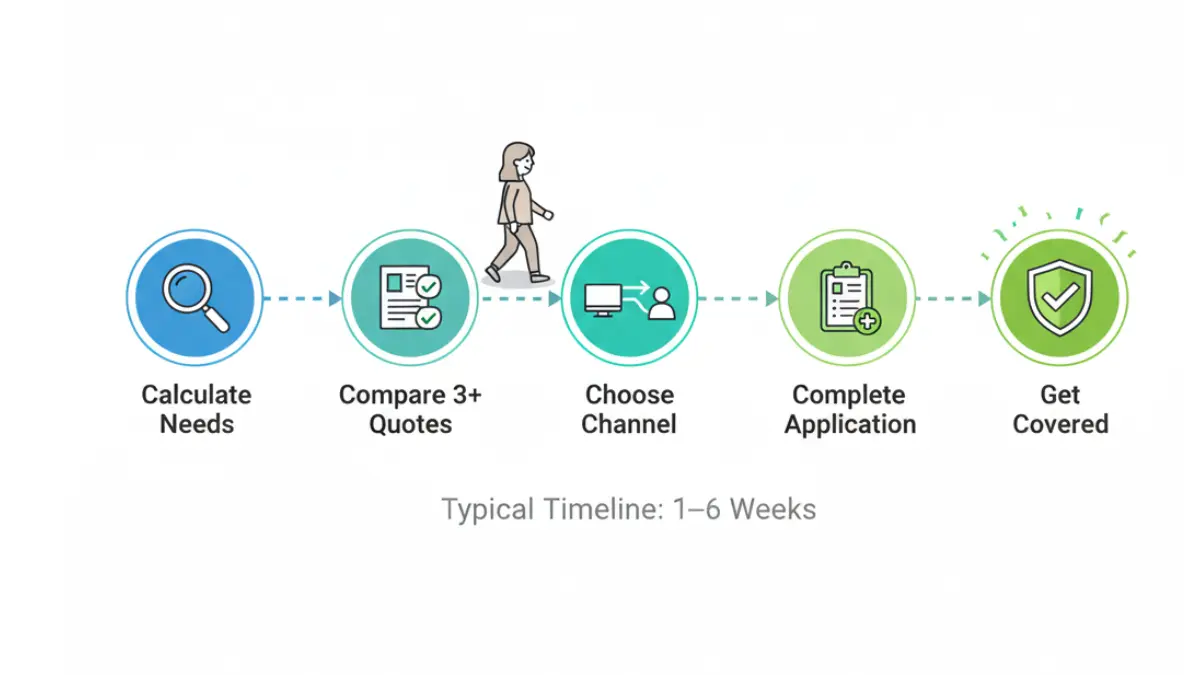
☐ Step 1: Calculate coverage needs using DIME method
- Add debt, income replacement (10-15 years), mortgage, education costs
- Subtract existing coverage, savings, Social Security survivor benefits
- Result = target coverage amount
☐ Step 2: Determine optimal policy type
- Temporary needs (mortgage, child-rearing) = Term life
- Estate planning, lifetime coverage = Whole life
- Flexible budget, moderate growth = Universal life
- Investment-focused with insurance = Variable life
☐ Step 3: Get quotes from 3+ carriers
- Compare online direct carriers (Haven Life, Ethos, Ladder)
- Check traditional nationals (State Farm, Northwestern Mutual, New York Life)
- Consider specialized carriers for health conditions
☐ Step 4: Review existing employer coverage gaps
- Typical employer policies provide only 1-2x salary
- Calculate shortfall vs family needs
- Obtain supplemental individual policy for difference
☐ Step 5: Optimize health before applying
- Lose excess weight (every 10 lbs can improve rating)
- Reduce cholesterol/blood pressure to normal ranges
- Quit smoking (must be tobacco-free 12+ months for best rates)
- Delay application 90+ days after medical procedures
☐ Step 6: Complete application honestly and thoroughly
- Gather prescription history, physician names/dates
- Disclose all medical conditions and treatments
- Schedule medical exam promptly when requested
- Respond quickly to underwriter questions
☐ Step 7: Implement and review policy annually
- Verify beneficiary designations
- Store policy documents securely
- Inform beneficiaries about coverage existence
- Review coverage after major life events (births, home purchase, income changes)
What This Means For You: Life insurance isn’t a one-time purchase—it’s an evolving component of financial security requiring periodic evaluation. Begin with adequate term coverage for immediate needs, then consider permanent insurance as wealth grows and estate planning becomes relevant.
Expert Final Word: “The perfect life insurance policy is the one you can afford to maintain for its entire term,” notes Michael Thompson, CFP with 22 years advising families. “I’d rather see clients purchase $500,000 in coverage they’ll keep than $1.5 million they’ll surrender in five years due to budget constraints. Start with what works today, then increase coverage as income grows.”
Comprehensive financial planning extends beyond life insurance—explore our complete suite of financial planning tools and educational resources at Finance Authority Hub to build a robust financial future protecting your family through all life stages.
Frequently Asked Questions About Life Insurance
Q1: What is the average cost of life insurance per month in 2026?
The average American pays $26/month for a 20-year, $500,000 term life insurance policy at age 40. Costs vary significantly based on age, health, gender, and coverage amount—a 30-year-old pays approximately $24/month for identical coverage, while a 50-year-old pays $87/month.
Q2: How much life insurance do I need for my family?
Use the DIME formula: calculate total Debt + Income replacement (10-15 years) + Mortgage balance + Education costs, then subtract existing savings and Social Security survivor benefits. Most families need 10-12x annual income plus enough to eliminate all debt. A family earning $100,000 with $300,000 mortgage and two children typically needs $1.5-$2 million coverage.
Q3: What’s the difference between term and whole life insurance?
Term life insurance covers you for a specific period (10-30 years) with no cash value and lower premiums, while whole life insurance provides lifetime coverage with guaranteed cash value accumulation but costs 5-15x more. Term suits temporary needs like mortgage protection; whole life serves estate planning and permanent protection goals.
Q4: Can I get life insurance without a medical exam?
Yes, accelerated underwriting uses prescription databases and medical records to approve policies within 24-48 hours without exams. However, no-exam policies cost 15-30% more and typically cap coverage at $250,000-$1 million. Healthy applicants save money by completing traditional medical exams for standard rates.
Q5: Is life insurance worth it if I’m single with no dependents?
It depends. If you have cosigned debts (student loans, car loans), elderly parents relying on future support, or want to lock in low rates while healthy, life insurance provides value. However, singles without financial obligations or dependents can prioritize emergency savings and investments instead.
Q6: How do life insurance payouts work?
Beneficiaries file a claim with the death certificate, and insurers typically process payments within 30-60 days. Proceeds are paid as a lump sum directly to beneficiaries, completely tax-free regardless of amount. Some policies offer installment payments or interest-bearing accounts if beneficiaries prefer gradual distribution.
Q7: Can I cash out my life insurance policy early?
Only permanent policies (whole, universal, variable life) build cash value you can access through policy loans or surrender. Term life insurance has no cash value and cannot be cashed out. Surrendering permanent policies triggers surrender charges (typically first 10-15 years) and potential taxation on gains above premiums paid.
Q8: What disqualifies you from getting life insurance?
Very few conditions cause automatic denial in 2026. Recent cancer diagnosis (within 2-5 years), uncontrolled diabetes with complications, advanced liver disease, recent stroke/heart attack, and certain high-risk combinations may result in postponement or guaranteed issue-only options. Most health conditions qualify for some coverage, albeit at higher premiums.
Q9: Is life insurance tax-deductible?
No, personal life insurance premiums are not tax-deductible. However, death benefits paid to beneficiaries arrive completely tax-free, and permanent policy cash value grows tax-deferred. Business owners may deduct premiums for key person insurance or split-dollar arrangements under specific circumstances.
Q10: How long does it take to get approved for life insurance?
Accelerated underwriting provides approval in 24-48 hours for healthy applicants under 50 seeking coverage under $500,000. Traditional underwriting with medical exams takes 4-6 weeks including exam scheduling, lab results, medical records review, and underwriter assessment. Complex cases requiring specialist consultations may extend to 8-10 weeks.
Q11: Can I have multiple life insurance policies?
Yes, you can own multiple policies from different insurers, often called “layering” or “laddering” coverage. This strategy optimizes costs—use cheaper term insurance for temporary large coverage needs while maintaining permanent policy for lifetime protection. Insurers do inquire about existing coverage during underwriting to prevent over-insurance relative to income.
Disclaimer
Disclaimer: This article provides educational information about life insurance and should not be considered financial, legal, or tax advice. Life insurance needs vary significantly based on individual circumstances including age, health, dependents, financial obligations, and long-term goals.
Consult with licensed insurance professionals, financial advisors, estate planning attorneys, and tax specialists before making coverage decisions. Premium rates, policy terms, coverage availability, and underwriting requirements mentioned in this guide are subject to change and may vary by location, health status, carrier, and specific underwriting criteria. All rate examples represent approximate market averages for illustrative purposes only.
The tax treatment of life insurance products discussed involves complex regulations that may change. Consult qualified tax professionals regarding your specific situation and current tax law applicability. This content is current as of January 2026 and should not substitute for professional personalized advice tailored to your unique circumstances.
Related Articles
 Life Insurance & Term Life
Term Insurance: Real Costs Most People Never See
February 23, 2026 Life Insurance & Term Life
Whole Life Insurance Truth: Worth It in 2026?
February 21, 2026 Life Insurance & Term Life
Term Life Insurance 2026: From $26/mo + Rate Calculator
February 4, 2026 Life Insurance & Term Life
Life Insurance: Costs, Types & What You Must Know
February 17, 2026 Life Insurance & Term Life
Term Life Insurance: Honest 2026 Guide by 30 Experts
February 21, 2026
Informational disclaimer
The content on Finance Authority Hub is provided for general informational and educational purposes only and should not be considered personalized financial, investment, tax, legal, or professional advice. Financial decisions depend on your individual goals, income, risk tolerance, location, and regulatory situation. Before acting on any information, strategy, estimate, or calculator result, consult a qualified licensed professional who can evaluate your specific circumstances.