The real rules behind a Social Security earnings record error
Social Security earnings record errors split in two: missing wages have no correction deadline; missing self-employment income often can never be added.

In This Article
In most cases, no — it is not too late. If wages are missing or understated on your record, federal regulation lets the Social Security Administration fix them with no deadline attached at all. The three-year limit filling your search results binds far less than those pages suggest.
A social security earnings record error is worth fixing because your benefit is built from the earnings on file, not the earnings you remember. This guide covers the correction itself — the rule that reopens your year, the proof that satisfies it, the form, and what happens after you file. If you have not yet found the error, start by reading your Social Security Statement line by line and come back.
ℹ️ Financial Disclaimer: This article is educational and not personalized advice. It touches on federal benefit rules, tax reporting, amended returns and administrative appeals, none of which can be applied to an individual record without seeing that record. Consult a CPA or enrolled agent before amending any tax return, a fiduciary advisor before making retirement decisions based on a benefit estimate, and a qualified attorney or an accredited nonprofit Social Security representative if a correction is refused.
Why earnings go missing from a Social Security record
Wage reporting is an annual data transfer between millions of employers and one federal database, and it fails at scale in ordinary, documented ways.

The four causes SSA names
SSA’s own publication How to Correct Your Social Security Earnings Record lists four reasons earnings go missing from earlier years. Your employer reported them under the wrong name or Social Security number. You married or divorced, changed your name, and never reported the change to SSA. Your employer reported the amount incorrectly. Or you worked under a Social Security number that was not yours.
Notice that two of the four are identity mismatches rather than arithmetic mistakes. That matters later, because the correction form has two specific fields built to catch exactly those cases.
How big the backlog actually is
When a wage report cannot be matched to a person, it does not vanish. It goes to the Earnings Suspense File and waits.
📊 Data Point: As of fiscal year 2025, the Earnings Suspense File held more than $2.4 trillion in wages and more than 424 million wage items covering tax years 1937 through 2024 — Source: SSA Office of the Inspector General, Major Management and Performance Challenges During Fiscal Year 2025, January 2026.
The same audit explains why that file exists in the agency’s own terms: suspended earnings are retained so that workers whose legitimate earnings are missing can obtain proper credit once they substantiate them. Your missing year may already be sitting in that file with your money attached to it.
Why the current year looks wrong and isn’t
If the gap is the current year or the one before it, SSA says not to worry — recent earnings may simply not be posted yet. Its own advice is to check your Statement in August to confirm last year’s figure.
Everything on your record feeds one calculation, which is why a single wrong year matters: see how your benefit is calculated from your earnings record. If the amount looks close but not right, compare it against the boxes on your W-2 that SSA actually reads before assuming an error.
What the three-year deadline actually binds
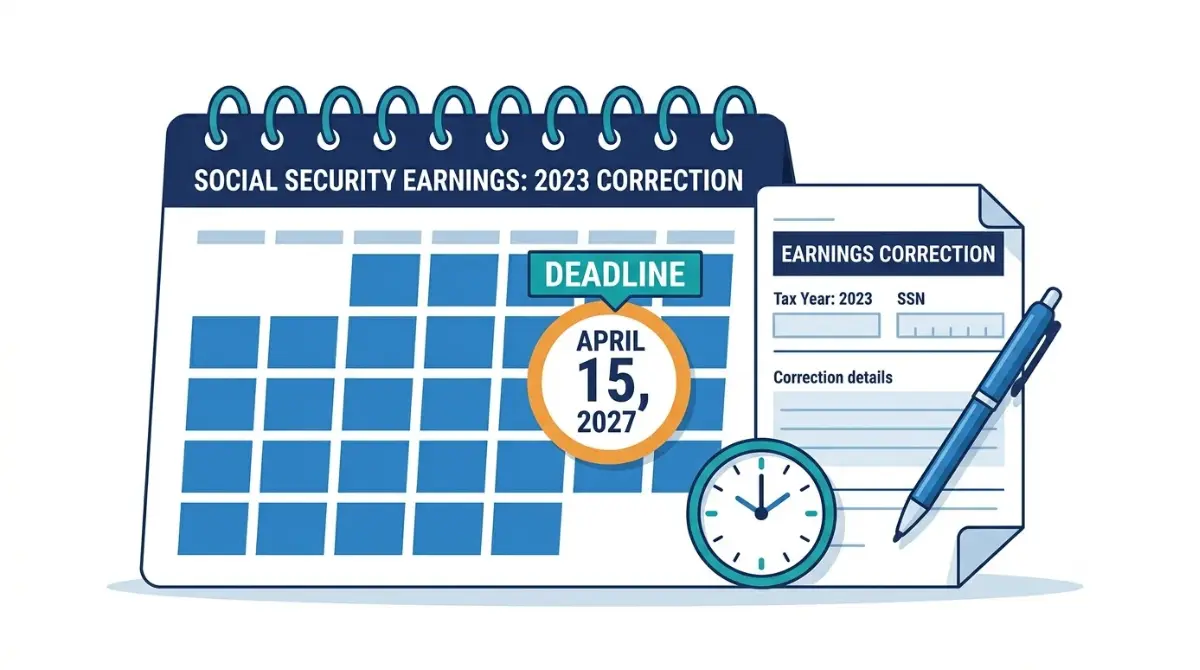
Ordinarily you cannot correct earnings more than three years, three months and 15 days after the end of the year the wages were paid. That is the rule every competing page quotes. It is real, and for most consumer errors it does not apply.
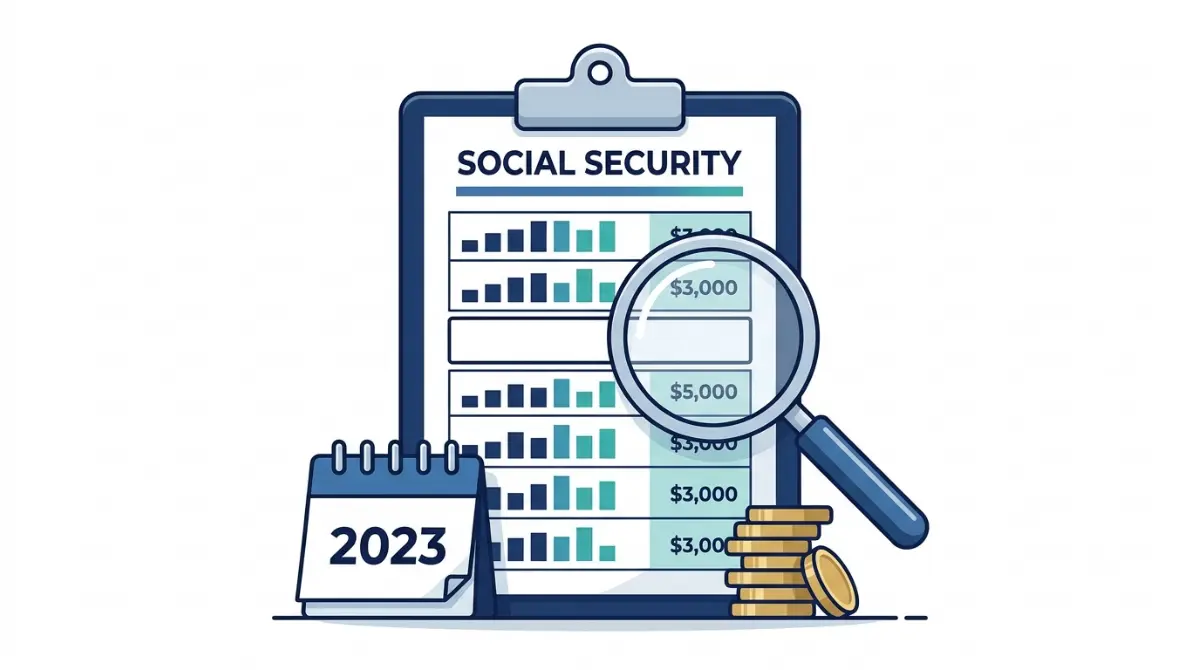
🔍 How It Works: The clock runs from the end of the tax year, not from your discovery of the error. For 2023 wages it starts on December 31, 2023, adds three years to December 31, 2026, three months to March 31, 2027, and 15 days to April 15, 2027. On the same arithmetic, 2024 closes in 2028 and 2025 closes in 2029.

Where the deadline comes from
Once the limit passes, SSA’s records become conclusive evidence of what you earned — unless one of the exceptions applies. SSA’s public FAQ lists four of them. The regulation those bullets summarise, 20 CFR 404.822, sets out fourteen separate provisions, and two of them cover the situations most readers are actually in.
The errors it does not bind
| What went wrong | Rule that reopens it | Still correctable? | Key detail |
|---|---|---|---|
| A year of wages missing entirely | 404.822(e)(5) | Yes | Covers wages where none was recorded |
| Wages posted lower than you earned | 404.822(e)(5) | Yes | Covers “less than the correct amount” |
| Wages shown on a filed wage tax return or state wage report | 404.822(b)(1) | Yes | SSA matches the record to the return |
| Earnings credited to the wrong person or period | 404.822(e)(4) | Yes | The wrong-SSN case |
| A clerical or mechanical error in SSA’s records | 404.822(e)(2) | Yes | Fixable without outside evidence |
| An entry created by fraud | 404.822(e)(3) | Yes | No time limit |
| Back pay awarded by a court or agency | 404.822(e)(6) | Yes | Wages awarded under employment or wage law |
| Railroad earnings sent to the wrong agency | 404.822(d)(1)–(2) | Yes | Transferable in either direction |
| Self-employment income, return filed before the limit | 404.822(b)(2)(i) | Yes | The filing date is what counts |
| Self-employment income, return filed after the limit | 404.822(b)(2)(ii) | No increase | SSA may reduce or remove only |
Source: 20 CFR 404.822, Social Security Administration. Conclusiveness rule at 20 CFR 404.803(c).
The one it does
⚠️ Costly Mistake: If your missing year was self-employment income and no tax return reporting it was filed before the limit expired, the regulation permits SSA to remove or reduce that income but not to increase it. Unlike a missing W-2 year, this loss is permanent, and it is the single reason a self-employed reader should act this month rather than next year.
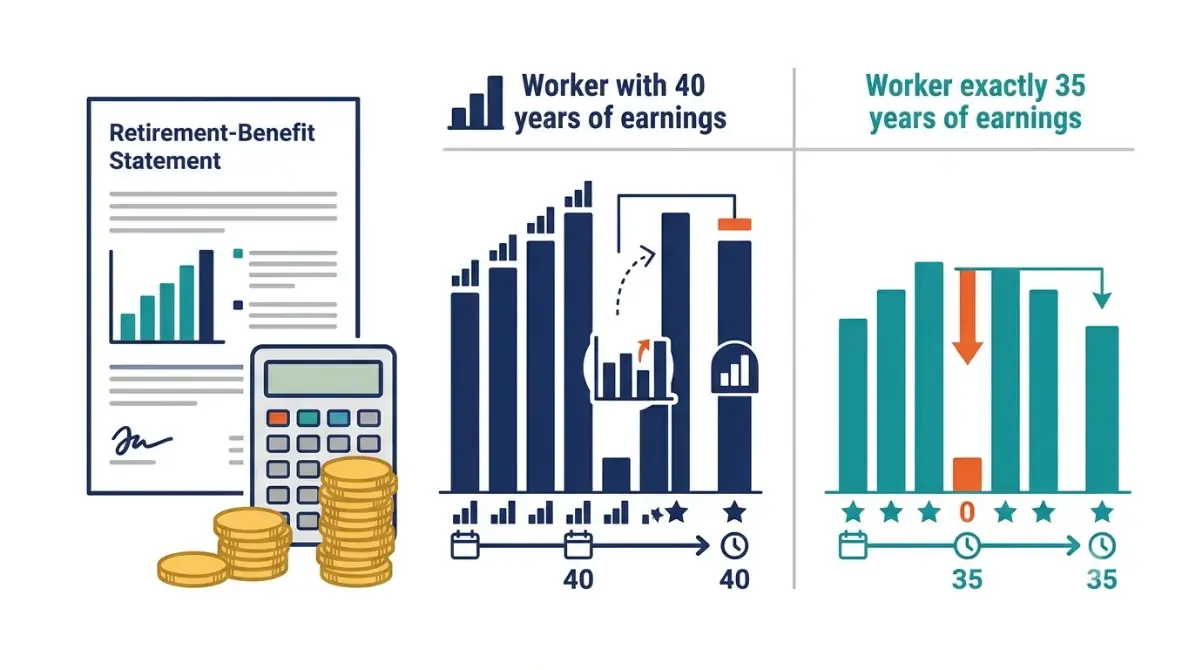
For what a single missing year is worth once it is restored, see what each zero costs your benefit.
What counts as proof, and what to do when you have none
SSA names five kinds of proof of earnings: a Form W-2, a tax return, a wage stub or pay slip, other wage records, and other documents showing you worked.

Getting copies when you have none
Missing paperwork is a delay, not a dead end. The IRS holds wage and income transcripts for the past ten tax years, drawn from the information returns your employer filed. The same page notes that the IRS keeps actual W-2 copies only when they were attached to a paper return, and charges $30 to send the full return instead.
✅ Action Step: SSA can supply microprint copies of your W-2s free of charge when they are used to resolve an SSA matter such as an earnings discrepancy, per that same IRS guidance — a fee applies only for unrelated purposes. Say plainly, when you request them, that you are correcting your earnings record. Reading your Statement first tells you exactly which years to ask for.
If you filed a return for the year, the return itself is evidence: pulling the income lines on your Form 1040 is often faster than chasing an old employer. Contract income is reported differently, so check which 1099 was filed and when.
When the employer is gone
If your employer never corrected a wrong W-2, the IRS will intervene. After the end of February you can ask the IRS to open a W-2 complaint; it writes to the employer requesting a corrected form within ten days and sends you Form 4852 to use in the meantime. That guidance also tells taxpayers to keep Form 4852 until they start receiving benefits, and to verify the wages with SSA after September 30.
If nothing survives, write down what you remember: the employer’s name, where you worked, the dates, the amount, and — the item that lets SSA search the suspense file — the name and Social Security number you used at the time. A written request must be signed and state the period you are questioning.
Filing the correction without defeating your own claim
There are three ways to file: through your my Social Security account, which now accepts uploaded forms and evidence; by phone on 1-800-772-1213; or in person at a field office by appointment. The paper form is Form SSA-7008, Request for Correction of Earnings Record, which SSA estimates takes about 28 minutes.
The four answers that sink a claim
Most walkthroughs treat every field equally. Four of them decide whether your claim survives.
Item 6 asks permission for SSA to disclose your name to your employers, and the form states in its own words that without that permission SSA cannot make a thorough investigation. Under 20 CFR 422.135, contacting the employer is the investigation.
⚠️ Costly Mistake: Answering “no” to Item 6 disables the process the form exists to start. Readers check it out of privacy instinct and then wait months for an inquiry that cannot proceed.
Items 4 and 5(b) ask for any other name you used at work and any other Social Security number used to report your wages. Those two fields are what reach the suspense file, and they map directly onto SSA’s two most common causes of missing earnings.
Item 9c tells self-employed filers to request return copies from the IRS if the return was filed less than six years ago. Item 7’s evidence column expects a W-2, a W-2c or a named substitute; if you have none, the form requires you to explain why in Item 10 rather than leave it blank.
What the form doesn’t tell you
There is a required remarks box, Item 10.A, for anyone whose self-employment income was reported to claim the Earned Income Tax Credit. Item 11 is a declaration under penalty of perjury, so estimate carefully and label estimates as estimates.
One genuine inconsistency: page 1 of the form directs you to mail it to SSA in Baltimore, while page 3 says to send or bring it to your local office. Confirm the destination before mailing.
If your dispute is the amount rather than the year, reconcile a pay stub against the reported figure using the paycheck calculator first. If the employer agrees, they file a corrected Form W-2 C, which goes to SSA directly.
Self-employment income: the one case where the deadline is final
For self-employment income, the date your original tax return was filed decides everything — not when you discovered the problem.
Why the return date decides everything
If a return reporting that income was filed before the limit expired, SSA may correct the record to agree with it. If the return was filed after the limit expired, SSA may reduce or remove the income but cannot add to it. There is a narrow third route where self-employment income replaces wages that were wrongly recorded and later removed, and it carries its own filing conditions.
💡 Expert Note: SSA’s consumer FAQ presents the time limit as a single rule with four exceptions. Its regulation is more generous for wage earners and stricter for the self-employed than that summary implies — which is why reading 404.822 directly changes the answer for a large group of readers.
What to do now
Nothing in this section tells you whether to amend a return; that depends on facts only your preparer can see, and the mechanics are set out in the IRS guidance on Form 1040-X, the amended individual return.
✅ Action Step: Ask a CPA or enrolled agent one specific question: “Was a return reporting this self-employment income filed, and on exactly what date?” That single date determines whether the year can ever be added to your record.
Self-employment income also buys the quarters that qualify you in the first place — see how work credits are earned. If you are self-employed and rebuilding retirement savings alongside this, what a SEP IRA allows is the usual next question.
After you file: what SSA does, and what to do if the answer is no
The investigation is a real administrative process, not a queue. Under 20 CFR 422.135, SSA contacts the employer and you to reconcile the discrepancy, then must notify you in writing of the determination and of your right to reconsideration.

How long it takes, and why nobody can tell you
You will find a “10 to 90 days” figure on several large sites. We could not trace it to any SSA source and are not repeating it. What is documented: SSA employed 52,100 staff at the end of September 2025, about 6,500 fewer than a year earlier.
📊 Data Point: Potential suspicious wage-reporting cases rose from roughly 300 to more than 12,000 in fiscal 2024, and the workload sits with a nine-member Employer Reporting Specialist team — Source: SSA Office of the Inspector General, January 2026.
Expect months rather than weeks, keep your copies, and follow up rather than refile.
If SSA says no
A refusal is a determination you can appeal. You have 60 days from receiving the notice to request reconsideration in writing at an SSA office, using Form SSA-561; if you miss it, you may ask in writing for more time and give your reasons. Download the form from SSA directly, since more than one edition circulates.
If you are already receiving benefits
Corrections to your record trigger a recomputation. Where the corrected earnings raise your primary insurance amount by at least $1.00, SSA processes the increase retroactive to January of the following year. For context on what those amounts look like now, see what benefits actually pay in 2026.
Common questions about earnings record errors
1. How do I fix an error on my Social Security earnings record?
Gather proof of the earnings — a W-2, tax return, pay stub or other wage record — then file through your my Social Security account, by calling 1-800-772-1213, or by submitting Form SSA-7008 to a field office. Complete Item 6 giving SSA permission to contact your employer, or the investigation cannot proceed.
2. Can I correct my earnings record after three years?
Usually yes. The ordinary limit is three years, three months and 15 days, but 20 CFR 404.822 contains fourteen provisions that reopen a record afterwards. Missing or understated wages, entries posted to the wrong person, and clerical errors in SSA’s own records all qualify with no deadline attached.
3. What proof does Social Security accept for missing earnings?
SSA names five kinds: a Form W-2, a tax return, a wage stub or pay slip, other wage records, and other documents showing you worked. If you have none, write down your employer’s name, location, the dates you worked, your pay, and the name and Social Security number you used at the time.
4. What if my employer is out of business?
You can still correct the record. IRS wage and income transcripts cover the past ten tax years, and SSA can supply microprint W-2 copies free when they are used to resolve an earnings discrepancy. Where no document survives, SSA searches its own records using the identifying details you supply.
5. Why are my earnings missing in the first place?
SSA names four causes: your employer used the wrong name or Social Security number, you changed your name after marriage or divorce and never told SSA, your employer reported the amount incorrectly, or you worked under a number that was not yours. Unmatched wage reports are held in the Earnings Suspense File.
6. How long does a correction take?
There is no published SSA processing time, and figures circulating on other sites are not traceable to the agency. SSA must contact your employer, obtain evidence and issue a written determination, and it was operating with about 6,500 fewer staff at the end of fiscal 2025. Plan for months and keep every copy.
7. Can I add missing self-employment income after the deadline?
Only if a tax return reporting that income was filed before the limit expired. If the return came later, SSA may reduce or remove self-employment income but cannot increase it, so the loss becomes permanent. Confirm the original filing date with a CPA or enrolled agent before doing anything else.
8. What happens if Social Security denies my correction?
SSA must tell you in writing and inform you of your right to reconsideration. You have 60 days from receiving that notice to file a written request at an SSA office using Form SSA-561, and you may ask in writing for more time if you miss it. An accredited nonprofit representative can help if it is refused again.
9. Do I have to let Social Security contact my employer?
Practically, yes. Item 6 of Form SSA-7008 asks permission to disclose your name to employers, and the form states that without it SSA cannot investigate thoroughly. Federal regulation confirms that contacting the employer is how the investigation is conducted, so withholding permission stalls your own claim.
10. Will my benefit go up if I am already receiving payments?
It can. A corrected record triggers a recomputation, and where the correction raises your primary insurance amount by at least $1.00, the increase applies retroactive to January of the following year. Confirm any resulting figures with SSA rather than relying on an estimate.
11. Is a missing current-year figure a problem?
Usually not. SSA says earnings for the current year or the previous one may simply not be posted yet and should appear on a later Statement. The agency’s own suggestion is to check in August to confirm last year’s amount.
What to do this week
Open your my Social Security account and read every year, not just the recent ones.
If a year is wrong, decide which kind of error it is before you file — that single question determines whether the calendar matters at all. Wage errors can wait without being lost. Self-employment gaps cannot, and 2023 closes on April 15, 2027.
Then gather what you have, file with Item 6 checked “yes,” and keep copies of everything you send.
Once the record is right, you can see where the restored earnings actually land in the benefit formula’s bend points, and model the corrected figure with the Social Security calculator.
Informational disclaimer
The content on Finance Authority Hub is provided for general informational and educational purposes only and should not be considered personalized financial, investment, tax, legal, or professional advice. Financial decisions depend on your individual goals, income, risk tolerance, location, and regulatory situation. Before acting on any information, strategy, estimate, or calculator result, consult a qualified licensed professional who can evaluate your specific circumstances.