Why Starting a 401(k) in Your 20s Pays Off
A 401(k) in your 20s has one edge nothing later can match: time. Here’s how the 2026 limit, the employer match, and compounding actually build a balance.
In This Article
You just started your first real job, HR handed you enrollment forms, and one mentions a 401(k). If retirement feels far away — or if loans and rent already eat your paycheck — you’re not alone in wondering whether saving now is realistic.
This guide meets you where you are: newly auto-enrolled and unsure what your money is doing, working somewhere with no plan, or torn between paying down debt and starting to save.
Here’s the one thing worth knowing up front: in your 20s, your biggest advantage isn’t how much you earn — it’s time. You don’t need to max out the 401(k) in your 20s (the IRS 2026 employee limit is $24,500, and most young savers start far below it). You just need to start.
ℹ️ Financial Disclaimer: This article is for general educational purposes only and is not personalized investment or tax advice. Retirement, investment, and tax decisions depend on your circumstances. Before acting — especially on how to invest, or whether to choose Roth or traditional — consult a fiduciary financial advisor or a CPA who can review your full situation.
Why time is your biggest advantage in your 20s
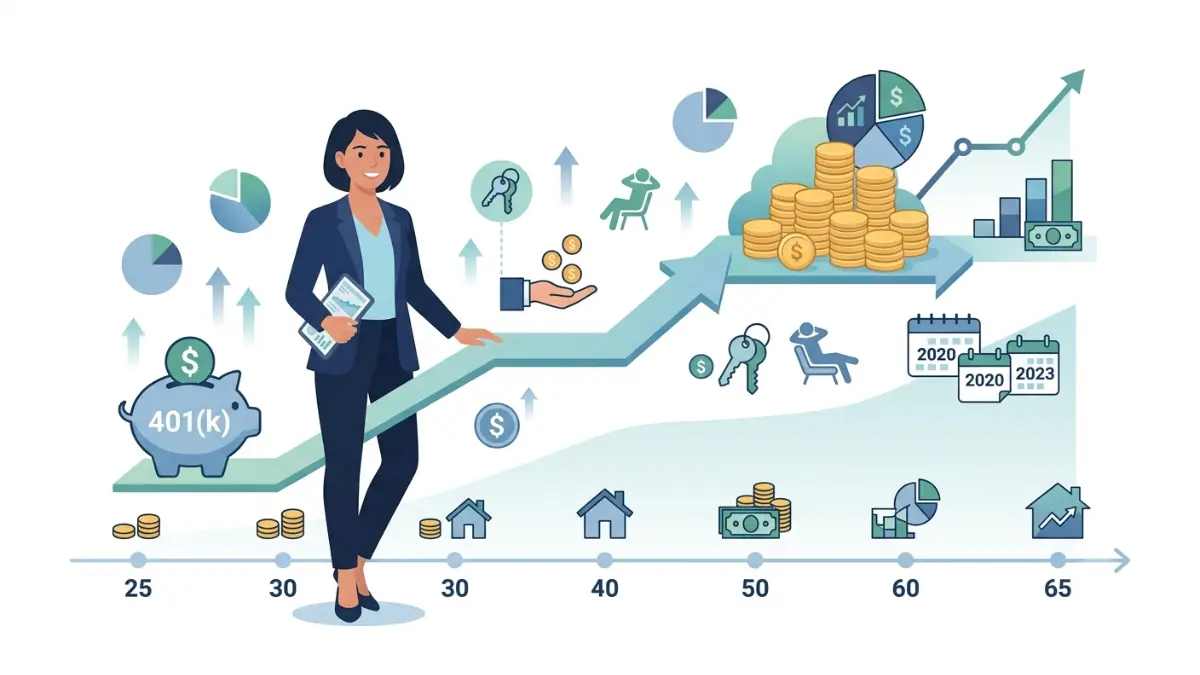
The reason starting early matters so much comes down to one mechanism: compound growth. It rewards time far more than the size of any single contribution.
How compounding actually works
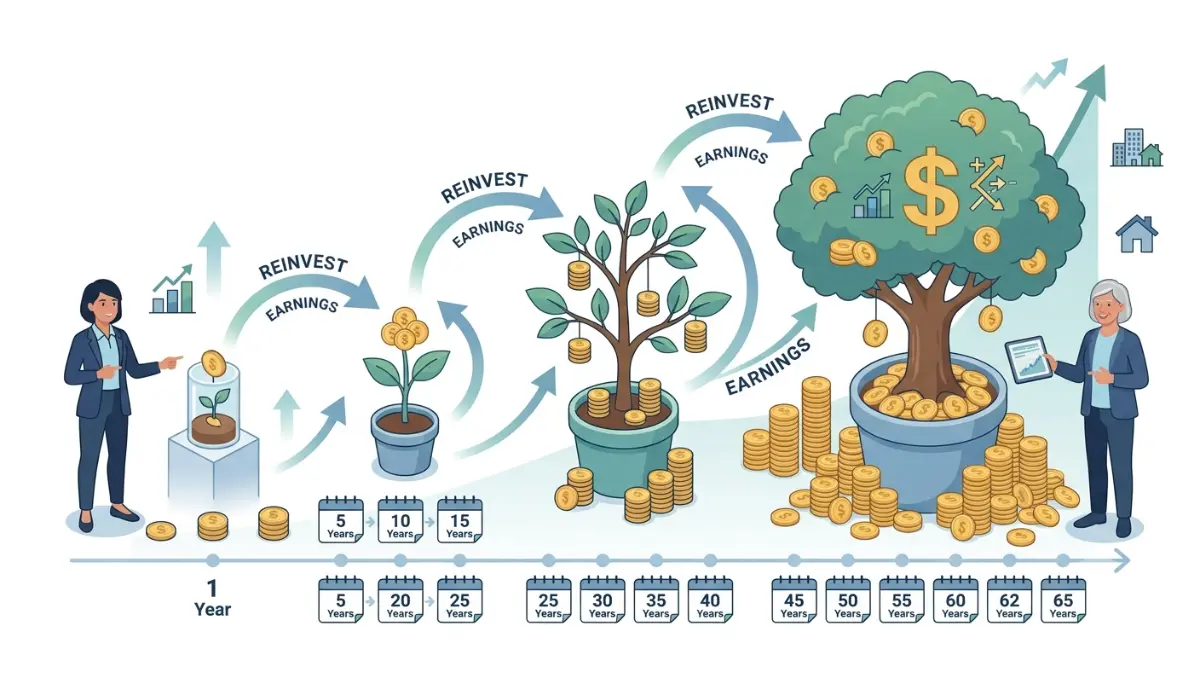
🔍 How It Works: Your contributions get invested and earn a return. Those returns are reinvested and earn returns of their own. Over decades, most of your final balance comes not from the money you put in, but from growth stacked on earlier growth.
A 25-year-old has roughly 40 years until a typical retirement age of 65 — four decades of that stacking effect doing the heavy lifting.
Why a decade early beats a decade of extra saving
Historically, a diversified stock portfolio like the S&P 500 has returned about 10% per year before inflation, or roughly 7% after inflation, over the long run since 1926. Those are long-term averages, not promises — markets fall as well as rise. We’ll use a conservative 7% as an illustration throughout.
You can model how compounding grows over time with different amounts, or try the SEC’s compound interest calculator on your own numbers.
The employer match: don’t leave free money behind
Before you worry about picking investments, capture your employer match — it’s the highest-return move available to most young savers.
How matching formulas work
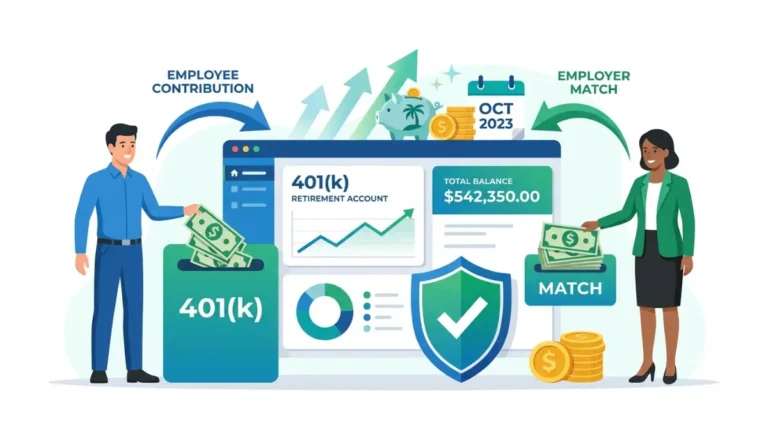
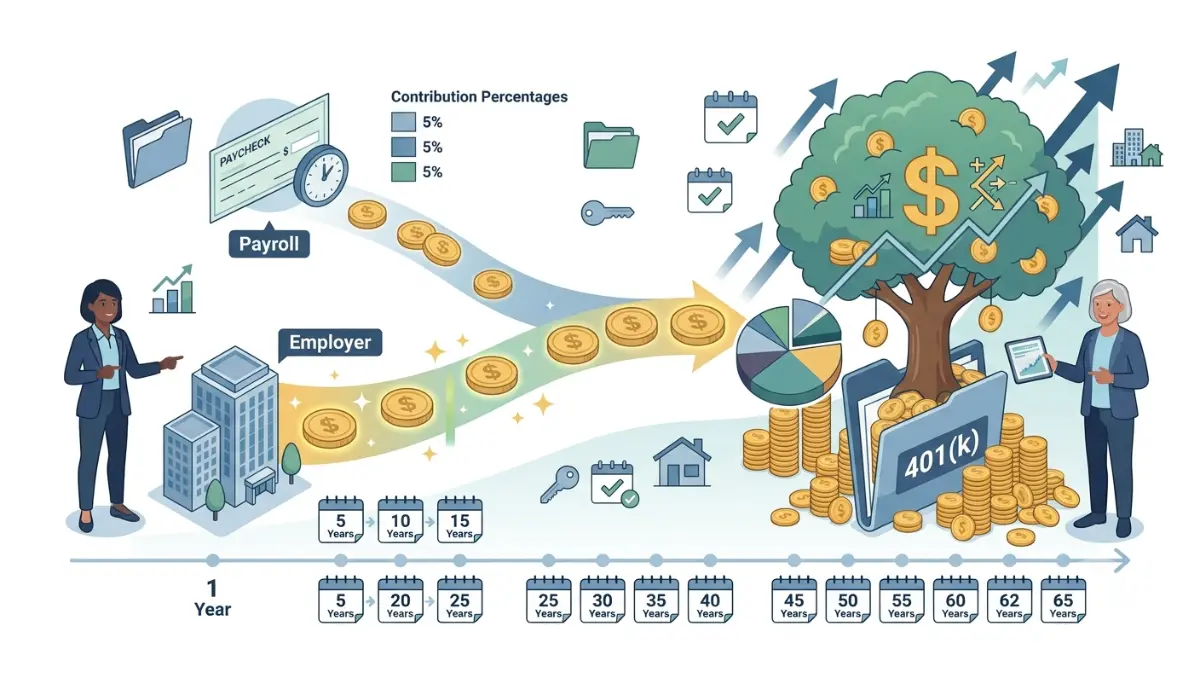
🔍 How It Works: A match means your employer adds money based on what you contribute — commonly 50 cents per dollar up to 6% of pay, or dollar-for-dollar up to 3%. Contribute enough to trigger the full match and that’s an immediate 50%–100% return, before any market growth.
📊 Data Point: The average employer match reached a record 4.7% of pay in Vanguard’s How America Saves 2026 report, based on nearly five million retirement-plan participants.
Access is widespread: per Bureau of Labor Statistics data, 70% of private-industry workers had access to a defined contribution plan like a 401(k) in March 2025. See how employer matching works if your formula is unusual.
What vesting means for your match
Your own contributions are always yours. The employer’s match may be subject to a vesting schedule — you may need to stay a few years before the matched money is fully yours.
⚠️ Costly Mistake: Contributing less than the amount needed for the full match leaves guaranteed money behind every paycheck. It’s the closest thing to a certain return in investing — don’t skip it.
What starting early is really worth: a worked example
Numbers make the case better than any pep talk. Here’s what a steady contribution of $250 a month becomes, depending on the age you start.
The cost of waiting 10 years
| Start age | Years to 65 | Total you contribute | Balance at 65 | Key detail |
|---|---|---|---|---|
| 25 | 40 | $120,000 | ~$656,000 | Time does most of the work |
| 30 | 35 | $105,000 | ~$450,000 | Five years costs ~$206,000 |
| 35 | 30 | $90,000 | ~$305,000 | Ten years costs ~$351,000 |
| 40 | 25 | $75,000 | ~$203,000 | A later start is far harder to catch up |
Source: FinanceAuthorityHub calculation. Assumes $250/month, a 7% average annual return, monthly compounding, retirement at 65. Illustration only; actual returns vary and are not guaranteed.
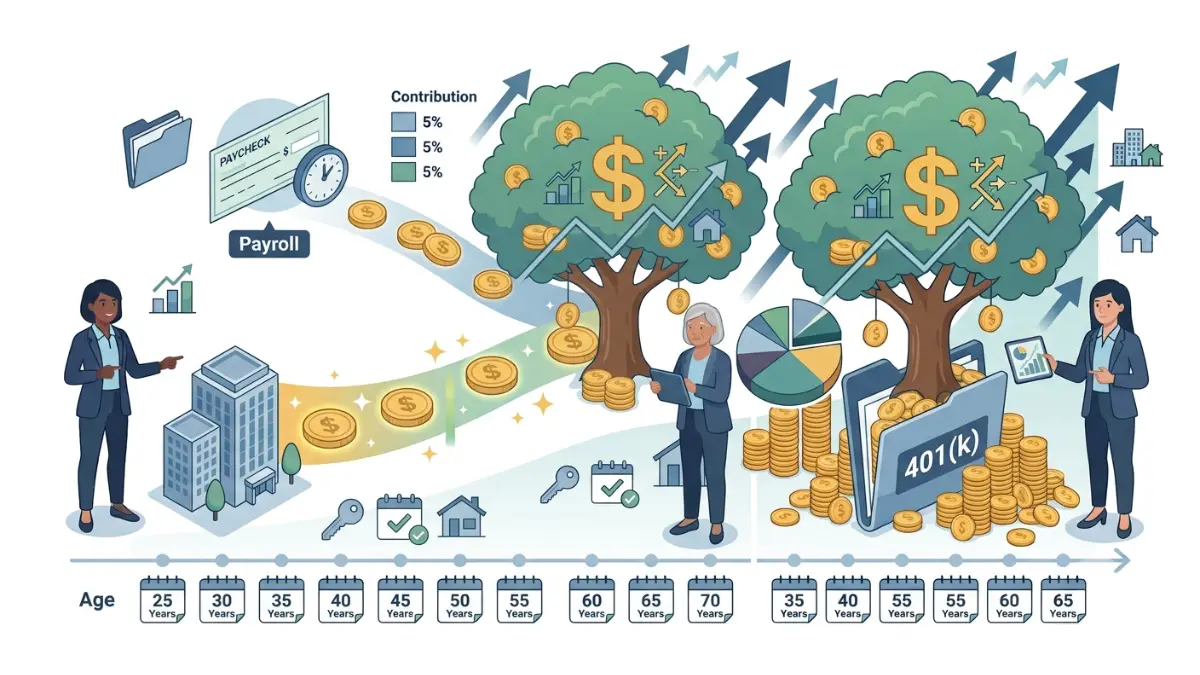
The headline is the gap between starting at 25 and at 35. The earlier saver puts in only $30,000 more out of pocket, yet ends with about $351,000 more at 65 — because those first ten years compound the longest.
Small contributions, big difference
You don’t need a large salary — you need time and consistency. To test your own salary, rate, and match, run your own projection and watch how a few percentage points change the outcome.
How much to contribute — and Roth vs traditional
Once you’re capturing the match, two questions follow: how much more to save, and whether it should be Roth or traditional.
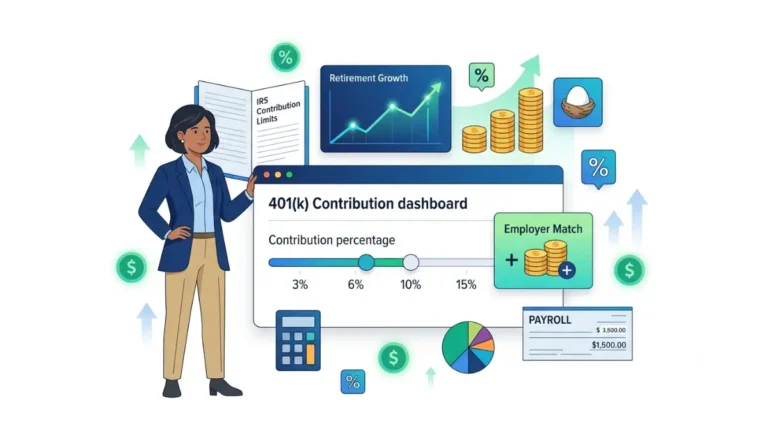
How much should you contribute in your 20s?
Think of your contribution rate as a ladder, not a single number:
- Contribute at least enough to get the full employer match.
- Build toward saving 10%–15% of your income, raising it as your pay grows.
- Reach for the $24,500 annual ceiling only if you have room after other priorities.
📊 Data Point: Vanguard suggests a total savings rate of 12%–15% of pay, including any employer match. The average participant saved 12.1% in Vanguard’s How America Saves 2026 report — a record high.
A simple habit does the work: raise your rate one point a year, or turn on automatic increases. See how much to contribute at each stage for detail.
Roth vs traditional 401(k) for young earners
🔍 How It Works: A traditional 401(k) gives you a tax break now and taxes withdrawals later. A Roth 401(k) is the reverse — you pay tax now, and qualified withdrawals in retirement are tax-free.
The deciding variable is your tax bracket today versus the one you expect in retirement. Many people early in their careers sit in a lower bracket than they later will, which is why Roth versus traditional 401(k) often leans Roth for young earners — a general pattern, not advice for you.
What about student loans?
A high-interest loan paid down is a guaranteed return that can rival investing. A reasonable order for many: capture the full match first, then weigh extra loan payments against extra saving based on the loan’s rate.
✅ Action Step: Ask a CPA or fiduciary advisor: “Given my income, expected future earnings, and student loan rate, should I prioritize a Roth or traditional 401(k), and how much should go to loans versus retirement?”
How to start your first 401(k) — and where you stand
Turning intent into action takes about fifteen minutes. Here’s the sequence, plus an honest look at how your balance compares.
Steps to enroll and set it up
- Enroll through your employer’s plan portal (if auto-enrolled, log in to confirm you’re in).
- Set your contribution percentage to at least capture the full match.
- Choose a target-date fund matched to your expected retirement year — a common, low-effort default.
- Turn on automatic annual increases so your rate rises without you thinking about it.
Starting from scratch? Setting up a 401(k) step by step walks through each screen.
What to invest in (the simple default)
A target-date fund holds a diversified mix that shifts toward safer assets as you age — which is why most participants use professionally managed options. For anything beyond that default, choosing your 401(k) investments covers the tradeoffs, and a fiduciary advisor can tailor an allocation to your goals.
The average 401(k) balance in your 20s
📊 Data Point: Vanguard’s How America Saves report (year-end 2024 data) found the average worker under 25 had about $6,900 in their plan, with a median near $1,950.
The median matters more than the average, which a few large accounts pull upward. Both are low — so simply starting now puts you ahead of most peers. Compare across ages with our guide to average 401(k) balance by age.
Common 401(k) mistakes to avoid in your 20s
A few avoidable errors quietly cost young savers the most. Knowing them protects decades of growth.
Cashing out when you change jobs
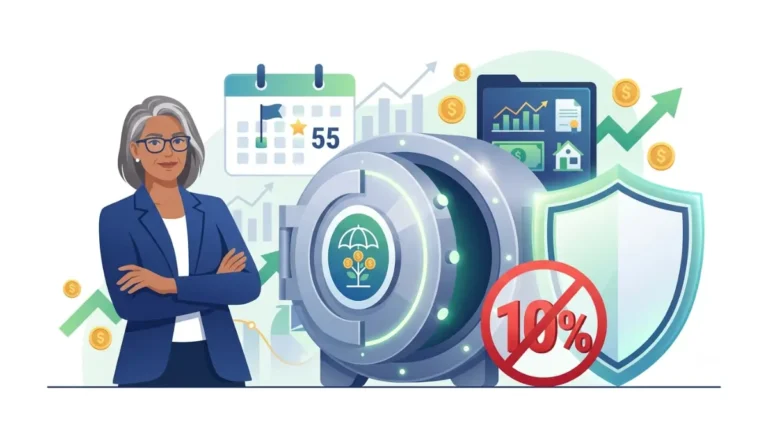
⚠️ Costly Mistake: Cashing out a 401(k) when you leave a first job triggers income tax plus a 10% early-withdrawal penalty under IRS rules for withdrawals before age 59½ — and erases years of compounding you can’t rebuild.
The fix is simple: when you switch jobs, leave the money invested or roll it into an IRA. A small balance left alone for decades becomes a large one, exactly as the worked example showed.
Skipping the match or playing it too safe
Two other habits hold young savers back: contributing below the match, and parking everything in cash when you have decades to ride out market swings. In your 20s, time is precisely what lets you tolerate short-term volatility — using it well is the whole advantage.
401(k) in your 20s: frequently asked questions
1. Is it worth starting a 401(k) in your 20s?
Yes. Starting a 401(k) in your 20s gives your money the longest time to compound, which matters far more than how much you earn early on. As the worked example shows, a 10-year head start on $250 a month can mean roughly $351,000 more by age 65, despite only about $30,000 more contributed.
2. How much should I contribute to my 401(k) in my 20s?
At minimum, contribute enough to capture your full employer match, since that’s guaranteed money. From there, build toward saving 10%–15% of your income over time, raising your rate as your pay grows. Reach for the $24,500 annual limit only once other priorities, like high-interest debt, are handled.
3. What’s the average 401(k) balance in your 20s?
Vanguard’s How America Saves report (year-end 2024 data) found the average worker under 25 had about $6,900, with a median near $1,950. The median is the more realistic benchmark for a typical saver. Both figures are low, so starting a 401(k) in your 20s puts you ahead of most peers.
4. How much can I contribute to a 401(k) in 2026?
For 2026, the IRS allows employees to contribute up to $24,500 to a 401(k). Most people in their 20s contribute well below that, which is fine. The priority early on is capturing the full employer match and building a consistent saving habit, not hitting the maximum.
5. Should I choose a Roth or traditional 401(k) in my 20s?
It depends on your current tax bracket versus the bracket you expect in retirement. A traditional 401(k) is taxed at withdrawal; a Roth is taxed now and withdrawn tax-free. Many young earners in lower brackets consider Roth, but confirm the right choice for you with a CPA or fiduciary advisor.
6. What if my employer doesn’t offer a match?
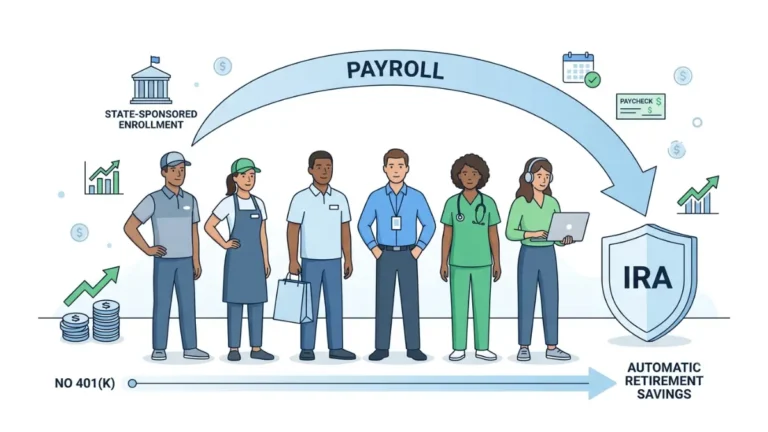
A 401(k) is still worth using without a match, because your contributions grow tax-advantaged over decades. If your plan is weak or absent, a Roth IRA opened on your own is a common next step for young savers. The habit of investing consistently and early matters more than any single feature.
7. Should I pay off student loans or contribute to my 401(k) first?
Capture your full employer match first, since it’s a guaranteed return. After that, weigh extra loan payments against extra saving based on your loan’s interest rate. A high-rate loan often deserves priority; for a personalized order, ask a CPA or fiduciary advisor about your specific rates and goals.
8. How much will $250 a month grow by retirement?
In our illustration, $250 a month at a 7% average annual return grows to about $656,000 over 40 years (starting at age 25) and roughly $305,000 over 30 years (starting at 35). These are illustrative figures using a long-term historical average; actual returns vary and are never guaranteed.
9. What should I invest my 401(k) in during my 20s?
A target-date fund matched to your expected retirement year is a common, low-effort default that diversifies and adjusts risk as you age. Diversification matters more than picking a “winning” fund. For an allocation tailored to your goals and risk tolerance, consult a fiduciary financial advisor.
10. Can I lose money in my 401(k)?
Yes. A 401(k) is invested, so its value rises and falls with the market. The advantage of starting in your 20s is that a long time horizon lets you ride out downturns, which historically have been followed by recoveries. Staying invested through volatility is generally what protects long-term growth.
11. What happens to my 401(k) if I change jobs?
Your 401(k) is yours to keep. When you leave, you can generally leave it in the old plan, move it to your new employer’s plan, or roll it into an IRA. Avoid cashing it out — that triggers taxes, a 10% penalty before age 59½, and lost compounding.
Start today, not “someday”
The biggest lever in retirement saving isn’t a clever strategy — it’s starting now and letting time compound. You’ve seen what a decade’s head start is worth, and how little you need to begin. Your next step takes minutes: enroll in your plan, or raise your contribution to capture the full employer match.
Want a simple walkthrough? Grab our free First-Paycheck 401(k) Starter Checklist — enroll, set your rate to the full match, pick a target-date fund, and automate your increases — so nothing gets missed.

Informational disclaimer
The content on Finance Authority Hub is provided for general informational and educational purposes only and should not be considered personalized financial, investment, tax, legal, or professional advice. Financial decisions depend on your individual goals, income, risk tolerance, location, and regulatory situation. Before acting on any information, strategy, estimate, or calculator result, consult a qualified licensed professional who can evaluate your specific circumstances.