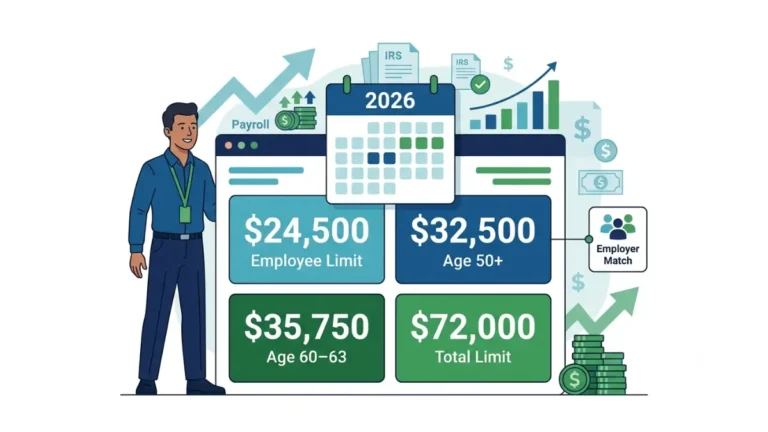
How to Find and Cut Your 401(k) Fees
Most 401(k) fees are invisible—skimmed from your returns before you ever see them. The average is just 0.26%; here’s how to find yours and pay less.

In This Article
Your 401(k) fees are probably charging you money you’ve never seen. They rarely arrive as a bill — they’re skimmed quietly from your investment returns, which is exactly why most people never notice them.
This guide is built for three situations. If you’ve never checked what your plan costs and want to know where to look, start with finding your fees. If you’ve seen a number and want to know whether it’s normal, skip to the benchmark; and if you already suspect you’re overpaying, the section on cutting costs is for you.
Here’s why it’s worth five minutes. According to the U.S. Department of Labor, a difference of just 1 percentage point in annual fees can reduce a retirement balance by about 28% over 35 years. On a $25,000 balance growing at 7%, that’s the gap between roughly $227,000 and $163,000 at retirement — with no extra contributions, just a lower fee.
The reassuring part: fees are knowable and, in most plans, at least partly fixable. Average 401(k) fund costs have fallen to historic lows over the past two decades. What follows is exactly what you’re paying and what to do about it.
ℹ️ Financial Disclaimer: This article is general educational information, not personalized investment or tax advice. 401(k) fee structures, fund options, and the tax treatment of withdrawals and rollovers vary by plan and by individual. Before changing your investments, moving or cashing out an account, or making any decision with tax consequences, consult a fiduciary financial advisor and a qualified tax professional (a CPA or tax attorney), and review your own plan documents.
The 401(k) fees you’re actually paying
Before you can cut a fee, you have to know it exists. Your 401(k) costs fall into three buckets, and they behave differently.
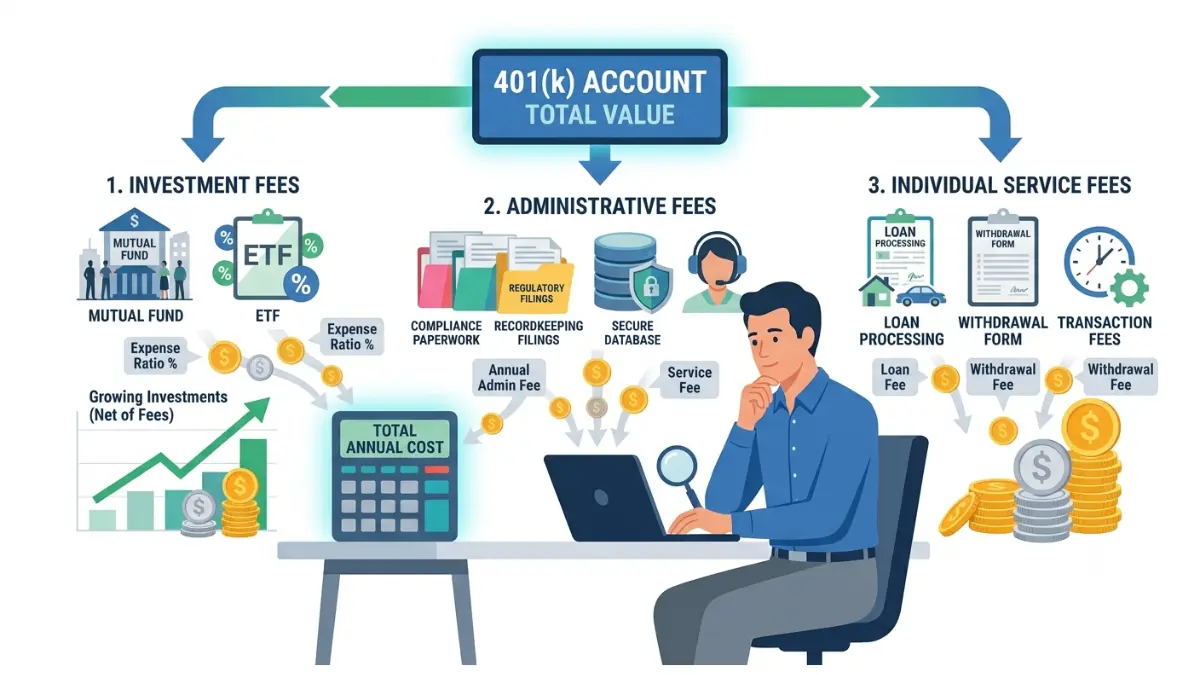
Investment fees are the biggest slice for most people. These are the annual operating costs of the funds you’re invested in, shown as an expense ratio — a percentage quietly deducted from the fund before any return reaches you. In 2024, the Investment Company Institute found that 401(k) participants paid an average equity-fund expense ratio of 0.26%, well below the 0.40% paid by fund investors industry-wide.
Administrative fees cover running the plan itself — recordkeeping, compliance, legal work, and customer service. Your employer sometimes absorbs these, and sometimes they’re passed to you as a flat per-participant charge or as a percentage of your balance.
Individual service fees are charged only when you take a specific action, such as a plan loan or a distribution. A fourth cost, the 12b-1 fee, is a marketing charge embedded inside some funds’ expense ratios — the vast majority of fund assets in 401(k) plans now carry no 12b-1 fee, but older funds in some plans still do.
🔍 How It Works: An expense ratio isn’t billed to you — it’s netted out of the fund’s return daily. If a fund earns 8% in a year and charges 0.50%, you see roughly 7.50%. That’s why fees are so easy to miss: nothing ever leaves your checking account.
For the official breakdown of how administration and investment charges are assessed, the IRS overview of retirement plan fees is a plain-language reference.
How to find out what fees you’re paying
To find your 401(k) fees, open two documents your plan is legally required to give you: your annual fee disclosure and your latest quarterly statement.
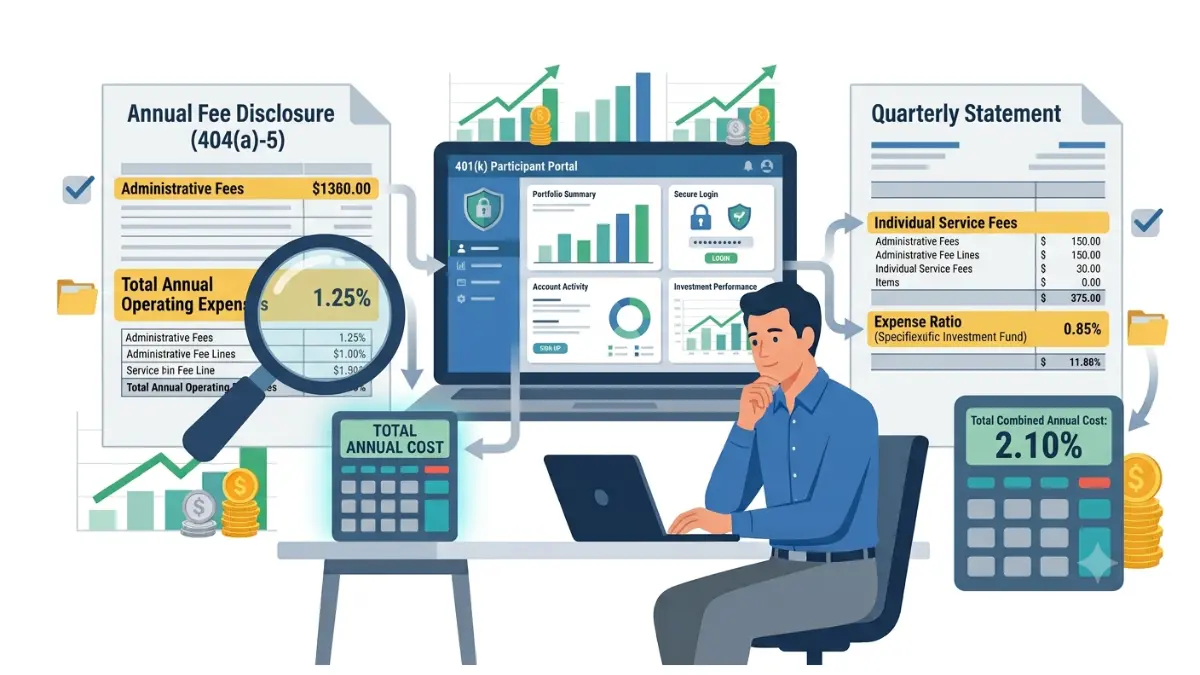
- Open your annual fee disclosure. Under Department of Labor rules, your plan must send participants a document — often called the 404(a)-5 disclosure — at least once a year. It arrives by mail or lives in your plan’s online portal.
- Read the “Total Annual Operating Expenses” column. The disclosure includes a comparison chart listing every fund in your plan next to its cost. The column labeled Total Annual Operating Expenses is the ongoing annual fee for each fund, shown as both a percentage and a dollar amount per $1,000 invested.
- Check your quarterly statement for real dollars. Separately, your plan must show, at least quarterly, the actual dollar amounts deducted from your account for administrative or individual service fees.
- Add it up. Combine the expense ratio of the funds you actually hold with any flat or asset-based administrative charges. That’s your true all-in cost.
✅ Action Step: Pull up your most recent 404(a)-5 disclosure this week and write down the Total Annual Operating Expenses for each fund you’re invested in. If you can’t find it, email your HR or benefits contact and ask for “the annual participant fee disclosure and the most recent quarterly fee statement.”
💡 Expert Note: A common point of confusion is the difference between the participant disclosure you receive and the separate 408(b)-2 disclosure that service providers must give your employer. The employer-facing version shows the plan’s total costs — so if your own statement is unclear, HR can request the fuller breakdown.
What’s a reasonable 401(k) fee?
A reasonable 401(k) fee depends heavily on the type of fund you hold, so the average is the right starting point for comparison.
| Fund type | Average expense ratio (401(k) participants, 2024) | Key detail |
|---|---|---|
| Equity (stock) mutual funds | 0.26% | Below the 0.40% industry-wide average for all investors |
| Target-date funds | 0.29% | Down from 0.67% in 2008 |
| Broad index funds | Often a fraction of the average | Passive management keeps costs low |
| Actively managed funds | Typically higher | You pay more for a manager trying to beat the market |
Source: Investment Company Institute, “The Economics of Providing 401(k) Plans: Services, Fees, and Expenses, 2024.” Broad-index and active ranges are general guidance, not ICI point figures.
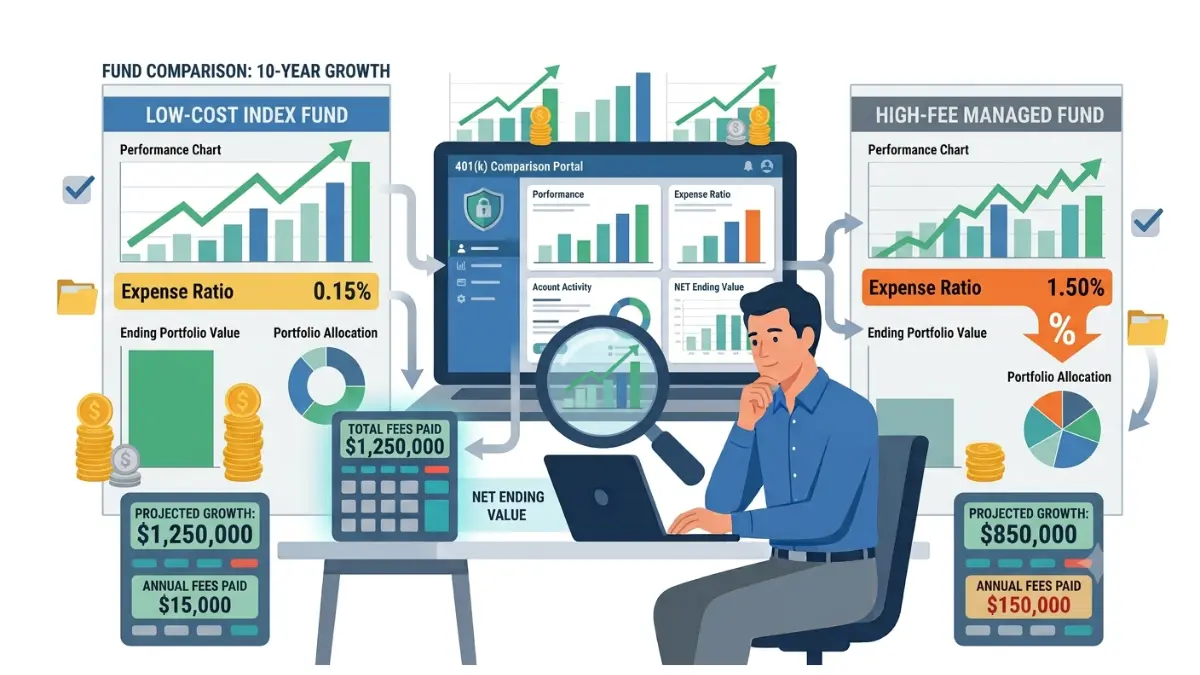
So how do you know if yours is too high? Use the Department of Labor’s own math as a threshold: because a 1-point difference compounds to roughly a 28% smaller balance over 35 years, an all-in cost meaningfully above 1% is worth questioning — especially if lower-cost funds sit right there in your plan. All-in costs also tend to run higher in smaller employers’ plans, which don’t have the scale to negotiate lower rates.
📊 Data Point: The average equity-fund expense ratio paid by 401(k) participants fell from 0.76% in 2000 to 0.26% in 2024 — a 66% decline. Source: Investment Company Institute, 2024.
For a side-by-side on why the passive-versus-active choice drives so much of your cost, see our guide to index funds versus actively managed funds. You can also research any specific fund’s long-run cost with the SEC’s explainer on calculating mutual fund fees.
How to reduce your 401(k) fees
Once you know your number and how it compares, you have several levers — and the order matters, because the easiest wins carry no tax cost.
- Switch to lower-cost funds already in your plan. Moving money from a higher-cost fund to a low-cost index or target-date fund within the same 401(k) changes your investments, not your account, so it triggers no taxes. This is usually the biggest, simplest saving.
- Consolidate old accounts, carefully. If you have a forgotten 401(k) from a past job, it may sit in higher-cost funds; you can track down an old 401(k) and, in some cases, roll it into an IRA with cheaper options — but compare total costs first.
- Ask your employer to improve the plan. Under ERISA, your employer is a plan fiduciary with a legal duty to keep the plan’s fees reasonable. Raising the issue — individually or with colleagues — can prompt a review.
⚠️ Costly Mistake: Chasing the lowest possible fee by picking funds that don’t match your goals or risk tolerance. Fees are one input; a rock-bottom-cost fund that’s wrong for your timeline can cost you far more than a slightly pricier one that fits. Cheaper is not automatically better.
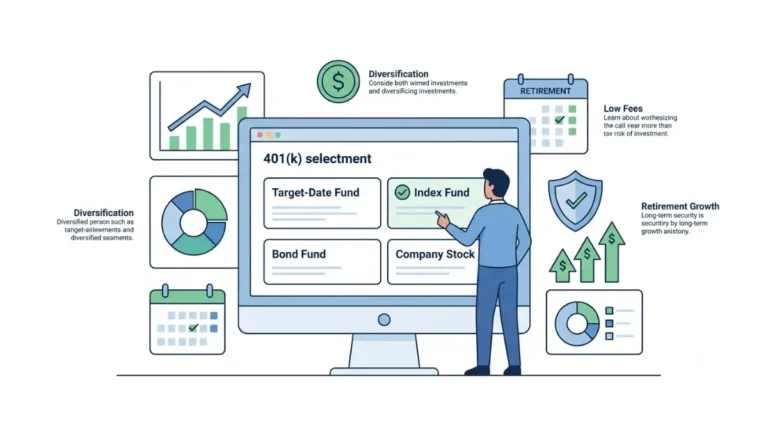
✅ Action Step: Before selecting or switching funds, talk to a fiduciary financial advisor and ask one specific question: “What are the lowest-cost index or institutional share classes available in my plan, and what’s the all-in cost of each?” For choosing among your plan’s options, see our walkthrough on choosing the funds in your 401(k).
To compare the long-term cost of specific funds side by side, FINRA’s Fund Analyzer is a free regulator-built tool.
What cutting your fees is really worth
Small fee differences look trivial on a statement and enormous over a career, because the money lost to fees also stops compounding.
Start with the Department of Labor’s illustration. On a $25,000 balance earning 7% for 35 years with no further contributions, paying 0.5% in fees leaves you about $227,000 — but paying 1.5% leaves only about $163,000. That single percentage point costs roughly $64,000, or 28% of the balance.
Now scale it to someone contributing steadily. Suppose you contribute the 2026 elective-deferral maximum of $24,500 a year for 30 years, earning 7% before fees.
| Annual fee | Estimated balance after 30 years |
|---|---|
| 0.30% | ~$2.19 million |
| 1.00% | ~$1.94 million |
Illustrative calculation by FinanceAuthorityHub. Assumptions: level $24,500 annual contributions (2026 IRS limit), 7% average annual return before fees, fees modeled as a flat reduction in return, no employer match or raises, contributions at year-end. Your actual result will differ; treat this as an order-of-magnitude estimate, not a projection.

🔍 How It Works: The ~$256,000 gap isn’t mostly the fees themselves — it’s the decades of growth those fee dollars would have earned if they’d stayed invested. That compounding-on-compounding effect is why a fraction of a percent matters so much over a long horizon.
Run your own numbers with our 401(k) and retirement calculator, or see the raw effect of fees on growth with the compound interest calculator.
Common 401(k) fee mistakes to avoid
Trying to escape fees can cost more than the fees themselves. These are the missteps to watch for.
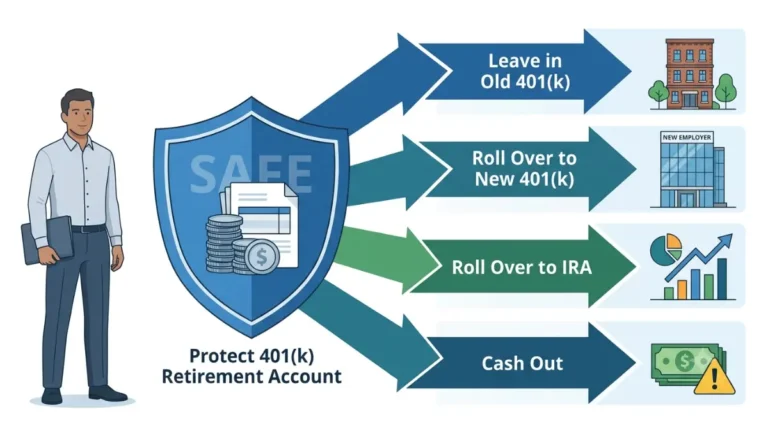
Cashing out to “get away” from a high-fee plan. Taking money out of a 401(k) before age 59½ generally triggers a 10% additional tax on top of ordinary income tax, and 401(k) distributions usually have 20% withheld up front. Between the early-withdrawal penalty and taxes, a chunk of your savings can vanish to solve a fee problem.
Rolling into a higher-cost account. A rollover isn’t automatically cheaper. Employer plans often benefit from economies of scale, so an IRA can cost more — compare the best place to roll over against what you already have before moving anything.
Sacrificing the match to chase low fees. No fee saving beats free money. If cutting fees ever tempts you to contribute less than what earns your full employer match, you’re coming out behind.
✅ Action Step: Before cashing out or rolling over an account to reduce fees, ask a fiduciary advisor and a tax professional one question: “Will this move actually lower my total cost after taxes and penalties, or just move the money?”
401(k) fees: frequently asked questions
1. What is a good expense ratio for a 401(k)?
A good expense ratio depends on the fund type. Broad index funds often cost a fraction of a percent, while the average equity-fund expense ratio paid by 401(k) participants was 0.26% in 2024, according to the Investment Company Institute. Actively managed funds run higher. Compare your funds against these averages, and consult a fiduciary advisor about your specific mix.
2. How much is too much for 401(k) fees?
There’s no single cutoff, but the Department of Labor’s math is a useful guide: a 1-point fee difference can cut a balance by about 28% over 35 years. An all-in cost meaningfully above 1% is worth questioning, especially if cheaper funds sit in your plan. A fiduciary advisor can help you judge your situation.
3. Are 401(k) fees worth it?
Often, yes. A 401(k) still offers tax advantages and, frequently, an employer match that can outweigh the fees. The goal isn’t zero fees — it’s reasonable fees for the value you receive. If your all-in cost looks high relative to the 2024 averages, it’s worth reviewing with a fiduciary advisor.
4. Can I avoid 401(k) fees entirely?
No — every 401(k) has some cost to run. But you can minimize what you pay by choosing lower-cost funds in your plan, consolidating high-cost old accounts, and avoiding funds with unnecessary charges like legacy 12b-1 fees. What’s fixed versus flexible depends on your specific plan’s lineup.
5. Should I roll over my 401(k) to lower fees?
Sometimes, but not always. Employer plans often have lower costs than IRAs because of their scale, so a rollover can raise your fees rather than cut them. Compare the all-in cost of both before moving money, and confirm the tax treatment with a tax professional first.
6. Do employers pay 401(k) fees?
Sometimes. Employers may cover administrative costs, or pass them to participants as flat per-participant charges or a percentage of assets. Investment fees (expense ratios) almost always come out of your returns regardless. Your annual fee disclosure and quarterly statement show who’s paying what.
7. What is a 12b-1 fee?
A 12b-1 fee is a marketing and distribution charge embedded in some funds’ expense ratios. The large majority of fund assets in 401(k) plans now carry no 12b-1 fee, but legacy funds in some plans still do. Check your fund’s prospectus or your fee disclosure to see whether you’re paying one.
8. What is the 404(a)-5 fee disclosure?
The 404(a)-5 disclosure is the annual document your plan must give participants, listing every investment option and its cost under a “Total Annual Operating Expenses” column. It’s the single best place to see what your funds charge. It usually arrives by mail or lives in your plan’s online portal.
9. How do 401(k) fees affect my retirement?
Because fees are deducted from returns, the money lost also stops compounding — so small differences grow large over decades. The Department of Labor illustrates that a 1-point fee gap can shrink a balance by about 28% over 35 years. Modeling your own numbers, ideally with a fiduciary advisor, shows the real stakes.
10. Where do I see the actual dollars I paid in fees?
Your quarterly statement is required to show the actual dollar amounts deducted from your account for administrative and individual service fees during that period. The annual disclosure shows percentages; the quarterly statement shows real dollars. Review both together for your true all-in cost.
11. How often should I check my 401(k) fees?
At least once a year, when your annual fee disclosure arrives, and again whenever you change funds or start a new job’s plan. A quick yearly check of your Total Annual Operating Expenses is enough to catch a high-cost fund before it quietly compounds against you.
Your next step
Fees are the rare part of investing you can actually control, and the first move takes minutes.
This week, open your 404(a)-5 fee disclosure and read the Total Annual Operating Expenses for the funds you hold. Compare them against the 2024 averages, and if anything looks high, check whether a lower-cost option already sits in your plan.
Then keep the bigger picture in view: low fees and full contributions work together. The more you contribute toward the 2026 contribution limits, the more every basis point you save compounds in your favor over the decades ahead.
Informational disclaimer
The content on Finance Authority Hub is provided for general informational and educational purposes only and should not be considered personalized financial, investment, tax, legal, or professional advice. Financial decisions depend on your individual goals, income, risk tolerance, location, and regulatory situation. Before acting on any information, strategy, estimate, or calculator result, consult a qualified licensed professional who can evaluate your specific circumstances.