Understanding 401(k) RMDs and the Age 73 Withdrawal Rules
The 401(k) RMD age is 73, but the divisor formula and April 1 deadline are where retirees slip. Here’s what to know before your first withdrawal.
In This Article
At some point the IRS stops letting your 401(k) grow untouched and requires you to start withdrawing — and taxing — the money. That trigger is the required minimum distribution, and the age it kicks in has changed twice in recent years, which is why so many people aren’t sure where they stand.
This guide is built for four situations. If you’re approaching 73 and planning ahead, start with the age and deadline rules below. If you’re already 73 and need a number, jump to the calculation. If you’re still working past 73, there’s a specific exception for you. And if you just realized a deadline may have slipped, the penalty section shows you how the damage is smaller — and more fixable — than the old “50%” figure you may have heard.
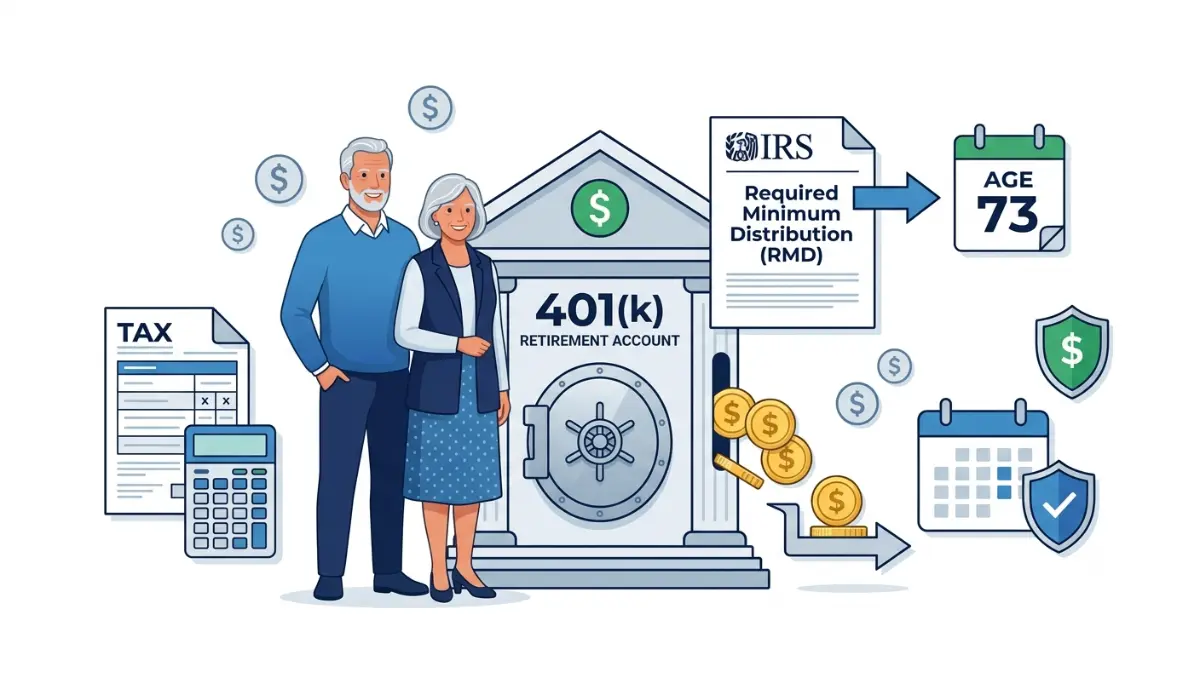
The current answer to the headline question: the 401k rmd age is 73 for anyone who reached 72 after December 31, 2022. Everything else follows from that.
ℹ️ Financial Disclaimer: This article is for general educational purposes only and is not personalized investment, tax, legal, lending, insurance, or debt-relief advice. Required minimum distributions interact with your specific income, account types, tax bracket, and estate plan. Before acting on any withdrawal or tax-timing decision, consult a fiduciary financial advisor, a CPA, or a qualified tax attorney about your own circumstances.
At what age do 401(k) RMDs start?
The RMD age for a 401(k) is 73 for anyone who reached age 72 after December 31, 2022 — which covers everyone taking a first distribution today. This is set by federal law and reported in the IRS RMD FAQ, not by your plan provider.
The reason the number confuses people is that it has moved. The SECURE 2.0 Act of 2022 raised the starting age from 72 to 73, and it is scheduled to rise again to 75 for people born in 1960 or later.
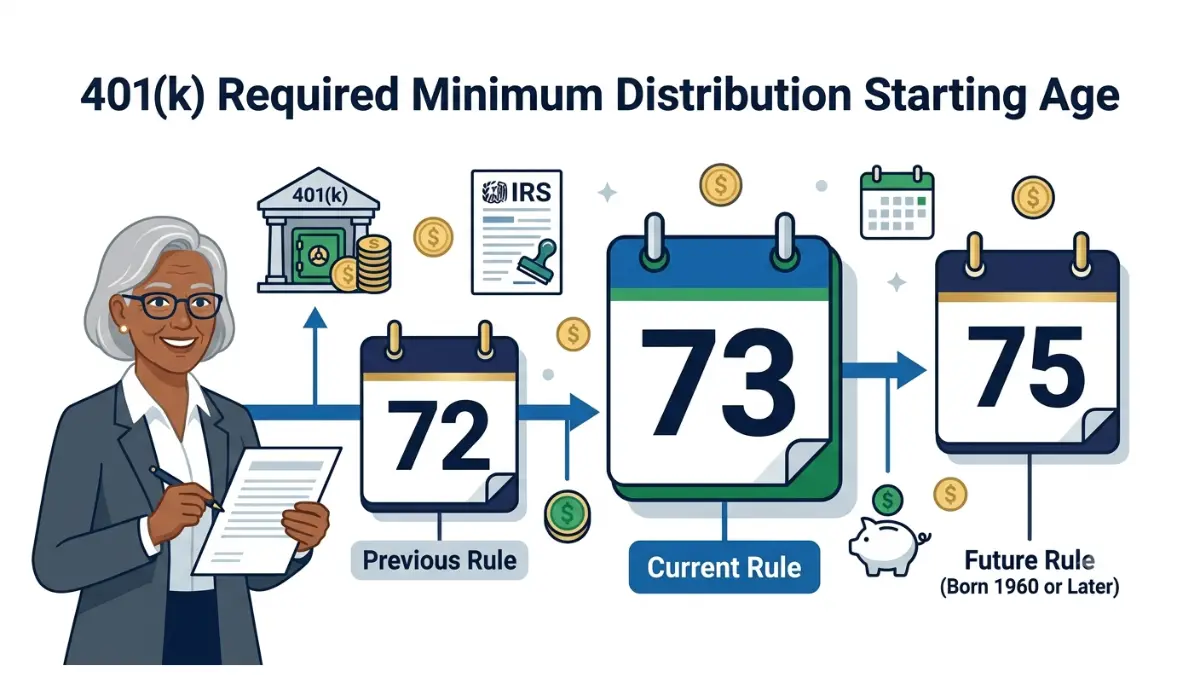
The current age is 73 (born 1951–1959)
If you were born between 1951 and 1959, your first RMD year is the year you turn 73. If you were born in 1960 or later, your starting age is 75. For anyone reaching the threshold in the current tax year, the age is 73.
Why RMDs exist at all
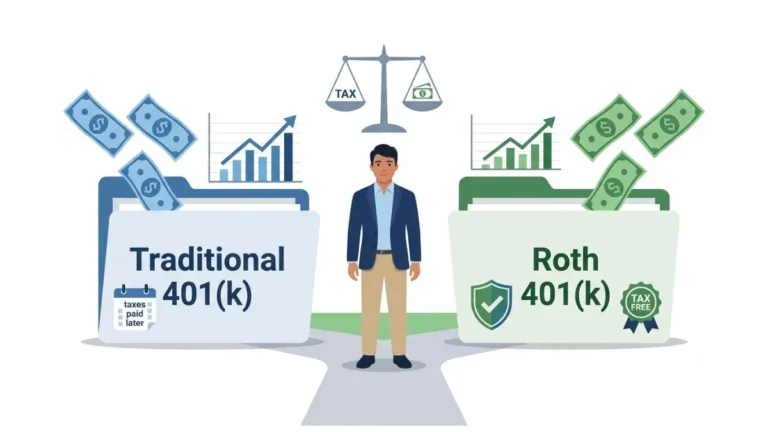
Traditional 401(k) contributions went in before tax and grew tax-deferred, so the IRS was never paid on that money. RMDs are how those deferred taxes finally come due — each withdrawal from a traditional 401(k) is taxed as ordinary income in the year you take it. You can estimate what that added income does to your bracket with our income tax calculator.
🔍 How It Works: “Tax-deferred” does not mean tax-free. You postponed the tax bill on contributions and growth; the RMD rules make sure that bill is eventually paid, starting the year you reach your required age.
When is your first 401(k) RMD due?
Your first RMD is due by April 1 of the year after the year you turn 73 — a date the IRS calls your required beginning date. Every RMD after the first is due by December 31 of its own year, per the IRS required minimum distribution rules.
That April 1 grace period sounds helpful, but it carries a tax cost worth understanding before you use it.
Your required beginning date: April 1 of the following year
If you turn 73 in 2026, your first RMD is the 2026 distribution, and you can wait until April 1, 2027, to take it. If you prefer, you can take it by December 31, 2026, instead.
Every RMD after the first: December 31
From the second year onward, the deadline is simply December 31. There is no April 1 option after your first year.
The two-RMDs-in-one-year trap
Here is the catch. If you delay that first RMD to April 1, 2027, your second RMD (for 2027) is still due December 31, 2027 — so two full years of taxable withdrawals land on one tax return.
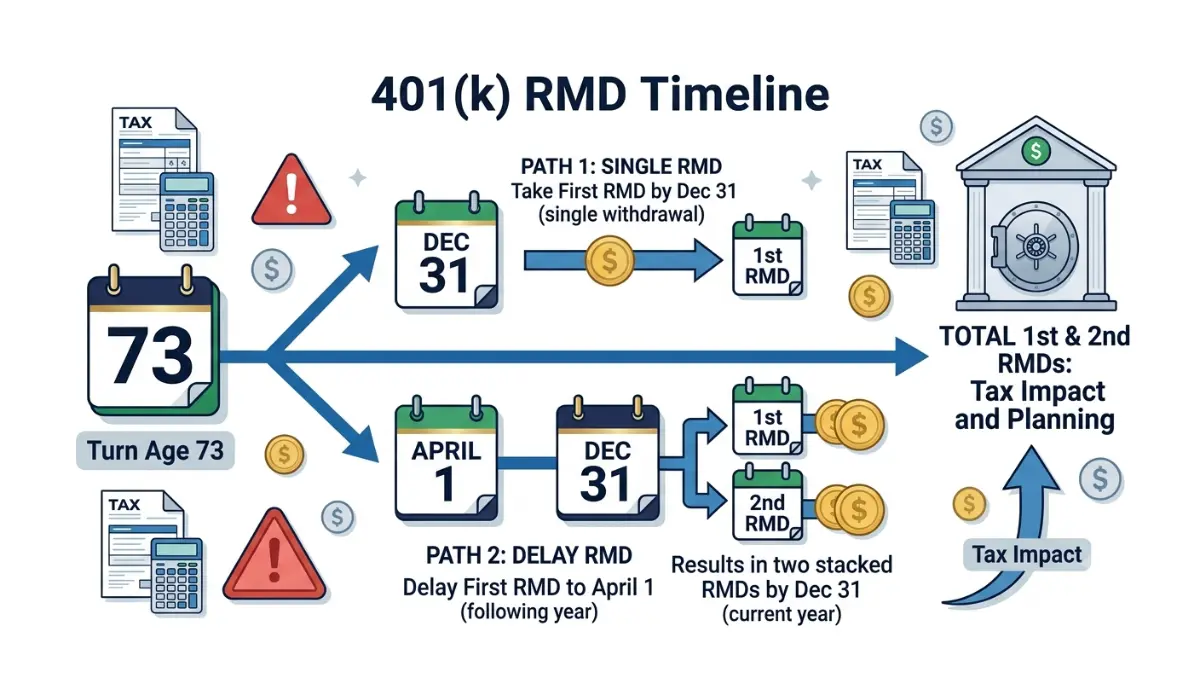
⚠️ Costly Mistake: Delaying your first RMD stacks two distributions into a single tax year, which can push you into a higher bracket and raise Medicare premiums. For many retirees, taking the first RMD by December 31 of the first year avoids this entirely. Model the income timing with our retirement calculator before deciding.
✅ Action Step: Before your first-RMD year ends, ask a CPA one specific question: “Given my other taxable income this year and next, should I take my first RMD by December 31 or defer it to April 1?”
How is your 401(k) RMD calculated?
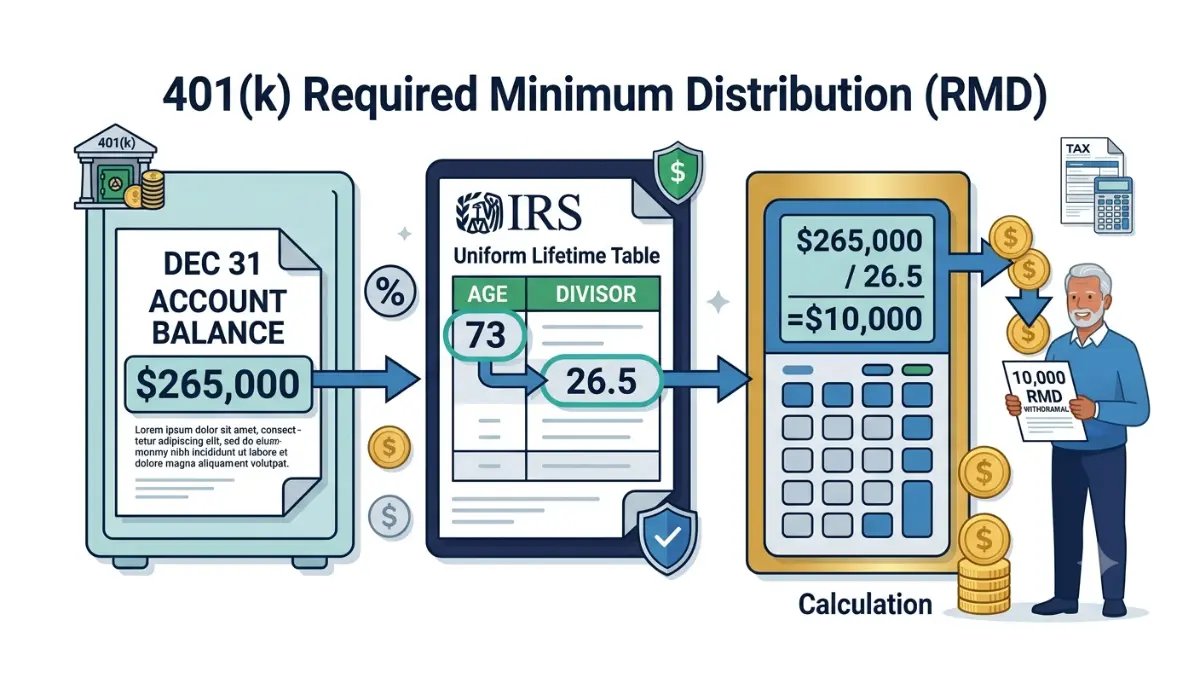
Your RMD is calculated in three steps: take your prior-year-end account balance, find your age’s divisor in the IRS Uniform Lifetime Table, and divide. The table lives in IRS Publication 590-B, Appendix B, Table III.
- Take your 401(k) balance as of December 31 of last year.
- Find the divisor (the “distribution period”) for your age this year.
- Divide the balance by the divisor — that is this year’s RMD.
Worked example: a $500,000 401(k) at age 73
The divisor at age 73 is 26.5. So a 73-year-old with $500,000 in a traditional 401(k) on December 31 has an RMD of $500,000 ÷ 26.5 = $18,868 for the year — about 3.77% of the balance.
📊 Data Point: At age 73 the Uniform Lifetime Table divisor is 26.5, producing a first-year withdrawal floor of roughly 3.77% of the prior-year balance — Source: IRS Publication 590-B (2025), Appendix B, Table III (percentage derived as 100 ÷ divisor).
Uniform Lifetime Table divisors (ages 73–85)
The divisor shrinks each year, so the required percentage rises as you age. These figures are the current IRS table (unchanged since 2022); the percentage column is derived from each divisor.
| Age | IRS divisor | Approx. RMD (% of balance) |
|---|---|---|
| 73 | 26.5 | 3.77% |
| 74 | 25.5 | 3.92% |
| 75 | 24.6 | 4.07% |
| 76 | 23.7 | 4.22% |
| 77 | 22.9 | 4.37% |
| 78 | 22.0 | 4.55% |
| 79 | 21.1 | 4.74% |
| 80 | 20.2 | 4.95% |
| 81 | 19.4 | 5.15% |
| 82 | 18.5 | 5.41% |
| 83 | 17.7 | 5.65% |
| 84 | 16.8 | 5.95% |
| 85 | 16.0 | 6.25% |
Source: IRS Publication 590-B (2025), Appendix B, Table III (Uniform Lifetime). Percentage column derived (100 ÷ divisor). A different table applies if your sole beneficiary is a spouse more than 10 years younger.
To run your own balance without the arithmetic, use our 401(k) calculator.
✅ Action Step: Confirm which IRS table applies to you by asking a CPA or fiduciary advisor: “Is my RMD figured on the Uniform Lifetime Table, or does the younger-spouse Joint and Last Survivor Table apply to my situation?”
What happens if you miss a 401(k) RMD?
First, the reassurance: the penalty is no longer the 50% figure many retirees still fear. Missing an RMD triggers an excise tax of 25% of the amount you should have withdrawn, and that drops to 10% if you fix it in time — a reduction made by the SECURE 2.0 Act.
Just as important, the penalty applies only to the shortfall — the gap between what you were required to take and what you actually took — not to your whole balance.
The penalty now: 25% of the shortfall
Say your RMD was $18,868 and you withdrew $10,000. The shortfall is $8,868, and the 25% tax applies to that $8,868 — about $2,217 — not to the full $18,868 and never to your account balance.
📊 Data Point: The excise tax for a missed RMD is 25% of the shortfall, reduced from 50% by the SECURE 2.0 Act effective 2023 — Source: Internal Revenue Code §4974 and the IRS Instructions for Form 5329.
How it drops to 10% — and possibly to zero
If you take the missed distribution and correct the error within the IRS correction window — generally two years — the rate falls to 10%. On that $8,868 shortfall, the penalty would be about $887 instead of $2,217. The IRS can also waive the tax entirely if the miss was due to reasonable cause and you have fixed it.
How to fix a missed RMD
The fix is a short, ordered process using IRS Form 5329:
- Withdraw the missed amount from the plan as soon as you notice — do not wait for tax season.
- Complete Part IX of Form 5329 for the year you missed.
- To request a waiver, follow the instructions to write “RC” (reasonable cause) with the shortfall amount and attach a brief statement explaining the miss and the correction.
Note that this is a different penalty from the 10% early-withdrawal tax that applies before age 59½; if that is your concern instead, see our guide to the 401(k) early withdrawal penalty.
✅ Action Step: If you missed an RMD, take the distribution today, then ask a CPA one question: “Can you help me complete Form 5329 Part IX and draft the reasonable-cause statement for my missed RMD?” Waiver outcomes are fact-specific and never guaranteed.
401(k) RMD rules that differ from an IRA
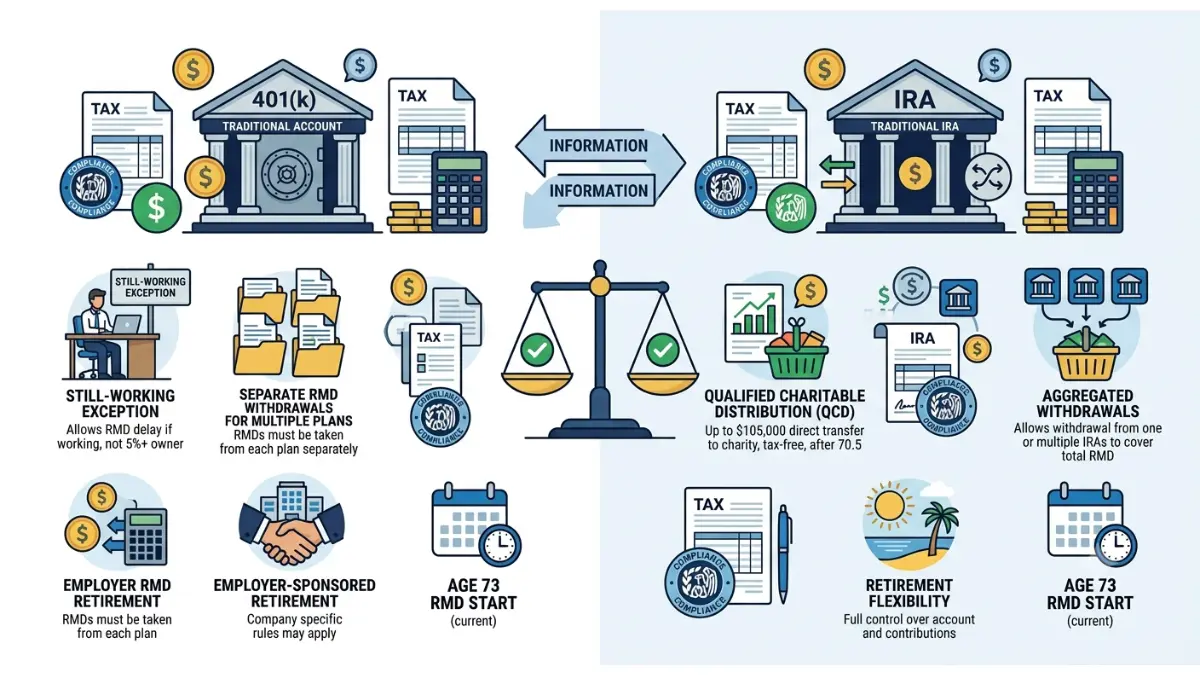
Generic RMD advice blurs the line between IRAs and 401(k)s, and the differences matter. Four 401(k) rules are easy to get wrong if you assume IRA rules apply.
The still-working exception (if you’re not a 5% owner)
If you are still employed and do not own more than 5% of the company sponsoring the plan, you can generally delay RMDs from that current employer’s 401(k) until the year you retire — the IRS RMD FAQ confirms this. The exception does not extend to your IRAs, to 401(k)s from former employers, or to anyone who is a 5% owner.
Roth 401(k)s no longer require lifetime RMDs
Starting in 2024, the SECURE 2.0 Act eliminated lifetime RMDs from designated Roth accounts — Roth 401(k)s, Roth 403(b)s, and governmental Roth 457(b)s. Before 2024, Roth 401(k)s did require them, which is why this change surprises people. Beneficiaries who inherit these accounts are still subject to RMD rules. If you are weighing account types, our comparison of the Roth versus traditional 401(k) covers the trade-offs.
You can’t combine RMDs across multiple 401(k)s
With IRAs, you can total your RMDs and take the whole amount from a single IRA. Qualified plans work differently: the IRS Instructions for Form 5329 state that plans cannot aggregate — you must figure and withdraw each 401(k)’s RMD separately from that specific plan. Rolling old 401(k)s into one IRA can simplify this; see rolling a 401(k) into an IRA.
💡 Expert Note: One more IRA-only feature: qualified charitable distributions, which let you satisfy an RMD tax-free by donating directly to charity, are not permitted from a 401(k). They work only from an IRA — another reason some retirees roll a 401(k) over before RMDs begin.
Common 401(k) RMD mistakes to avoid
Most RMD penalties come from a handful of avoidable errors. Run through this list against your own accounts each year.
- Assuming the still-working exception covers everything. It applies only to your current employer’s plan, and only if you are not a 5% owner — your IRAs and old 401(k)s still owe their RMDs on schedule.
- Forgetting a 401(k) from a former employer. Because 401(k)s can’t be aggregated, an old account left behind still requires its own separate distribution. If you have lost track of one, our 401(k) calculator can help you size the withdrawal once you locate it.
- Missing the first-year April 1 deadline — or triggering the two-RMD stack by using it without planning for the tax hit.
If large future RMDs are the real worry, there are legitimate ways to shrink them ahead of time, such as pre-73 Roth conversions (model them with our Roth IRA calculator) or a qualified longevity annuity; see how a QLAC can reduce RMDs.
401(k) RMD FAQ
1. At what age do 401(k) RMDs start?
The 401(k) RMD age is 73 for anyone who reached age 72 after December 31, 2022 (people born 1951–1959). For those born in 1960 or later, the starting age is 75. The age was raised from 72 to 73 by the SECURE 2.0 Act, and rises again to 75 in 2033.
2. When is my first 401(k) RMD due?
Your first RMD is due by April 1 of the year after you turn 73 — your required beginning date. Every RMD after that is due by December 31. If you delay the first one to April 1, you must take two RMDs that calendar year, which can raise your tax bill. Consider discussing the timing with a CPA.
3. How is my 401(k) RMD calculated?
Divide your 401(k) balance as of December 31 last year by your age’s divisor from the IRS Uniform Lifetime Table. At age 73 the divisor is 26.5, so a $500,000 balance gives an RMD of $18,868. A younger-spouse exception can change the table, so confirm yours with a CPA.
4. What is the penalty for missing a 401(k) RMD?
The penalty is a 25% excise tax on the shortfall — the amount you should have withdrawn but didn’t — not on your whole balance. It drops to 10% if you correct the miss within roughly two years, and the IRS may waive it entirely for reasonable cause. A tax professional can help you file for relief.
5. Can I fix a missed RMD?
Yes. Take the missed distribution as soon as you notice, then file IRS Form 5329, Part IX, for that year. To request a waiver, follow the instructions to note “RC” and attach a short reasonable-cause explanation. Waiver outcomes are never guaranteed, so consult a CPA about your specific case.
6. Do I have to take RMDs from my 401(k) if I’m still working?
Not necessarily. If you are still employed and do not own more than 5% of the company, you can generally delay RMDs from that current employer’s 401(k) until you retire. This still-working exception does not apply to your IRAs or to 401(k)s from previous employers. Confirm eligibility with your plan administrator.
7. Does a Roth 401(k) require RMDs?
No. Starting in 2024, the SECURE 2.0 Act eliminated lifetime RMDs from Roth 401(k)s, Roth 403(b)s, and governmental Roth 457(b)s. Before 2024 they were required. Beneficiaries who inherit a designated Roth account are still subject to RMD rules.
8. Are 401(k) RMDs taxed?
Yes. Withdrawals from a traditional 401(k), including RMDs, are taxed as ordinary income in the year you take them, because the money went in pre-tax and grew tax-deferred. Qualified Roth 401(k) distributions are an exception. A CPA can estimate the bracket impact for your income.
9. Can I combine RMDs across multiple 401(k)s?
No. Unlike IRAs — where you can take the total from one account — each 401(k) must have its RMD calculated and taken separately from that specific plan. The IRS does not allow qualified plans to aggregate distributions for RMD purposes, so an old 401(k) needs its own withdrawal.
10. Can I use a QCD to satisfy a 401(k) RMD?
No. Qualified charitable distributions, which satisfy an RMD tax-free by donating to charity, are allowed only from IRAs, not from 401(k)s. Some retirees roll a 401(k) into an IRA specifically to access this option. Discuss whether a rollover fits your plan with a fiduciary advisor.
11. Will the RMD age change again?
Yes. Under current law, the starting age rises from 73 to 75 for people born in 1960 or later, effective in 2033. If you are taking distributions now, the age that applies to you is 73.
Your 401(k) RMD next steps
The essentials come down to four points: the age is 73, the first RMD is due by April 1 of the following year (with a December 31 deadline every year after), the amount is your balance divided by your IRS divisor, and a missed RMD costs 25% of the shortfall — 10% if you fix it promptly.
The single most useful move is to know your date and your number before the deadline, then coordinate the withdrawal with your other retirement income, including Social Security (our Social Security calculator helps you see the combined picture). For the full savings-to-withdrawal view of your account, revisit the 401(k) contribution limits guide. For your exact figures and tax timing, a CPA or fiduciary advisor is worth the visit.

Informational disclaimer
The content on Finance Authority Hub is provided for general informational and educational purposes only and should not be considered personalized financial, investment, tax, legal, or professional advice. Financial decisions depend on your individual goals, income, risk tolerance, location, and regulatory situation. Before acting on any information, strategy, estimate, or calculator result, consult a qualified licensed professional who can evaluate your specific circumstances.