How to Choose 401(k) Investments With Clarity
Choosing 401(k) investments is simpler than it looks: two paths, and one factor—fees—that outweighs fund names. The average fund charges 0.26%.
In This Article
You enrolled in your 401(k), opened the investment menu, and found a dozen funds with names that mean nothing to you. That moment — cursor hovering, worried you’ll pick wrong and lose money — is where most people freeze. You don’t need to guess, and you don’t need a finance degree to choose well.
This guide is written for three readers. If you just enrolled and have no idea where to start, the next two sections give you a simple path. If you already picked something and want to know whether your fees are reasonable, skip to the section on costs. And if you’re closer to retirement and rethinking your mix, the section on timeline and risk is for you.
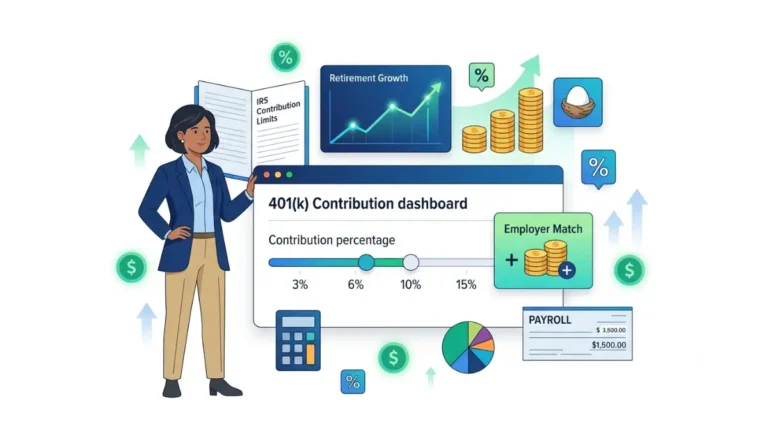
First, one thing matters more than any single fund. If your employer offers a match, contribute enough to capture your full employer match before optimizing anything else — that’s an immediate return no fund can promise. For 2026, the IRS set the employee contribution limit at $24,500, so there’s room to build on once the match is handled. Only then does fund selection become the decision in front of you.
ℹ️ Financial Disclaimer: This article is general educational information, not personalized investment, tax, or financial advice. The right funds, allocation, and account choices depend on your individual circumstances, and investing involves risk, including possible loss of principal. Before acting, consult a fiduciary financial advisor (such as a CFP® professional) or a CPA for guidance specific to your situation.
Your 401(k) fund menu, decoded
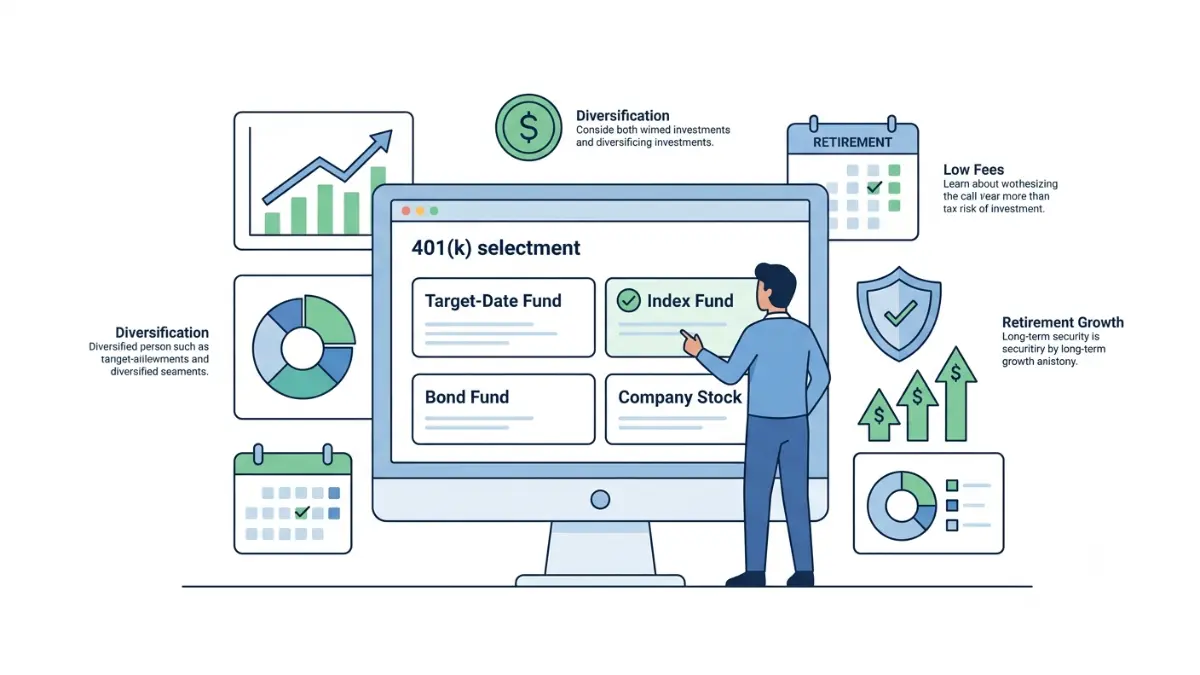
Before you can choose, it helps to know what you’re looking at. Most menus contain only a handful of fund types, and once you can name them, the list stops feeling random.
The main fund types you’ll see
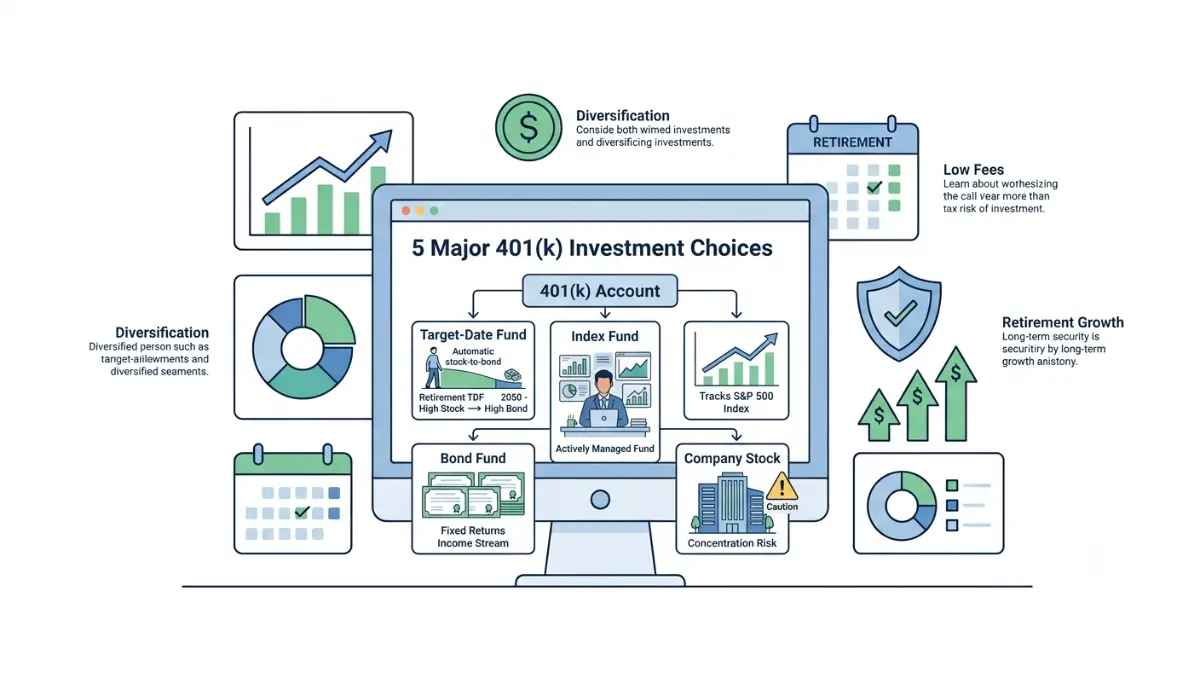
A target-date fund holds a diversified mix of stocks and bonds in one fund and gradually shifts toward a more conservative mix as a chosen year approaches. On the menu it usually carries a year in its name, like “Target 2055.” An index fund aims to track a market benchmark, such as the S&P 500, by holding the securities that make up the index. An actively managed fund instead pays a manager to pick holdings in an attempt to beat that benchmark. You may also see bond funds, a stable value or money market option, and sometimes your own company’s stock.
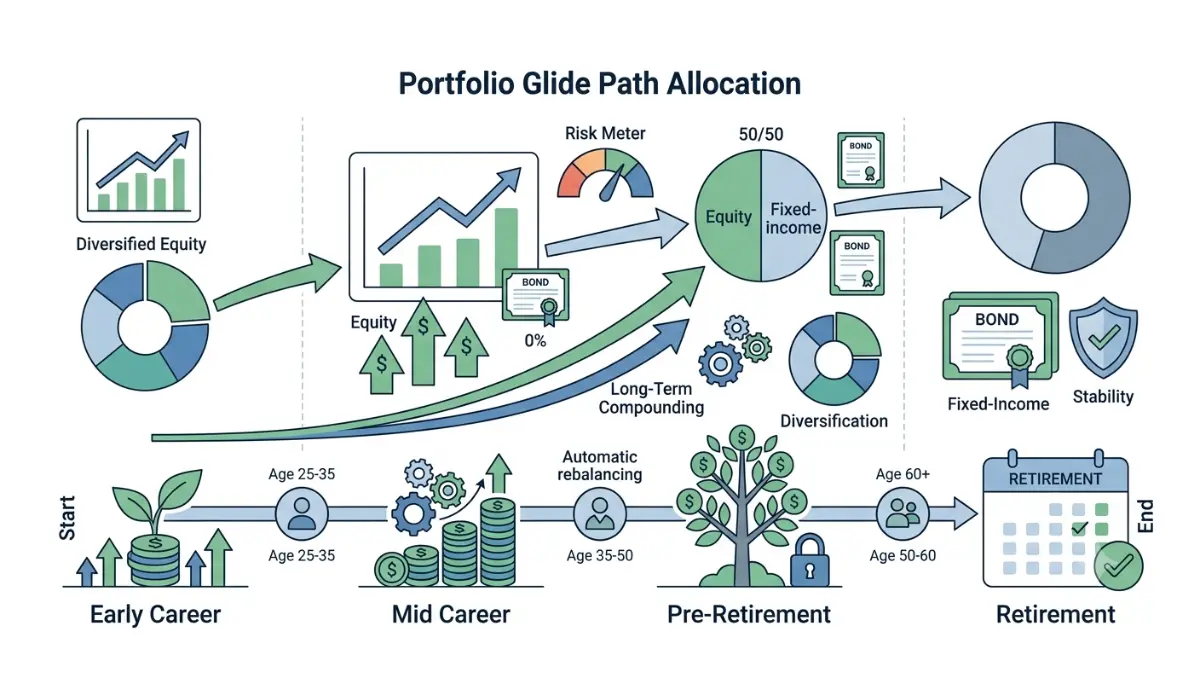
🔍 How It Works: A target-date fund follows a “glide path” — more stocks when the target year is far off, automatically shifting toward more bonds as that year nears. The SEC notes these funds are diversified but do not guarantee income, and two funds with the same target year can hold different mixes.
The account versus the funds inside it
Here’s the distinction that trips up most new savers. Your 401(k) plan is the account — the tax-advantaged container your paycheck contributions flow into. The funds are the separate investments you choose inside that container. Enrolling and choosing funds are two different steps, and whether your plan is traditional versus Roth 401(k) is a separate question again from which funds you hold. If the account-level setup still feels fuzzy, our guide on how a 401(k) actually works covers the basics.
Two simple paths: one fund or a small mix
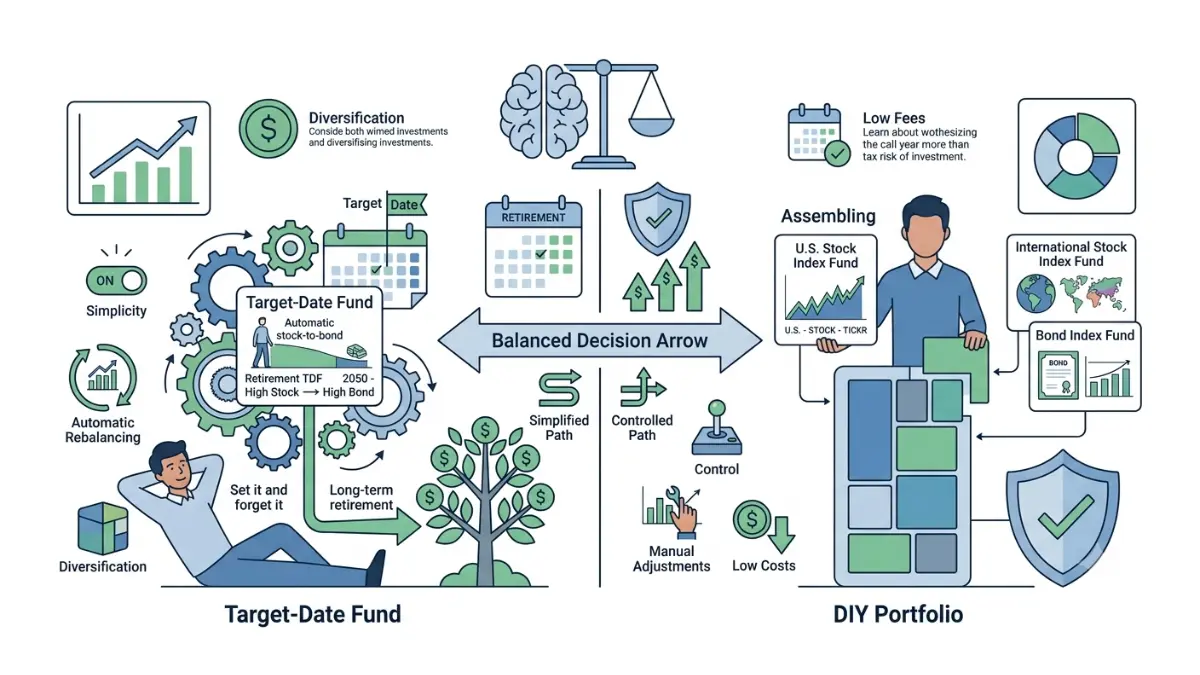
There are two sensible ways to choose 401(k) investments, and both are legitimate. Here’s the short version:
- Capture your full employer match first, then focus on fund choice.
- Decide how hands-on you want to be.
- For hands-off: pick one target-date fund near your retirement year.
- For more control: build a small mix of low-cost index funds.
- Whichever you choose, keep fees low and review once a year.
The right path depends mostly on how involved you want to be.
Path A: one target-date fund (the hands-off default)
Pick the target-date fund closest to the year you expect to retire, put your whole contribution there, and you’re essentially done. It’s already diversified, and it adjusts its own mix over time — which is why it’s the default in many plans. The SEC’s investor bulletin on target-date funds is worth a read, because the target year should match your plans; you can choose an earlier or later year if it fits your situation better.
Path B: build a simple low-cost mix
If you’d rather assemble your own, most people can cover the ground with a few broad, low-cost building blocks — a total-market or S&P 500 index fund for stocks and a bond index fund, in a proportion that suits your timeline. The goal is broad diversification at low cost, not a long list of overlapping funds.
How to decide between them
Choose Path A if you want a single decision you rarely revisit. Choose Path B if you want more control and will actually rebalance it.
✅ Action Step: List your plan’s funds and their expense ratios first. If you’re unsure whether one target-date fund or a custom mix fits you, ask a fiduciary advisor (a CFP® professional): “Given my age, timeline, and other savings, is a single target-date fund appropriate, or should I hold a custom mix?”
Why fees decide more than fund names
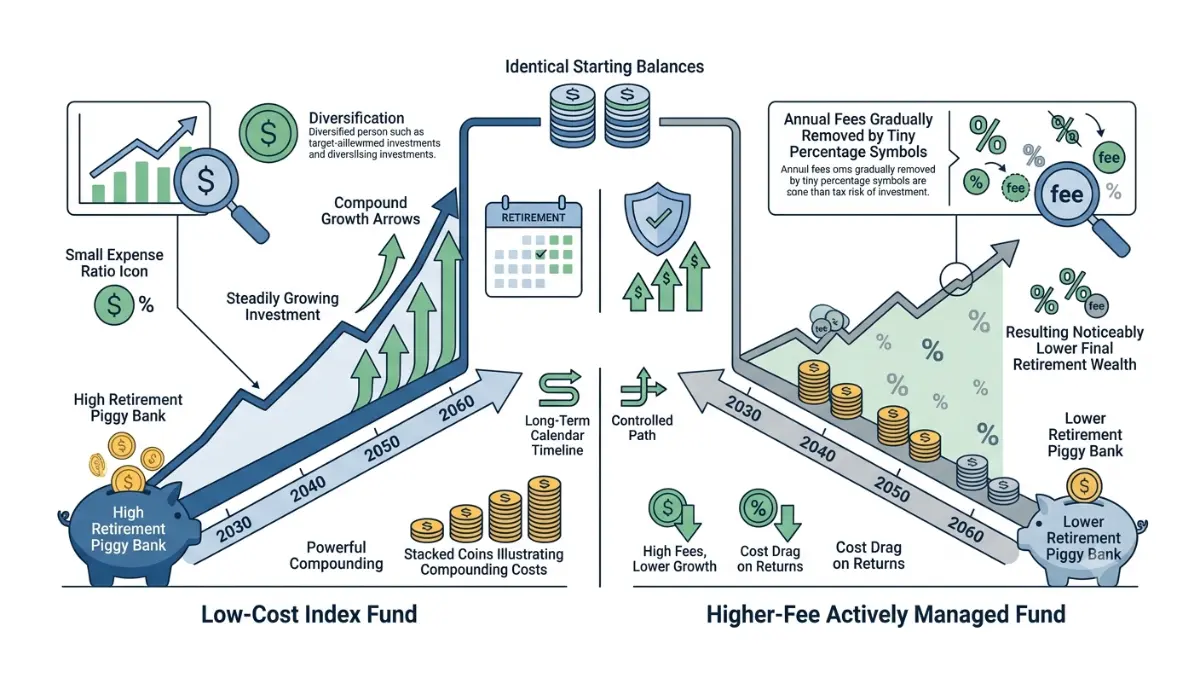
Fund names get the attention, but expense ratios — the annual fee each fund charges — quietly do more to shape your ending balance. A fee is a percentage skimmed from your returns every year, and it applies to every dollar you contribute up to the 2026 contribution limits. Lower is almost always better.
What’s a good 401(k) expense ratio?
As a benchmark, the average 401(k) equity mutual fund charged 0.26% in 2024, and the average target-date fund charged 0.29%, according to Investment Company Institute research. Many index options run below those averages. If a fund in your plan charges 0.75% or more while a comparable index fund charges a fraction of that, the gap is worth questioning.
📊 Data Point: The average expense ratio for 401(k) equity mutual funds fell from 0.76% in 2000 to 0.26% in 2024 — Source: Investment Company Institute, The Economics of Providing 401(k) Plans, 2024.
What a small fee gap costs over a career
A fraction of a percent sounds trivial, but it compounds.
🔍 How It Works: Picture two savers, each holding $25,000 and earning the same 7% return for 35 years with no new contributions. One pays 0.26% in fees; the other pays 0.76%. That 0.50% gap alone leaves the higher-fee saver with roughly $37,000 less at the end — on returns that were otherwise identical. (Illustrative only, not a projection; your results will differ.)
You can model your own fee and return scenario to see the effect on your numbers.
Index versus actively managed: what the record shows
Over long periods, most active funds have not beaten their benchmarks. S&P Dow Jones Indices’ SPIVA Scorecard found that over the 15 years ending 2024, not a single one of 22 U.S. equity fund categories had a majority of active managers outperform their index. Some managers do win in any given year, and a few researchers argue the gap narrows when results are weighted by assets — but that long-run pattern is why low-cost index funds are a common default. Our deeper comparison of index funds versus actively managed mutual funds walks through the tradeoffs.
Matching your mix to your timeline and risk tolerance
How much of your 401(k) asset allocation sits in stocks versus bonds comes down to two things: how long until you’ll use the money, and how you’d handle a downturn along the way. There’s no universal right number.
How your time horizon changes the picture
The longer your time horizon, the more time your account has to recover from the market’s inevitable drops — which is why longer-dated target-date funds hold more stocks and shift toward bonds as the target nears. If you’re within a decade of retirement and weighing a more conservative tilt, note that catch-up contributions if you’re 50 or older can help close a savings gap at the same time.
Being too safe carries a cost too
Playing it safe feels prudent, but parking most of your balance in cash or a stable value fund has its own risk: over decades, inflation erodes money that isn’t growing. A mix that’s too conservative for a long horizon can quietly leave you short. You can estimate whether you’re on track and see how targets shift with age using retirement savings benchmarks by age.
When your timeline and risk tolerance disagree
Sometimes your timeline says “hold more stocks” but your stomach says otherwise. That tension is normal, and the resolution depends on your full picture — other savings, income stability, and how you actually behaved in past downturns.
✅ Action Step: For a mix matched to your situation, ask a fiduciary advisor (a CFP® professional): “Given my age, when I plan to use this money, my other savings, and how I handled past market drops, what stock-and-bond mix is appropriate for me?”
Five fund-selection mistakes that quietly cost you
Most fund-selection damage comes from a few avoidable habits, and each has a calmer alternative.
- Loading up on company stock. A large position in your employer’s stock ties your savings to the same company that pays your salary — if it stumbles, both take the hit. Broad diversification spreads that risk.
- Chasing last year’s top performer. Strong past performance rarely persists, and SPIVA’s data shows few managers stay on top year after year. Buying last year’s winner often means buying high.
- Paying active fees for index-like results. Some pricey active funds hug their benchmark while charging far more than an index fund. You end up paying for outperformance you may never receive.
- Sitting in cash by default. Money left in a stable value or money market option barely grows, and over decades inflation steadily erodes it.
- Owning five funds that do the same thing. Holding several overlapping stock funds feels diversified but often isn’t — a single broad index fund or target-date fund may do the job more cleanly.
⚠️ Costly Mistake: Concentrating a large share of your 401(k) in company stock is the most common version of mistake one. If you hold a big position, a fiduciary advisor can help you think through concentration risk before you decide what to do.
How to finalize your choices and keep them on track
Understanding the options is most of the battle. These final steps turn it into a done decision.
Find your fund fees and compare them
Your plan must give you an annual fee disclosure listing each fund’s expenses — check your plan’s website or ask your administrator. To compare funds side by side, FINRA’s free Fund Analyzer lets you line up expense ratios and see their long-run cost.
Make or confirm your election
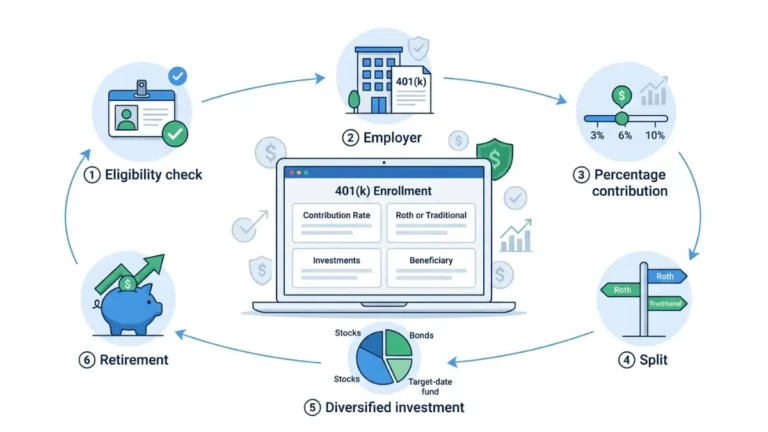
Log into your plan, set your contribution percentage, and choose your fund or funds. If you picked a target-date fund, you’re essentially finished — it handles the rest.
A once-a-year check-in
✅ Action Step: Put a yearly reminder on your calendar to confirm your contribution rate, glance at your fees, and check that your mix still fits your timeline. If you hold a target-date fund, it rebalances itself — leave it alone between check-ins.
Frequent trading tends to hurt more than help, so resist the urge to react to headlines. A light annual review is enough for most savers.
Your next step
Choosing 401(k) investments doesn’t require predicting the market. Pick an approach that fits you — one target-date fund, or a small mix of low-cost index funds — keep fees low, and review once a year. That’s a sound, defensible plan for most savers.
The single most useful thing you can do today is log in and confirm two things: that you’re contributing enough to get your full match and move toward your goal, and that your money is in low-cost funds rather than sitting uninvested. If you’re unsure how much to put in, our guide on how much to contribute to your 401(k) can help you land on a number.
A sensible default beats a perfect choice you never make.
Frequently asked questions
1. How do I choose the right funds in my 401(k)?
Start by deciding how hands-on you want to be. A single target-date fund is a complete, diversified choice that adjusts over time, or you can build a small mix of low-cost index funds. Either way, keep expense ratios low and match the mix to your timeline. For a plan tailored to you, consult a fiduciary advisor.
2. What is a target-date fund, and is it a good choice?
A target-date fund holds a diversified mix of stocks and bonds and automatically shifts toward a more conservative mix as your target retirement year approaches. The SEC notes it does not guarantee income. For many savers it’s a reasonable one-decision option, but confirm the target year fits your plans. Consider input from a fiduciary advisor.
3. What’s a good expense ratio for a 401(k) fund?
Lower is better, since fees come straight out of returns. Investment Company Institute research put the 2024 average 401(k) equity fund expense ratio at 0.26% and target-date funds at 0.29%, and many index options run below that. Compare your plan’s funds by cost. A fiduciary advisor can help weigh fees against your goals.
4. Are index funds or actively managed funds better for a 401(k)?
Over long periods, most active funds have trailed their benchmarks. S&P Dow Jones Indices found that over the 15 years ending 2024, no U.S. equity fund category had a majority of active managers beat their index. Low-cost index funds are a common default, though results vary year to year. Consult a fiduciary advisor for your specifics.
5. How many funds should I hold in my 401(k)?
Often just one is enough — a single target-date fund is already diversified across stocks and bonds. If you build your own mix, a few broad, low-cost funds usually cover it; owning many overlapping funds adds complexity without real diversification. The right number depends on your approach, which a fiduciary advisor can help you set.
6. Should I invest in my company’s stock in my 401(k)?
A large position in any single stock — including your employer’s — concentrates risk, since your paycheck already depends on that company. Broad diversification spreads that risk. Company stock isn’t off-limits, but keeping any one holding modest is a common principle. A fiduciary advisor can help you assess concentration risk for your situation.
7. How much of my 401(k) should be in stocks versus bonds?
There’s no single right number. It depends on how long until you’ll use the money, your other savings, and how you’d handle a market drop — longer horizons generally allow more stock exposure, shorter ones less. A target-date fund makes this shift for you. For a personalized mix, consult a fiduciary advisor.
8. What’s the difference between a 401(k) and the funds inside it?
The 401(k) is the account — the tax-advantaged container your contributions go into. The funds are the separate investments you choose within it, such as target-date, index, or bond funds. Enrolling in a 401(k) and choosing your funds are two different steps, and the funds determine how your money is actually invested.
9. Do I need to rebalance my 401(k)?
If you hold a single target-date fund, no — it rebalances automatically along its glide path. If you built your own mix, occasional rebalancing keeps it from drifting as some funds grow faster than others. An annual check is a common rhythm. If you’re unsure how to rebalance, a fiduciary advisor can guide you.
10. How often should I review my 401(k) investments?
A once-a-year check-in is usually enough: confirm your contributions, glance at fees, and make sure your mix still fits your timeline. Frequent trading tends to hurt more than help. Big life changes — a new job, or nearing retirement — are also good moments to review, ideally with input from a fiduciary advisor.
11. What if I picked the wrong funds — can I change them?
Yes. You can change your 401(k) fund elections at any time through your plan’s website, and switching funds inside the plan generally isn’t a taxable event. If you’re unsure whether a change makes sense for your goals, compare your options by their fees first, and consider consulting a fiduciary advisor.
Informational disclaimer
The content on Finance Authority Hub is provided for general informational and educational purposes only and should not be considered personalized financial, investment, tax, legal, or professional advice. Financial decisions depend on your individual goals, income, risk tolerance, location, and regulatory situation. Before acting on any information, strategy, estimate, or calculator result, consult a qualified licensed professional who can evaluate your specific circumstances.