Is Your 401(k) on Track for Your Age?
How much should be in your 401(k) by 40, 50, or 60? Fidelity says 3x, 6x, and 8x your salary — see how your balance really compares.
In This Article
How much should you have in your 401(k) by your age?
You checked your 401(k) balance, did some quick math, and now you’re wondering whether you’re behind. That worry is close to universal — and the honest answer comes in two halves.
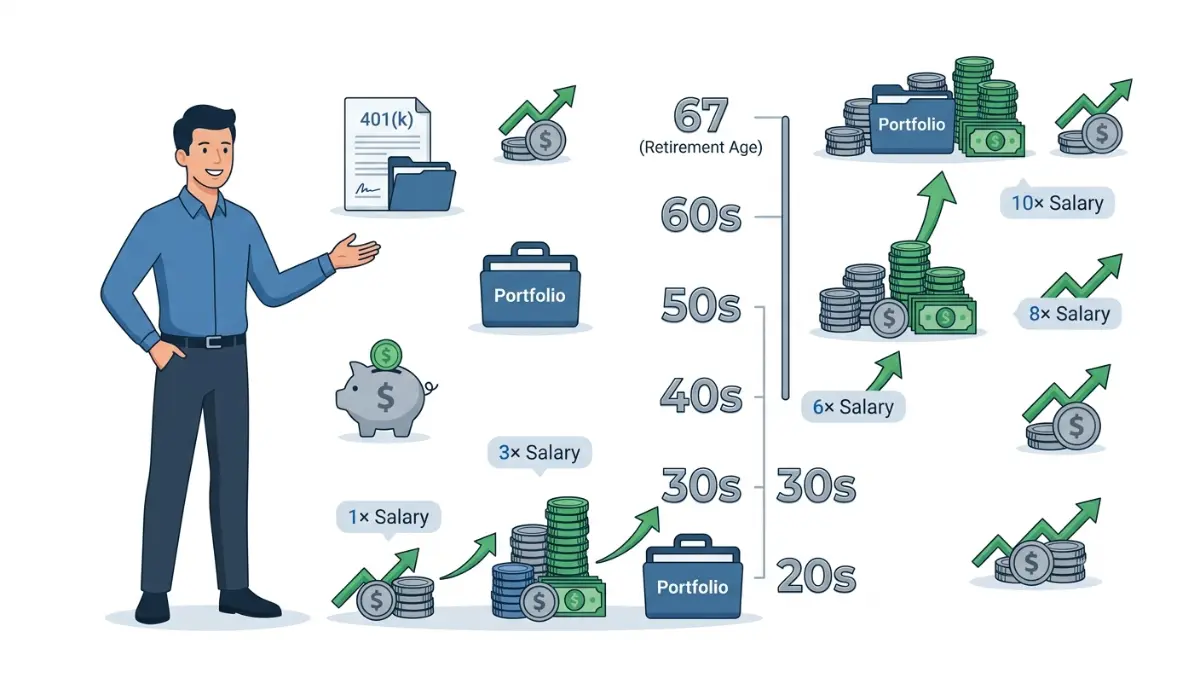
By a widely used benchmark from Fidelity, a rough target is about 1x your salary saved by 30, 3x by 40, 6x by 50, 8x by 60, and 10x by 67. But what people actually have looks very different: the median 401(k) balance across all savers was $44,115 at the end of 2025 (Vanguard). Both numbers matter, and neither is a pass/fail grade.
Where you go next depends on your situation. In your 20s or 30s, focus on what the benchmark asks and why time is your biggest advantage. If you’re 40 to 55 and feel behind, the catch-up section is built for you. Within a decade of retiring, focus on what your balance actually buys. Everyone should start with the reality check below.
ℹ️ Financial Disclaimer: This article is general financial education, not personalized investment, tax, or retirement advice. The benchmarks and averages here are national reference points, not recommendations for your circumstances. Retirement saving, contribution, and withdrawal decisions depend on facts unique to you — consider consulting a fiduciary financial advisor or a CPA before you act.
The savings-by-age benchmark: how much you should have
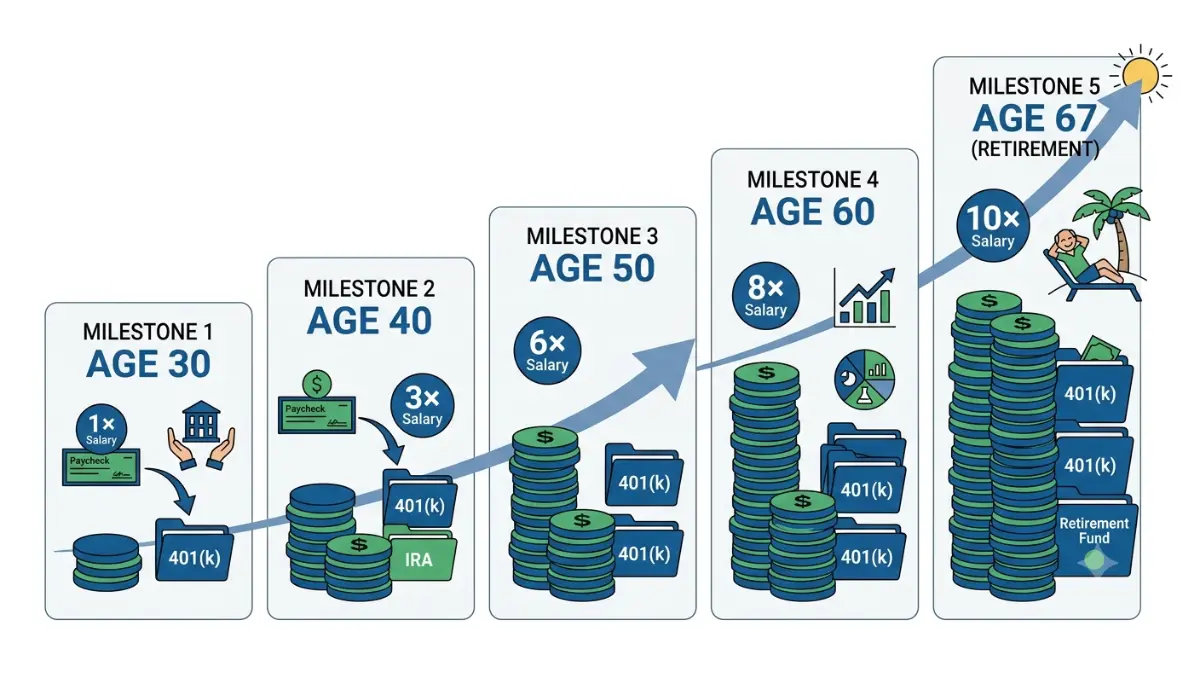
Fidelity’s retirement guidelines turn a distant goal into age milestones, each expressed as a multiple of your current salary — the most cited salary multiplier targets in the US.
- By 30: 1x your salary
- By 40: 3x
- By 50: 6x
- By 60: 8x
- By 67: 10x
More granular checkpoints fill the gaps: about 0.5x by 25, 2x by 35, 4x by 45, and 7x by 55.
🔍 How It Works: The multiplier isn’t arbitrary. Fidelity built it assuming you save 15% of pay each year (including your employer match), retire around 67, and need savings to replace roughly 45% of your pre-retirement income — with Social Security covering much of the rest, planned to last through age 93.
When the benchmark fits you — and when it doesn’t
That set of assumptions means the milestones fit best if you plan to retire near 67 and want to keep your current lifestyle. Retire earlier or plan to spend more, and your target climbs — Fidelity notes someone retiring at 62 may need closer to 12x. A pension or a plan to downsize can pull it lower.
💡 Expert Note: A common misread is treating the multiplier as a hard line. Fidelity itself calls these milestones “aspirational” — goalposts to steer by, not a score you pass or fail. For a wider view, see our look at retirement-savings targets across all account types by age.
What Americans actually have saved by age
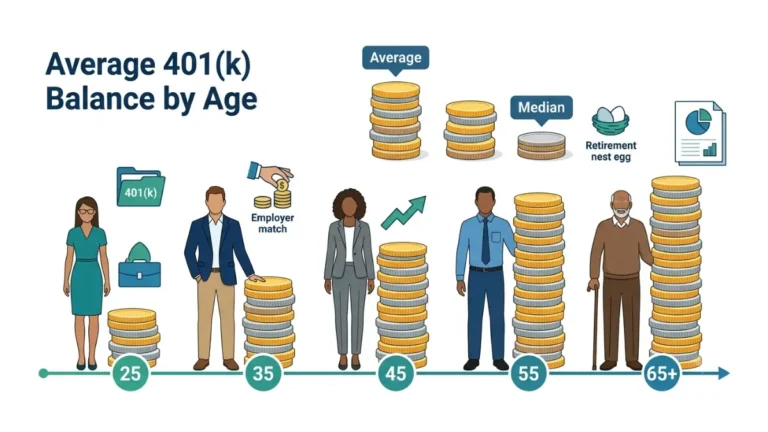
The benchmark tells you the goal; this is the reality. Here is the average 401(k) balance — and the more telling median — for each age group.
| Age | Average balance | Median balance |
|---|---|---|
| Under 25 | $7,259 | $2,234 |
| 25–34 | $50,261 | $18,732 |
| 35–44 | $120,742 | $46,919 |
| 45–54 | $214,991 | $78,730 |
| 55–64 | $305,006 | $107,269 |
| 65 and older | $330,186 | $103,202 |
| All participants | $167,970 | $44,115 |
Source: Vanguard, How America Saves 2026 (data as of December 31, 2025). Figures reflect only money held inside a 401(k).
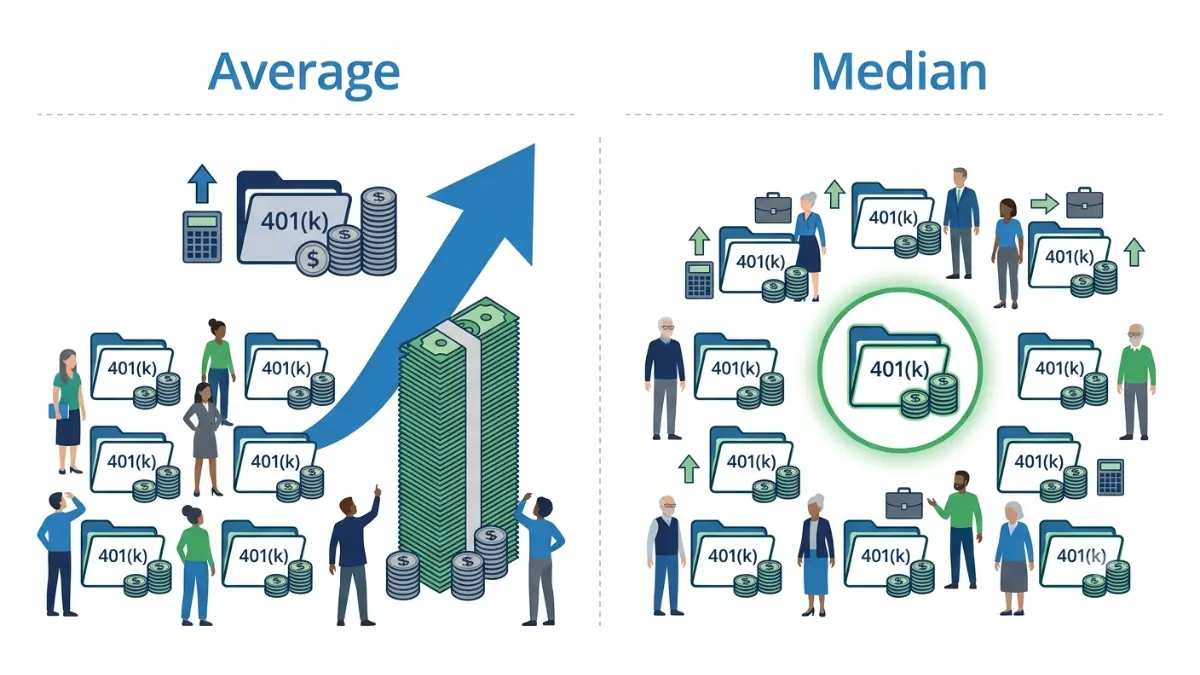
🔍 How It Works: The average looks high because a small number of very large accounts drag the mean upward. Vanguard’s data shows 1 in 4 participants hold under $10,000, while 18% have $250,000 or more. The median — $44,115 — marks the true midpoint and is the fairer yardstick for most savers.
⚠️ Costly Mistake: Comparing yourself to “the average” can make you feel hopelessly behind when you’re not. The all-participant average of $167,970 sits near the 75th percentile — so if your balance beats the median for your age, you’re already ahead of more than half your peers.
For the full picture, including balances broken out by income, see our detailed breakdown of average and median 401(k) balances by age.
Are you on track? How to read your number
You now have both reference points. Turning them into a personal verdict takes two questions, not a spreadsheet — a simple way to know whether you’re on track.
- How close is your balance to your age multiplier from the benchmark above?
- Where does it sit versus the median for your age?
Answering both keeps you honest without false comfort or panic. Trailing the benchmark while beating the median is the norm — it signals catch up, not give up.
🔍 How It Works: A rough way to picture retirement income is the “4% rule” — a widely cited guideline that you can withdraw about 4% of your balance in the first year, then adjust for inflation. Fidelity’s own estimate runs slightly higher, up to roughly 4.5%.
📊 Data Point: Run the median pre-retiree balance through that math: $107,269 for ages 55–64 generates only about $4,300 a year at 4%. — Source: Vanguard, How America Saves 2026; author’s calculation.
That figure sounds alarming until you remember a 401(k) is only one piece. Social Security, IRAs, a pension, and home equity all add to it, which is why a single balance never tells the whole story. For a plain-English primer on how these plans work, the SEC offers a useful overview of traditional and Roth 401(k) plans.
✅ Action Step: Before your next contribution change, run your real numbers — current balance, age, income, and target retirement date — through a 401(k) and retirement calculator so “on track” becomes a number, not a guess. If the gap looks large, ask a fiduciary financial advisor one specific question: “Given my age, balance, and target retirement date, what annual savings rate keeps me on track?”
What to do if you’re behind on 401(k) savings
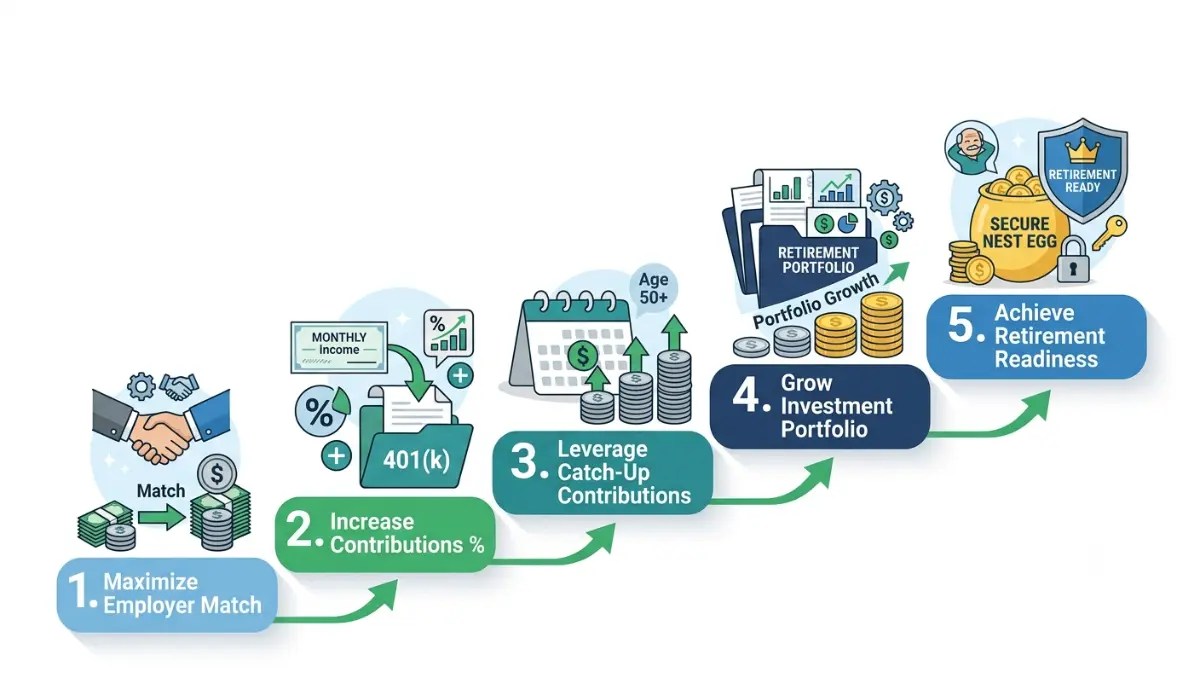
Most savers trail the benchmark, and the fix is a short, ordered list — start with the cheapest, highest-return move first. The single biggest lever is your employer match.
- Capture your full employer match — this is money you already earned.
- Raise your contribution rate, even by 1% each time you get a raise.
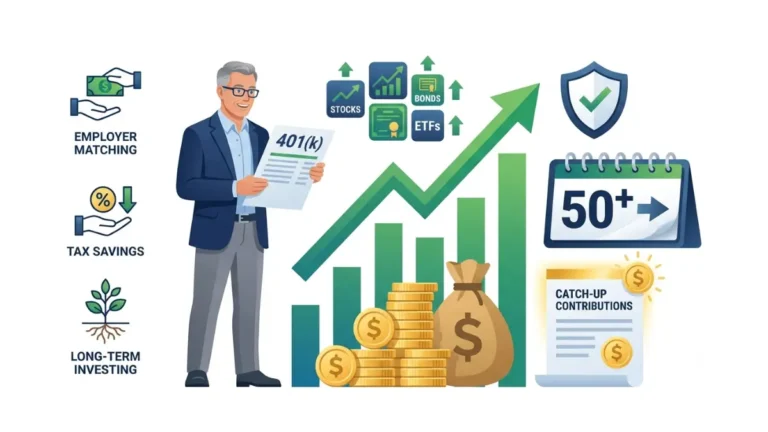
- At 50 or older, add the annual catch-up contribution.
- At 60 to 63, use the higher “super catch-up” if your plan allows.
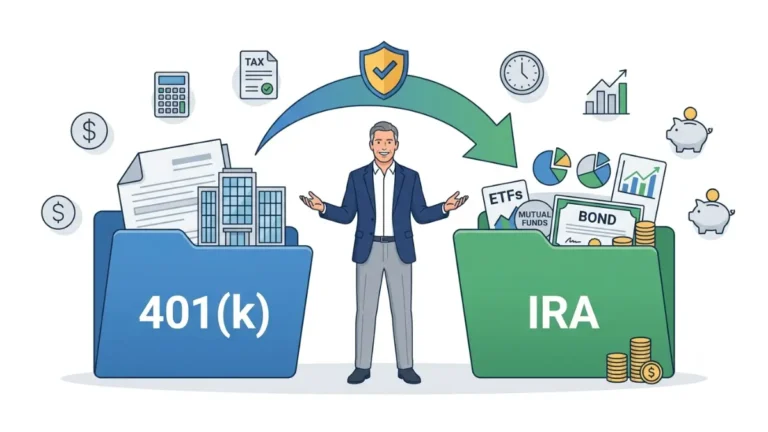
- Once you’ve maxed the 401(k), consider an IRA.
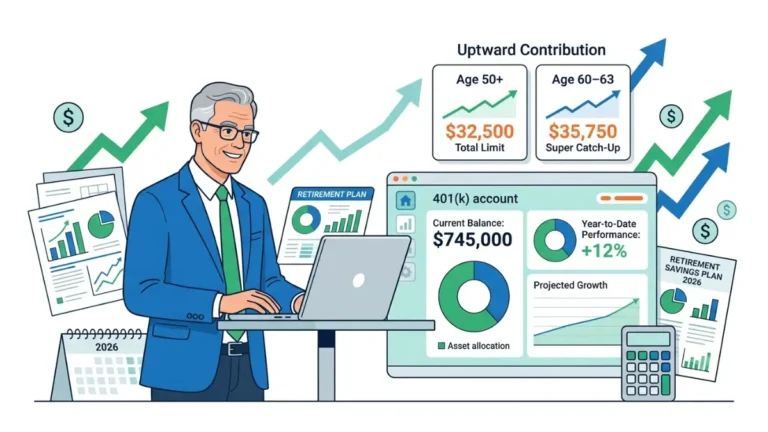
📊 Data Point: For 2026, the IRS set the employee 401(k) limit at $24,500, with an extra $8,000 catch-up at 50+ (a $32,500 total) and $11,250 for ages 60–63 (a $35,750 total). — Source: IRS, 2026 contribution limits.
⚠️ Costly Mistake: Skipping the match is the most expensive error on this list. If your employer adds 50 cents per dollar up to 6% of pay and you contribute nothing, you’re turning down an instant 50% return the day you enroll.
The room to save more is real: only about 14% of savers contribute the maximum, and the average worker defers just 7.6% of pay (Vanguard, 2025). Our breakdown of who actually maxes out a 401(k) shows how few reach the ceiling.
🔍 How It Works: Each 1% you add compounds. A dollar invested at 50 still has more than a decade to grow before a typical retirement — exactly why catch-up limits exist. You can see how each 1% increase compounds over time.
One 2026 wrinkle affects higher earners: if your prior-year wages topped $150,000, your catch-up contributions must go into a Roth (after-tax) account.
✅ Action Step: Confirm whether the high-earner Roth catch-up rule applies to you before you set your 2026 elections — a CPA can tell you based on last year’s W-2 wages. For the mechanics of limits, matching, and payouts, see the 2026 401(k) contribution limits.
Why your target might be higher or lower
One benchmark can’t fit every life, and the biggest reason is income — it shapes both what you can save and what you’ll need.
📊 Data Point: Income drives balances more than any other factor. Vanguard’s 2026 data shows a median 401(k) balance of $29,033 for those earning $50,000–$74,999, rising to $103,396 at $100,000–$149,999. — Source: Vanguard, How America Saves 2026.
Retirement age matters just as much: retire earlier and you need a higher multiple, because savings must stretch longer. Lifestyle sets the rest — the more of your current spending you want to keep, the larger your target.
What the benchmark leaves out
The salary multiplier counts all your retirement accounts — 401(k), IRAs, and pension value — but not home equity or ordinary taxable savings, and Social Security is counted separately. If you’re self-employed with no match, the same targets apply; only the tools differ, and a solo 401(k) or IRA does the job a workplace plan would. Our guide on whether to prioritize a 401(k) or an IRA first can help you choose.
💡 Expert Note: For total retirement savings across every account type — not just 401(k)s — the Federal Reserve’s Survey of Consumer Finances is the broadest national benchmark. The simple adjustment rule: plan to retire early or spend more, aim above the base multiplier; expect a pension or plan to downsize, and you may need less.
Common mistakes when comparing your 401(k) to your age
Two behavioral traps quietly undo otherwise-solid savers, and the data exposes both. The first is panic-selling after reading a scary number.
2025’s record balances were largely a market story — the S&P 500 rose 16% and the average participant saw a 19.3% one-year return. A balance reflects where the market sat that day, not a permanent figure, so selling in a downturn locks in losses the market has historically recovered from.
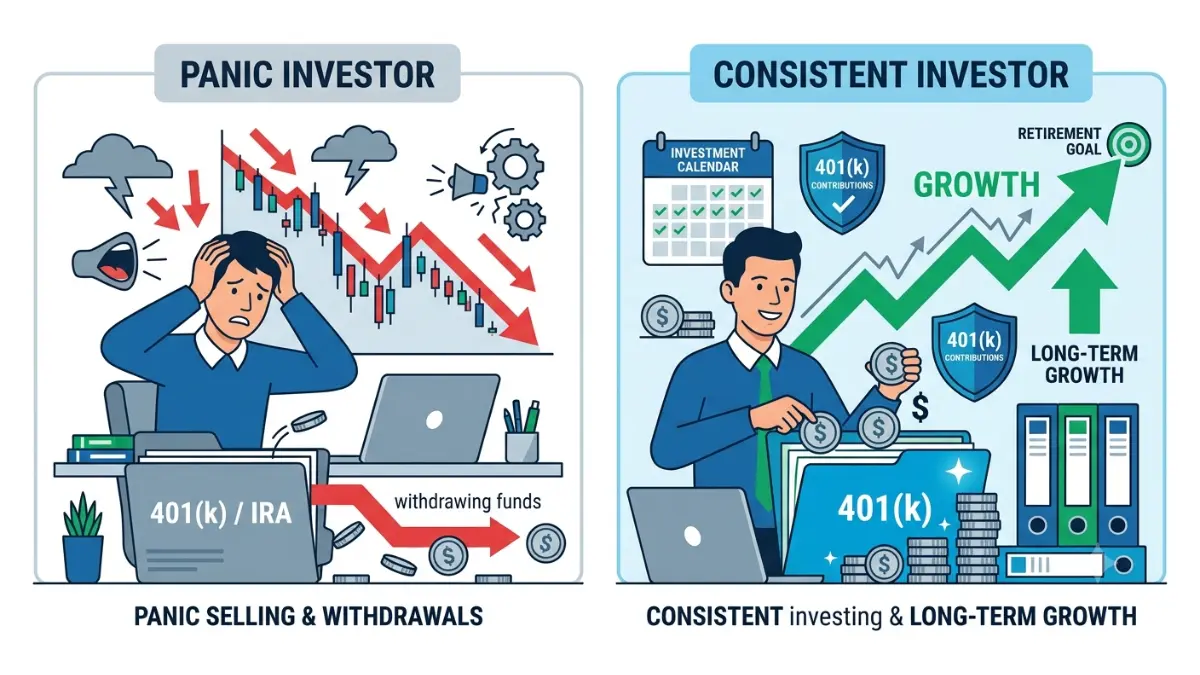
⚠️ Costly Mistake: A record 6% of savers took a hardship withdrawal in 2025 — the fourth straight annual rise. The median was just $1,900, and the top reasons were avoiding foreclosure or eviction (36%) and medical bills (31%). — Source: Vanguard, How America Saves 2026.
The reassuring flip side: 94% of participants saw their balance rise in 2025, and 97% of the money available to cash out was left invested. Most people, most of the time, stay the course — and that habit does more for the long run than any single year’s number.
✅ Action Step: Keep your 401(k) for retirement by building a separate cushion. Aim for three to six months of expenses in a savings account so a surprise bill never forces an early withdrawal — size a separate emergency fund to see your target.
401(k) savings by age: frequently asked questions
1. How much should I have in my 401(k) at 30?
A common benchmark from Fidelity suggests roughly 1x your annual salary saved by 30. In reality, Vanguard’s 2026 data puts the median 401(k) balance for ages 25–34 at $18,732. If you land between those figures, you’re doing fine — your ideal number scales with your income and when you plan to retire.
2. How much should I have in my 401(k) at 40, 50, and 60?
The Fidelity benchmark is about 3x your salary by 40, 6x by 50, and 8x by 60. Actual medians run far lower: $46,919 for ages 35–44, $78,730 for 45–54, and $107,269 for 55–64 (Vanguard, 2026). Most people trail the benchmark, so treat the gap as a catch-up target, not a verdict.
3. What is a good 401(k) balance at 50?
The benchmark aims for roughly 6x your salary by 50, while the median 401(k) balance for ages 45–54 is $78,730 (Vanguard, 2026). “Good” depends on your income, other savings, and retirement date, so use both as reference points — and consider a fiduciary advisor to set a target for your situation.
4. What is the average 401(k) balance by age?
Per Vanguard’s 2026 report, average 401(k) balances rise from $7,259 under 25 to $305,006 for ages 55–64 and $330,186 at 65+. But averages are skewed high by large accounts — the all-participant average of $167,970 sits near the 75th percentile. Medians are a more realistic comparison for most savers.
5. Why is the average 401(k) balance so much higher than the median?
A small number of very large accounts pull the average upward. Vanguard’s 2026 data shows 1 in 4 participants hold under $10,000, while 18% have $250,000 or more. That spread lifts the $167,970 average well above the $44,115 median, which marks the true midpoint and better reflects the typical saver.
6. How much should I contribute to my 401(k)?
Fidelity suggests saving about 15% of pre-tax income including your employer match; Vanguard targets 12–15%. In practice the average worker defers just 7.6% (Vanguard, 2026), so most people have room to increase. Start by capturing your full match, then raise your rate over time. A CPA can help with tax-efficient timing.
7. What are the 2026 401(k) contribution limits?
For 2026, the IRS set the employee 401(k) limit at $24,500, up from $23,500. Workers 50 and older can add an $8,000 catch-up (a $32,500 total), and those aged 60–63 can add $11,250 (a $35,750 total) if their plan allows. The combined employee-plus-employer cap is $72,000.
8. Am I too late to start a 401(k) at 40 or 50?
No. Catch-up contributions exist for this — an extra $8,000 a year at 50+ and $11,250 at 60–63 (IRS, 2026), on top of the $24,500 base. Consistent contributing and capturing your full employer match matter more than any single milestone. A CPA can help with tax-efficient catch-up timing.
9. Does the 401(k) benchmark include IRAs and Social Security?
The salary-multiplier benchmark counts all your retirement accounts — 401(k), IRAs, and pension value — but not home equity or ordinary taxable savings. Social Security is separate: Fidelity’s model assumes it covers part of your income while your savings replace roughly 45% of pre-retirement pay. So your 401(k) alone doesn’t have to hit the full target.
10. What’s the fastest way to catch up if I’m behind on retirement savings?
In order of payoff: capture your full employer match, raise your contribution rate even 1% per raise, then use catch-up limits if you’re 50+ ($8,000) or 60–63 ($11,250). Only about 14% of savers max out (Vanguard, 2026), so there’s usually real room. A fiduciary advisor can build a personalized plan.
11. How long will my 401(k) last in retirement?
It depends on your balance, spending, and withdrawal rate. As a rough frame, the “4% rule” means the median pre-retiree balance of $107,269 (Vanguard, 2026) generates only about $4,300 a year. That’s why Social Security, other savings, and a real withdrawal plan matter — map yours out with a fiduciary advisor.
The bottom line
The benchmark gives you a target; the real data shows most people trail it — and that’s workable, not shameful. If you take one thing from all these numbers, let it be this: the median saver is behind the benchmark too, the levers that close the gap are ordinary and proven, and the best move today is to capture your full employer match and raise your rate where you can.
Then make “on track” concrete for your own life. Run your balance, income, and retirement date through a retirement planning calculator, and revisit it once a year. For a plan built around your specifics, a fiduciary advisor or CPA can help.
Informational disclaimer
The content on Finance Authority Hub is provided for general informational and educational purposes only and should not be considered personalized financial, investment, tax, legal, or professional advice. Financial decisions depend on your individual goals, income, risk tolerance, location, and regulatory situation. Before acting on any information, strategy, estimate, or calculator result, consult a qualified licensed professional who can evaluate your specific circumstances.