Your 2026 401(k) Contribution Limits, Clearly Explained
The 2026 401(k) contribution limits brought a $1,000 increase—but a quieter SECURE 2.0 change now requires high earners to make catch-ups Roth this year.
In This Article
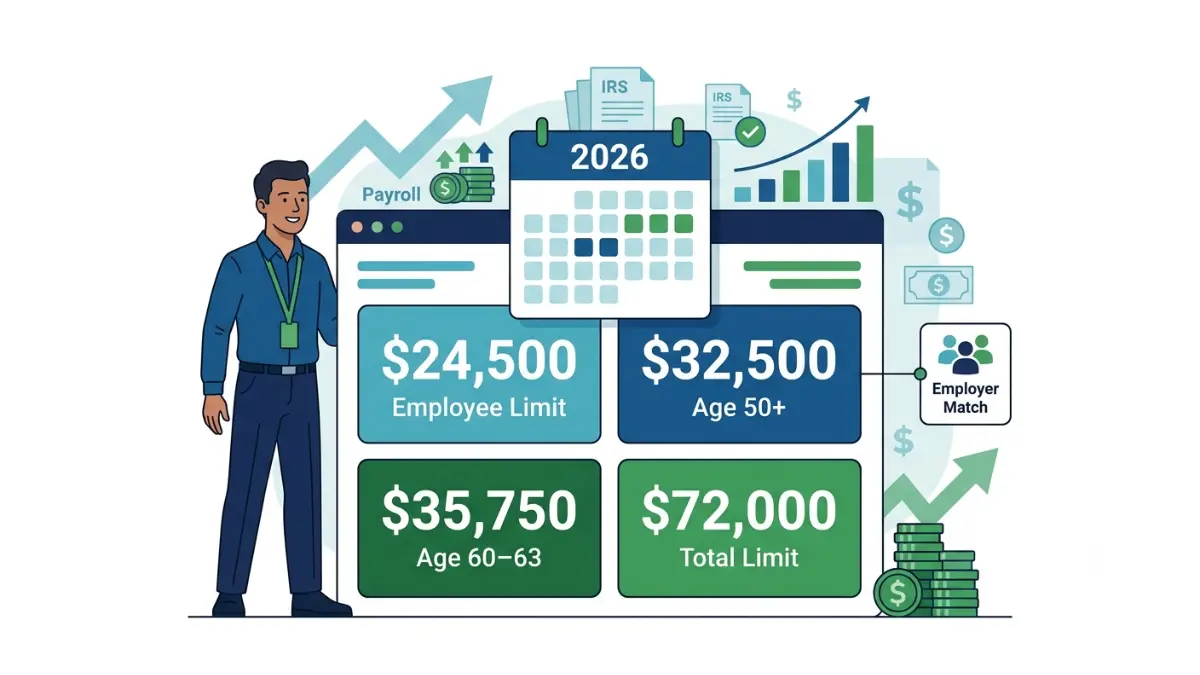
The 2026 401(k) contribution limit is $24,500 for your own salary deferrals — $1,000 more than 2025. That headline number means something different depending on your age and income, so here’s where your answer lives:
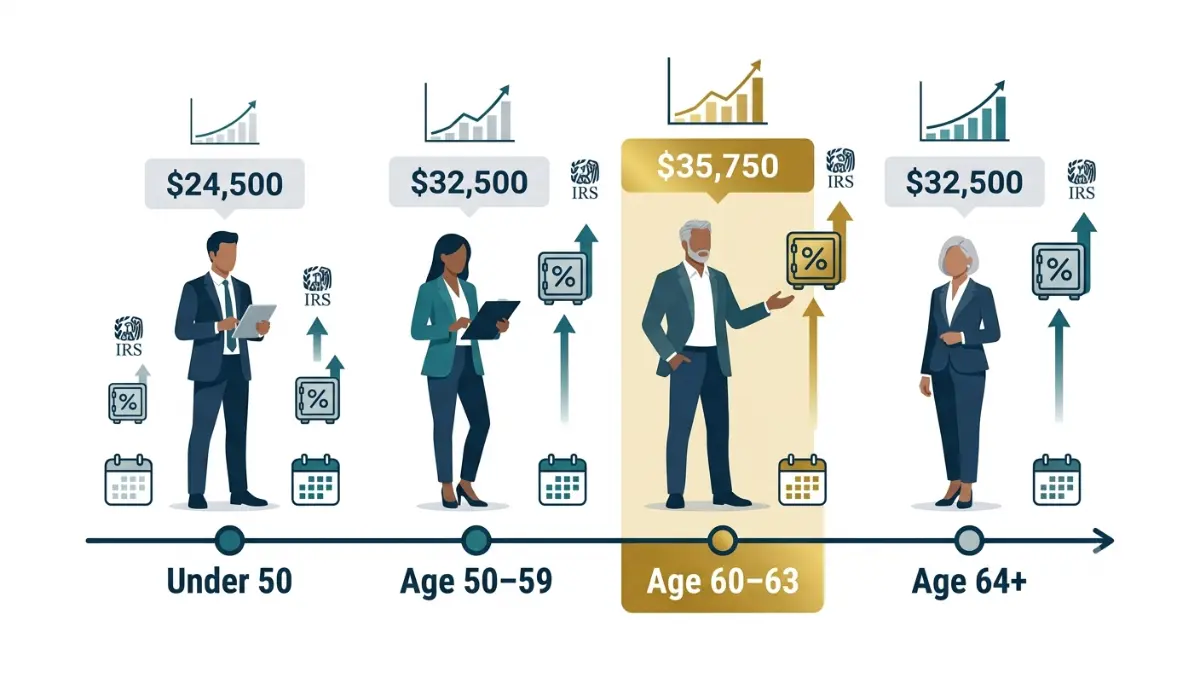
- Under 50: Your cap is $24,500.
- Age 50–59: Add an $8,000 catch-up for $32,500 total.
- Age 60–63: A larger super catch-up reaches $35,750.
- Earning over $150,000: A brand-new 2026 rule changes how your catch-up must be made — covered below.
This guide explains what each limit actually covers, who the new rules touch, and how to turn the annual cap into a per-paycheck number you can set today. Every figure is tied to the IRS.
ℹ️ Financial Disclaimer: This is general educational information about retirement contribution limits and tax rules — not personalized investment, tax, lending, insurance, or debt advice. Limits, tax treatment, and plan features depend on your situation and your employer’s plan. Before changing contributions or making a tax decision, consult a CPA or a fiduciary financial advisor and confirm details with your plan administrator.
What the 2026 401(k) contribution limit actually covers
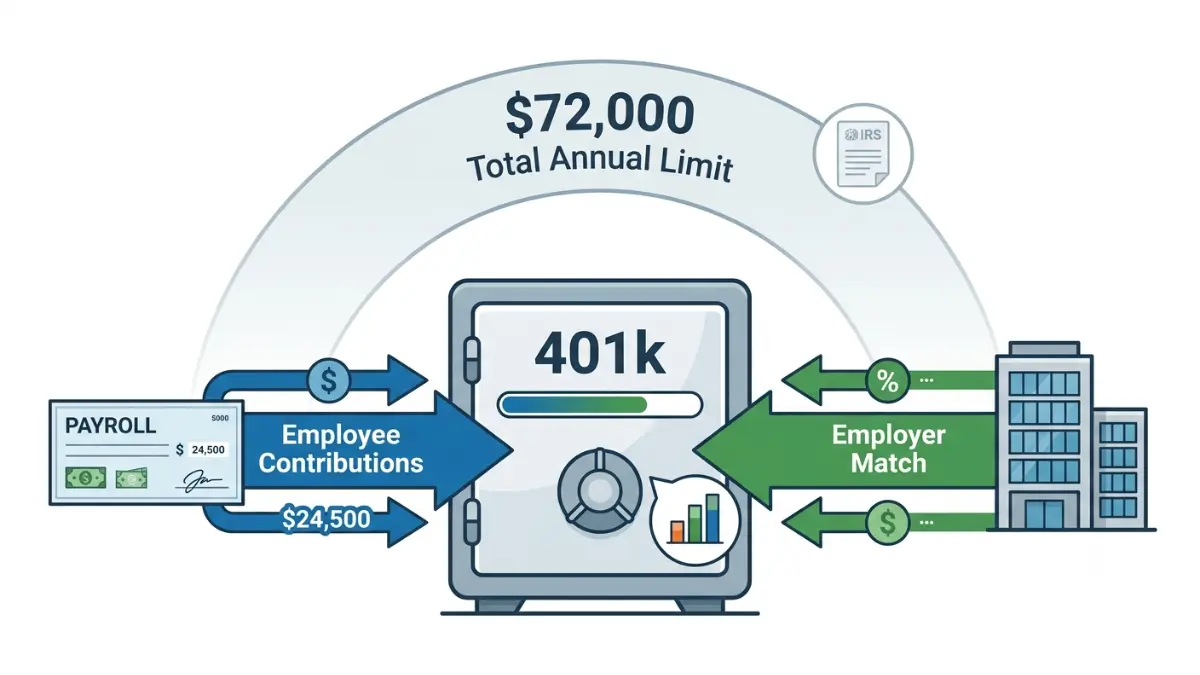
Your employee contribution limit of $24,500 is a cap on what you put in from your paycheck — not the total that can land in your account. The IRS calls this the 402(g) limit, and it applies per person across every 401(k) you hold, under the IRS’s elective deferral rules.
📊 Data Point: The 2026 employee deferral limit is $24,500, up from $23,500 in 2025 — Source: IRS, Notice 2025-67.
Pre-tax and Roth count toward the same $24,500
If your plan offers both pre-tax and Roth 401(k) options, you don’t get $24,500 in each. The single limit covers your combined pre-tax and Roth deferrals for the year.
Your employer’s match doesn’t count toward your limit
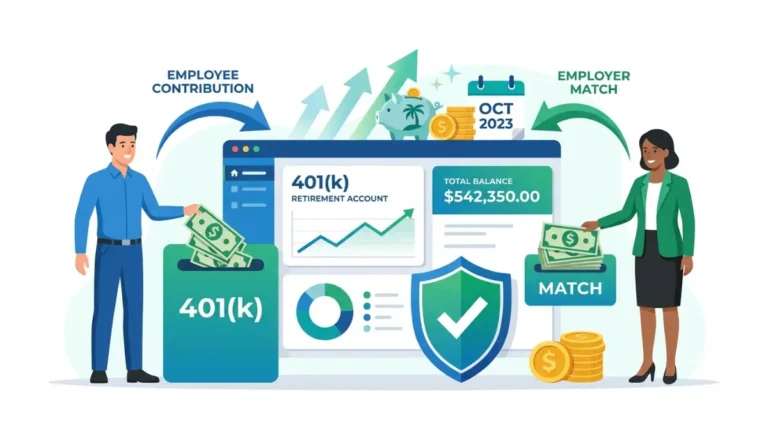
🔍 How It Works: Employer matching and profit-sharing contributions sit outside your $24,500 cap. They count toward a separate, higher ceiling — the total additions limit covered next — so a generous match never reduces how much you can personally defer.
💡 Expert Note: A common point of confusion is treating the match as part of your $24,500. It isn’t — your deferral and your employer’s contribution are tracked separately under different IRS rules.
2026 401(k) contribution limits by age, at a glance
Here is every 2026 contribution figure in one place, by age bracket, drawn from the IRS’s official 2026 announcement.
| Your age in 2026 | Your employee limit | Catch-up | Your total deferral |
|---|---|---|---|
| Under 50 | $24,500 | — | $24,500 |
| 50–59 | $24,500 | $8,000 | $32,500 |
| 60–63 | $24,500 | $11,250 | $35,750 |
| 64+ | $24,500 | $8,000 | $32,500 |
Source: IRS Notice 2025-67 (2026 figures). Catch-up amounts apply only if your plan offers them.
The $72,000 ceiling (you plus your employer)
Separately, the most that can enter your 401(k) from all sources — your deferrals, the employer match, and any after-tax contributions — is $72,000 in 2026, up from $70,000. Add the age-50 catch-up and that rises to $80,000.
📊 Data Point: The 2026 total additions limit (IRC §415(c)) is $72,000, up from $70,000 in 2025 — Source: IRS, Notice 2025-67.
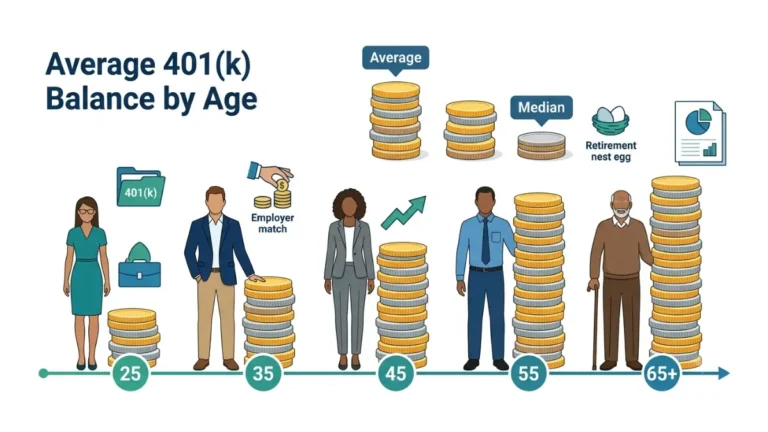
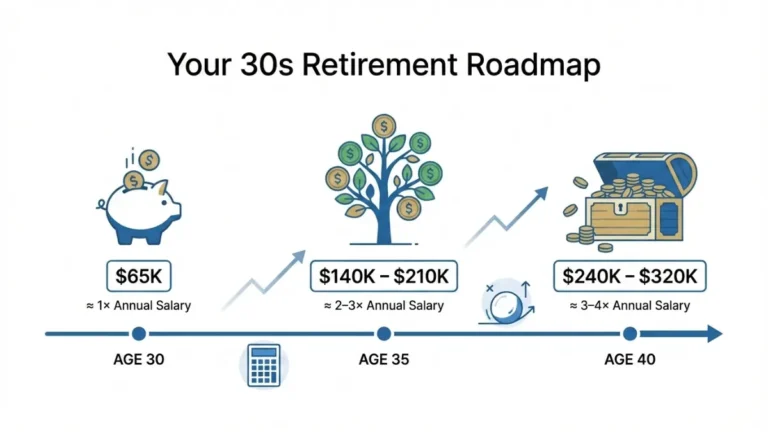
To see how your bracket’s number stacks against where savers your age typically stand, compare it with retirement savings benchmarks by age.
Catch-up contributions: the $8,000 and $11,250 rules
If you’re 50 or older, catch-up contributions let you save above the standard $24,500. The amount depends on your exact age, and the two tiers don’t stack.
The standard catch-up at 50+: an extra $8,000
Once you turn 50 by year-end, you can add $8,000 in 2026 (up from $7,500), for $32,500 total, under the IRS’s catch-up contribution rules. This applies whether you’re 50 or 70 — with one exception in your early 60s.
The super catch-up at 60–63: up to $11,250
🔍 How It Works: Under the SECURE 2.0 Act, savers who are 60, 61, 62, or 63 by the end of 2026 can make a larger catch-up of $11,250 instead of the $8,000, bringing their total to $35,750. At 64 you drop back to the standard $8,000. Your plan must offer this tier, and not all do.
⚠️ Costly Mistake: Assuming the $11,250 stacks on top of the $8,000. It replaces it — the most a 60-to-63-year-old can defer in 2026 is $35,750, not $43,750.
New for 2026: high earners must make catch-ups Roth
A SECURE 2.0 provision takes effect for the first time in 2026, and it changes how higher earners make catch-up contributions — not how much. If your prior-year wages cross a threshold, your catch-up dollars must go into a Roth (after-tax) account.
Who’s affected: the $150,000 FICA-wage threshold
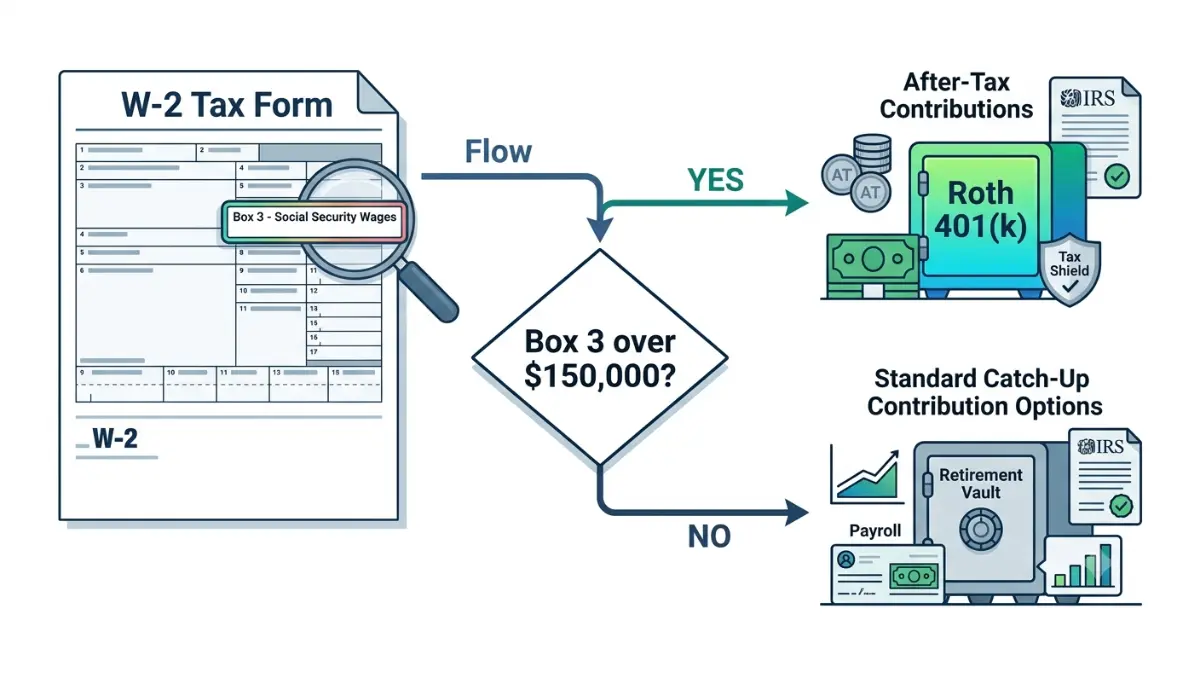
The rule applies if you earned more than $150,000 in FICA (Social Security) wages from your plan’s employer in 2025. The law set the bar at $145,000, indexed for inflation; $150,000 is the 2026 figure. Your regular deferrals up to $24,500 are unaffected — only catch-ups must be Roth.
How to check (Form W-2, Box 3)
🔍 How It Works: This threshold uses your Social Security wages, found in Box 3 of your 2025 W-2 — not your total income or your adjusted gross income. It’s also separate from the $160,000 highly compensated employee line, which is a different rule. If Box 3 tops $150,000, your 2026 catch-ups must be Roth, where qualified growth comes out tax-free.
If your plan has no Roth option
If your employer’s plan doesn’t offer Roth and you’re over the threshold, you may not be able to make catch-ups at all until Roth is added.
✅ Action Step: Pull your 2025 W-2, check Box 3, and if it exceeds $150,000, ask your CPA or plan administrator: “Are my 2026 catch-up contributions required to be Roth, and does my plan support Roth catch-ups?”
What the limits mean for your paycheck: a worked example
Knowing the cap is $24,500 doesn’t tell you what to enter in your payroll system. Here’s the per-paycheck math to actually hit it.
Per-paycheck math to max out at $24,500
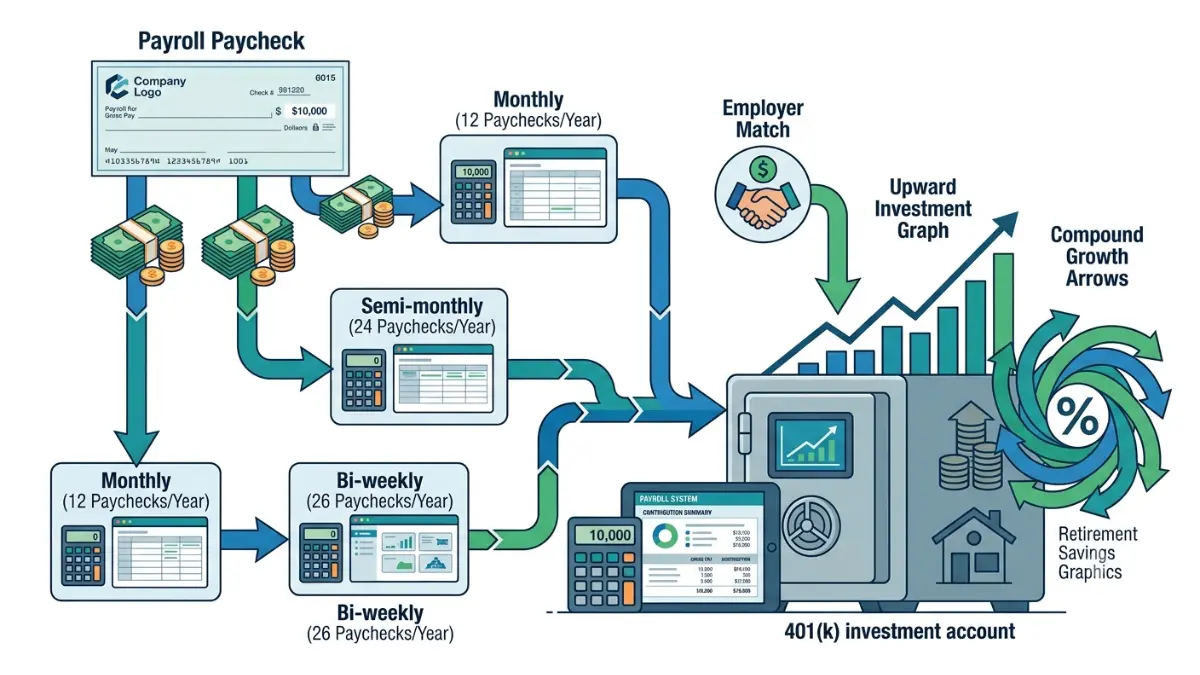
🔍 How It Works: Divide the $24,500 limit by your number of pay periods. The result is the deferral that lands you at the cap by December.
| Pay schedule | Pay periods | To max out, defer each check |
|---|---|---|
| Bi-weekly | 26 | ~$942.31 |
| Semi-monthly | 24 | ~$1,020.83 |
| Monthly | 12 | ~$2,041.67 |
Figures derived from the 2026 IRS limit of $24,500. Your plan will stop you at the limit if you round up slightly.
If you’re 50+ aiming for $32,500, the semi-monthly figure rises to about $1,354.17 per check.
How the match stacks toward the $72,000 ceiling
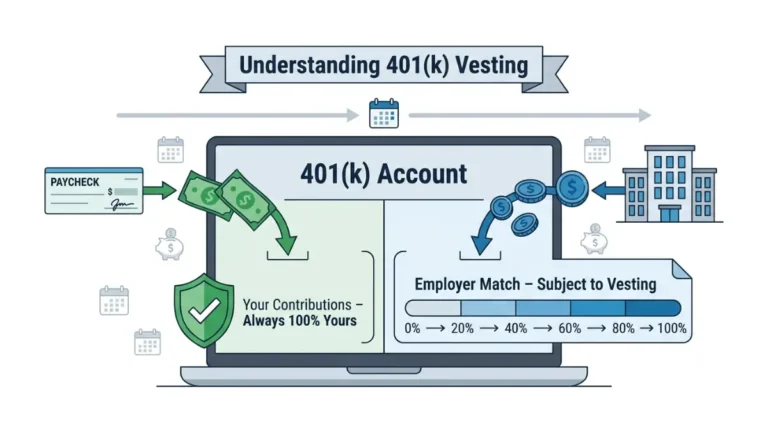
Suppose you defer the full $24,500 and your employer adds $6,000 in matching. You’re at $30,500 — far below the $72,000 total ceiling, with room for after-tax contributions if your plan allows them. Capturing that match is the highest-return move available, which is why leaving employer match on the table is so costly.
✅ Action Step: Use a 401(k) contribution calculator to set your per-paycheck percentage, then check it against your plan’s match formula so you capture the full match across all 26 pay periods. To see the long-run payoff, run it through a compound interest calculator.
Common 2026 401(k) contribution mistakes to avoid
Most contribution problems come down to a handful of avoidable errors. Here are the ones that cost real money.
Over-contributing across two employers (and the April 15 fix)
🔍 How It Works: Your $24,500 limit is per person, not per plan. If you switch jobs and contribute to two 401(k)s in the same year, their combined total can quietly exceed the cap — creating an excess deferral.
⚠️ Costly Mistake: Leaving an excess deferral in place. If you don’t withdraw the excess (plus its earnings) by April 15 of the following year, that money is taxed twice — once in the year contributed and again when you eventually withdraw it.
Front-loading and missing your employer match
If you max out early, your contributions stop — and if your match is applied per paycheck without a true-up, you can forfeit match dollars in later months. After maxing your 401(k), the next bucket matters: many savers weigh whether to fund a 401(k) or IRA first, and some find an HSA delivers stronger tax treatment. The 2026 IRA limit is $7,500, with a $1,100 catch-up at 50 or older.
✅ Action Step: If you exceeded your limit across two plans, contact your plan administrator before April 15 and ask: “How do I request a corrective distribution of my excess deferral plus earnings for the tax year?”
Frequently asked questions about 2026 401(k) contribution limits
1. What is the 2026 401(k) contribution limit?
The 2026 401(k) contribution limit for your own salary deferrals is $24,500, up $1,000 from 2025. This is your personal cap across all 401(k) accounts you hold. It covers your combined pre-tax and Roth 401(k) contributions, but not your employer’s match, which falls under a separate limit.
2. Does my employer match count toward the $24,500 limit?
No. Your employer’s match and any profit-sharing do not count toward your $24,500 employee 401(k) contribution limit. They count instead toward the higher total additions limit of $72,000 for 2026. A generous match never reduces how much you can personally defer from your paycheck.
3. How much is the 401(k) catch-up contribution for 2026?
If you’re 50 or older by year-end, the 2026 401(k) catch-up contribution is $8,000 on top of the $24,500 limit, for $32,500 total. That’s up from $7,500 in 2025. The catch-up applies only if your plan offers it, which most plans do.
4. What is the super catch-up for ages 60 to 63?
Savers who are 60, 61, 62, or 63 by the end of 2026 can make a larger 401(k) catch-up of $11,250 instead of the standard $8,000, reaching $35,750 total. At age 64, you return to the $8,000 catch-up. Your plan must offer this tier for you to use it.
5. Who has to make Roth catch-up contributions in 2026?
Starting in 2026, if your 2025 FICA wages from your plan’s employer exceeded $150,000, your 401(k) catch-up contributions must be made as Roth (after-tax) dollars. Your regular deferrals are unaffected. Check Box 3 of your W-2, and confirm with your CPA or plan administrator how the rule applies to you.
6. What is the total 401(k) contribution limit including my employer?
The 2026 total 401(k) contribution limit — your deferrals plus employer match plus any after-tax contributions — is $72,000, up from $70,000. Adding the age-50 catch-up raises it to $80,000. Most employees never approach this ceiling, because a typical match falls well short of it.
7. Can I contribute to both a 401(k) and an IRA in 2026?
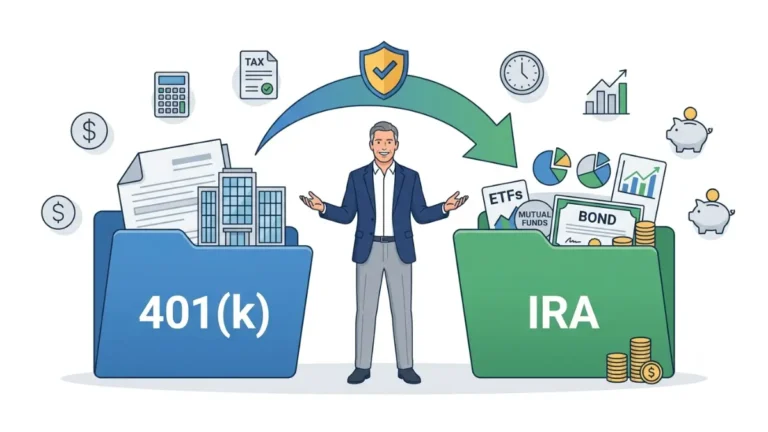
Yes. Your 401(k) and IRA have separate limits, so you can fund both. The 2026 IRA contribution limit is $7,500, with a $1,100 catch-up at 50 or older. Deductibility and Roth IRA eligibility depend on your income, so check with a CPA about your specific situation.
8. What happens if I contribute too much to my 401(k)?
If your contributions exceed the $24,500 limit — often after switching employers mid-year — you have an excess deferral. Withdraw the excess plus its earnings by April 15 of the following year, or it’s taxed twice. Contact your plan administrator promptly, and ask a CPA if you’re unsure how to proceed.
9. Are Roth and traditional 401(k) limits separate?
No. If your plan offers both a Roth 401(k) and a traditional pre-tax 401(k), they share the same $24,500 employee contribution limit for 2026. You can split contributions between them however you like, but the combined total can’t exceed $24,500 (or $32,500 with the age-50 catch-up).
10. How do I max out my 401(k) in 2026?
To reach the $24,500 limit, divide it by your pay periods: about $1,020.83 per check if paid semi-monthly, or $942.31 if paid bi-weekly. Set that deferral in your payroll system early in the year, and verify it captures your full employer match across every paycheck.
11. Did the 401(k) limit increase for 2026?
Yes. The employee 401(k) contribution limit rose by $1,000, from $23,500 in 2025 to $24,500 in 2026. The age-50 catch-up also increased, from $7,500 to $8,000, and the total additions limit climbed from $70,000 to $72,000. These reflect annual IRS cost-of-living adjustments.
Putting your 2026 401(k) plan into action
Your 2026 contribution plan comes down to three moves. First, find your number: $24,500 under 50, $32,500 at 50+, or $35,750 at 60–63. Second, translate it into a per-paycheck deferral and set it in your payroll system. Third, if your 2025 W-2 Box 3 topped $150,000, confirm with your plan administrator that your catch-ups are set up as Roth.
To see how maxing out compounds over a full career, run the numbers through a retirement projection calculator, and if you’re weighing Roth dollars, a Roth IRA growth calculator can help you compare. The limits are set — what matters now is capturing every dollar of tax-advantaged space and your full employer match.
Informational disclaimer
The content on Finance Authority Hub is provided for general informational and educational purposes only and should not be considered personalized financial, investment, tax, legal, or professional advice. Financial decisions depend on your individual goals, income, risk tolerance, location, and regulatory situation. Before acting on any information, strategy, estimate, or calculator result, consult a qualified licensed professional who can evaluate your specific circumstances.