Tax refund offset or IRS correction? How to tell which one
Tax refund offset order: IRS tax first, then child support, federal agency debts, state income tax and unemployment debts.
In This Article
Rates and limits checked on November 19, 2026.
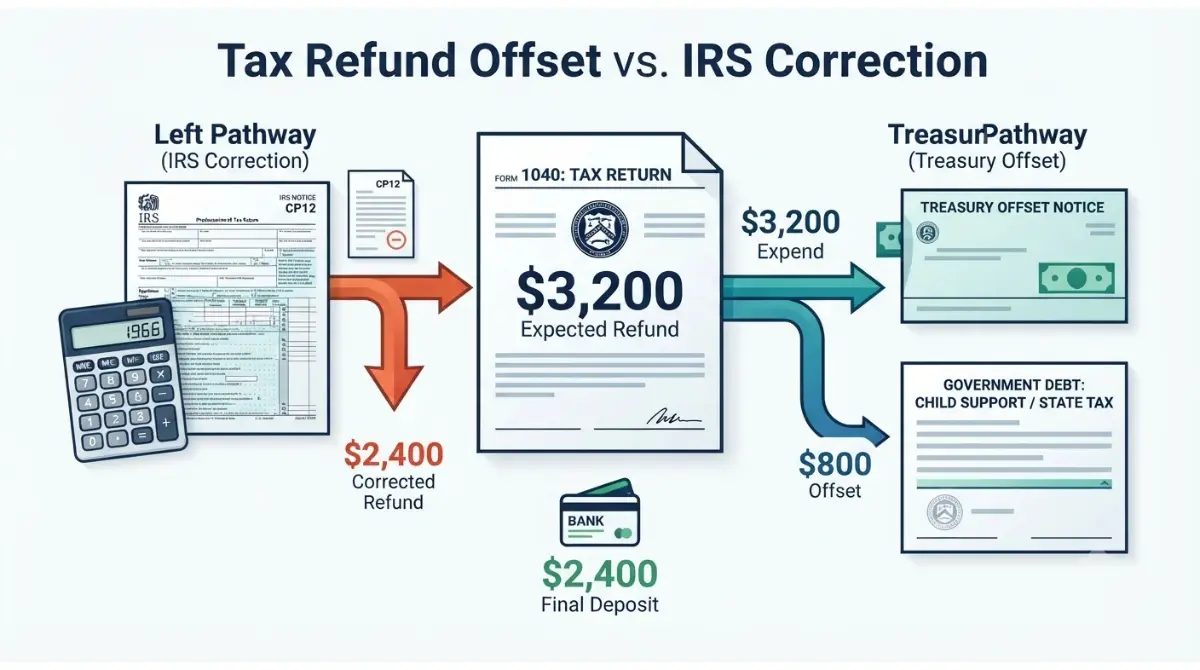
A refund that lands smaller than the amount on your return was cut in one of two ways: the IRS corrected something on the return, or part of the money went to a debt. The letter you get tells you which. Corrections come from the IRS on notices such as CP12, while offsets for child support, state tax and other agency debts are reported by the Bureau of the Fiscal Service (IRS reduced refund page).
Tax refund offset vs IRS correction
An offset leaves your return exactly as you filed it. The refund is figured as you expected, and then some or all of it is applied to a past-due debt before it reaches you.
A correction changes the return itself. The IRS found a math error or a credit or deduction it says you can’t claim, or your estimated tax payments came up short, and it recalculated the refund.
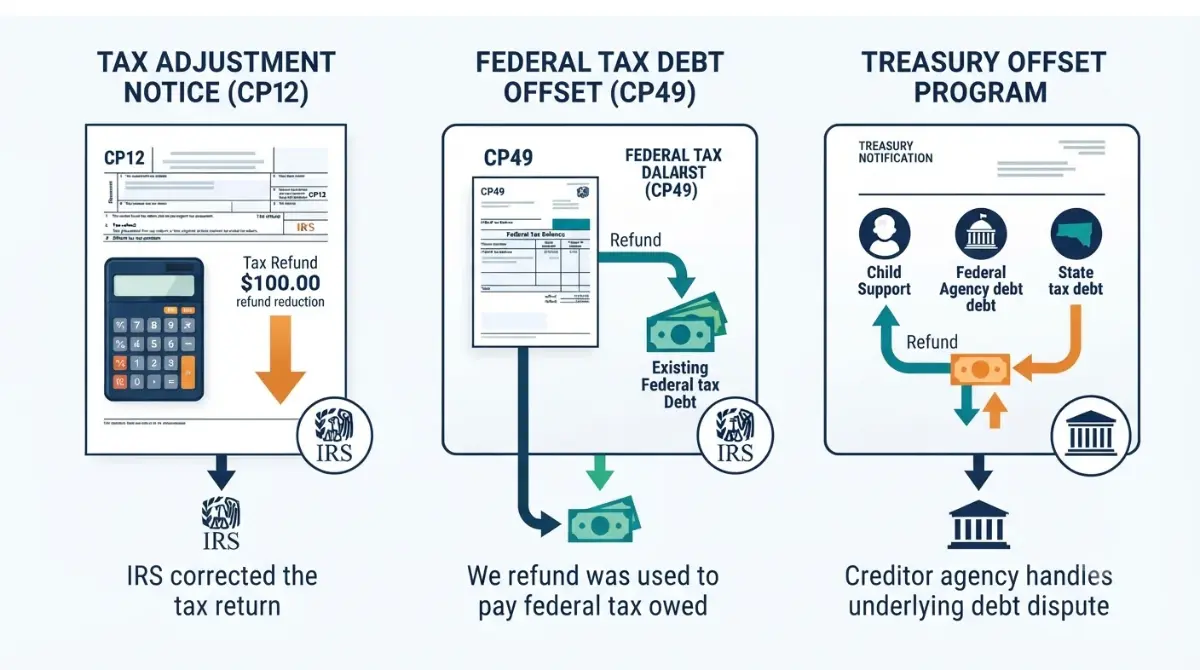
| Letter | Sent by | What happened | Who can change it |
|---|---|---|---|
| CP12 | IRS | The IRS corrected mistakes on your return and the refund amount changed | The IRS, at the number on the notice |
| CP49 | IRS | The IRS used all or part of the refund to pay a federal tax balance you owe | The IRS, at the number printed on the CP49 |
| Offset notice | Bureau of the Fiscal Service | The refund paid past-due child support, a federal agency debt, state income tax or certain state unemployment compensation debt | The agency named on the letter |
Sources: IRS reduced refund page, Understanding your CP12 notice, Understanding your CP49 notice.
Both can hit the same refund. A corrected refund still goes out only if you don’t owe other tax or debts the IRS is required to collect (CP12), so one return can produce two or three separate letters.
Check the sender before you call anyone
The Fiscal Service letter lists your original refund, the amount taken and the agency that received it. The IRS doesn’t receive those offset details, so it can’t tell you why a child support or state tax offset happened (IRS).
One figure on that letter decides whether the IRS is involved at all. If the original refund it shows differs from the refund your return claimed, the IRS says to call the IRS about that difference.
No letter yet? Work through these in order:
- Call the Treasury Offset Program line at 800-304-3107 (TTY 800-877-8339), Monday through Friday, 7:30 a.m. to 5 p.m. Central time (IRS).
- Sign in to your IRS Online Account and open the account transcript for that tax year.
- Look for transaction code 898, which the Internal Revenue Manual describes as a Treasury Offset Program offset recorded by the Bureau of the Fiscal Service. Code 826 marks a tax offset, where the refund paid IRS tax (IRM 21.4.6).
A code 898 means the agency details are held by the Fiscal Service and its TOP line, not by the IRS.
$3,200 on the return, $600 in the bank
Example: a married couple files jointly and their return shows a $3,200 refund. One spouse owes $1,500 in past-due child support from before the marriage, and the couple owes $700 to their state revenue department.
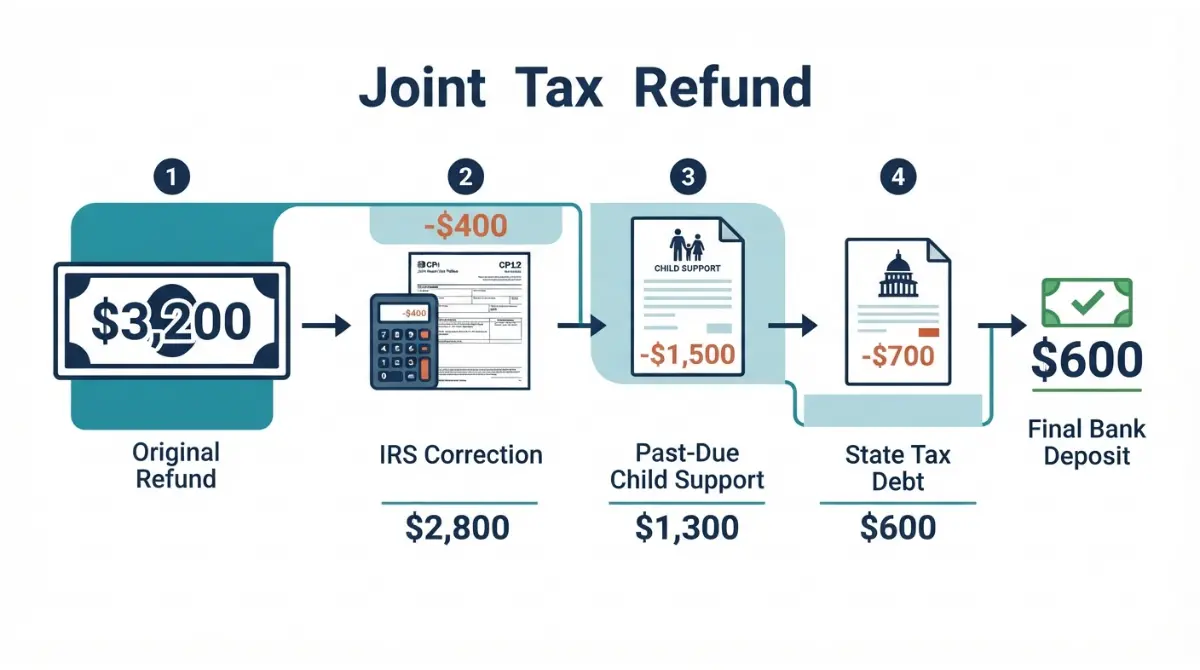
The IRS finds a math error in a credit and lowers the refund by $400. That correction arrives as a CP12. The remaining $2,800 then meets the offsets. Any federal tax the couple owed would come out first; after that, the Treasury Offset Program pays child support, then federal agency debts, then state income tax, then unemployment compensation debts (IRM 21.4.6.4).
| Step | What took money | Amount | Refund left | Letter |
|---|---|---|---|---|
| Return as filed | Nothing yet | $0 | $3,200 | None |
| IRS correction | Math error on a credit | $400 | $2,800 | CP12 from the IRS |
| Offset 1 | Past-due child support | $1,500 | $1,300 | Fiscal Service notice |
| Offset 2 | State income tax debt | $700 | $600 | Fiscal Service notice |
Figures are for illustration. Offset order: Internal Revenue Manual 21.4.6.4.
The $2,600 gap has three owners. The IRS answers for $400, the state child support agency for $1,500 and the state revenue department for $700. Calling the IRS about the $1,500 gets the couple nothing, and calling the child support agency about the $400 doesn’t either.
To check the IRS’s math on your own return, enter your income, deductions and credits in the income tax calculator and compare its total tax with the figures on the CP12.
How do you dispute an IRS correction?
If you agree with a CP12, you don’t reply. The corrected refund comes by check in 4 to 6 weeks, as long as you don’t owe other tax or debts the IRS must collect (CP12).
If you disagree, call the toll-free number the notice gives by the date on the notice. When a correction lowered a refund you claimed, the IRS will usually reverse most of the changes on request, even without documents, though supporting papers can speed it up. If it can’t confirm what you first reported, it may send the case to audit, and audit staff would contact you within 6 weeks.
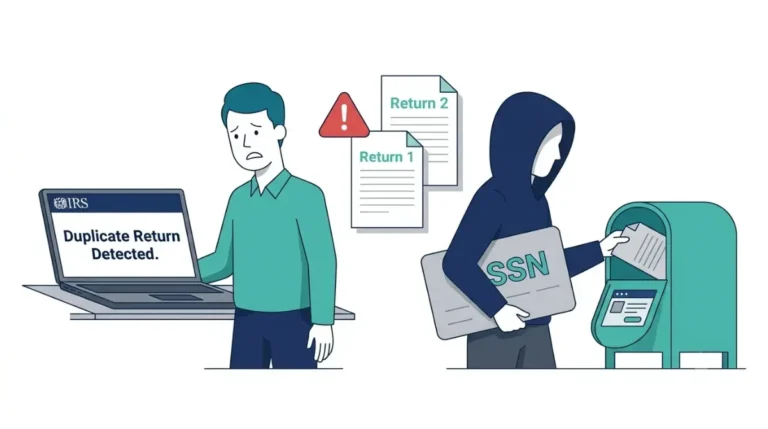
If the notice mentions income or a return you don’t recognize, follow the steps for a return filed in your name instead.
An enrolled agent or CPA can read the notice with you. Ask whether this change is one the IRS reverses on request, or one that needs documents, and which documents.
Deadline: If you miss the date on your CP12, you lose the formal right to have the change reversed and the right to appeal to the U.S. Tax Court. The IRS still considers documents sent later and may reverse the change.
Offsets are disputed with the agency that got the money
The agency named on the Fiscal Service letter is the office that can tell you whether you owe it and what balance is left. The IRS page on reduced refunds tells you to dispute an offset by following the instructions in that notice.
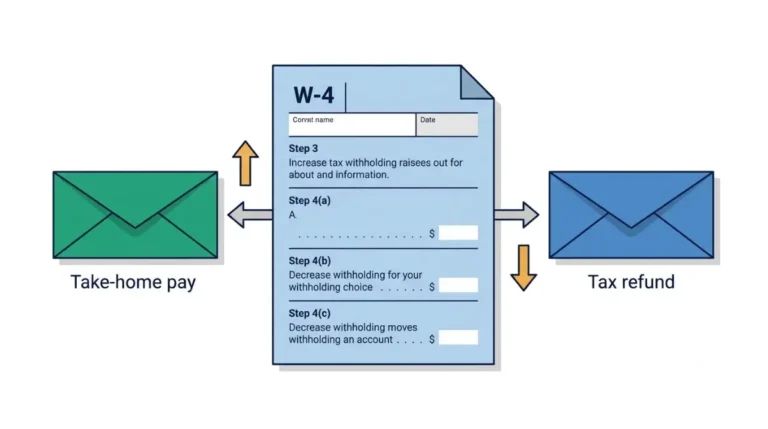
A CP49 works differently because the debt is federal tax. The IRS applied the refund to your balance, and if you think you didn’t owe that tax, the call goes to the IRS line listed on the CP49, with your return in hand. When a federal balance keeps taking your refunds, changing your W-4 withholding is what moves next year’s number.
If some tax is still owed after the offset, you can pay online, apply for a payment plan or ask for a temporary collection delay if you qualify. Any refund left once the balance is paid goes out by check within 3 weeks unless other debts take it (CP49).
Form 8379 when the debt is your spouse’s
The spouse who doesn’t owe the debt can ask for their share of a joint refund back. Form 8379, Injured Spouse Allocation, applies only when your share was, or will be, offset against your spouse’s legally enforceable past-due debt (Form 8379 instructions).
You can file it with the joint return or on its own after the offset. Processing takes about 14 weeks with a paper joint return, 11 weeks with an e-filed one, and about 8 weeks when Form 8379 is filed alone after the return has been processed. Each year with an offset needs its own Form 8379.
Deadline: File Form 8379 within 3 years of the original return’s due date (including extensions) or 2 years from when the tax was paid, whichever is later.
In Arizona, California, Idaho, Louisiana, Nevada, New Mexico, Texas, Washington and Wisconsin, the IRS uses each state’s community property rules to work out the injured spouse’s share. If you live in one of those states, ask a CPA or enrolled agent how your state’s rule splits the refund before you complete the allocation section of the form.
If you’re asking to be relieved of tax your spouse owes on the joint return, Form 8379 is the wrong form. That request goes on Form 8857, for innocent spouse relief.
Pull your transcript and match each letter to its office
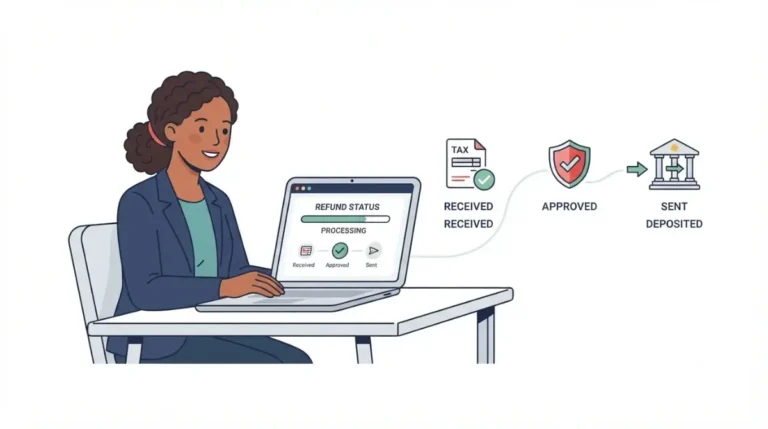
Lay each letter you’ve received next to your account transcript for the year. A CP12 or CP49 goes back to the IRS number printed on it, an offset letter to the agency it names, and a code 898 with no letter means a call to the TOP line at 800-304-3107. If nothing explains the full gap, the refund status checks and IRS escalation options cover when to call the IRS directly.
Found this helpful? See more of our guides on Google.
Want to see our guides first on Google?
Informational disclaimer
The content on Finance Authority Hub is provided for general informational and educational purposes only and should not be considered personalized financial, investment, tax, legal, or professional advice. Financial decisions depend on your individual goals, income, risk tolerance, location, and regulatory situation. Before acting on any information, strategy, estimate, or calculator result, consult a qualified licensed professional who can evaluate your specific circumstances.