The real rules behind delaying Social Security to 70

Delaying Social Security to 70 is governed by three credit-timing rules in federal regulation — Social Security’s own planner page publishes only one.

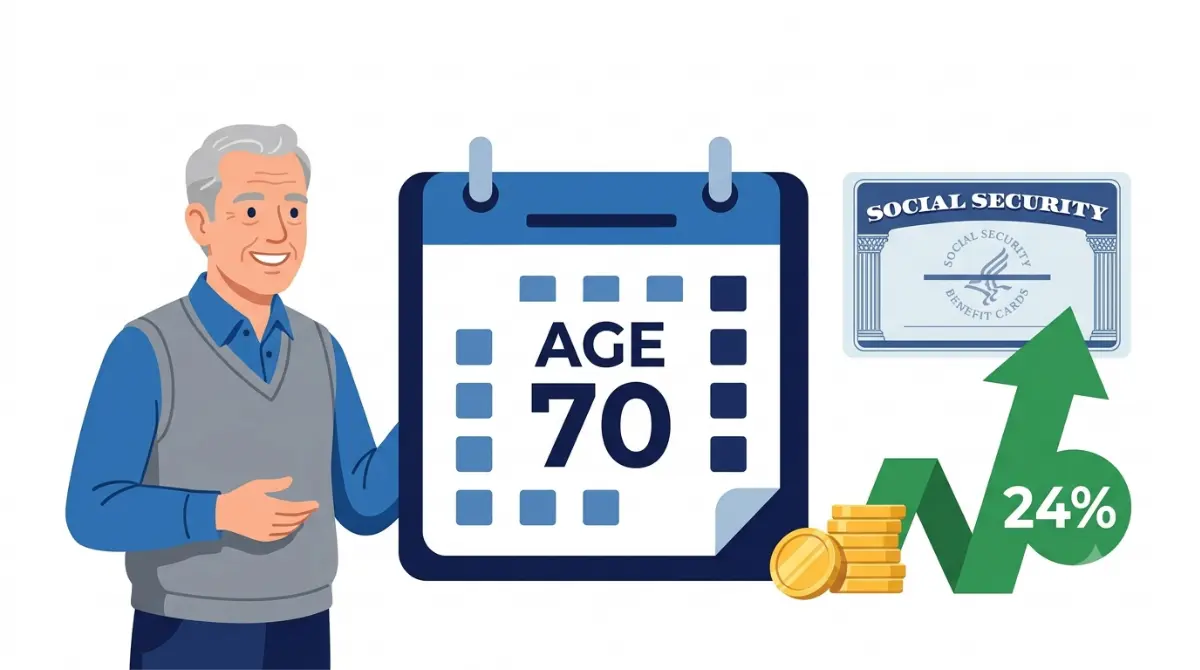
Delaying Social Security from full retirement age to 70 increases monthly retirement benefits through delayed retirement credits shown on a benefit growth timeline.

What waiting until 70 actually buys you

Delaying Social Security to 70 raises your monthly payment by two-thirds of 1% for every month you wait past full retirement age. That is the entire rule. Everything that follows is what the rule does not say out loud.

Start where you are:

  • Approaching or just past full retirement age, deciding whether to wait — read the next three sections in order.
  • Already past 70 without filing — skip to the six-month rule. A deadline is running against you right now.
  • Claiming on a husband’s or wife’s record — Section 4. Waiting past your own full retirement age may add nothing whatsoever.
  • Already claimed early — Section 4 covers the route back into credits.

This page does not run a break-even model against life expectancy. That analysis lives in our guide to claiming Social Security at 62. Here we price the credit itself: how it is built, which benefits it reaches, and when it actually lands in your account.

If you are already past 70

Your benefit stopped growing the month you turned 70. Social Security will not start paying you automatically, and it will only backdate a limited number of months.

If your benefit comes from a spouse’s record

A spousal benefit is capped at half of the worker’s full retirement amount, and delayed credits are not part of that calculation. Waiting past your own full retirement age on a spousal benefit alone buys you nothing.

ℹ️ Financial Disclaimer: This article is general education about Social Security claiming rules, not personalized advice. It touches on investment decisions, federal and state tax treatment, credit and lending choices, insurance including Medicare, and debt relief, none of which can be tailored to your circumstances here. Before acting on anything below, consult a fiduciary financial advisor, a CPA, or a qualified attorney about your own record and household.

How a delayed retirement credit is built

Delayed retirement credits accrue at two-thirds of 1% for each month you postpone benefits beyond full retirement age, which works out to 8% for a full year. The rate has applied unchanged to everyone born after 1 January 1943, and it is set out in the Code of Federal Regulations at section 404.313 rather than left to agency discretion.

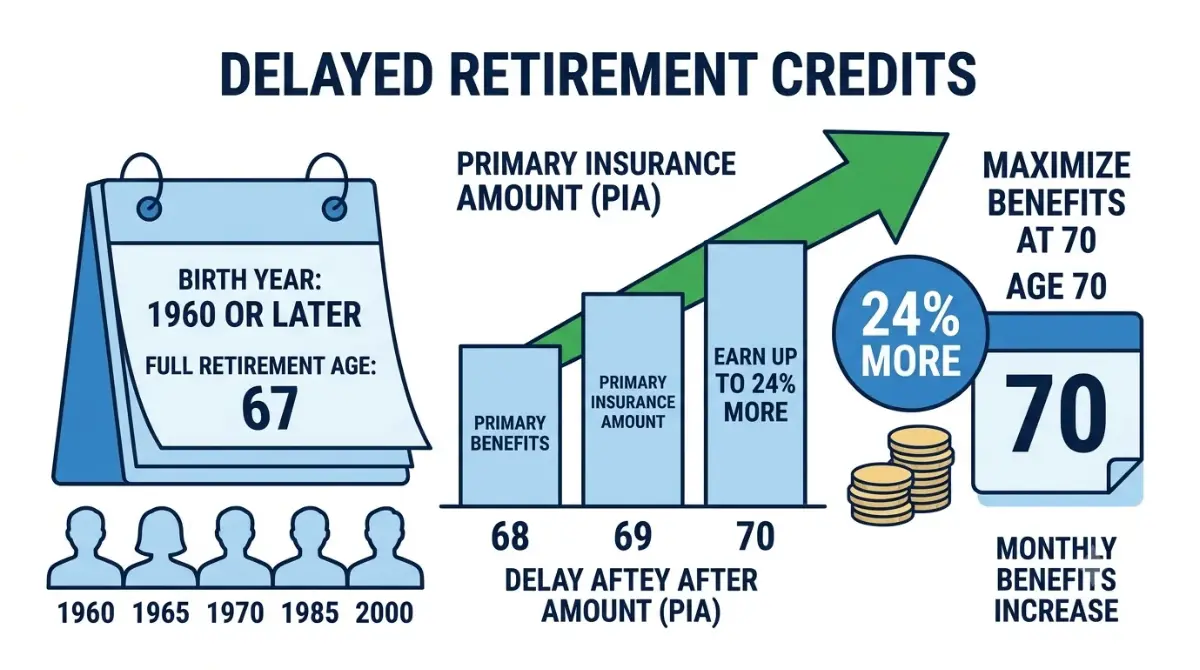
Delaying Social Security increases retirement benefits through delayed retirement credits calculated from your Primary Insurance Amount and monthly credit formula.
This illustration explains how delayed retirement credits are calculated from the Primary Insurance Amount and accumulate until age 70.

The rate and the window

Credits begin the month you reach your full retirement age and end when you reach 70. For anyone born in 1960 or later, full retirement age is 67, so the window holds 36 months. Thirty-six months at two-thirds of 1% is 24%, which is why age 70 pays 124% of your baseline.

That baseline is your primary insurance amount — the figure produced by how Social Security is calculated from your earnings record. Credits multiply that number. They do not change it.

Why your increase is rounded down twice

🔍 How It Works: The regulation sets out the arithmetic step by step. Social Security totals your credits, multiplies by the applicable percentage, applies that to your benefit amount, then rounds the result down to the next lower ten cents. The increase is added, any Medicare premium is deducted, and the final figure is rounded down again to the next lower dollar.

The agency’s own published example uses a worker with a $782.60 primary insurance amount and 12 credits at the older 11/24 of 1% rate. That produces 5.5%, or $43.04, which becomes $43.00 after the first rounding, for a monthly benefit of $825.60.

💡 Expert Note: Because both rounding steps run downward, nobody receives quite the full headline percentage. The gap is cents rather than dollars, but it is the reason a calculator estimate and your actual award notice rarely match to the penny.

The third year of waiting is worth less than the first

The 8% a year figure is calculated against your primary insurance amount, so each month adds the same fixed slice. Measured against the payment you would otherwise already be drawing, however, the three years are not equal.

If you start atYou receiveWhat that year of waiting addedKey detail
67 (full retirement age)100.0%The baseline
68108.0%+8.00%The only year the headline rate is exact
69116.0%+7.41%Same fixed credit, larger base
70124.0%+6.90%Credits stop the month you reach 70

Percentages as published by the Social Security Administration for people born in 1960 or later. The year-over-year comparisons in column three are our own arithmetic on those published figures, not agency projections.

The final year of waiting returns about 6.9%, roughly a seventh less than the first. That is still a strong return for deferring income, and it remains the reason waiting appeals to healthy people with other assets. It is simply not 8%.

Why 32% is no longer available to anyone

Older articles still offer a 32% increase for waiting until 70. That figure required a full retirement age of exactly 66, which applied to people born in 1954 or earlier — a group that passed 70 by 2024.

⚠️ Costly Mistake: Planning around a 32% delayed increase means budgeting for money that cannot arrive. Anyone born in 1960 or later tops out at exactly 24%, and the 1959 cohort at roughly 25.3%. If a retirement projection you have been shown uses 32%, ask which birth year it assumes before you rely on it.

Delaying does not cost you cost-of-living increases

Cost-of-living adjustments attach to your primary insurance amount from the year you reach 62, whether or not you have claimed. The regulations governing benefit computation state this directly: automatic increases effective in or after the year you reached 62 are applied to your amount. Waiting forfeits payments, not inflation protection.

You can model your own filing month against your actual record with our Social Security calculator, and compare the result against what retirees at each age actually receive.

Which benefits grow when you wait, and which don’t

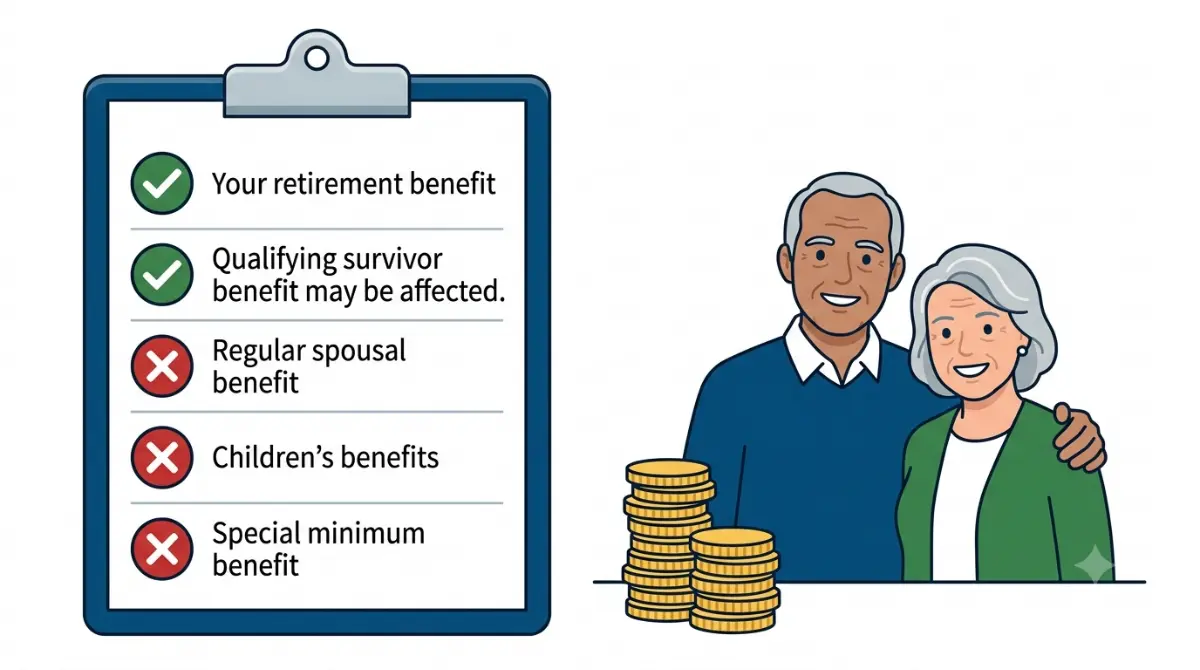
No. Delayed credits raise your own retirement benefit and the benefit your survivor may one day receive. They do not raise anything else paid on your record.

Benefit typeDo credits apply?Key detail
Your own retirement benefitYesTwo-thirds of 1% per month from full retirement age to 70
Survivor benefit on your recordYesIncludes credits earned in the year of death, counted up to but not including the month of death
Spousal benefit on your recordNoCapped at 50% of your primary insurance amount, which excludes credits
Children or other family membersNoCredits raise only the worker’s own benefit
A benefit based on the special minimumNoCredits attach only to a regular primary insurance amount

Source: 20 CFR 404.313(d) and (e).

Delaying Social Security increases retirement and survivor benefits but does not increase spousal, children's, or certain other Social Security benefits.
A comparison infographic showing which Social Security benefits receive delayed retirement credits and which benefits remain unchanged.

Your own benefit and your survivor’s

This asymmetry is the strongest argument for waiting in a household with one much higher earner. Credits earned by the higher earner flow into the survivor benefit, so delaying functions as insurance for whichever spouse lives longer. Credits are not forfeited if you die before filing — the regulation counts them up to the month of death.

There is also an ordering quirk worth knowing. Credits are added to your own benefit after the family maximum is applied, but to a surviving spouse’s benefit before the family maximum reduction.

The special minimum exception

A small group of long-service, low-wage workers receive benefits computed under the special minimum rather than the regular formula, explained in our guide to Social Security’s 35-year rule. Credits are not added to those benefits at all.

If you already claimed early

You can ask Social Security to suspend payments any time between full retirement age and 70 and earn credits for each suspended month. Suspension starts the month after you request it, and it carries a real cost: anyone else drawing on your record stops being paid for the same period, though a divorced spouse continues.

Action Step: If you are married and considering waiting, ask a fiduciary financial advisor one specific question before deciding — “Given both our earnings records, how much does my delaying raise the eventual survivor benefit, and does that justify funding the gap years from savings?” The answer turns on the difference between your two amounts, not on either one alone.

When your delayed credits actually reach your check

There are three rules governing when credits are applied, not one. Social Security’s public planner page states only the first, which is why so many people open their first payment and find it smaller than expected.

  1. Credits earned after you start benefits, before the year you turn 70 take effect the following January.
  2. Credits earned in the year you turn 70 take effect beginning with the month you reach 70 — not the January after.
  3. Credits earned before you file at all are included in your initial payment through the end of the year before you file, with any credits from the year you turn 70 added at 70.

The January rule everyone quotes

The agency’s own illustration: someone reaching full retirement age at 67 in June who files at 69 gets an initial amount reflecting credits through the end of the previous year. The remaining credits appear the following January.

The year you turn 70 is different

Rules two and three are the part almost no consumer guide carries. If your credits are earned in the calendar year you turn 70, they attach at your 70th birthday month rather than waiting for January.

💡 Expert Note: A first payment that looks short is usually this timing rule rather than an error. Before assuming a mistake, check whether the missing amount matches credits earned in the current calendar year — and confirm your earnings history is clean, because a wrong record permanently understates the base your credits multiply. Our guide to fixing a Social Security earnings record error covers that correction.

The six-month rule that reverses at 70

Social Security can pay retroactive benefits for up to six months, but never for any month before you reached full retirement age. That single rule works in opposite directions depending on which side of your 70th birthday you are standing on.

Delaying Social Security affects how the six-month retroactive filing rule works before and after reaching age 70.
This infographic explains how retroactive Social Security benefits work differently before and after age 70.

Before 70, the lump sum costs you 4%

Ask for six retroactive months while you are still earning credits and you are being paid for six months in which credits would otherwise have accrued. Six months at two-thirds of 1% is 4%, removed from your monthly amount permanently. The lump sum arrives once; the reduction stays for life.

After 70, the same six months are free

Once credits stop, retroactive months cost nothing, because no credit could have been earned in them. File at 70 and three months, and the backdating simply recovers what you were owed. File at 71, and six months are gone permanently.

⚠️ Costly Mistake: Suspended benefits restart automatically at 70. Benefits you never claimed do not. Someone who suspended at full retirement age is protected by that automatic restart, while someone who simply never filed is relying on their own memory — and loses a month of income for every month past the six-month window.

Pricing the loss on your own benefit

Published figures often attach this loss to the 2026 maximum of $5,181 a month, which almost nobody receives. Multiply your own expected amount by the number of months beyond the six-month window instead. The method is what matters; the maximum is a ceiling, not an estimate.

A large backdated payment lands in a single tax year, which can push more of your benefits into taxable territory. The IRS allows a special lump-sum election for benefits paid for an earlier year that may reduce the taxable amount.

Action Step: If you are past 70 and have not filed, contact Social Security this week and ask one question — “What is the earliest month I can claim, and does that capture the full six months of retroactive payment?” Also confirm your claiming-age estimates before you file.

What the waiting years cost you

Waiting is not free, and the honest cost of delaying goes beyond the missed payments themselves.

Delaying Social Security can increase future monthly benefits while also creating Medicare, tax, and cash flow considerations during the waiting years.
A visual comparison of the advantages and costs associated with delaying Social Security retirement benefits until age 70.

Medicare still starts at 65

Social Security tells anyone postponing retirement benefits to sign up for Medicare at 65 anyway. Because no benefit payment exists to deduct from, the Centers for Medicare & Medicaid Services bills you directly — the 2026 standard Part B premium is $202.90 a month, up $17.90 from 2025, rising with income to as much as $689.90.

Direct billing has a second consequence. The hold-harmless protection that caps Part B increases at the size of your cost-of-living adjustment applies only where premiums are deducted from a benefit payment.

📊 Data Point: The 2026 cost-of-living adjustment is 2.8%, comfortably larger than the $17.90 Part B increase — Source: Social Security Administration and CMS, 2026. Hold-harmless matters in years when the adjustment is small or zero, which was last the case at scale in 2016. For most people delaying in 2026 the exposure is real but minor.

When waiting is the wrong call

Waiting is a poor fit if your health or family history points to a shorter retirement, if funding the gap years would drain savings you cannot replace, if your benefit rests on a spouse’s record, or if it is computed under the special minimum. Bridging the gap from retirement accounts also has tax consequences that compound with required withdrawals later, and the interaction between delaying and Medicare enrollment can affect health savings account eligibility — a mechanism worth confirming against current rules rather than assumed. See retirement savings strategies by age and our guide to how an HSA compares with a 401(k).

Action Step: Before funding a gap year from an IRA, ask a CPA — “Does this withdrawal push me into a higher bracket or a higher Medicare income tier two years from now?” The IRS explains how benefits become taxable alongside other income.

Frequently asked questions

1. What is the maximum Social Security benefit at 70 in 2026?

Social Security publishes $5,181 a month for someone retiring at 70 in 2026. That figure assumes earnings at or above the taxable maximum across a full career, so it describes a ceiling rather than a typical outcome. Your own amount depends entirely on your earnings record and claiming month.

2. Do I lose cost-of-living increases if I delay claiming?

No. Cost-of-living adjustments are applied to your primary insurance amount from the year you reach 62, whether or not you have filed. When you eventually claim, every adjustment since then is already built into the amount your delayed credits multiply. Delaying forfeits payments, not inflation protection.

3. Does delaying Social Security to 70 increase my spouse’s benefit?

No. A spousal benefit is capped at 50% of your primary insurance amount, and delayed credits are excluded from that calculation. Delaying does raise the survivor benefit your spouse may later receive, which is a different payment with different rules. Discuss household timing with a fiduciary advisor.

4. What happens if I don’t file at 70?

Your benefit stops growing the month you reach 70, and Social Security does not begin paying automatically. Every month you wait beyond that is income you cannot recover, apart from the limited retroactive window. Delaying past 70 has no financial upside under current rules.

5. Can I get retroactive benefits if I file late?

Yes, for up to six months, and never for a month before you reached full retirement age. After 70 those months cost you nothing. Before 70, six retroactive months forfeit six months of credits and permanently reduce your payment by 4%. Confirm the effect before electing them.

6. When will my first check include all my delayed credits?

It depends on when the credits were earned. Credits from years before the year you turn 70 are applied the following January. Credits earned in the year you turn 70 are applied beginning with the month you reach 70. A first payment that looks short usually reflects this timing.

7. Do I still sign up for Medicare at 65 if I’m delaying?

Yes. Social Security advises enrolling in Medicare at 65 even when postponing retirement benefits, because late enrollment can raise your costs. With no benefit payment to deduct from, Medicare bills you directly at the 2026 standard Part B premium of $202.90 a month, more at higher incomes.

8. Can I still earn credits if I already claimed early?

Yes. Between full retirement age and 70 you can ask Social Security to suspend payments and earn credits for each suspended month. Suspension begins the month after your request, and anyone else drawing on your record stops being paid meanwhile, except a divorced spouse.

9. Does my surviving spouse get my delayed credits?

Yes. Benefits for a surviving spouse or surviving divorced spouse are computed using your primary insurance amount plus the credits you earned, including any earned in the year of your death. Credits are counted up to but not including the month of death, so waiting is not wasted if you die before filing.

10. Is a 32% increase still available for waiting until 70?

No. A 32% delayed increase required a full retirement age of 66, which applied to people born in 1954 or earlier, all of whom passed 70 by 2024. Anyone born in 1960 or later reaches exactly 24% at age 70.

11. Are delayed credits added to the special minimum benefit?

No. Credits attach only to a regular primary insurance amount, not to one computed under the special minimum provision. If the regular amount plus credits produces more, Social Security pays the higher figure. This affects a small group of long-service, lower-wage workers.

Choosing your month

Delaying to 70 is a real 24% increase for anyone born in 1960 or later, and it is the closest thing to inflation-protected longevity insurance most households will ever be offered. It is also three rules deep: the credit is rounded down twice, it reaches only two of the five benefit types paid on your record, and it lands on a calendar the public planner page does not fully describe.

Pick a filing month rather than a filing age. Confirm your earnings record first, because credits multiply whatever base that record produces — the mechanics of which are set out in our explanation of Social Security’s bend points. If you are already past 70, file inside the six-month window this month. And if you are funding the gap years from savings, model the drawdown with our retirement calculator before committing.

Editorial process

About this content

This content is prepared through a structured publishing workflow with dedicated writing, financial review and editorial checks.

1 contributor
Important notice

Informational disclaimer

The content on Finance Authority Hub is provided for general informational and educational purposes only and should not be considered personalized financial, investment, tax, legal, or professional advice. Financial decisions depend on your individual goals, income, risk tolerance, location, and regulatory situation. Before acting on any information, strategy, estimate, or calculator result, consult a qualified licensed professional who can evaluate your specific circumstances.