The Best Place to Roll Over a 401(k) Without a Tax Hit
The best place to roll over a 401(k) isn’t one broker — it’s the one matching your goal. Compare five on cost, support, and a 1% match.
In This Article
Where to roll over a 401(k) (and will it cost you anything)
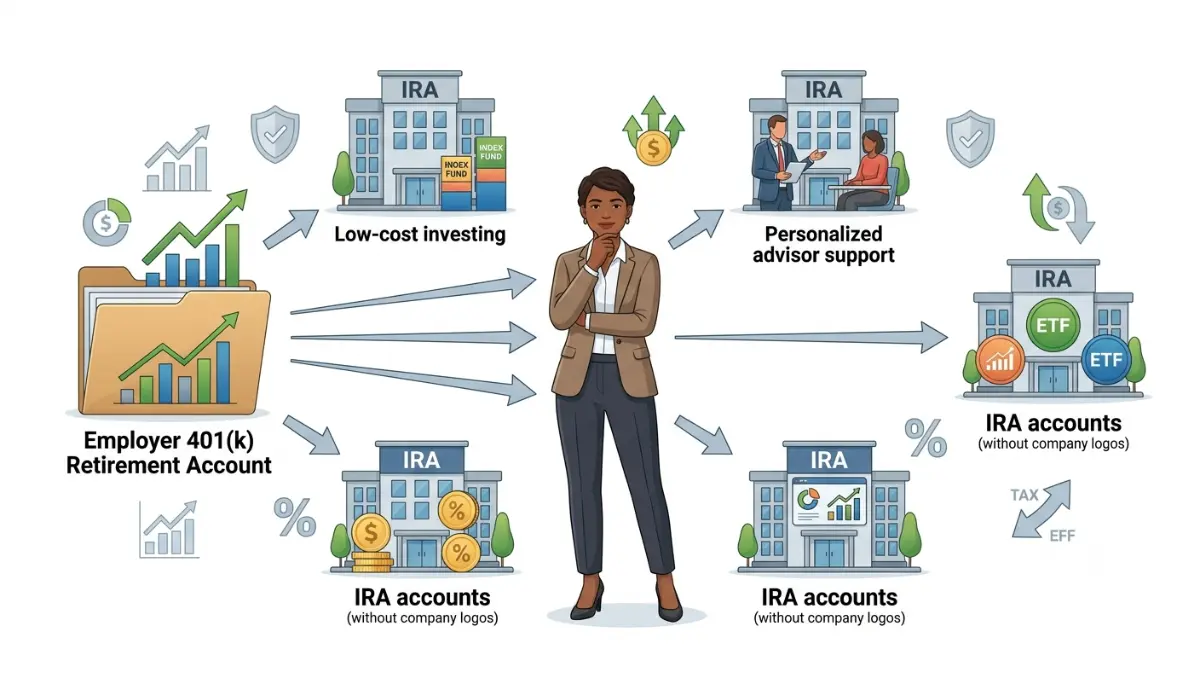
You left a job and have an old 401(k) sitting with a former employer — and you want to move it somewhere better without triggering a tax bill. Done correctly, a rollover to an IRA is free and not taxable, so the real question is where to send it.
This guide compares the five brokerages most people actually choose. Skip to what matters to you: if you want the lowest-cost index funds and maximum portability, Vanguard and Fidelity lead; if you want a person and a branch to walk you through it, Schwab stands out; if a cash match on your balance matters most, Robinhood and SoFi pay one. A rollover is one of four options after you leave a job — the others are leaving the money in the old plan, moving it to a new employer’s plan, or cashing out. See your options after leaving a job if you are still deciding.
Before you move anything, it helps to know what your balance could grow to over the next few decades.
ℹ️ Financial Disclaimer: This article is general education about retirement accounts and rollovers, not personalized investment or tax advice. Provider comparisons are informational and are not a recommendation to choose any specific brokerage. FinanceAuthorityHub is not a registered investment adviser, tax preparer, or law firm, and may earn affiliate compensation from some providers mentioned (disclosed at each placement). Before rolling over a 401(k) or choosing investments, consult a fiduciary financial adviser or a CPA about your specific situation.
Direct vs. indirect rollover: the choice that decides your taxes
A direct rollover and an indirect rollover reach the same destination, but only one avoids a tax headache. The difference is who touches the money.
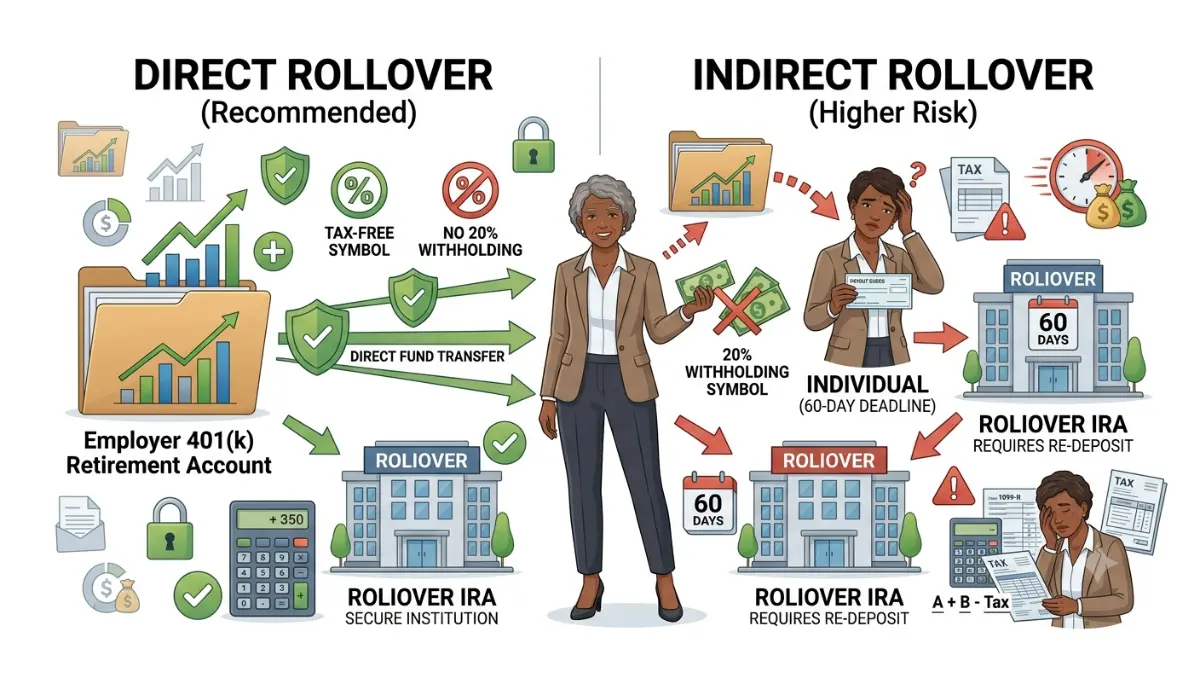
🔍 How It Works: “Direct” and “indirect” describe who receives the distribution. A direct rollover is paid to the receiving IRA, so no withholding applies and there is no deadline. An indirect rollover is paid to you first, which triggers withholding and a 60-day clock.
Direct rollover (trustee-to-trustee): no withholding
In a direct rollover, your old plan sends the funds straight to your new IRA custodian, with the check made payable to the custodian rather than to you. Because the money never passes through your hands, no mandatory withholding applies. This is the method the IRS rollover rules describe as avoiding withholding entirely.
Indirect rollover: the 20% trap and the 60-day clock
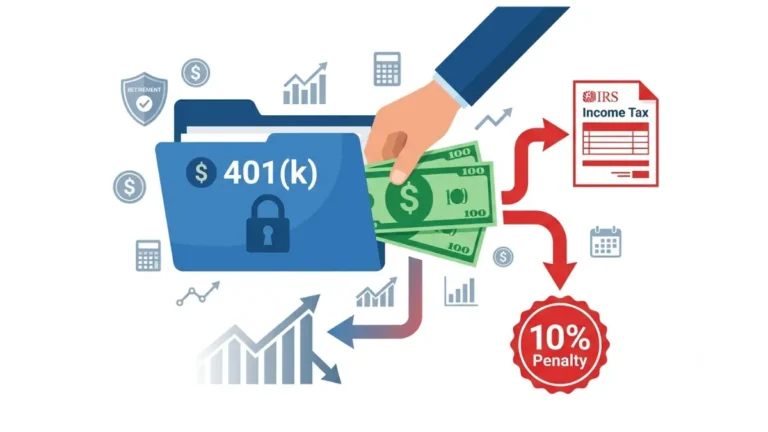
In an indirect rollover, the plan pays the distribution to you — and a 20% mandatory withholding is taken first, even if you intend to roll it over. You then have 60 days to deposit the full original amount into an IRA, replacing that withheld 20% from other cash, or the shortfall becomes taxable income (plus a 10% penalty if you are under 59½).
⚠️ Costly Mistake: Taking the check yourself and assuming the 80% you received is the whole rollover. To make it fully tax-free, you must redeposit 100% of the original amount within 60 days — the withheld 20% included — and reclaim that 20% later at tax time.
One point that trips people up: the once-per-12-months rollover limit applies only to IRA-to-IRA indirect rollovers, not to a 401(k)-to-IRA rollover. For the full walk-through, see how a 401(k) rollover to an IRA works.
The 5 best places to roll over a 401(k), compared
The five brokerages below are the ones most rollover savers realistically choose. All five cost $0 to open with no account maintenance fees, and all offer commission-free online stock and ETF trades — so the deciding factors are rollover support, investment costs, exit fees, and whether they pay a match.
| Brokerage | Account minimum | Standout for rollovers | Transfer-out fee | Best for |
|---|---|---|---|---|
| Fidelity | $0 | Rollover specialists; $1 fractional shares | $0 | An all-in-one hub |
| Charles Schwab | $0 | Rollover Consultants; 400+ branches | $50 (full only) | In-person help |
| Vanguard | $0* | Investor-owned, ultra-low-cost index funds | $100 (not ACH) | A low-cost index core |
| Robinhood | $0 | 1% match on rollovers, no cap | — | A cash match |
| SoFi | $0 | 1% match ($20k min) + advisor access | $100 | A match plus guidance |
Some Vanguard mutual funds require a $1,000–$3,000 minimum (its Admiral Shares total-market fund starts at $3,000). Robinhood’s transfer-out fee is not shown here; confirm it on Robinhood’s fee schedule. Sources: each provider’s current pricing/rollover page, verified July 2026.
Fidelity and Schwab: best all-round support
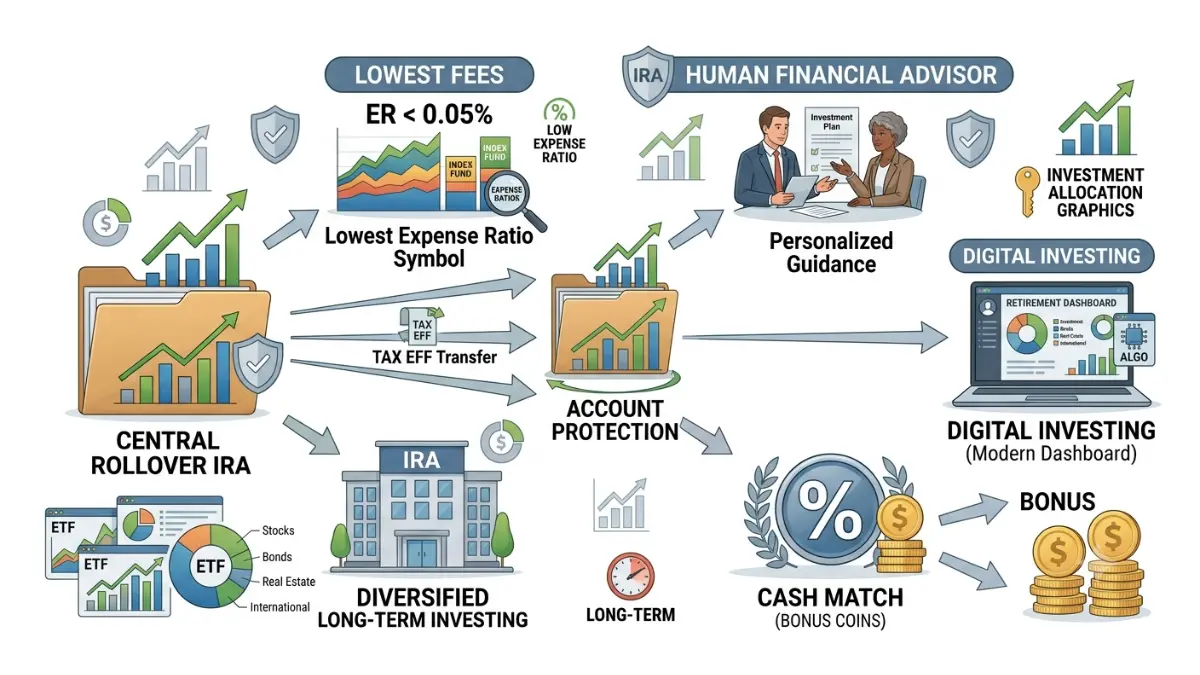
Both charge $0 to open and $0 commissions on online stock and ETF trades, and both offer live rollover help. Fidelity charges no account transfer-out fee and lets you buy fractional shares of any US stock or ETF from $1. Schwab runs a dedicated Rollover Consultant line and 400-plus branches if you prefer to sit across from a person; its $50 transfer-out fee applies only if you move the whole account out.
Vanguard: the lowest-cost index core
Vanguard’s flagship total-market ETF carries a 0.03% expense ratio, and because it is an ETF it transfers in kind to any brokerage without being sold. Its trade-off is a more self-directed rollover process and a $100 full transfer-out fee that does not apply to electronic bank transfers. If you have an old account to move first, here is how to track down an old 401(k).
Robinhood and SoFi: a match on your rollover
Robinhood adds a 1% match on old-401(k) rollovers, with no cap and no Gold subscription required; its higher 3% match applies to annual contributions with Gold ($5/month), not to rollovers. SoFi pays a 1% match on rollovers of $20,000 or more, processed through its partner Capitalize. Both require you to keep the funds in place for five years, or the match can be reclaimed. You can model how the balance could grow either way.
How to roll over a 401(k) in 3 steps
Rolling over a 401(k) takes three steps, and the second one is where the tax safety happens.
- Open your rollover IRA. Open a traditional IRA (a “rollover IRA”) at the brokerage you chose — all five above cost $0 to open. Match the account type to your money: pre-tax 401(k) dollars go to a traditional IRA to stay tax-deferred.
- Request a direct rollover from your old plan. Ask your former plan administrator for a direct rollover, with the check made payable to your new custodian “for the benefit of” you — for example, “Fidelity FBO [Your Name].” This wording keeps the money out of your hands and avoids the 20% withholding, per the IRS guidance on rollover withholding.
- Confirm the deposit and choose investments. The funds usually arrive as cash. Choosing what to buy is its own decision, not an automatic one — see how to choose your investments.
✅ Action Step: Before you call your plan administrator, write down two things — the exact payee wording, “[Custodian] FBO [Your Name],” and your new IRA account number — so the transfer is set up as a direct rollover on the first try.
💡 Expert Note: Which specific funds belong in your rollover is investment selection, and it depends on your age and risk tolerance. A fiduciary financial adviser can build an allocation for your timeline; a reasonable question to ask is, “Given my age and when I plan to retire, what mix of stock and bond index funds fits this rollover?”
How to choose the best place for your rollover
The best place is the one that fits your single biggest priority, and each choice trades off something.
If you want the lowest-cost, most portable index core
Choose Vanguard or Fidelity. Vanguard’s index ETFs are investor-owned and transfer in kind to any firm later. Fidelity matches the low cost and adds a smoother, more guided rollover — the trade-off is that its zero-fee house funds cannot leave Fidelity, which the next section explains.
If you want a human and a branch
Choose Schwab. Its dedicated Rollover Consultants and 400-plus branches suit anyone who wants to hand off the paperwork or ask questions face to face, and you give up nothing on cost to get that support.
If a signup match matters most
Choose Robinhood or SoFi, but treat the match as a bonus rather than the deciding factor. A 1% match is real money, yet it comes with a five-year holding requirement, and a match never outweighs a platform that otherwise fits you poorly. Use the retirement calculator to project your number to see how much the underlying balance matters versus a one-time match.
Rollover costs and the fine print that changes the answer
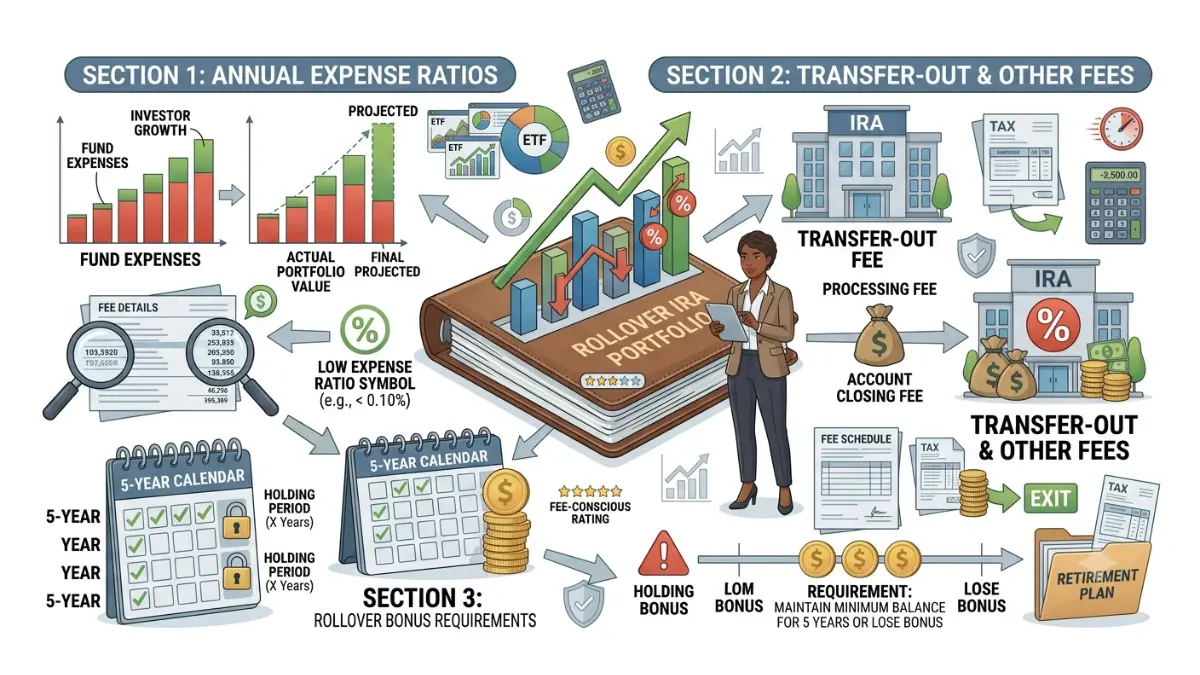
A direct rollover itself is free at all five brokerages, but three costs can still catch you: your fund’s expense ratio, an account transfer-out fee, and a match’s strings.
🔍 How It Works: A fund’s expense ratio is the annual percentage it charges on your invested balance. On $100,000, a 0.03% expense ratio costs about $30 a year, versus $0 on a true zero-fee fund — small, but it compounds over decades. See what a fee gap compounds to.
The ‘free’ fund that can’t leave
Fidelity’s zero-expense-ratio house funds are exclusive to Fidelity and cannot transfer in kind to another brokerage — to move them, you would have to sell first (not a taxable event inside an IRA, but a real friction). A total-market ETF like Vanguard’s or Schwab’s transfers in kind to any firm.
Transfer-out fees and match clawbacks
Exit fees differ: Fidelity charges $0, Schwab $50 (full transfers only), and Vanguard and SoFi each charge $100 — Vanguard’s does not apply to electronic bank transfers. The match offers also bind you: Robinhood and SoFi both require the funds to stay put for five years, or the match can be reclaimed.
One reassurance on safety: if a brokerage itself fails, SIPC protects up to $500,000 per account, including a $250,000 limit for cash — but SIPC does not cover money lost to market declines, as Investor.gov’s page on SIPC account protection explains.
5 rollover mistakes that cost real money
Most rollover losses come from a few avoidable mistakes — and the expensive ones are usually about taxes.
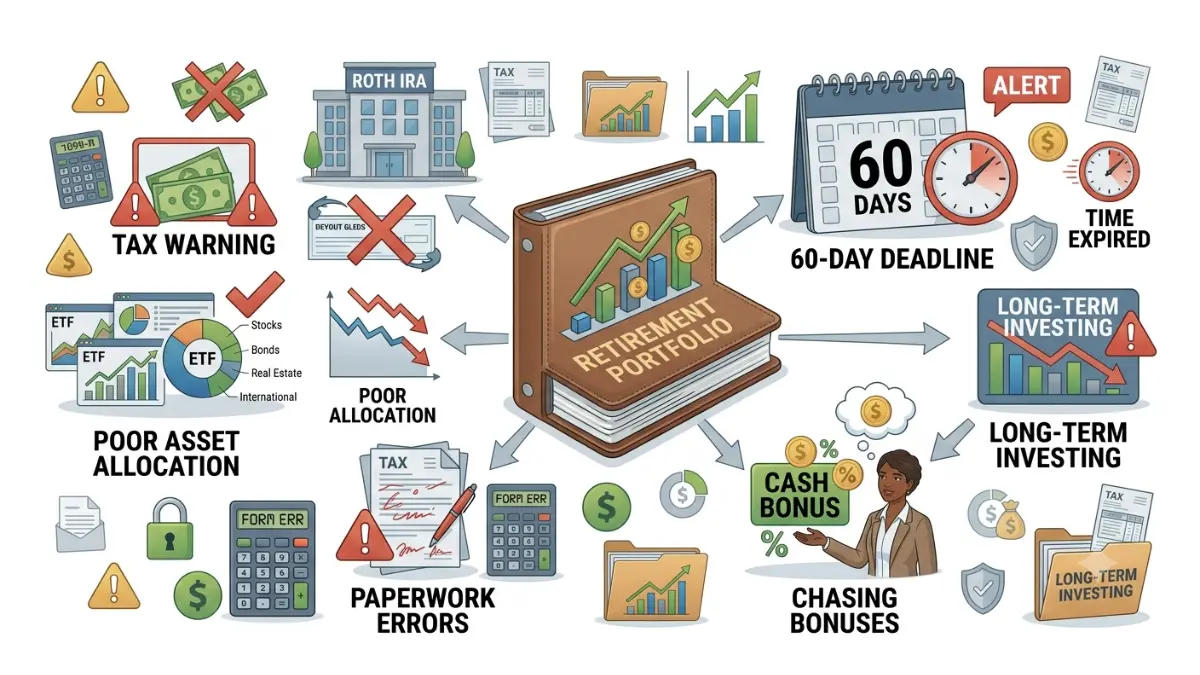
Rolling pre-tax money into a Roth by accident
Moving a traditional, pre-tax 401(k) into a Roth IRA is a Roth conversion — a taxable event in the year you do it. It can be a sound strategy, but only when you plan for the tax bill first. Roth vs. traditional explains which side your money is on, and the Roth IRA calculator compares growth between them.
Missing the 60-day window
If you took an indirect rollover and miss the 60-day deadline, the distribution becomes taxable income, plus a 10% penalty if you are under 59½. A direct rollover removes this risk.
Chasing a match into the wrong account
FINRA warns that “free” or “no-fee” rollover advertising can mislead, because there are almost always underlying account or investment costs. A 1% match is real, but it should not lock you into a poorly fitting platform for five years — FINRA’s rollover cautions list the factors worth weighing.
✅ Action Step: If any part of your rollover moves pre-tax money into a Roth, ask a CPA one specific question first: “How much ordinary income tax will this conversion add this year, and does the pro-rata rule apply to me?”
401(k) rollover FAQs
1. Where is the best place to roll over a 401(k)?
There is no single best place — it depends on your priority. For low-cost index funds and portability, Vanguard or Fidelity lead; for in-person help, Schwab; for a cash match, Robinhood or SoFi. All five cost $0 to open with commission-free stock and ETF trades.
2. Does rolling over a 401(k) cost money?
A direct rollover is free at all five brokerages compared here. The costs to watch are your fund’s expense ratio, an account transfer-out fee later ($0 at Fidelity, up to $100 at Vanguard or SoFi), and any five-year holding requirement attached to a match.
3. What’s the difference between a direct and indirect rollover?
In a direct rollover, your old plan sends the money straight to your new IRA, with no withholding and no deadline. In an indirect rollover, the plan pays you first, withholds 20%, and you must redeposit the full amount within 60 days to avoid taxes.
4. Can I roll a 401(k) into Fidelity, Schwab, or Vanguard?
Yes. Fidelity, Schwab, and Vanguard all accept 401(k) rollovers into a rollover IRA that costs $0 to open. Request a direct rollover so the funds move without the 20% withholding, and choose your investments once the money arrives as cash.
5. How long does a 401(k) rollover take?
A direct rollover typically takes about one to two weeks, depending on how quickly your old plan releases the funds. Some providers settle faster — Robinhood, for example, reports that transfers usually complete within five to seven business days after the request is received.
6. Will I owe taxes on a 401(k) rollover?
A direct rollover from a traditional 401(k) to a traditional IRA is not taxable. You would owe taxes only if you convert pre-tax money to a Roth IRA, or miss the 60-day window on an indirect rollover. Consult a CPA about a conversion’s tax impact.
7. Is there a limit on how much I can roll over?
No. Rollovers are not capped by the annual IRA contribution limit, which is $7,500 for 2026. You can roll over your entire 401(k) balance — whether it is $10,000 or $500,000 — in a single direct rollover without hitting any contribution ceiling.
8. Does Robinhood or SoFi really match a 401(k) rollover?
Yes. Robinhood adds a 1% match on old-401(k) rollovers, with no cap and no subscription required. SoFi pays a 1% match on rollovers of $20,000 or more. Both require you to keep the funds in place for five years, or the match can be reclaimed.
9. Can I keep my current investments when I roll over?
Sometimes. Exchange-traded funds usually transfer in kind between brokerages without being sold. But some funds cannot move — Fidelity’s zero-fee house funds, for instance, are exclusive to Fidelity — and 401(k) plans typically send cash rather than shares anyway.
10. What happens if I miss the 60-day deadline?
If you took an indirect rollover and do not redeposit the funds within 60 days, the distribution becomes taxable income for that year. If you are under age 59½, a 10% early-withdrawal penalty may also apply. A direct rollover avoids this deadline entirely.
11. Is a rollover better than leaving it in the old plan?
It depends on fees, investment choices, and whether you want your accounts consolidated. An IRA usually offers more investment options; some employer plans offer lower-cost institutional funds. Compare both on cost, and consult a fiduciary adviser about your specific situation.
Your next step
The best place to roll over your 401(k) is the one that matches your top priority: Vanguard or Fidelity for low-cost, portable index funds; Schwab for face-to-face help; Robinhood or SoFi if a cash match matters and you can leave the money untouched for five years. Whichever you pick, request a direct rollover so the transfer stays free and tax-free, and choose your investments deliberately once the cash arrives.
If you are rolling an old account into a new chapter of saving, it helps to know the 2026 401(k) contribution limits for the account you will keep funding — because a rollover moves your past savings, while your contribution rate builds what comes next.
Informational disclaimer
The content on Finance Authority Hub is provided for general informational and educational purposes only and should not be considered personalized financial, investment, tax, legal, or professional advice. Financial decisions depend on your individual goals, income, risk tolerance, location, and regulatory situation. Before acting on any information, strategy, estimate, or calculator result, consult a qualified licensed professional who can evaluate your specific circumstances.