The Average 401(k) Employer Match, and How to Get It All
The average 401(k) employer match is worth about 4-6% of pay, yet auto-enrollment often defaults workers below the level that earns the full amount.
In This Article
You’ve seen “employer match” on your pay stub, and you’re probably wondering two things: is mine normal, and am I getting all of it? This guide answers both, with current numbers and a calculation you can run on your own salary.
If you just enrolled, start with what a typical match looks like and how the formulas work. If you’ve been contributing for years, skip ahead to why roughly 1 in 5 workers quietly miss part of their match. If you’re weighing a job change, the vesting section shows what you keep — and what you’d forfeit — by leaving early.
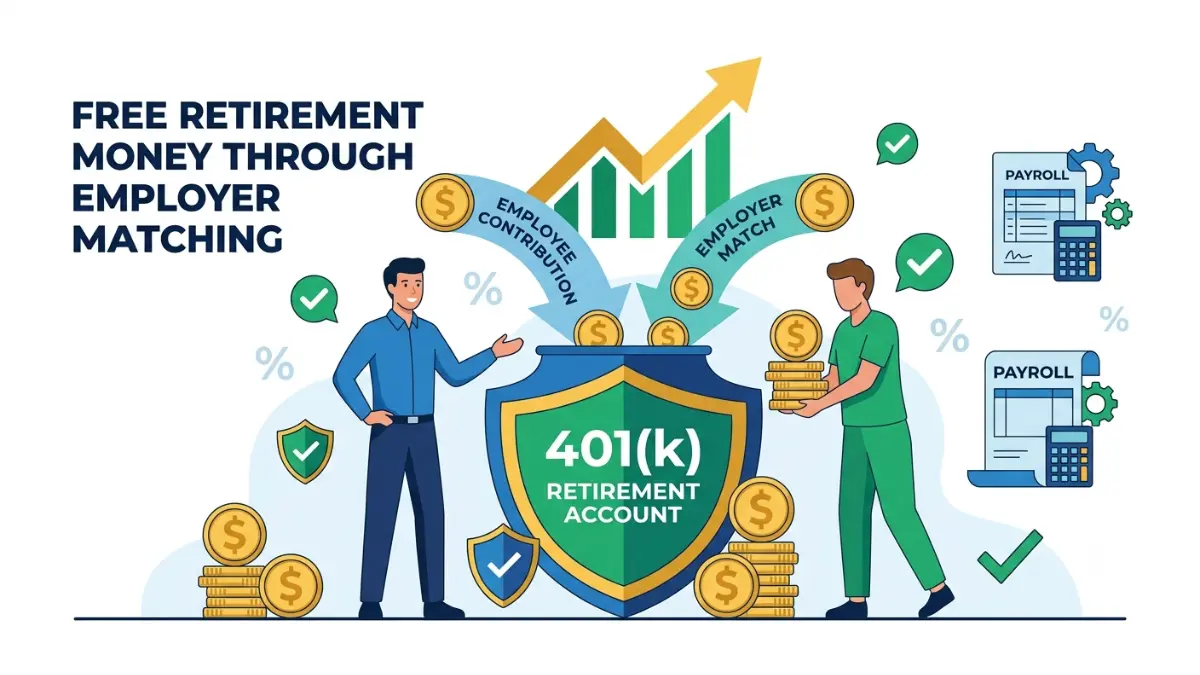
A 401(k) employer match is money your company adds to your retirement account when you contribute, and it’s one of the few genuinely free things in personal finance. The catch is that you only collect it if you contribute enough to earn it.
ℹ️ Financial Disclaimer: This article is for educational purposes only and is not personalized investment, tax, or retirement advice. 401(k) match formulas, vesting schedules, and contribution limits vary by employer and change over time. Before adjusting your contributions, changing jobs, or taking a withdrawal, consult a fiduciary financial advisor or a CPA, and confirm your plan’s specifics in your Summary Plan Description.
What is the average 401(k) employer match?
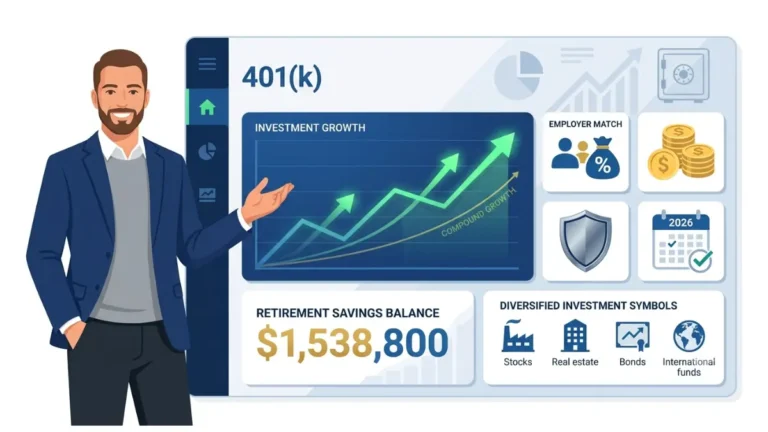
The typical average 401(k) employer match falls between about 4% and 6% of your pay, a range commonly cited across recordkeeper data. Fidelity’s 2025 analysis puts the average employer contribution rate at 4.8% — its highest level on record — while the average employee defers about 9.5%, for a combined savings rate near 14.3%. By the end of 2025, roughly 88% of Fidelity participants received a contribution from their employer.
One nuance matters here. That 4.8% figure is the average employer contribution, which includes non-matching dollars; the average match specifically is closer to 4% for employees who contribute at least 5%.
📊 Data Point: The average 401(k) employer contribution rate reached 4.8% in 2025 — the highest level on record — alongside a 9.5% average employee rate. Source: Fidelity Investments, 2025 Retirement Analysis.
What counts as a “good” match?
A dollar-for-dollar match up to 5% or 6% of pay is considered generous and is fairly common. Anything higher is unusually strong, while a 50-cents-on-the-dollar partial match is more typical.
The match is separate from your contribution limit
Your employer’s match does not count against the amount you can personally contribute. For 2026, the IRS lets employees defer up to $24,500, and the match sits on top of that — a point covered in depth in our guide to the 2026 401(k) contribution limits. Combined employer and employee contributions are capped at $72,000 for 2026, a ceiling most workers never approach.
How a 401(k) match actually works
Employers structure matches in one of two ways, and knowing which one you have tells you exactly how much to contribute.
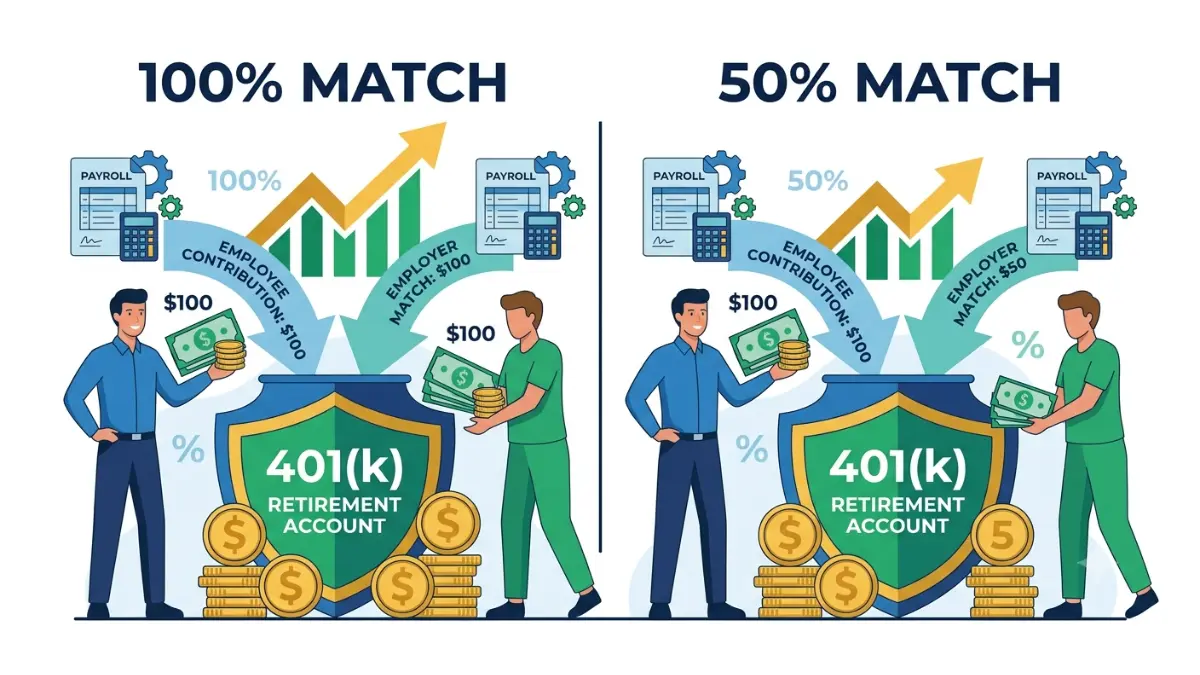
Full (dollar-for-dollar) vs. partial matches
A full match adds one dollar for every dollar you contribute, up to a cap. A partial match adds a fraction — most often 50 cents per dollar — up to a cap. Both stop once you pass the cap, so contributing beyond it earns no additional match.
The two most common formulas
On Fidelity’s platform, the most common formula is a dollar-for-dollar match on your first 3% plus 50 cents per dollar on the next 2% — so contributing 5% earns a 4% match, or 9% total. Among Vanguard plans, the most common is a single 50% match on contributions up to 6% of pay, so contributing 6% earns a 3% match. Vanguard reports that about 96% of its plans include some form of employer contribution.
| Match formula | You contribute | Employer adds | Key detail |
|---|---|---|---|
| Fidelity’s most common: 100% on first 3% + 50% on next 2% | 5% | 4% | Full match on the first slice, partial on the rest |
| Vanguard’s most common: 50% up to 6% of pay | 6% | 3% | Single-tier partial match; needs the full 6% to max out |
Source: Fidelity and Vanguard recordkeeper data, 2025.
🔍 How It Works: A “50% match up to 6%” means your employer matches half of what you put in, but only on the first 6% of your salary. Contribute 6% and they add 3% (half of 6%). Contribute less than 6%, and you leave part of that 3% unclaimed.
How much do you need to contribute to get the full match?
To capture your full match, you need to contribute at least up to your plan’s match cap. Here’s how to find your number:
- Find your plan’s match cap — the percentage your employer matches up to — in your Summary Plan Description or benefits portal.
- Multiply your gross salary by that cap percentage. That’s the annual contribution that earns every matched dollar.
- Divide by your number of pay periods to get the per-paycheck amount.
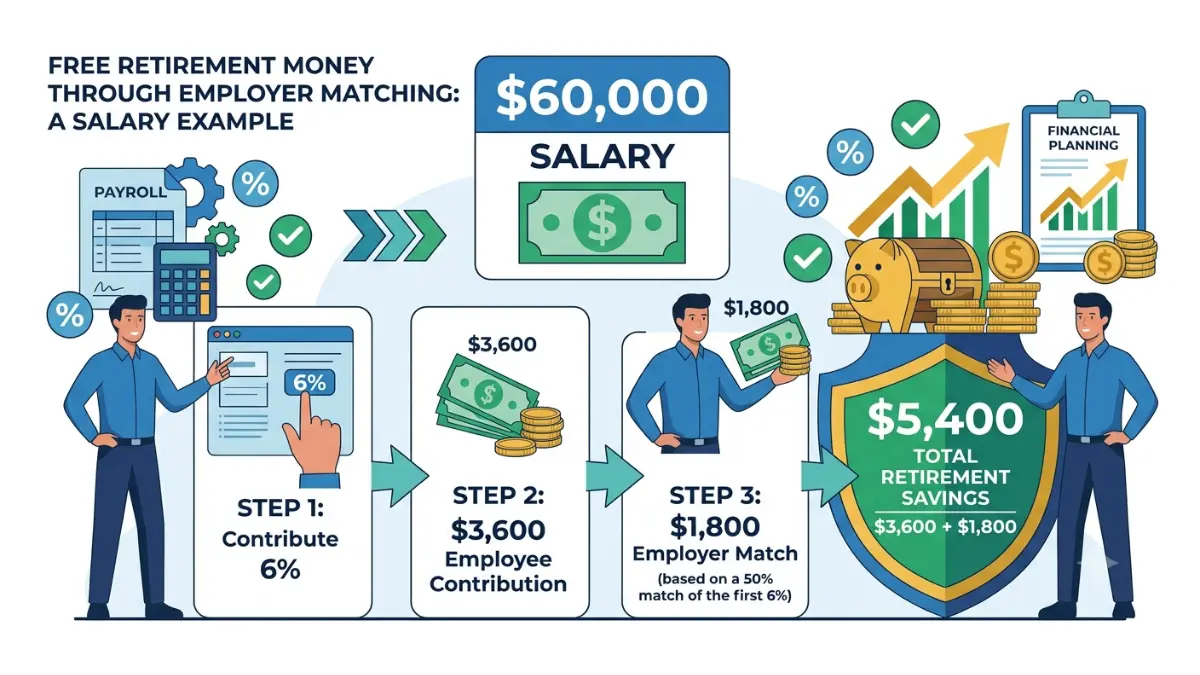
🔍 How It Works: The match cap is a percentage of your pay, not a dollar amount. Salary × match cap = the contribution that collects every matched dollar. Anything less leaves part of the match behind.
Worked example: a $60,000 salary
Say you earn $60,000 and your plan matches 50% up to 6% of pay. To max the match, you contribute 6% — $3,600 a year — and your employer adds 3%, or $1,800. Contribute only 3%, and you’d receive just $900 in match, leaving $900 on the table (these figures are illustrative, based on the stated formula).
⚠️ Costly Mistake: Contributing “something” isn’t the same as contributing enough. If your plan matches up to 6% and you defer only 3%, you forfeit half the match every year — often $900 or more that your employer would otherwise have paid you.
Your turn: find your match-cap percentage
Your figures will differ, but the method is identical. A 401(k) match calculator can model it in seconds if you’d rather not do the math by hand. Because a higher deferral lowers your paycheck, it also helps to see the trade-off first with a take-home pay calculator.
Does the match count toward my limit?
No — the match is separate from your $24,500 employee limit for 2026, so earning it never reduces how much you can personally contribute. It does count toward the combined $72,000 cap, but that ceiling rarely matters for typical earners, as our breakdown of how employer contributions count toward the limit explains.
✅ Action Step: Log into your 401(k) portal today, find your plan’s match cap, and multiply it by your salary. If your current deferral is below that number, raise it to at least the cap — the single highest-return move available to most savers.
When does the employer match actually become yours?
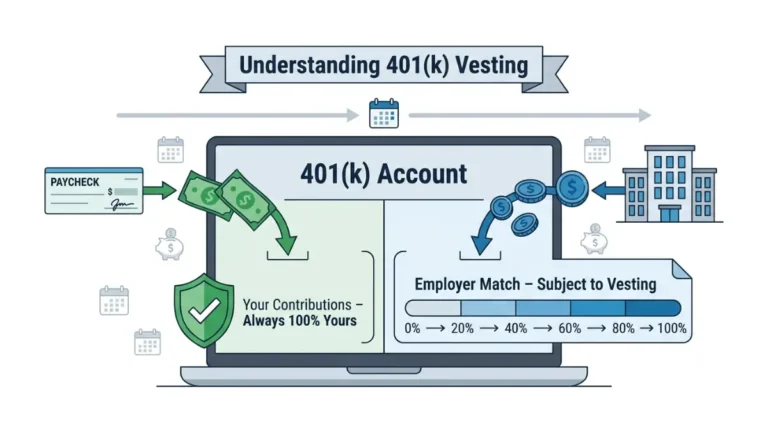
Vesting is the rule that decides how much of your employer’s contributions you keep if you leave. Your own contributions are always 100% yours from day one; the match may take time.
Cliff vs. graded vesting
Federal law caps how long an employer can make you wait. Under cliff vesting, you own none of the match until you hit a milestone — no more than three years — then you own all of it at once. Under graded vesting, ownership builds gradually to 100% over no more than six years, per the IRS rules on vesting employer contributions.
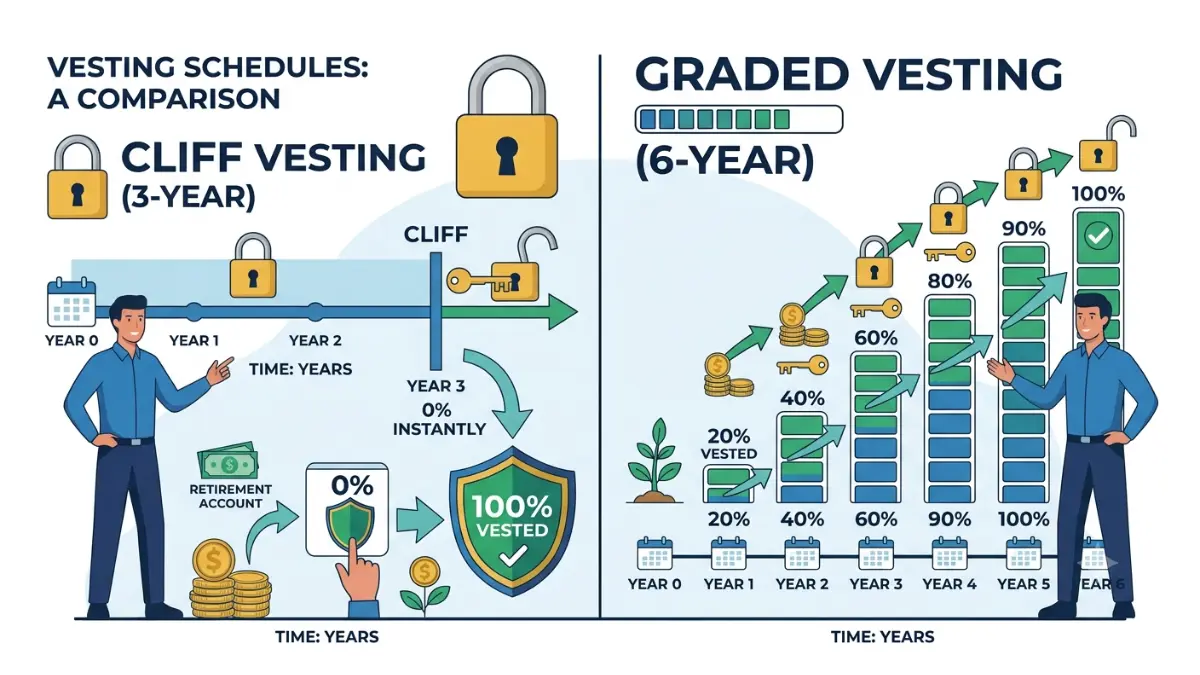
🔍 How It Works: On a six-year graded schedule, ownership rises 20% a year from year two onward. Leave after four years and you keep 60% of the employer match, forfeiting the other 40%. Your own contributions — and any growth on them — always leave with you in full.
What you forfeit if you leave early
Some plans vest immediately, and safe-harbor plans must. Others hold you to the full schedule, so timing a resignation around a vesting date can be worth thousands. Your Summary Plan Description spells out your exact schedule, and by law your plan must provide it on request.
✅ Action Step: Before accepting a new job, request your current plan’s Summary Plan Description and ask HR for a written statement of your vested percentage. For a large unvested balance, ask a fiduciary financial advisor whether delaying your start date to cross a vesting cliff is worth it.
Why most workers don’t capture their full match
Many workers default into a contribution rate that sits below their plan’s match cap — and never raise it. The result: roughly 1 in 5 don’t contribute enough to collect their entire match.
📊 Data Point: Fidelity reports that not all workers contribute enough to receive their entire employer match; industry analyses of Fidelity plan data put the share who capture the full match at about 78% — leaving roughly 1 in 5 short. Source: Fidelity Investments (2025).
The auto-enrollment trap
More than 6 in 10 plans now enroll workers automatically, often at a default rate of 4% or lower. If your match cap is 5% or 6%, that default quietly leaves part of the match unclaimed unless you raise your rate. The average worker defers about 7.6%, above many caps — but the median is lower, and defaults tend to anchor people where they start.
How much you could be leaving behind
On a $60,000 salary, the gap between a 3% default and a 6% match cap can mean giving up around $900 a year in employer money — before decades of compounding on it. You can see how quickly that adds up with a compound growth calculator, and our guide on how to avoid leaving 401(k) money on the table walks through the full picture. Access is rarely the barrier: about 70% of private-industry workers could join a defined-contribution plan in March 2025, but far fewer contribute enough to max the match.
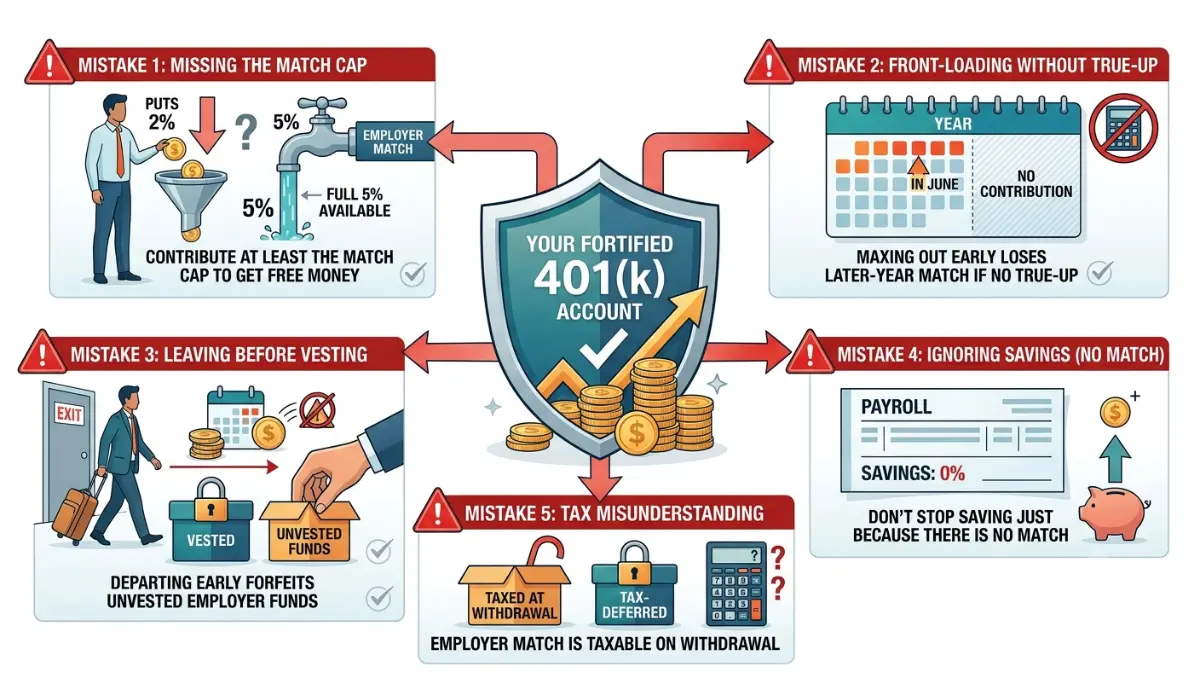
Five match mistakes that quietly cost you money
Beyond simply under-contributing, a few avoidable errors shrink the employer match you actually keep.
- Defaulting below the cap. Auto-enrollment rates are a starting point, not a target — raise yours to at least the match cap. If cash flow is what’s holding your rate down, a budgeting calculator can help you find room.
- Front-loading without a true-up. If you hit the annual limit early and your plan lacks a “true-up” feature, you can miss match on later paychecks. Check whether your plan trues up at year-end.
- Job-hopping through a vesting cliff. Leaving weeks before you vest can forfeit the entire match. Confirm your vested date before you resign.
- Ignoring a no-match plan. If your employer doesn’t match, the 15% total savings guideline still applies — you simply carry more of it yourself.
- Assuming the match is taxed now. A traditional match grows tax-deferred and is taxed at withdrawal; some plans now offer a Roth match under SECURE 2.0.
💡 Expert Note: A common point of confusion is treating the annual dollar limit and the match cap as the same thing. They’re independent — you can hit your plan’s match cap at a modest contribution rate while still sitting far below the $24,500 limit.
401(k) employer match: frequently asked questions
1. What is the average 401(k) employer match?
The average 401(k) employer match typically runs between about 4% and 6% of pay. Fidelity’s 2025 data shows an average employer contribution rate of 4.8%, with the match portion closer to 4% for employees contributing at least 5%. The exact figure depends on your plan’s formula, so confirm yours in your benefits portal.
2. What is a good 401(k) match?
A dollar-for-dollar match up to 5% or 6% of your salary is considered generous and reasonably common. A 50-cents-on-the-dollar partial match, often up to 6% of pay, is more typical. Any match is worth capturing in full — it’s an immediate, guaranteed return on the money you contribute.
3. How does a 401(k) match work?
Your employer contributes to your 401(k) based on how much you put in, up to a cap set as a percentage of your salary. A full match adds a dollar per dollar; a partial match adds a fraction, usually 50 cents. Two common formulas are 100% on your first 3% plus 50% on the next 2%, or 50% up to 6%.
4. What’s the difference between a full and partial match?
A full (dollar-for-dollar) match contributes $1 for every $1 you save, up to the cap. A partial match contributes less — most often 50 cents per dollar — up to the cap. A full match reaches its ceiling at a lower contribution rate, while a partial match requires you to contribute more to collect the maximum employer dollars.
5. How much do I need to contribute to get the full match?
Contribute at least up to your plan’s match cap: multiply your gross salary by that cap percentage to find the annual amount. On a $60,000 salary with a 6% cap, that’s $3,600 a year to collect the full match. Contributing below the cap leaves employer money unclaimed.
6. Does the employer match count toward my contribution limit?
No — the match doesn’t count against your $24,500 employee deferral limit for 2026, so earning it never limits your own contributions. It does count toward the combined $72,000 employee-and-employer cap for 2026, though most workers never come close. Consult a CPA if your total contributions approach that combined limit.
7. What is 401(k) vesting?
Vesting determines how much of your employer’s contributions you keep if you leave, and your own contributions are always 100% vested immediately. Federal rules cap the match schedule at a three-year cliff or a six-year graded schedule, though many employers vest faster. Check your Summary Plan Description for your exact schedule.
8. What happens to my match if I leave before I’m vested?
You forfeit any portion of the employer match that hasn’t vested; your own contributions and their growth always stay with you. On a graded schedule, you keep the vested percentage — for example, 60% after four years of a six-year schedule. Confirm your vested percentage with HR before resigning, especially for a large balance.
9. Why do so many workers miss part of their match?
Many are auto-enrolled at a default rate — often 4% or lower — that sits below their plan’s match cap, and never raise it. Because defaults tend to anchor behavior, roughly 1 in 5 workers don’t contribute enough to collect their full match. Raising your deferral to the cap fixes it immediately.
10. Can I save for retirement if my employer offers no match?
Yes — an IRA or, for the self-employed, a solo 401(k) lets you keep saving tax-advantaged, and a Roth IRA calculator can help you plan contributions. Our guide on whether to max your 401(k) or IRA first covers the order of priority. Consider asking a fiduciary advisor which account fits your situation.
11. Is the employer match taxed?
A traditional employer match grows tax-deferred and is taxed as ordinary income when you withdraw it in retirement. Under SECURE 2.0, some plans now let you receive the match as Roth, which is taxed the year it’s contributed but grows tax-free afterward. A CPA can help you weigh the trade-off for your tax bracket.
Your next step: check your deferral today
The employer match is rare in personal finance — a guaranteed, immediate return you only forfeit by not showing up for it. If you remember one thing, make it this: contribute at least up to your plan’s match cap, then aim higher toward the 15% guideline as your budget allows, as our guide on how much to contribute to your 401(k) explains.
Log into your plan portal, confirm your match cap, and raise your rate if you’re below it. A retirement savings calculator can show what that change compounds to over time. If your employer offers no match, an IRA or solo 401(k) keeps you on track — and for a large balance or a pending job change, ask a fiduciary advisor whether your timing and contribution rate are optimal before you act.
Informational disclaimer
The content on Finance Authority Hub is provided for general informational and educational purposes only and should not be considered personalized financial, investment, tax, legal, or professional advice. Financial decisions depend on your individual goals, income, risk tolerance, location, and regulatory situation. Before acting on any information, strategy, estimate, or calculator result, consult a qualified licensed professional who can evaluate your specific circumstances.