What a MYGA Is and How It Compares to a Bank CD
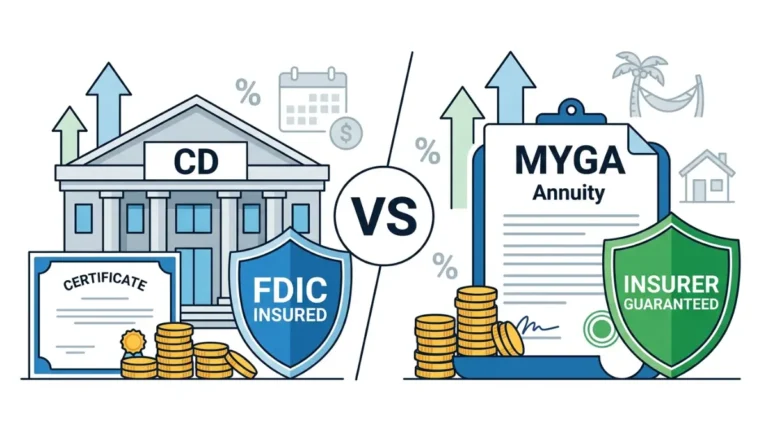
A MYGA works like a CD from an insurer—fixed rate, tax-deferred growth—but it isn’t FDIC-insured. Here’s how the two really compare.

In This Article
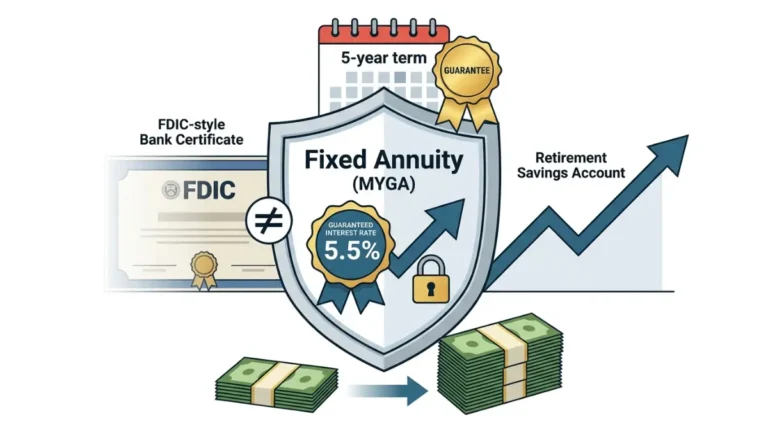
A multi-year guaranteed annuity (MYGA) is a fixed annuity that locks in a guaranteed interest rate for a set term — usually three to ten years — and lets your money grow tax-deferred until you withdraw it. It’s often called the insurance industry’s version of a bank CD, and the comparison is fair: you hand over a lump sum, you get a fixed rate for a fixed period, and your principal is protected.
But a MYGA is an insurance contract, not a bank deposit — and that one difference changes how it’s taxed, how it’s backed, and how easily you can get your money out. Those differences are exactly what this guide is about.
If you have a lump sum sitting in a maturing CD or a savings account and you’re wondering whether a MYGA is just a higher-paying version of the same thing, you’re asking the right question. We’ll cover how MYGAs work, what they pay right now, how they really stack up against a CD, the tax and liquidity rules that trip people up, and who should — and shouldn’t — consider one. For the bigger picture, start with what an annuity is and how it works.
Disclaimer: This article is for general educational purposes only and is not investment, tax, or insurance advice. Annuities are insurance products; suitability, tax treatment, and guaranty coverage depend on your individual situation, your state, and the specific contract. Consult a licensed fiduciary advisor and a CPA or tax professional before buying or withdrawing from any annuity. FinanceAuthorityHub may earn advertising revenue from ads on this page; that never affects our analysis.
How a MYGA works, step by step
A MYGA has two simple phases. During the accumulation phase, you make a single lump-sum deposit — often around $10,000 at minimum, though it varies by carrier — and the insurance company credits a guaranteed rate of interest every year for the length of the term. If you lock in 5% for five years, you earn 5% each year, no matter what happens to interest rates or markets. Your interest compounds, and it grows tax-deferred: you don’t owe income tax on the growth until you take money out.
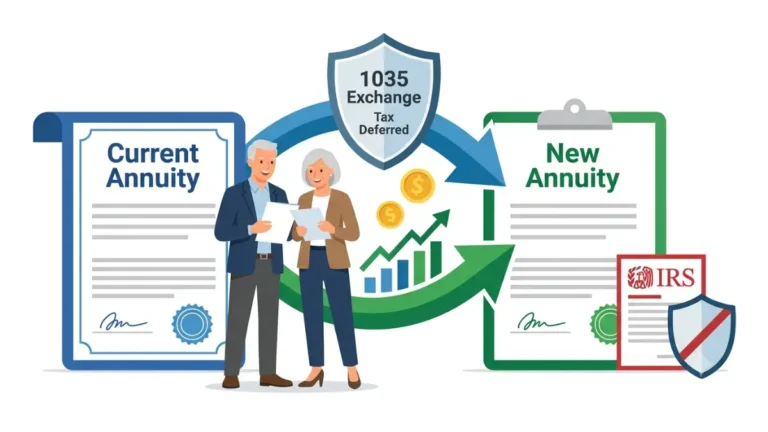
When the term ends, you typically have four choices: take the full balance as a lump sum, roll it into a new MYGA, exchange it tax-free into another annuity, or convert it into a stream of income payments.

That’s the whole product. It’s one of the simplest annuities you can buy — far less complex than a variable or indexed annuity. For a closer look at the mechanics, see a deeper walkthrough of how MYGAs work, and to understand where it sits among the main types of annuities, the fixed family is the conservative end of the spectrum. MYGAs are regulated by state insurance departments rather than the SEC, but the SEC’s neutral overview of how annuities are structured is a useful primer.
What MYGAs pay right now (and what $100,000 could earn)
MYGA rates move with the broader interest-rate environment, tracking Treasury yields and the Federal Reserve’s policy rate (the Fed’s target range was 3.50%–3.75% as of mid-2026). As of mid-2026, top three-year MYGA rates were running roughly 5.10%–5.55% and top five-year rates roughly 5.00%–5.85%, depending on the carrier and the size of the deposit. Seven- and ten-year rates vary more widely. These rates reprice frequently — sometimes daily — so always confirm the current rate before you commit.
Here’s what the math looks like. Put $100,000 into a five-year MYGA at 5.5%, compounded annually, and you’d have about $130,700 at the end of the term — roughly $30,700 in interest, all of it growing tax-deferred until you withdraw it. Because nothing is skimmed off for taxes along the way, the full balance keeps compounding each year.
Want to run your own numbers? Plug your deposit, rate, and term into a compound interest calculator to see how the balance grows over the term.
MYGA vs CD: the differences that actually matter
On the surface, a MYGA and a bank CD look almost identical. The differences underneath are what matter.
| MYGA | Bank CD | |
|---|---|---|
| Issued by | Insurance company | Bank or credit union |
| Rate | Guaranteed, fixed for the full term | Guaranteed, fixed for the term |
| Backing | State guaranty association (varies by state) | FDIC, up to $250,000 |
| Tax on interest | Tax-deferred until withdrawn | Taxed every year as ordinary income |
| Getting out early | Surrender charge + possible market value adjustment + 10% IRS penalty on gains before 59½ | Early-withdrawal penalty (often a few months’ interest) |
| Typical minimum | Often ~$10,000 | Often $500–$1,000 |
Two differences stand out. First, taxes: CD interest is taxed every year, even if you never touch it, while a MYGA’s growth is tax-deferred until you withdraw — which lets the full balance keep compounding. Second, backing: a CD is FDIC-insured up to $250,000 per depositor, per bank, per ownership category. A MYGA is not.

Are MYGAs FDIC-insured? No. MYGAs are backed instead by state guaranty associations, which cover at least $250,000 in present value of annuity benefits in most states — though limits vary by state, roughly from $100,000 to $500,000, and they apply per owner, per insurer. That’s a real safety net, but it’s not the same as FDIC insurance — and “not FDIC-insured” is not the same as “unsafe.” You can check what the same money would earn in a CD to weigh the trade-off, and the FDIC’s deposit-insurance rules spell out exactly what a CD covers.
Taxes, surrender charges, and the age-59½ rule
This is where MYGAs get more complicated than CDs, and where mistakes get expensive — so treat the following as general education and talk to a CPA about your own situation.
When you withdraw money from a MYGA, the growth is taxed as ordinary income (not the lower capital-gains rate). On a non-qualified annuity — one bought with after-tax money — the IRS treats withdrawals as interest-first, so early withdrawals are generally fully taxable. And if you take money out before age 59½, the IRS generally adds a 10% penalty on top of the income tax on the gains, unless an exception applies. You can estimate the tax on a withdrawal yourself, but the rules are detailed — the IRS’s rules on pension and annuity income lay them out in full.

On top of taxes, MYGAs carry surrender charges if you cash out during the term. The charge usually starts high and declines each year, and most contracts let you withdraw a limited amount — commonly up to 10% — each year penalty-free. Some also apply a market value adjustment (MVA), which can raise or lower your surrender value depending on how interest rates have moved. The takeaway: a MYGA is for money you won’t need until the term ends. Before buying or withdrawing, talk to a fiduciary advisor and a tax professional about your specific numbers.
Is a MYGA right for you?
A MYGA tends to fit people who want a guaranteed, predictable return with zero market risk, and who won’t need the money before the term ends. That often means conservative savers and people near retirement — especially anyone disappointed by falling CD renewal rates who wants to lock in a higher rate for several years. It can also be a place for cash that sits beyond what a single bank’s FDIC coverage protects.
Think twice if any of these apply: you might need the funds before the term is up; you’re under 59½ and using after-tax money (the penalty exposure is real); or you want the growth and inflation protection that a fixed rate can’t provide. In those cases, a Roth IRA for tax-free growth, or simply staying liquid, may serve you better. And if your goal is guaranteed lifetime income rather than accumulation, an immediate income annuity is a different tool worth comparing.
One strategy worth knowing is laddering — splitting your money across MYGAs with different terms, and across more than one highly rated carrier. That balances rate and access, and helps you stay within state guaranty limits. To see how a MYGA fits the rest of your plan, run the numbers through a retirement calculator, and talk to a fee-only fiduciary advisor about whether it suits your timeline.

The biggest MYGA mistakes to avoid
The most common myth is that a MYGA is completely risk-free. It isn’t — but the real risks are manageable once you know them.
The first is the carrier itself. Because a MYGA is backed by the insurance company (with your state’s guaranty association as a backstop), the company’s financial strength matters. Check its rating from an agency like AM Best, and keep your deposit within your state’s guaranty limit — splitting larger amounts across carriers if needed. Chasing the very highest rate from a weak carrier is a classic mistake.
The second risk is self-inflicted: pulling money out early. Between surrender charges, a possible negative market value adjustment, and the 10% pre-59½ tax penalty, an early exit can hand you back less than you put in.
There’s also inflation. Locking a fixed rate for ten years feels safe, but inflation can quietly erode what that money buys over a long term. FINRA’s neutral overview of annuities and their fees and risks is worth reading before you sign.
Can you lose money in a MYGA? Within your state’s guaranty limit and held to term, your principal is protected — the losses come from early exits and from holding more with one insurer than the guaranty covers.
MYGA FAQs
1. What is a MYGA?
A MYGA, or multi-year guaranteed annuity, is a fixed annuity that locks in a guaranteed interest rate for a set term — typically three to ten years — and grows tax-deferred until you withdraw the money. It works much like a bank CD issued by an insurance company, with principal protection and a predictable, contractually guaranteed return.
2. What are current MYGA rates?
As of mid-2026, top three-year MYGA rates ran roughly 5.10%–5.55% and five-year rates roughly 5.00%–5.85%, depending on the carrier and deposit size. Rates track Treasury yields and reprice frequently — sometimes daily — so confirm the current rate with a provider before you commit. Longer seven- and ten-year terms vary more widely.
3. Is a MYGA better than a CD?
Neither is universally better. A MYGA often pays a higher rate and grows tax-deferred, while a CD is FDIC-insured and simpler to access. The right choice depends on your tax situation, how soon you’ll need the money, and how much safety margin you want. Consult a financial advisor about your specifics before deciding.
4. Are MYGAs FDIC-insured?
No. MYGAs are insurance products, not bank deposits, so they aren’t covered by the FDIC. They’re backed instead by state guaranty associations, which protect at least $250,000 in present value of annuity benefits in most states, per owner per insurer — though limits vary by state, roughly from $100,000 to $500,000.
5. How are MYGAs taxed?
A MYGA’s growth is tax-deferred and taxed as ordinary income when you withdraw it — not at capital-gains rates. On after-tax (non-qualified) contracts, the IRS treats withdrawals as interest-first, so early withdrawals are generally fully taxable. The rules have several exceptions, so talk to a CPA about your situation.
6. What’s the penalty for withdrawing from a MYGA early?
Three costs can apply: a surrender charge set by the contract, a possible market value adjustment, and a 10% IRS penalty on the gains if you’re under 59½ (unless an exception applies). Together, these can return less than you deposited. Consult a tax professional before taking an early withdrawal.
7. What is a market value adjustment (MVA)?
An MVA is an adjustment to your surrender value if you withdraw more than the penalty-free amount during the term. It moves with interest rates: if rates have risen since you bought in, the MVA typically reduces your value; if rates have fallen, it can increase it. It applies only to withdrawals during the surrender period.
8. What happens when my MYGA term ends?
You generally have four options: take the full balance as a lump sum, renew into a new MYGA, exchange it tax-free into another annuity, or convert it into a stream of income payments. Many contracts renew automatically if you don’t act before the deadline, so mark your maturity date and decide early.
9. Who should buy a MYGA?
MYGAs suit conservative savers who want a guaranteed multi-year return with no market risk and won’t need the money before the term ends — often people near retirement. Think twice if you may need liquidity, are under 59½ with after-tax money, or want inflation protection. Consult a fiduciary advisor about your goals.
10. Can you lose money in a MYGA?
Held to term and within your state’s guaranty limit, your principal is protected. The real risks are withdrawing early — where surrender charges, a negative MVA, and the 10% penalty can cost you — and holding more with one insurer than the guaranty limit covers. Consult an advisor about your coverage.
11. What’s the minimum to buy a MYGA?
Minimums vary by carrier, but many MYGAs start around $10,000. Some require more, and a few accept less. The deposit is a single lump-sum payment, not ongoing contributions, so plan to fund the contract in one transfer rather than over time.
The bottom line on MYGAs
A MYGA can be a smart, low-stress home for cash you won’t touch for several years — often paying more than a CD and letting your money grow tax-deferred. The catch is exactly what makes it different from a CD: it’s an insurance contract, so it’s backed by a state guaranty system rather than the FDIC, the growth is taxed as ordinary income when you withdraw, and getting out early can be costly. If those trade-offs fit your timeline, check the carrier’s financial strength, stay within your state’s guaranty limit, and talk to a fiduciary advisor before you buy.
Informational disclaimer
The content on Finance Authority Hub is provided for general informational and educational purposes only and should not be considered personalized financial, investment, tax, legal, or professional advice. Financial decisions depend on your individual goals, income, risk tolerance, location, and regulatory situation. Before acting on any information, strategy, estimate, or calculator result, consult a qualified licensed professional who can evaluate your specific circumstances.