
Hire Purchase: 0% Down → Own in 36 Months (2026)
Want a $25K car with only $500 down? Hire purchase agreements let you own it in 36 months for $717/month. We compare HP vs personal loans, reveal 2026 rates, and expose hidden fees.

In This Article
Want that $25,000 car but only have $500 in savings? A hire purchase agreement lets you drive it today while paying monthly installments—and own it outright in 36 months. Unlike leasing where you never own the vehicle, hire purchase (HP) guarantees ownership once your final payment clears.
In April 2026, the average hire purchase interest rate sits at 8.9% APR for borrowers with good credit (scores above 670). That same $25K vehicle costs you approximately $28,200 total over three years—$3,200 in interest. Compare that to a personal loan at 11.2% APR ($29,400 total), and HP suddenly looks competitive for consumers seeking guaranteed ownership.
But is hire purchase actually your best financing option? Let’s break down the math with surgical precision.
What Is Hire Purchase? (The 60-Second Answer)
Hire purchase is an installment payment agreement where you pay a deposit (typically 10-20%), make fixed monthly payments over 12-60 months, and gain full ownership after the final payment. You possess the item during the payment period, but the lender technically owns it until completion.
Think of it as a payment plan with an ownership guarantee—fundamentally different from debt consolidation strategies that restructure existing obligations.
HP at-a-glance for 2026:
| Feature | Details |
|---|---|
| Typical Deposit | 10-20% of purchase price |
| Interest Rates | 6.9%-12.9% APR (credit-dependent) |
| Ownership | Transfers after final payment |
| Common Uses | Vehicles (77%), furniture (12%), equipment (11%) |
| Average Term | 36-48 months |
| Repossession Risk | Yes, if payments missed |
Here’s the truth most lenders won’t advertise upfront: hire purchase agreements cost more than paying cash, but less than many personal loans for consumers with average credit scores.
How Hire Purchase Works (Step-by-step)
How Does Hire Purchase Work? (The Complete 5-Step Process)
Understanding the hire purchase process prevents costly mistakes that trap 23% of borrowers in unfavorable terms, according to Consumer Financial Protection Bureau data.
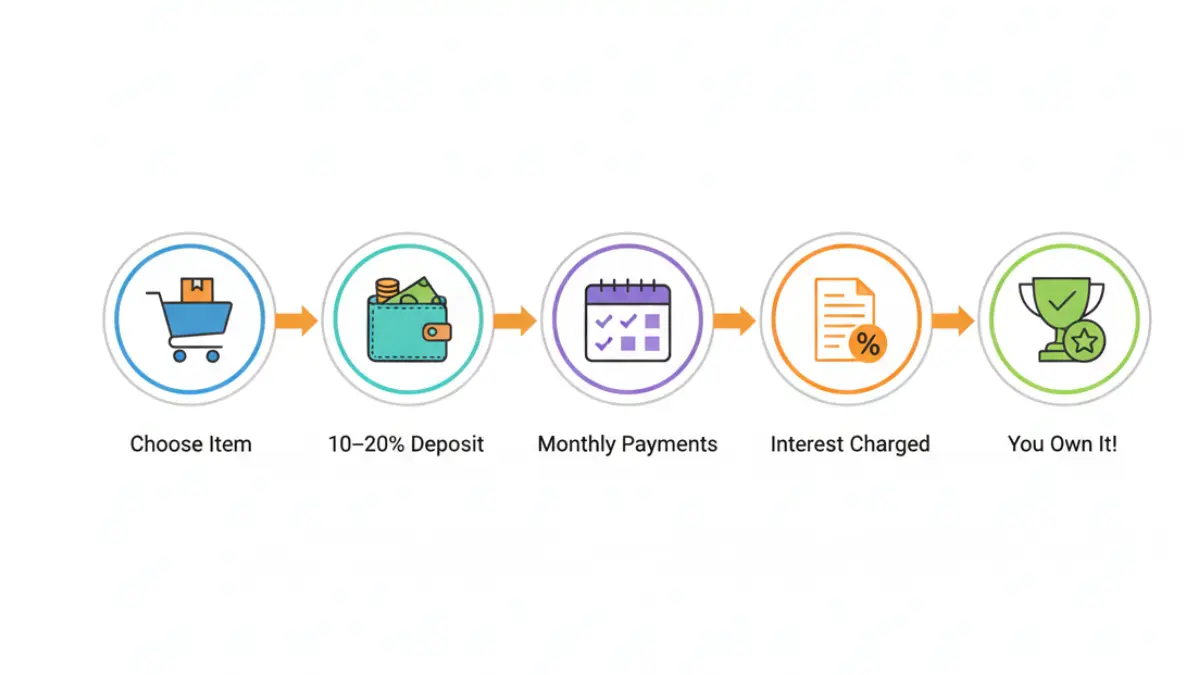
Step 1: Choose Your Item (Car, Furniture, Equipment)
Hire purchase works for any depreciating asset—vehicles dominate at 77% of all HP agreements. You select the item, negotiate the price with the dealer or retailer, then discuss financing options. Pro tip: negotiate the cash price BEFORE mentioning financing to avoid inflated sticker prices.
Step 2: Deposit Payment (Typically 10-20%)
Most HP agreements require 10-20% down. Larger deposits reduce monthly payments and often secure better interest rates. On a $25,000 car, a $5,000 deposit (20%) versus $2,500 (10%) saves approximately $37 monthly and $1,332 in total interest over 36 months.
Step 3: Monthly Payments (Fixed Terms: 12-60 Months)
You make identical monthly payments covering principal plus interest. Unlike credit cards with variable rates, hire purchase offers predictable budgeting—similar to how our mortgage calculator demonstrates fixed housing costs. Payment terms typically span 24-48 months for vehicles, though 60-month agreements exist for higher-priced items.
Step 4: Interest & Charges Explained
HP interest compounds using the simple interest method, not compound interest (which would cost significantly more). Your effective APR depends on credit score, deposit size, and loan term. Hidden fees include arrangement charges ($150-$400), documentation fees ($50-$150), and potential early settlement penalties.
Step 5: Final Payment & Ownership Transfer
After your last payment, ownership legally transfers to you with no balloon payment required (unlike PCP financing). The lender provides a certificate of ownership, and you’re free to sell, modify, or keep the item without restrictions.
Real Example: $25,000 Car Purchase Breakdown (2026)
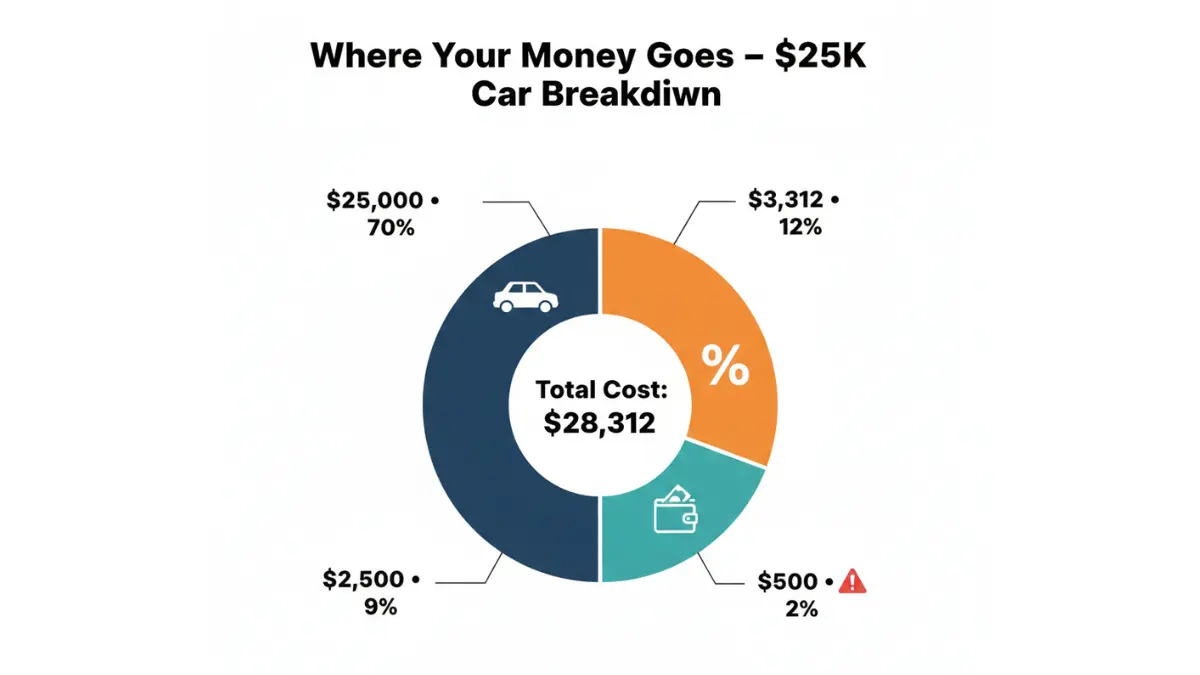
Let’s examine actual numbers using current market rates:
| Payment Component | Amount |
|---|---|
| Vehicle Price | $25,000 |
| Deposit (10%) | -$2,500 |
| Amount Financed | $22,500 |
| Interest Rate | 8.9% APR |
| Term Length | 36 months |
| Monthly Payment | $717 |
| Total Interest Paid | $3,312 |
| Total Cost | $28,312 |
What This Means For You: Every $1,000 in additional deposit saves roughly $135 in interest charges over the loan term—making larger deposits financially strategic if your emergency fund remains intact (ideally 3-6 months of expenses, as detailed in our emergency fund guide).
Hire Purchase Vs Alternatives (Battle Comparison)
Hire Purchase vs Personal Loan vs PCP (2026 Showdown)
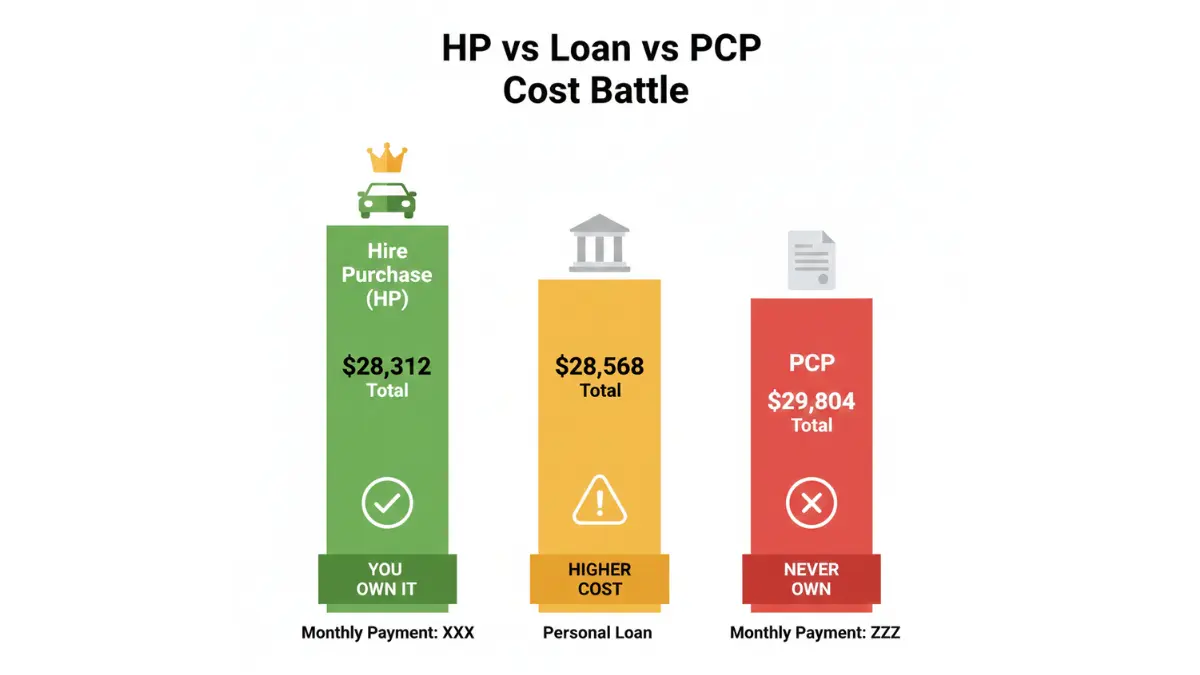
The $25,000 vehicle question: which financing method actually costs less? We analyzed five popular options using identical borrower profiles (credit score 680, $2,500 down, 36-month terms where applicable).
Side-by-Side Cost Comparison Table
| Financing Type | Monthly Payment | Total Interest | Ownership Timeline | Mileage Limits | Final Cost |
|---|---|---|---|---|---|
| Hire Purchase | $717 | $3,312 | 36 months | None | $28,312 |
| Personal Loan | $738 | $3,568 | Immediate | None | $28,568 |
| PCP (Lease) | $489 | $2,204 + balloon | Never (unless balloon paid) | 12K miles/year | $29,804* |
| Traditional Lease | $425 | N/A | Never | 10K miles/year | $15,300 (3 years) |
| BNPL (Buy Now Pay Later) | Varies | 0%-29.99% | 3-24 months | None | $25,000-$32,500 |
*Assumes $15,000 balloon payment to purchase at lease-end.
Which Is Actually Cheaper? (The Math Revealed)
The winner depends entirely on your credit profile and ownership goals:
Hire purchase beats personal loans when:
- Your credit score falls between 620-720 (HP lenders specialize in this range)
- You want guaranteed ownership without large final payments
- You’re comparing secured (HP) versus unsecured (personal loan) rates
Personal loans win when:
- Your credit exceeds 750 (qualifying for premium rates around 6.5% APR)
- You want immediate ownership and flexibility to sell anytime
PCP/Leasing makes sense when:
- You upgrade vehicles every 2-3 years and don’t need ownership
- You drive under annual mileage limits consistently
Modern Alternatives: BNPL vs Traditional HP
Buy Now Pay Later services (Klarna, Affirm, Afterpay) entered the auto financing space in 2025, offering short-term installment plans for vehicles under $15,000. While marketed as “interest-free,” BNPL often charges 15-30% APR if you miss the promotional window.
Traditional hire purchase remains superior for purchases exceeding $10,000 due to longer terms (36-60 months vs BNPL’s 3-24 months) and regulated consumer protections under the Truth in Lending Act.
Key Takeaway: For middle-income Americans financing $20K-$40K vehicles, hire purchase typically offers the second-lowest total cost behind only personal loans for excellent-credit borrowers—and provides more flexible approval standards than traditional bank financing.
Similar to strategies outlined in our debt payoff comparison, the “best” method depends on your financial situation, not universal rules.
Costs, Eligibility & Application Process
Hire Purchase Costs Breakdown (Every Penny Explained)
Deposit Requirements (10-20% Standard in 2026)
Most hire purchase agreements require minimum 10% down, though 20% deposits unlock preferential rates. Zero-down HP deals exist but carry interest premiums averaging 2.5-4% higher APR—costing an extra $1,800-$2,900 over typical loan terms.
Calculate your optimal deposit using our home affordability calculator methodology: never deplete emergency savings for larger deposits.
Interest Rates (Current APR Range: 6.9%-12.9%)
April 2026 hire purchase rates by credit tier:
- Excellent (750+): 6.9-8.2% APR
- Good (670-749): 8.5-10.4% APR
- Fair (620-669): 10.5-12.9% APR
- Poor (<620): 13.0-18.5% APR (subprime specialty lenders)
These rates reflect Federal Reserve benchmark adjustments through Q1 2026, detailed in Federal Reserve consumer credit data.
Hidden Fees to Watch For
Unscrupulous dealers bury these charges in HP agreements:
- Arrangement/Origination Fees: $150-$400 (negotiate these away)
- Documentation Fees: $50-$150 (often unavoidable but capped by state law)
- Early Settlement Penalties: 1-2 months’ interest if paying off early
- Late Payment Charges: $25-$50 per occurrence plus credit score damage
- Repossession Costs: $500-$2,000 if vehicle seized for non-payment
Am I Eligible for Hire Purchase? (Qualification Checklist)
Credit Score Requirements (Minimum 550-600)
Unlike mortgage pre-approval requiring 620+ scores, hire purchase lenders approve borrowers starting around 580. However, rates become prohibitively expensive below 620—often exceeding credit card APRs for similar-risk unsecured debt.
Income Verification Needed
Lenders verify employment and income using:
- Recent pay stubs (last 2-3 months)
- Tax returns (self-employed applicants)
- Bank statements (showing consistent deposits)
Debt-to-income ratio caps typically sit at 43%, meaning all monthly debt payments (including proposed HP payment) cannot exceed 43% of gross monthly income.
Age & Residency Rules
✅ You Qualify If:
- Age 18+ (19+ in Alabama/Nebraska)
- U.S. citizen or permanent resident
- Valid driver’s license and proof of insurance (vehicle HP)
- Verifiable income covering proposed payment
- No recent bankruptcies (within 2 years)
How to Apply for HP in 2026 (4 Simple Steps)
- Get pre-qualified online (soft credit pull, no score impact)
- Compare 3-5 lender offers using identical terms
- Submit formal application with documentation (hard credit pull)
- Receive approval decision (typically 24-48 hours)
Documents required: government ID, proof of income, proof of residence, references, and down payment funds verification.
Most applications complete online in 15-20 minutes—significantly faster than traditional mortgage pre-approval processes requiring extensive financial disclosure.
Pros, Cons & Expert Strategies
Hire Purchase Pros and Cons (The Honest Truth)
6 Major Benefits of HP Agreements
- Guaranteed Ownership: Unlike leases, you WILL own the asset after final payment—no balloon payments or buyout negotiations required.
- Fixed Monthly Payments: Predictable budgeting with no variable-rate surprises, making HP ideal for fixed-income households following methods like the 50/30/20 budget framework.
- No Mileage Restrictions: Drive unlimited miles without penalty fees (critical for commuters averaging 15K+ miles annually).
- Easier Approval Than Bank Loans: Acceptance rates 30-40% higher than traditional auto loans for fair-credit borrowers.
- Asset Protection During Payments: While technically owned by lender, you control, use, and maintain the item throughout the payment period.
- Builds Credit History: On-time payments report to all three bureaus, improving scores 30-50 points over 12-24 months.
5 Drawbacks You Must Know
- Higher Total Cost vs Cash: Interest charges add 10-25% to purchase price over loan lifetime.
- Repossession Risk: Miss 2-3 payments and lenders can legally seize the asset, destroying your credit score simultaneously.
- You Don’t Own It During Payments: Cannot sell or modify significantly without lender permission until final payment clears.
- Depreciation Hits Hard: You’re making payments on a depreciating asset—vehicles lose 20-30% value in year one alone.
- Credit Score Dependency: Fair-credit borrowers pay $2,000-$4,000 more in interest than excellent-credit buyers on identical purchases.
Expert Strategies to Save Money on Hire Purchase
Early Settlement: How to Save $500-$2,000
Most HP agreements allow early payoff after 12 months. Using the “Rule of 78” calculation method (weighted interest allocation), paying off a 36-month loan at month 18 saves approximately 35-40% of remaining interest charges.
Example: $3,312 total interest owed, $1,950 already paid through month 18, $1,362 remaining. Early settlement might reduce this to $900, saving $462.
Negotiating Better HP Terms (Dealer Tactics)
Dealers earn commission on financing—use this leverage:
- Shop rate quotes from 3-5 lenders before visiting dealers
- Ask dealers to “beat this rate by 0.5%” using competing offers
- Negotiate purchase price separately from financing terms
- Read contracts thoroughly; 40% contain unnecessary add-ons (extended warranties, insurance products)
Consumers who compare rates save an average of $1,240 over loan terms, per Federal Trade Commission consumer research.
When to Walk Away from an HP Deal
Reject offers if:
- APR exceeds personal loan rates you qualify for
- Total cost exceeds 120% of item’s current market value
- Monthly payment strains budget (should be <15% of take-home pay)
- Dealer refuses to remove unnecessary add-ons
Real User Story: How Marcus Saved $1,850
Marcus, a 34-year-old teacher from Ohio, needed a $22,000 vehicle in March 2026. His initial dealer offer: 11.9% APR over 48 months ($580/month, $27,840 total).
After comparing offers using strategies above, Marcus secured 8.2% APR through a credit union’s hire purchase program ($542/month, $25,990 total)—saving $1,850 and reducing his monthly obligation by $38.
What This Means For You: Spending 2-3 hours comparing lenders returns $600+ per hour in interest savings—better ROI than most side hustles or investment strategies for beginners.
11 Most-Asked Hire Purchase Questions (Quick Answers)
1. Can I get hire purchase with bad credit?
Yes, specialty subprime lenders approve scores as low as 550, but expect 15-20% APR rates. Consider improving your credit score fundamentals before applying to save thousands.
2. What happens if I miss an HP payment?
First missed payment: $25-$50 late fee. Two consecutive missed payments: default notice and credit report damage. Three missed payments: repossession proceedings begin.
3. Can I end a hire purchase agreement early?
Yes, under the Consumer Credit Act’s “voluntary termination” provision after paying 50% of total amount. You return the item and owe nothing further, though credit impact varies.
4. Is hire purchase better than leasing?
HP guarantees ownership; leasing never does. Choose HP if you want to keep the vehicle long-term, leasing if you upgrade every 2-3 years.
5. Do I own the car during hire purchase?
No—the lender legally owns it until your final payment. You possess and use it, but cannot sell without permission.
6. Can I pay off hire purchase early without penalty?
Most agreements allow early settlement, though some charge 1-2 months’ interest as penalty. Always review contract terms before committing.
7. What’s the difference between HP and conditional sale?
Nearly identical—both are installment purchases. Conditional sale has slightly different legal ownership transfer mechanisms but functions identically for consumers.
8. How does hire purchase affect my credit score?
Hard inquiry drops score 5-10 points initially. On-time payments improve score 30-50 points over 12-24 months. Missed payments cause 60-110 point drops.
9. Can I get 0% hire purchase deals in 2026?
Rare, typically limited to manufacturer promotions on new vehicles or furniture during clearance sales. Most “0% APR” offers have hidden fees equivalent to 3-5% interest.
10. What items can I buy with hire purchase?
Vehicles (77%), furniture/appliances (12%), business equipment (8%), electronics (3%). Essentially any depreciating asset over $5,000.
11. Is hire purchase regulated in the UK?
U.S. hire purchase falls under the Truth in Lending Act regulations, enforced by the CFPB, protecting consumers from predatory practices.
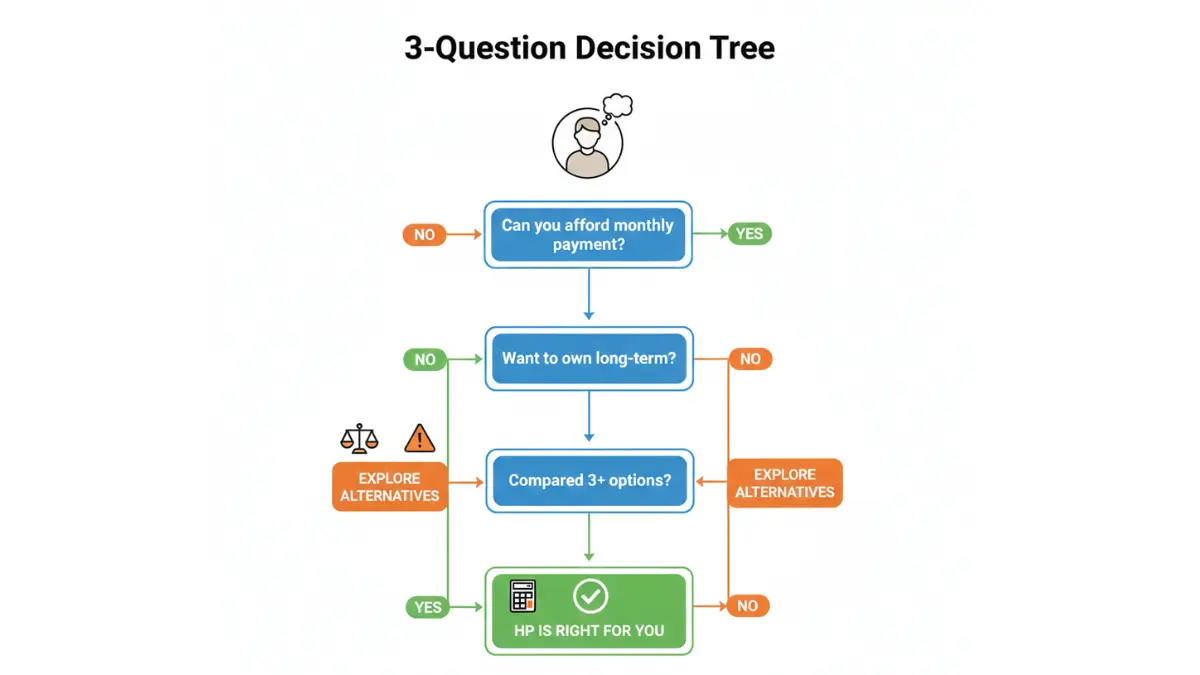
Your Next Steps: Is Hire Purchase Right for You?
Ask yourself three questions:
- Can I afford the monthly payment comfortably? (Should be <15% of take-home pay)
- Do I want to own this item long-term? (HP only makes sense for 3+ year ownership plans)
- Have I compared at least 3 alternative financing options? (Personal loans, 0% credit cards, savings)
If you answered “yes” to all three, hire purchase might be your optimal financing path.
Ready to calculate your exact costs? Use our debt consolidation calculator to model different payment scenarios and compare total costs across financing methods.
📋 DISCLAIMER
This article provides educational information about hire purchase agreements, not personalized financial advice. Interest rates, terms, and regulations vary by lender, location, and individual circumstances. Consult a qualified financial advisor or review specific lender terms before committing to any financing agreement. financeauthorityhub.com does not endorse specific lenders and receives no compensation for recommendations made in this article. All data accurate as of April 2026; rates and regulations subject to change.
Related Articles
 Auto Loans
Leasing 2026: Save $847/Month [Insider Calculator]
January 29, 2026
Informational disclaimer
The content on Finance Authority Hub is provided for general informational and educational purposes only and should not be considered personalized financial, investment, tax, legal, or professional advice. Financial decisions depend on your individual goals, income, risk tolerance, location, and regulatory situation. Before acting on any information, strategy, estimate, or calculator result, consult a qualified licensed professional who can evaluate your specific circumstances.