How 401(k) Hardship Withdrawals Work and What They Cost
A 401(k) hardship withdrawal can cover an urgent bill — but qualifying for one and avoiding the 10% penalty are two separate tests most people confuse.
In This Article
If an urgent bill is bearing down and a 401(k) hardship withdrawal feels like the only cash within reach, this guide is for you. It routes three situations: readers mid-emergency unsure whether their reason qualifies, readers worried about the tax hit, and readers weighing this against a loan or the newer $1,000 emergency option.
The honest headline first: a hardship withdrawal is a real, IRS-sanctioned option, but it is almost always taxed as ordinary income, and under age 59½ it usually carries a 10% penalty on top. Every number below is tied to the actual IRS rules; use the section that matches your moment.
ℹ️ Financial Disclaimer: This article is general financial education, not personalized investment, tax, lending, or insurance advice. Retirement withdrawals carry tax consequences and long-term trade-offs that depend on your circumstances. Before acting, consult a fiduciary financial advisor or a CPA, and confirm your plan’s rules with your plan administrator.
What counts as a hardship? The 6 IRS-approved reasons
The IRS deems six categories of expense an immediate and heavy financial need, and most plans use this safe harbor list to decide who qualifies.
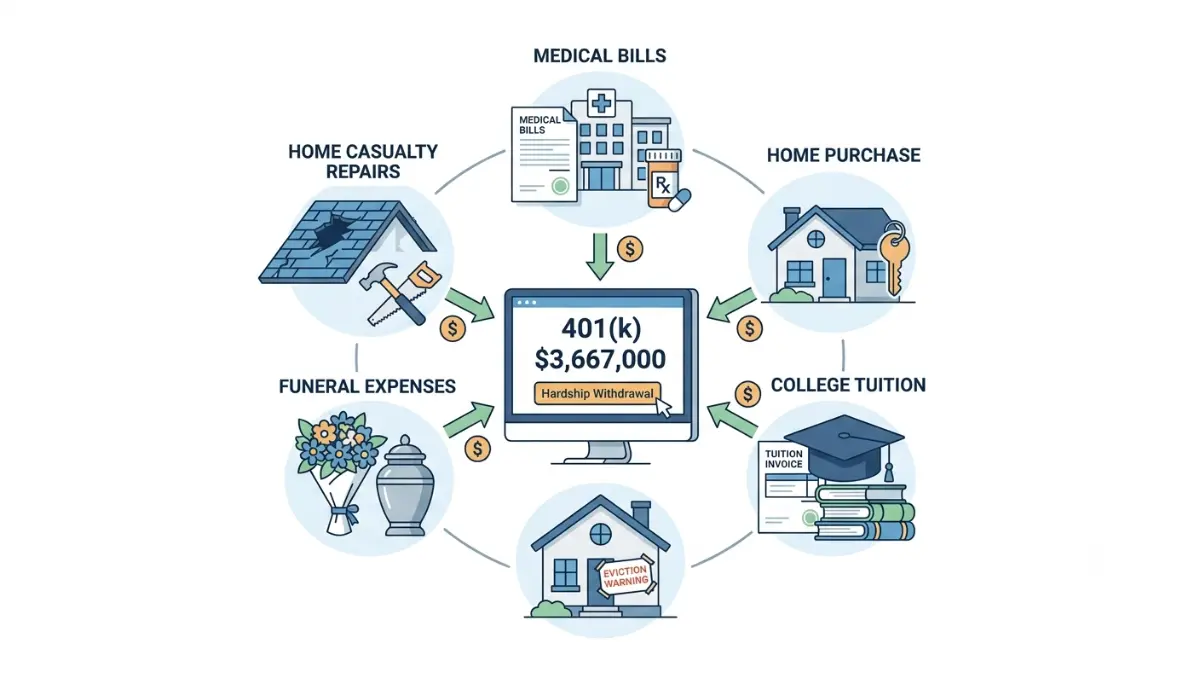
The six safe-harbor expenses
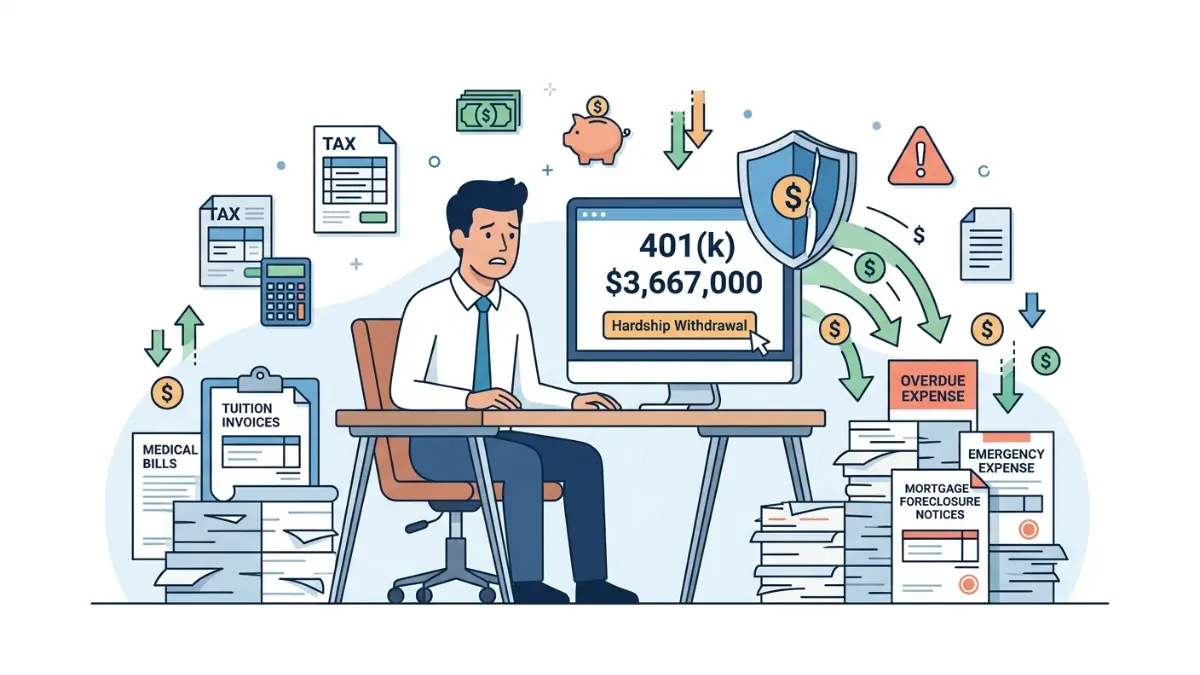
A hardship distribution automatically qualifies when the money goes toward:
- Medical care for you, your spouse, dependents, or a plan beneficiary
- Costs to buy your principal residence (not ongoing mortgage payments)
- Up to 12 months of tuition, fees, and room and board for you or your family
- Payments to prevent eviction or foreclosure on your principal residence
- Funeral or burial expenses for a parent, spouse, child, or dependent
- Repair of casualty damage to your principal residence
Your plan may also add federally declared disaster expenses, per the IRS definition of an immediate and heavy financial need. The plan document controls which it offers, so check your Summary Plan Description.
How much you’re allowed to withdraw
You can take only the amount needed, plus enough for the income tax and any penalty it triggers — no rounding up “just in case.”
⚠️ Costly Mistake: Everyday debt does not qualify. Credit card balances, car purchases, and cash-flow gaps fall outside the six categories, and requesting a hardship for them can get it denied.
What a hardship withdrawal really costs: taxes and the 10% penalty
A hardship withdrawal usually costs you twice: it is taxed as ordinary income, and under 59½ it generally carries a 10% early-withdrawal penalty unless a separate exception applies.
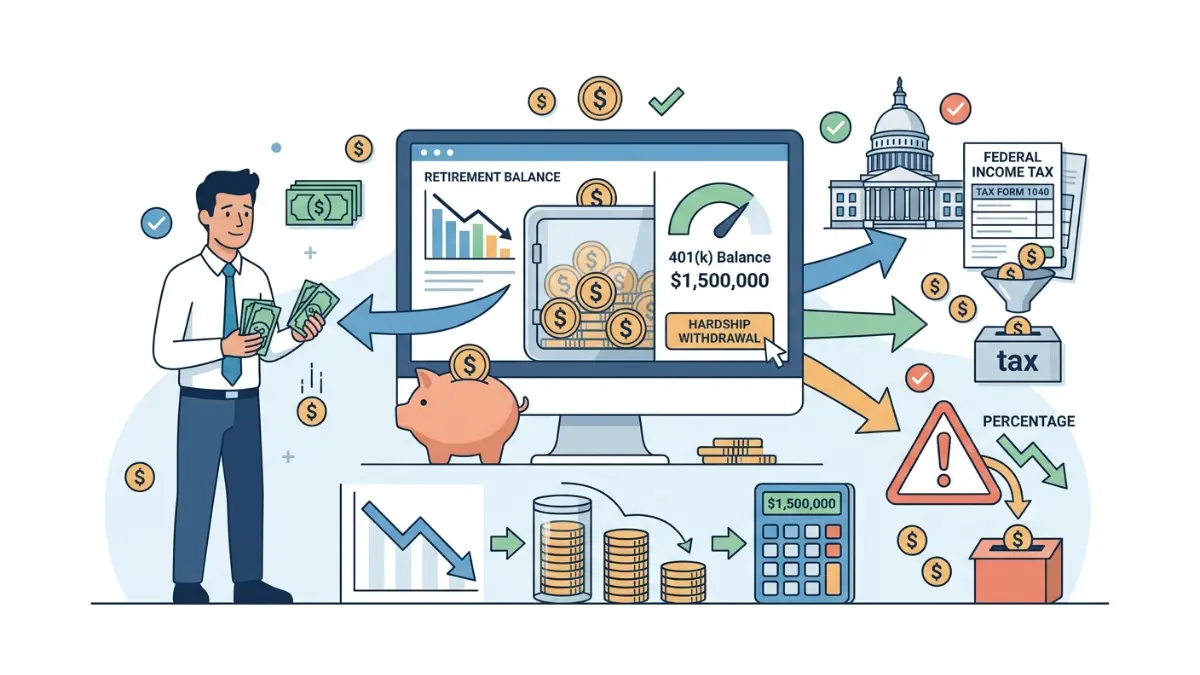
It’s taxed as ordinary income
Every pre-tax dollar you withdraw joins your taxable income, reported on Form 1099-R. Only Roth-source money escapes income tax, because Roth contributions are taxed differently going in — the rest is taxed at your marginal rate, as the IRS summary of the tax consequences confirms.
Why hardship isn’t an automatic penalty exception
The point most guides blur: qualifying for a hardship and escaping the 10% penalty are separate tests. Approval to take the money does not waive the penalty — you need a distinct exception, and which ones apply depends on your account type.
🔍 How It Works: Under IRS Topic 558, the part of a withdrawal covering unreimbursed medical expenses above 7.5% of your AGI escapes the 10% penalty, whether or not you itemize. So an eviction hardship stays penalized; a large medical one may not.
A worked example: what $20,000 really leaves you
Say you withdraw $20,000, you are under 59½, and your marginal rate is 22%. Federal income tax runs about $4,400 and the penalty adds $2,000, so roughly $6,400 leaves before any state tax — netting about $13,600. Model what a withdrawal costs your future balance and read how the 10% early-withdrawal penalty works in detail.
✅ Action Step: Ask a CPA: “Given my marginal bracket and whether any penalty exception applies to me, what is my true tax cost this year?” The answer often changes the size of the withdrawal you actually need.
How to request a 401(k) hardship withdrawal, step by step
Requesting a hardship withdrawal generally follows five steps, though your plan’s process may vary.
The five steps
- Confirm your plan allows hardship withdrawals (check the Summary Plan Description)
- Confirm your reason fits a qualifying category
- Gather supporting records — bills, notices, or statements
- Submit the request to your plan administrator or provider portal
- Choose your tax withholding and set money aside for the bill
Documentation and timing
Most plans let you self-certify a qualifying need with no other reasonable resource, so you usually won’t attach documents — but keep them in case the IRS asks. Processing runs from a few days to a couple of weeks.
🔍 How It Works: A hardship withdrawal can’t be rolled over, so 10% federal tax is withheld by default (adjustable on Form W-4R), not the 20% for rollover-eligible distributions. Under-withholding is easy — estimate the income tax to set aside first.
Hardship withdrawal vs. 401(k) loan vs. the $1,000 emergency option
Before you lock in a withdrawal, weigh it against two routes that often cost far less: a 401(k) loan and the newer SECURE 2.0 emergency distribution.
| Option | Taxed? | 10% penalty? | Repayable? | Best for |
|---|---|---|---|---|
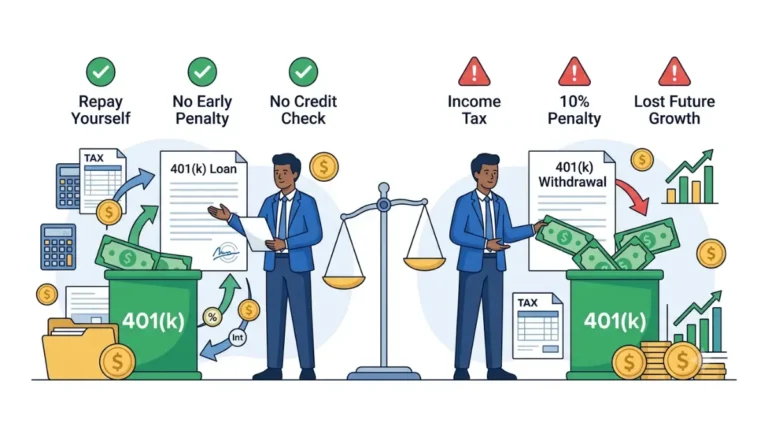
| Hardship withdrawal | Yes, ordinary income | Usually, if under 59½ | No | A large, qualifying need with no cheaper source |
| 401(k) loan | No, if repaid on terms | No | Yes, to your own account | Those who expect to stay employed and repay |
| $1,000 emergency distribution | Yes | No | Yes, within 3 years | A small, one-off emergency of $1,000 or less |
Source: IRS rules on hardships, loans, and SECURE 2.0 distributions.
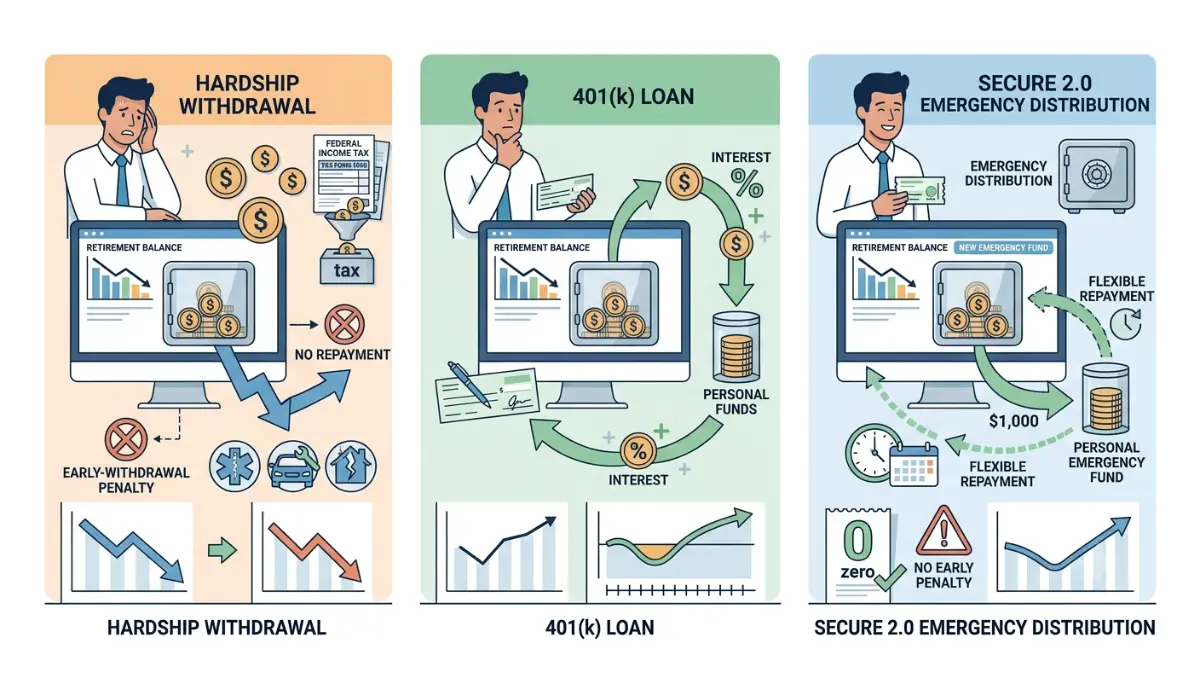
401(k) loan: borrowing from yourself
A loan lets you repay your own account with interest, avoiding both tax and penalty if you stay on schedule. The main risk is leaving your job, which can make the balance due quickly.
The $1,000 SECURE 2.0 emergency withdrawal
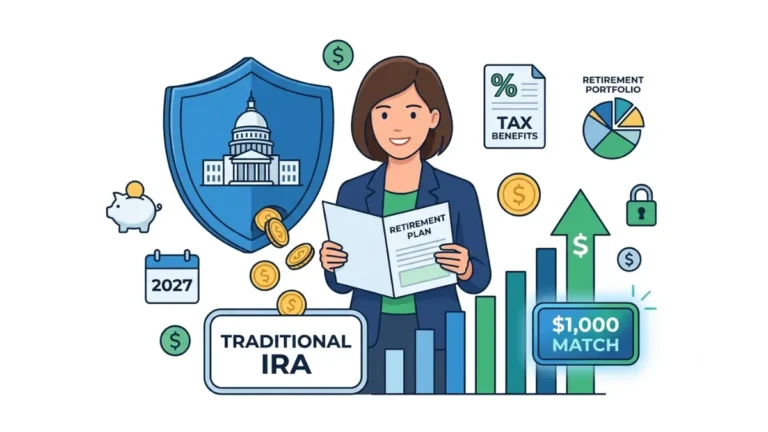
Since 2024, you can take up to $1,000 once per calendar year for an emergency without the 10% penalty, repayable within three years. You can’t take another for three years unless you repay the first, and it is still taxed as income.
💡 Expert Note: The $1,000 emergency distribution and a hardship withdrawal are different tools. The emergency distribution skips the penalty and can be repaid; a hardship withdrawal usually can do neither.
✅ Action Step: Ask a fiduciary financial advisor: “For my timeline, which of these options minimizes total cost and long-term retirement damage?”
The 2024–2026 rule changes that widened penalty-free access
Recent law has expanded the ways to reach 401(k) money without the 10% penalty and trimmed old friction around hardship distributions.
📊 Data Point: SECURE 2.0 penalty-free caps (2026) — emergency personal expense: $1,000/year; domestic abuse: the lesser of $10,000 or 50% of the vested balance; federally declared disaster: up to $22,000; long-term care insurance premiums: up to $2,600. Source: IRS (§72(t) exceptions; Notice 2026-33), 2026.
Each waives the 10% penalty but not income tax, and each is optional for your plan. Terminal illness certified by a physician also qualifies. See the full list of IRS penalty exceptions and the IRS FAQ on hardship distributions.
What the IRS removed
Two old restrictions are gone: plans can no longer force a six-month pause on your contributions after a hardship, and they can no longer require you to take a plan loan first. If age is your angle instead, the Rule of 55 can unlock penalty-free access earlier than 59½.
Can you still contribute after a withdrawal?
Yes. Because the six-month suspension was eliminated, you can keep contributing right away, up to the annual 401(k) contribution limits.
✅ Action Step: Ask a CPA: “Do I qualify for a penalty exception, and how do I claim it on Form 5329?”
Costly mistakes to avoid (and cheaper moves to try first)
A hardship withdrawal can be right, but avoidable errors make it far more expensive than it needs to be.
- Assuming a hardship automatically skips the 10% penalty — it doesn’t
- Under-withholding and facing a tax bill next April
- Overlooking the permanent hit to decades of compounding
- Withdrawing before pricing cheaper options
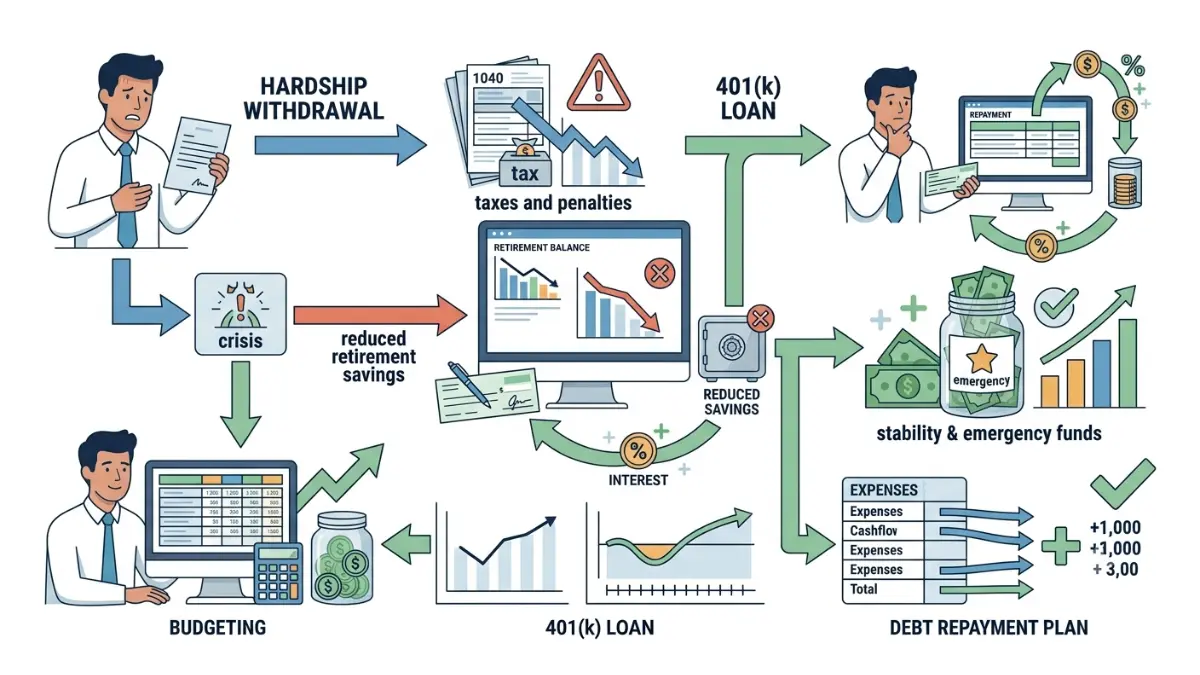
⚠️ Costly Mistake: A hardship withdrawal is permanent — it can’t be repaid or rolled back, so the money and its growth are gone for good. Pulling $20,000 in your 30s can cost far more than $20,000 in lost savings once compounding is counted.
A 401(k) loan, a starter fund, or freeing up cash can each spare you the tax and penalty. Try a structured debt payoff plan if wider debt is the pressure, find room in your monthly budget to cover the gap, or plan a starter emergency fund before the next surprise.
401(k) hardship withdrawal FAQs
1. Do I pay taxes on a 401(k) hardship withdrawal?
Yes. A 401(k) hardship withdrawal from pre-tax money is added to your taxable income and reported on Form 1099-R; only Roth-source amounts avoid income tax. Confirm your specific impact with a CPA.
2. Does a hardship withdrawal avoid the 10% penalty?
Usually not. Qualifying for a 401(k) hardship withdrawal and avoiding the 10% penalty are separate tests. Under 59½, the penalty applies unless a distinct exception fits, such as medical costs above 7.5% of AGI. Ask a CPA.
3. What proof do I need for a hardship withdrawal?
Most plans let you self-certify a qualifying need with no other reasonable resource, so you typically won’t submit documents. But keep bills or notices yourself — if the IRS later questions the hardship withdrawal, that documentation protects you.
4. How much can I withdraw for a hardship?
Only the amount needed for the qualifying expense, plus enough to pay the income tax and any penalty it triggers. Your plan may also cap the amount at your available contributions.
5. Can I be denied a hardship withdrawal?
Yes. Your plan must offer hardship withdrawals, and your reason must fit a qualifying category. If it lacks the feature, or your expense falls outside the approved list, the request can be denied. Check your Summary Plan Description first.
6. Is a 401(k) loan better than a hardship withdrawal?
Often, yes. A 401(k) loan avoids income tax and the 10% penalty if you repay on schedule. The main risk is that leaving your job can make the balance due quickly. Weigh both with a financial advisor.
7. How long does a hardship withdrawal take?
It depends on your plan. A 401(k) hardship withdrawal can take from a few days to a couple of weeks, depending on your administrator and any documentation review. Ask your administrator for the timeline.
8. Can I use a 401(k) hardship withdrawal for credit card debt?
Generally, no. Credit card balances and routine bills aren’t among the six IRS safe-harbor categories, so they don’t qualify. If debt is the pressure, a repayment plan or lower-cost loan is usually better.
9. Do I have to pay back a hardship withdrawal?
No, and you can’t. Unlike a loan, a 401(k) hardship withdrawal isn’t repaid, so it permanently reduces your balance and its future growth — which is why exhausting repayable options first protects your retirement.
10. What is the $1,000 emergency 401(k) withdrawal?
It’s a SECURE 2.0 option, effective since 2024, to take up to $1,000 once per calendar year for an emergency without the 10% penalty. It’s repayable within three years, still taxed as income, and blocks another for three years unless repaid.
11. Can I still contribute after a hardship withdrawal?
Yes. The old rule pausing contributions for six months after a hardship withdrawal was eliminated, so you can keep contributing right away — especially enough to capture any employer match and rebuild what the withdrawal took.
Weighing the decision before you tap your 401(k)
A 401(k) hardship withdrawal exists for exactly the moments that push people to it, but it is rarely free money — you’ll usually owe income tax, and under 59½ a 10% penalty unless an exception applies.
Before acting, confirm your reason qualifies, price cheaper alternatives, and run the numbers. Project your retirement savings first; if you move forward, a CPA can help you size the withdrawal and its tax.
Informational disclaimer
The content on Finance Authority Hub is provided for general informational and educational purposes only and should not be considered personalized financial, investment, tax, legal, or professional advice. Financial decisions depend on your individual goals, income, risk tolerance, location, and regulatory situation. Before acting on any information, strategy, estimate, or calculator result, consult a qualified licensed professional who can evaluate your specific circumstances.