
Total Interest on a Home Loan: How Much Do You Really Pay Over 30 Years?
Most homeowners don’t realize a $400K home loan costs over $880K in total. Here’s the shocking interest breakdown — and how to cut it by $100,000.
In This Article
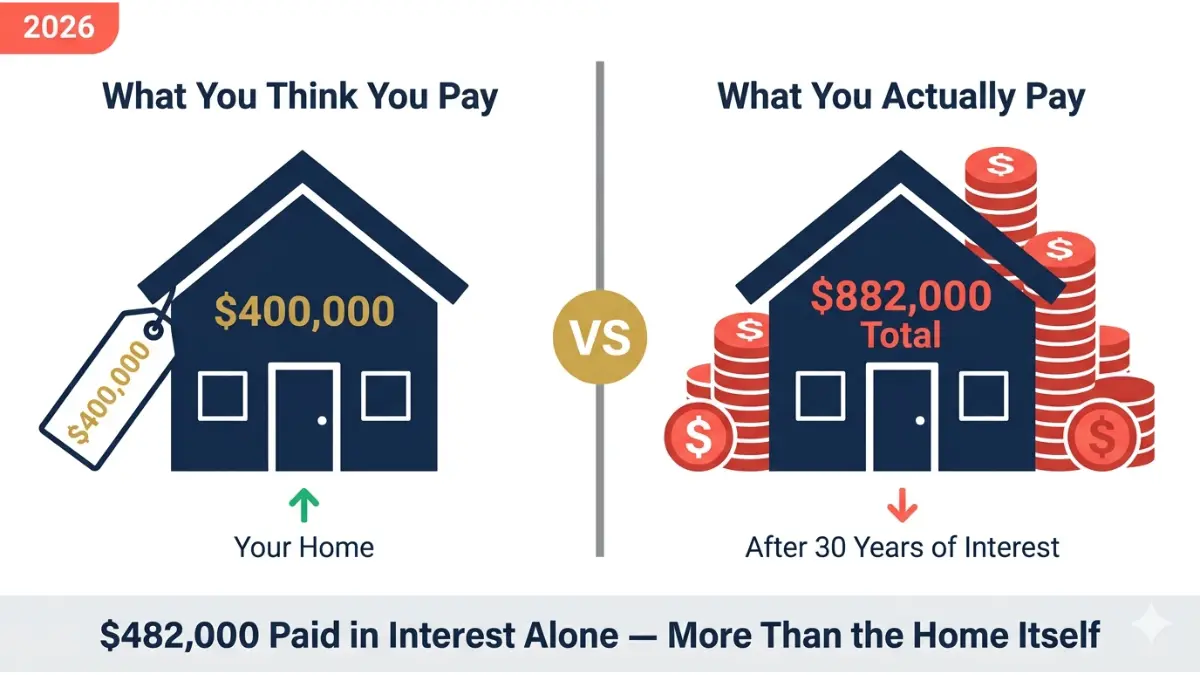
On a $400,000 home loan at today’s average rate of 6.22%, you’ll pay over $462,000 in interest alone over 30 years — more than the home itself cost. Your total repayment exceeds $860,000. This is the number lenders rarely show you upfront, and the one that changes every financial decision you’ll make as a homeowner.
Use our Mortgage Calculator right now to see your exact interest total in under 60 seconds.
The Shocking Real Cost of a Home Loan Over 30 Years
Most Americans focus on the monthly payment. That’s exactly what lenders count on.
The brutal truth: for every $100,000 you borrow at 6.22% over 30 years, you pay back approximately $220,000. Your home loan doubles the cost of your home before you’ve paid a single cent in taxes, insurance, or maintenance.
According to the Consumer Financial Protection Bureau (CFPB), the part of your payment that goes to interest does not reduce your loan balance or build your home equity — it is a pure cost of borrowing.
Here’s what the real numbers look like in 2026, based on Freddie Mac’s current 30-year fixed rate of 6.22%:
Table 1 — Total Interest Paid by Home Loan Amount (6.22% Rate, 30-Year Term, 2026)
| Home Loan Amount | Monthly Payment | Total Interest Over 30 Years | Total You Repay |
|---|---|---|---|
| $200,000 | $1,225 | ~$241,054 | ~$441,054 |
| $300,000 | $1,838 | ~$361,581 | ~$661,581 |
| $400,000 | $2,451 | ~$482,108 | ~$882,108 |
| $500,000 | $3,063 | ~$602,635 | ~$1,102,635 |
| $600,000 | $3,676 | ~$723,162 | ~$1,323,162 |
💡 Key Takeaway: On a $400,000 home loan, you pay back more than double what you borrowed. That extra $482,000 is pure interest — money paid to the lender, not toward your home.
What This Means For You: If you’re a first-time buyer asking how much home you can afford, the sticker price is only half the equation. Understanding the total cost of your home loan before you sign is the single most important financial move you can make.
Why Home Loan Interest Is Front-Loaded — The Tipping Point No One Tells You About
This is where most homeowners get blindsided.
Your 30-year home loan is amortized — meaning each monthly payment is mathematically split between interest and principal. In the early years, the overwhelming majority goes to interest. Principal reduction comes agonizingly slowly.
What Is Mortgage Amortization?
Amortization means paying off your loan through equal regular payments over time, so the amount you owe gradually decreases. As the CFPB explains, the split between interest and principal changes with every single payment — but the shift is brutally slow in a 30-year term.
The Interest Tipping Point: Year 18–19
On a standard 30-year home loan, the tipping point — when more of your monthly payment finally goes to principal than interest — doesn’t arrive until Year 18 or 19. For nearly two decades, you’re paying more in interest charges than you are reducing what you actually owe.
Table 2 — Year-by-Year Interest vs. Principal Breakdown ($400,000 Home Loan at 6.22%)
| Year | Monthly Payment | Goes to Interest | Goes to Principal | Remaining Balance |
|---|---|---|---|---|
| Year 1 | $2,451 | $2,071 | $380 | $395,440 |
| Year 5 | $2,451 | $1,983 | $468 | $375,830 |
| Year 10 | $2,451 | $1,845 | $606 | $340,260 |
| Year 15 | $2,451 | $1,659 | $792 | $295,640 |
| Year 18–19 | $2,451 | ~$1,220 | ~$1,231 | ~$232,000 |
| Year 25 | $2,451 | $785 | $1,666 | $133,000 |
| Year 30 | $2,451 | $13 | $2,438 | $0 |
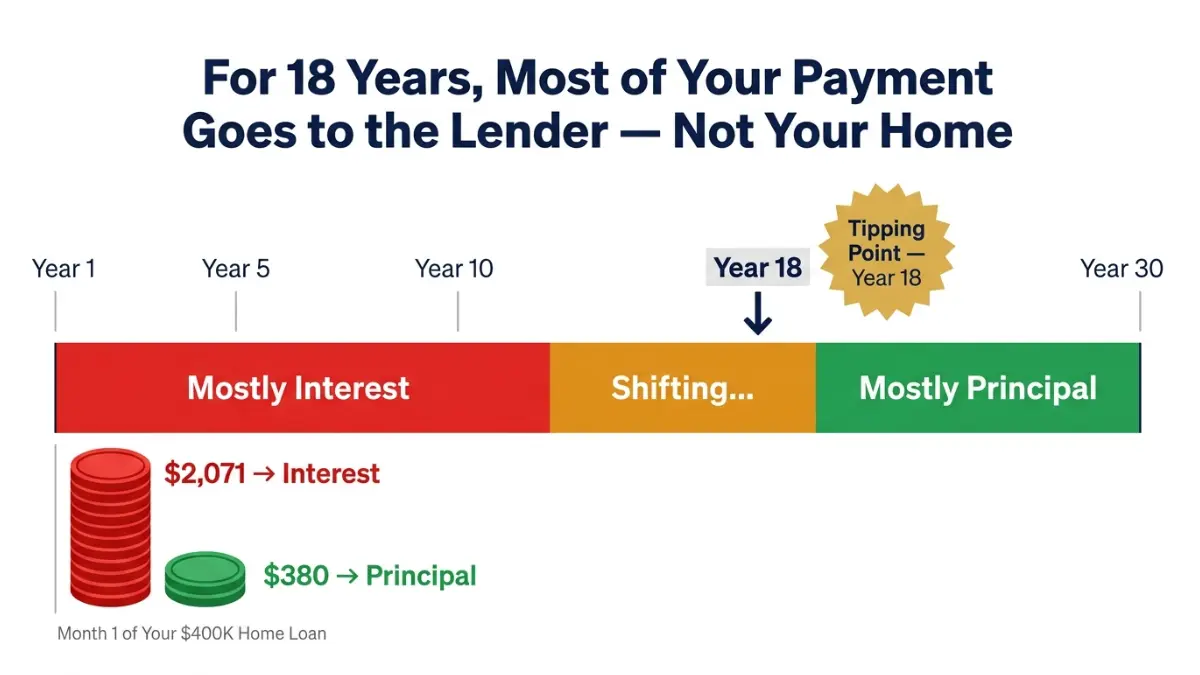
💡 Key Takeaway: If you sell your home before Year 18, you’ve spent the majority of your payments on interest — not equity. This is why understanding mortgage amortization payment breakdowns before buying is essential.
How Your Credit Score Directly Impacts Total Home Loan Interest
Your interest rate — and therefore your total home loan cost — is determined largely by your credit score. The difference is staggering:
Table 3 — Credit Score vs. Interest Rate vs. Total Interest Paid ($400,000 Loan, 30 Years)
| Credit Score Range | Estimated Rate | Monthly Payment | Total Interest Paid | Extra vs. Best Rate |
|---|---|---|---|---|
| 760–850 (Excellent) | ~5.90% | $2,373 | ~$454,280 | Baseline |
| 700–759 (Good) | ~6.20% | $2,446 | ~$480,560 | +$26,280 |
| 680–699 (Fair) | ~6.50% | $2,528 | ~$510,176 | +$55,896 |
| 620–679 (Poor) | ~7.20% | $2,713 | ~$576,680 | +$122,400 |
A 1% rate difference on a $400,000 home loan costs you roughly $83,000–$122,000 more over 30 years. Use our Credit Score Calculator to find where you stand, and read our full guide on the minimum credit score to buy a house in 2026.
30-Year vs. 15-Year Home Loan — The Real Interest Cost Comparison
This is the most searched home loan question in America — and most articles give you a table without the emotional reality.
Here it is plainly: choosing a 15-year home loan over a 30-year home loan can save you over $278,000 in interest on a $400,000 loan. That’s a new car, a college education, or a decade of retirement contributions.
Table 4 — $400,000 Home Loan: 30-Year vs. 15-Year Full Comparison (2026 Rates)
| Factor | 30-Year Home Loan | 15-Year Home Loan | You Save / Difference |
|---|---|---|---|
| Interest Rate (Freddie Mac avg, March 2026) | 6.22% | 5.54% | 0.68% lower |
| Monthly Payment | $2,451 | $3,270 | Pay $819 more/month |
| Total Interest Paid | ~$482,108 | ~$188,643 | $293,465 saved |
| Total Amount Repaid | ~$882,108 | ~$588,643 | — |
| Debt-Free Date (from 2026) | 2056 | 2041 | 15 years earlier |
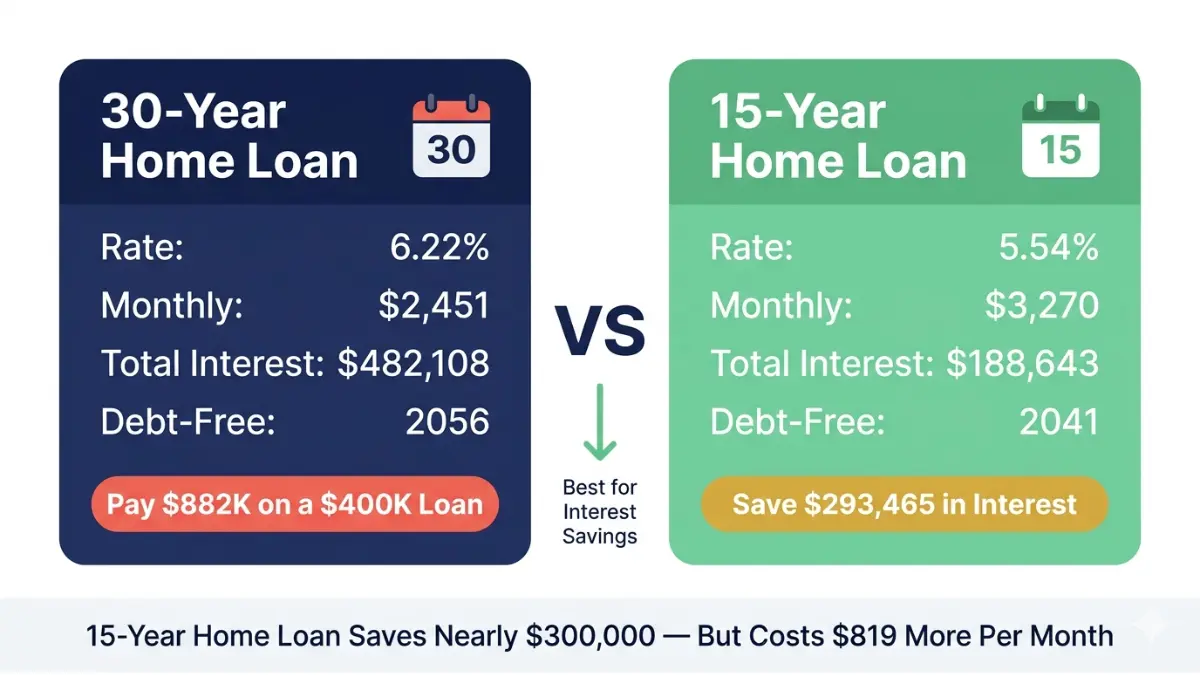
💡 Key Takeaway: The 15-year home loan costs $819 more per month but makes you mortgage-free in 2041 instead of 2056 — and saves you nearly $300,000. Read our full 30-year vs. 15-year mortgage comparison to decide which is right for your situation.
Who Should Choose a 30-Year Home Loan:
- You need the lower monthly payment to qualify or maintain cash flow
- You plan to invest the difference aggressively (stock market returns historically outpace 6% over long periods)
- You may sell or refinance within 7–10 years
Who Should Choose a 15-Year Home Loan:
- You can comfortably afford the higher payment without stress
- Your priority is building equity fast and minimizing total interest
- You are within 20 years of retirement and want to be mortgage-free sooner
Use our Mortgage Refinance Calculator to model what switching terms could save you right now.
5 Proven Strategies to Cut Total Home Loan Interest — With Real Dollar Savings
Every competitor gives you vague tips. We give you exact numbers.
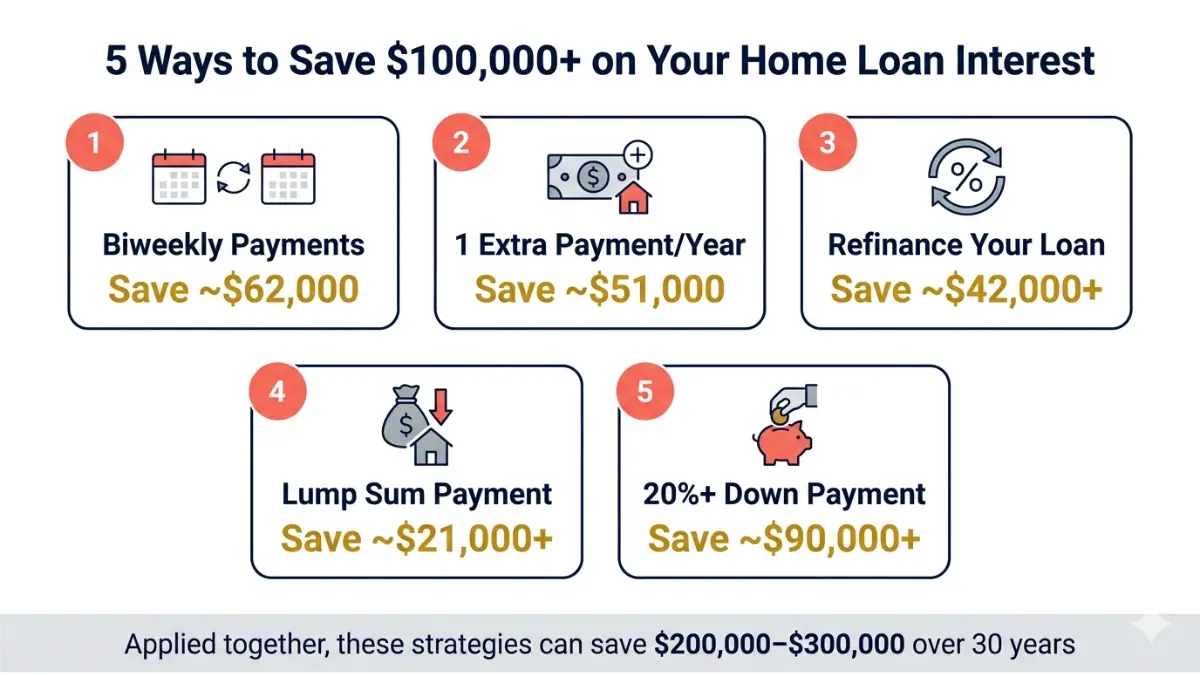
These five strategies can collectively save you $100,000–$300,000 on a standard 30-year home loan, depending on how aggressively you apply them.
Strategy 1 — Switch to Biweekly Payments
Instead of 12 monthly payments per year, you make 26 biweekly half-payments. That equals 13 full payments per year instead of 12 — one extra payment annually, automatically.
Impact on a $400,000 home loan at 6.22%:
- Interest saved: ~$62,000
- Loan paid off: ~3.5 years early
- Debt-free date moves from 2056 to ~2052
Action Step: Call your lender and ask specifically to set up a biweekly payment plan. Confirm that extra payments are applied to principal only, not future interest.
Strategy 2 — Make One Extra Principal Payment Per Year
Even one additional full monthly payment per year — applied to principal — makes a dramatic difference.
Impact on a $400,000 home loan at 6.22%:
- Interest saved: ~$51,000
- Loan paid off: ~4 years early
A tax refund, annual bonus, or year-end windfall directed to principal is one of the highest guaranteed returns available. According to our Tax Refund Guide, the average U.S. tax refund in 2026 is approximately $3,100 — more than enough for one extra home loan payment.
Strategy 3 — Refinance When Rates Drop 1% or More
Refinancing your home loan to a lower rate — especially in the first 10 years — can eliminate tens of thousands in interest charges.
Example: You took a $400,000 home loan in 2024 at 7.1%. In 2026, rates are at 6.22% (Freddie Mac, March 2026). Refinancing in Year 2 on a ~$392,000 remaining balance:
- Monthly saving: ~$230/month
- 10-year interest saving: ~$42,000
- Break-even on closing costs (~$6,000): approximately 26 months
⚠️ Warning: Refinancing resets your amortization schedule. If you’re past Year 15, the math often works against you — you’ve already paid most of the front-loaded interest. Use our Mortgage Refinance Calculator to calculate your specific break-even point before refinancing.
Also review our guide on current home loan interest rates to track when rates drop enough to trigger a refinance.
Strategy 4 — Make a Lump-Sum Principal Payment Early
A one-time $10,000 principal payment in Year 1 of a 30-year home loan has compounding benefits across all 30 years.
Impact on a $400,000 home loan at 6.22% (Year 1 lump sum of $10,000):
- Interest saved over lifetime: ~$21,000
- Loan paid off: ~8 months early
A $25,000 lump sum in Year 1 saves approximately $53,000 in interest. Every dollar you redirect to principal in the early years of your home loan carries the highest leverage.
Strategy 5 — Increase Your Down Payment to 20% or More
Every dollar you don’t borrow is a dollar you don’t pay interest on — for 30 years.
Table 5 — Down Payment Impact on Total Home Loan Interest ($500,000 Home, 6.22% Rate)
| Down Payment | Loan Amount | Total Interest Over 30 Years | Difference |
|---|---|---|---|
| 5% ($25,000) | $475,000 | ~$572,504 | Baseline |
| 10% ($50,000) | $450,000 | ~$542,372 | Save $30,132 |
| 20% ($100,000) | $400,000 | ~$482,108 | Save $90,396 |
| 25% ($125,000) | $375,000 | ~$451,976 | Save $120,528 |
A 20% down payment also eliminates Private Mortgage Insurance (PMI), which typically adds $100–$300/month to your payment. Read our complete guide on what PMI is and how to avoid it.
Use our Down Payment Calculator to find the optimal down payment for your home loan.
Home Loan Interest Costs Across the USA in 2026
Since 95% of our readers are in the United States, here’s what total home loan interest looks like across different U.S. markets using 2026 data.
Table 6 — Total Home Loan Interest by U.S. Loan Size (6.22% Rate, 30-Year Fixed, 2026)
| Typical Market | Avg Loan Amount | Monthly Payment | Total Interest (30 Yrs) | Total Repaid |
|---|---|---|---|---|
| Rural / Midwest | $200,000 | $1,225 | ~$241,054 | ~$441,054 |
| Sun Belt / Southeast | $300,000 | $1,838 | ~$361,581 | ~$661,581 |
| Mid-Size Cities | $400,000 | $2,451 | ~$482,108 | ~$882,108 |
| Coastal Cities | $600,000 | $3,676 | ~$723,162 | ~$1,323,162 |
| High-Cost Markets (CA, NY) | $800,000 | $4,902 | ~$964,216 | ~$1,764,216 |
Data Source: Calculations based on Freddie Mac PMMS rate of 6.22% as of March 19, 2026, using standard 30-year amortization.
The Invest vs. Overpay Question
One of the most debated home loan decisions: should you make extra payments, or invest that money instead?
- If your home loan rate is 6.22% and your long-term investment return is 8–10% (S&P 500 historical average), investing may mathematically outperform overpayment.
- However, overpaying your home loan is a guaranteed, risk-free return of exactly your interest rate. Investing carries market risk.
- Our expert panel recommends: Max out tax-advantaged accounts (Roth IRA, 401(k)) first, then apply surplus cash to home loan principal. Use our Investment Calculator to model both scenarios.
Expert Panel Insights + Your 2026 Home Loan Action Checklist
What Our Financial Experts Say
Laura M. Bennett, CFP (USA): “The front-loading of interest on a 30-year home loan is the most underestimated cost in personal finance. Most homeowners don’t realize that in the first five years, over 80% of every payment goes to the lender as interest — not toward their own equity. Biweekly payments are the single easiest structural change most borrowers can make with zero lifestyle impact.”
Daniel Moreau, CPA/CFP (Canada): “The 20% down payment threshold is a double benefit — it eliminates PMI and permanently reduces your home loan principal, saving you tens of thousands over the full term. Borrowers who stretch to reach 20% down almost universally report it was the right financial decision.”
Michael R. Thompson, CFA: “At a rate of 6.22%, the math slightly favors investing surplus funds in diversified equities over aggressive mortgage overpayment — but only if you have sufficient liquidity and risk tolerance. For most households, the psychological and financial security of reducing mortgage debt early outweighs the marginal return difference.”
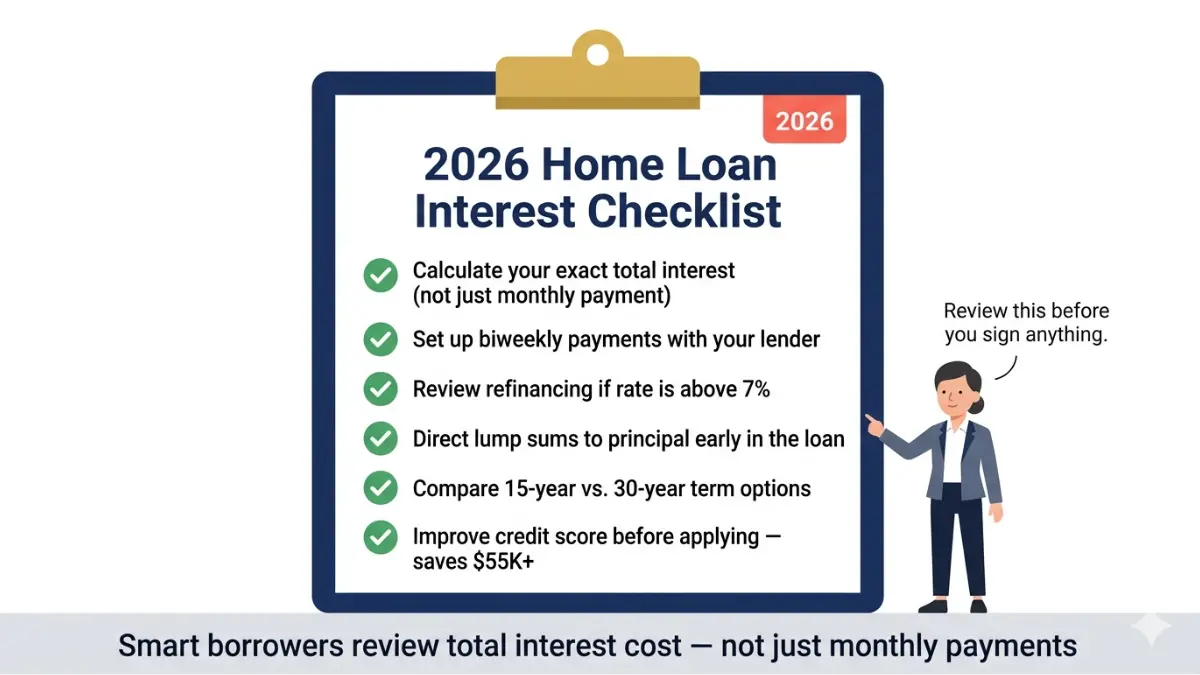
Your 2026 Home Loan Interest Action Checklist
Use this before you close — and revisit it every year:
- ✅ Calculate your exact total interest using our Mortgage Calculator — don’t just look at the monthly payment
- ✅ Check if biweekly payments are available with your lender and confirm they apply to principal
- ✅ Review refinancing eligibility if your current rate is above 7% — use our Refinance Calculator to find your break-even point
- ✅ Direct any lump sums to principal early — tax refunds, bonuses, and inheritances have the greatest interest-saving impact in Years 1–10
- ✅ Compare 15-year vs. 30-year if you can afford the ~$800/month increase — the interest savings are nearly $300,000
- ✅ Improve your credit score before applying — a 760+ score versus 680 saves you ~$56,000 in interest on a $400,000 home loan
- ✅ Model your Home Affordability including total interest, not just monthly payment
Frequently Asked Questions (FAQs)
1. How much interest do you pay on a $300,000 home loan over 30 years?
At 6.22% (March 2026 rate), a $300,000 30-year home loan generates approximately $361,581 in total interest. You’ll repay roughly $661,581 on a $300,000 loan.
2. Is it worth paying off your home loan early?
Yes — in most cases. Every extra dollar applied to principal in the early years eliminates years of front-loaded interest. The savings on a $400,000 home loan can exceed $60,000 with consistent extra payments.
3. What is the interest tipping point on a 30-year mortgage?
The tipping point — when more of your payment goes to principal than interest — typically doesn’t arrive until Year 18 or 19 on a standard 30-year home loan. On a 15-year loan, it arrives by Year 3–4.
4. Does a 15-year home loan always save money?
It saves dramatically on total interest (nearly $300,000 on a $400,000 loan) but requires higher monthly payments. It only “saves money” in the full sense if you can comfortably afford the increase without financial strain.
5. How does a biweekly payment reduce home loan interest?
Biweekly payments result in 26 half-payments per year — equivalent to 13 full monthly payments. That one extra payment per year consistently hits principal and eliminates approximately 3–4 years from a 30-year home loan, saving tens of thousands in interest.
6. Can refinancing reduce total home loan interest?
Yes — if done early in the loan term and the rate drops by 1% or more. Refinancing in Years 15–25 often doesn’t help because you’ve already paid most of the front-loaded interest.
7. What happens if I make one extra payment per year on my home loan?
On a $400,000 home loan at 6.22%, one extra annual payment of ~$2,451 saves approximately $51,000 in interest and pays off the loan about 4 years early.
8. How does a higher credit score lower total home loan interest?
A 760+ credit score vs. a 680 score can mean a rate difference of 0.6%–1.3%, translating to $55,000–$122,000 more in total interest on a $400,000 home loan over 30 years.
9. Is it better to invest extra money or pay off my home loan faster?
At 6.22%, both are valid. Mathematically, long-term equity investing may return more, but overpaying your home loan is a guaranteed, risk-free return. Most experts recommend maxing out Roth IRA and 401(k) first, then overpaying the home loan.
10. What is mortgage amortization and how does it affect total interest?
Amortization is the schedule of equal payments that gradually pays off both principal and interest over the loan term. Because interest is calculated on the remaining balance, early payments are overwhelmingly interest-heavy — which is why total interest on a 30-year home loan is so high.
11. How much does a 1% interest rate difference cost over 30 years on a $400,000 home loan?
A 1% rate increase on a $400,000 home loan adds approximately $83,000–$90,000 in total interest over 30 years. This is why your credit score and lender shopping are among the most financially consequential decisions you’ll make.
⚠️ Disclaimer: This article is for educational and informational purposes only and does not constitute financial, mortgage, or investment advice. All home loan interest calculations are estimates based on standard amortization formulas and the Freddie Mac PMMS rate of 6.22% as of March 19, 2026. Actual rates, payments, and total interest costs will vary based on lender, credit profile, loan type, loan amount, and prevailing market conditions. Always consult a licensed financial advisor or mortgage professional before making any home loan decisions.
Related Articles
 Mortgage Costs & Fees
Property Value 2026: 12 Factors That Set Real Price
February 8, 2026 Mortgage Costs & Fees
Home Loan Closing Costs: What You’ll Actually Pay in 2026
March 26, 2026
Informational disclaimer
The content on Finance Authority Hub is provided for general informational and educational purposes only and should not be considered personalized financial, investment, tax, legal, or professional advice. Financial decisions depend on your individual goals, income, risk tolerance, location, and regulatory situation. Before acting on any information, strategy, estimate, or calculator result, consult a qualified licensed professional who can evaluate your specific circumstances.