
EFTPS 2026: Individual Shutdown + New Payment Options
EFTPS individual enrollment ended October 2025, with mandatory transition by September 2026. Learn how to switch to IRS Direct Pay or Online Account before losing access.

In This Article
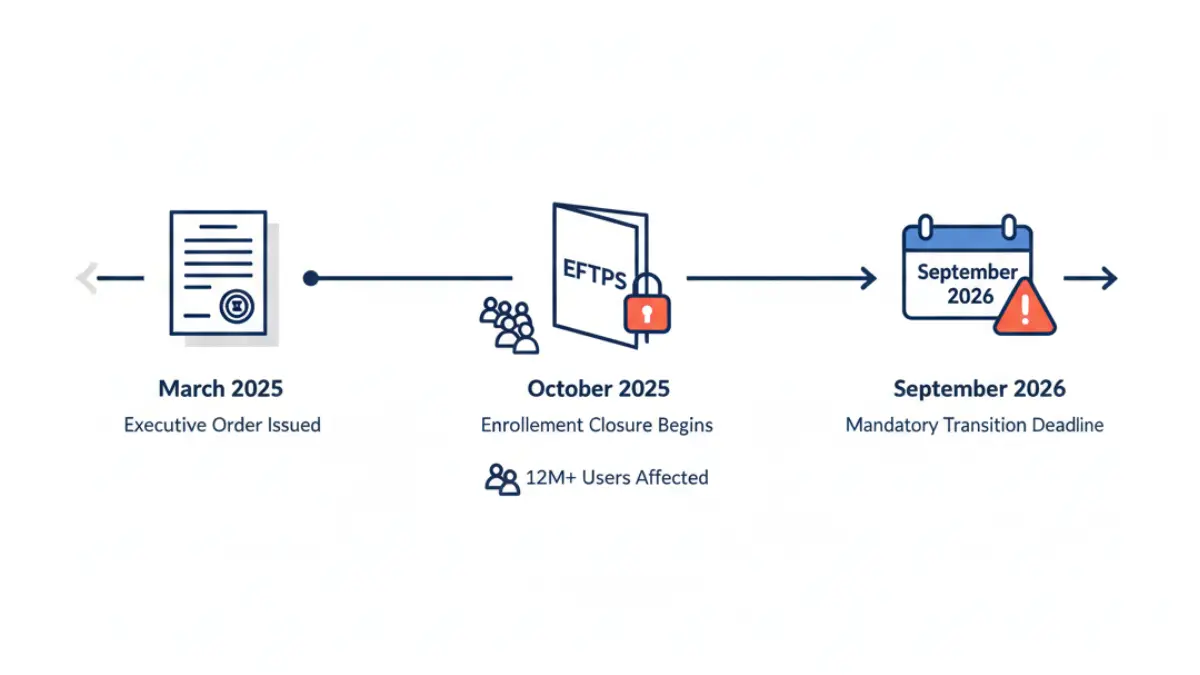
The Electronic Federal Tax Payment System (EFTPS) for individual taxpayers officially ended new enrollments on October 17, 2025, with mandatory full transition coming in September 2026. If you’re one of over 12 million individual users affected by this federal tax payment system shutdown, you must switch to alternative methods like IRS Direct Pay or IRS Online Account before your access ends. Businesses can still use EFTPS indefinitely.
This shift stems from Executive Order 14247, which mandates electronic payments to reduce fraud (Treasury checks are 16 times more likely to be lost or stolen) and save taxpayers $657 million annually. Here’s everything you need to navigate this transition successfully, avoid payment failures, and choose the best replacement option for your tax situation.
What Happened to EFTPS in 2026?
The U.S. Treasury Department is phasing out EFTPS access for individuals as part of a massive government payment modernization initiative. President Trump signed Executive Order 14247 (“Modernizing Payments To and From America’s Bank Account”) in March 2025, targeting inefficiencies in paper-based payment systems.
Timeline of Critical Changes
| Date | Event | Action Required |
|---|---|---|
| March 25, 2025 | Executive Order 14247 signed | No immediate action |
| October 17, 2025 | Individual EFTPS enrollment closed | Existing users continue temporarily |
| September 2026 | Mandatory transition deadline | All individuals must use alternatives |
Why the IRS Is Ending Individual EFTPS Access
The federal government identified three major problems with maintaining dual payment systems:
Fraud Risk: Paper checks face exponentially higher theft rates compared to electronic transfers. According to U.S. Treasury data, electronic payments provide 16-fold better security.
Operational Costs: Maintaining physical infrastructure for paper payment processing cost taxpayers over $657 million in fiscal year 2024 alone. Electronic systems dramatically reduce these expenses.
Mail Theft Surge: Since the COVID-19 pandemic, mail theft complaints have risen substantially, with tax refund checks being prime targets for criminals.
The transition affects only individual taxpayers. Businesses must continue using EFTPS for federal tax deposits, payroll taxes, and corporate payments—there’s no alternative system for business tax obligations currently.
If you scheduled 2026 payments through EFTPS before the shutdown, those payments remain valid until September 2026. After that cutoff, you’ll need to reschedule using IRS Online Account or another approved method. Managing your tax obligations efficiently is similar to optimizing your finances with tools like our debt consolidation calculator when planning major financial moves.
How to Pay Federal Taxes Without EFTPS
Individual taxpayers now have four primary alternatives to replace EFTPS functionality. Each option serves different needs, from one-time payments to recurring quarterly estimated taxes.
IRS Online Account (Recommended for Most Users)
The IRS Online Account provides the most comprehensive replacement for EFTPS features. This free platform requires one-time setup using ID.me or Login.gov authentication.
Key Features:
- Schedule up to 5 payments simultaneously
- Store up to 5 bank accounts for quick access
- View 24 months of payment history (vs. 15 months with EFTPS)
- Schedule payments up to 365 days in advance
- Cancel or modify payments
Best For: Self-employed individuals making quarterly estimated payments, anyone wanting comprehensive payment tracking, and users who previously relied on EFTPS scheduling capabilities.
Setup Time: 10-15 minutes with government ID verification
Access your IRS Online Account at the official IRS payments portal, where you’ll create credentials and verify your identity. The system provides immediate confirmation numbers and email notifications for all transactions.
IRS Direct Pay (Quick One-Time Payments)
Direct Pay offers instant access without registration requirements. The IRS Direct Pay system verifies your identity using information from prior tax returns.
Key Features:
- No enrollment required—use immediately
- Payments process within 1-2 business days
- Schedule payments up to 30 days in advance
- Maximum 2 payments per 24-hour period
- Payment limit: $10 million per transaction
Best For: One-time tax bills, last-minute payments before deadlines, users who don’t want to maintain login credentials.
Limitations: You must re-enter payment information each time. No payment history tracking unless you save confirmation numbers manually. This makes Direct Pay ideal for occasional use but impractical for regular quarterly payments.
Credit/Debit Cards and Digital Wallets
Card payments through IRS-approved processors offer instant processing but include convenience fees ranging from 1.85% to 1.98% of the payment amount.
Payment Processors:
- PayUSAtax
- Pay1040
- ACI Payments, Inc.
Digital Wallet Options: PayPal and Click to Pay accepted
Processing Fees:
- Debit cards: $2.20-$2.50 flat fee
- Credit cards: 1.85%-1.98% of payment amount
Best For: Emergency same-day payments, earning credit card rewards (if rewards exceed fees), users without bank accounts who rely on prepaid cards.
Important: Card fees are tax-deductible for business payments but not for individual income tax payments. Similar to how understanding income tax brackets helps optimize your tax strategy, knowing payment processing fees helps minimize costs.
Same-Day Wire and Alternative Methods
For urgent situations where EFTPS or Direct Pay won’t meet deadlines:
Same-Day Wire Transfer: Available through your bank with Federal Tax Collection Service. Bank fees typically $15-$50. Must be initiated before 5 PM ET for same-day credit.
Cash Payments: Through retail partners like CVS, 7-Eleven, and Family Dollar using PayNearMe service. Maximum $1,000 per payment, $1 convenience fee.
Check or Money Order: Still accepted but strongly discouraged under the new electronic payment mandate.
EFTPS vs IRS Direct Pay: Complete 2026 Comparison
Understanding the differences between EFTPS (ending for individuals) and its replacements helps you choose the right alternative.
Registration and Setup Requirements
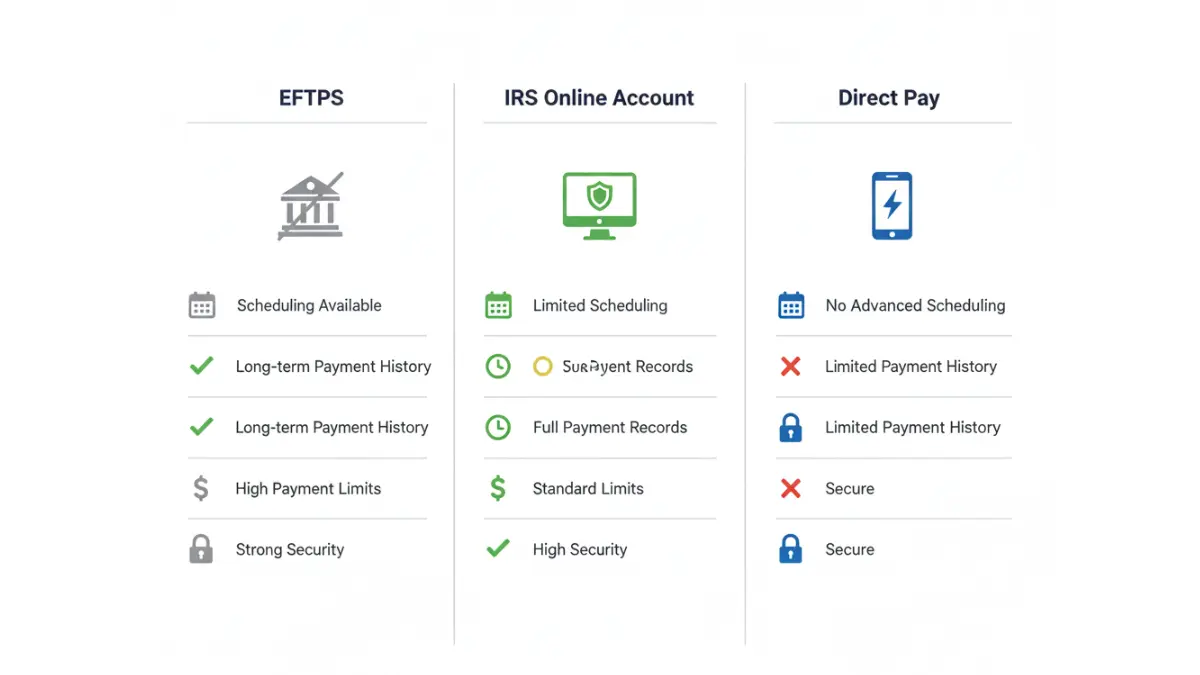
| Feature | EFTPS (Ending) | IRS Online Account | Direct Pay |
|---|---|---|---|
| Enrollment Required | Yes, 5-7 days for PIN | Yes, 10-15 minutes | No |
| Identity Verification | Mailed PIN | ID.me or Login.gov | Prior tax return data |
| Saved Information | Bank account, routing | Up to 5 bank accounts | None |
| Initial Access | After PIN arrival | Immediate after verification | Instant |
EFTPS required a formal enrollment process where you received a Personal Identification Number (PIN) via U.S. mail within 5-7 business days. This PIN, combined with your Taxpayer Identification Number and self-created password, provided three-factor authentication.
IRS Online Account streamlines enrollment to 10-15 minutes using modern identity verification through ID.me or Login.gov. These services verify your identity using government-issued ID and selfie matching.
Direct Pay requires no enrollment—you simply verify your identity each session using information from a recent tax return (filing status, SSN, refund or amount owed).
Payment Features and Capabilities
Phone Payments: EFTPS offered 24/7 automated phone payments at 1-800-555-3453. Neither replacement offers this convenience, though you can call IRS customer service to assist with Online Account payments.
Payment Scheduling:
- EFTPS: Up to 365 days advance
- IRS Online Account: Up to 365 days advance
- Direct Pay: Maximum 30 days advance
Payment Limits:
- EFTPS: $50 million per transaction
- IRS Online Account: $10 million per transaction
- Direct Pay: $10 million per transaction
Payment History Access:
- EFTPS: 15 months (download before account closes)
- IRS Online Account: 24 months
- Direct Pay: None (unless manually saved)
For businesses managing larger operations, payment tracking becomes as critical as monitoring performance metrics—similar to how real estate investors use our mortgage calculator to track property finances.
Security and Reliability Comparison
All three systems use bank-level 256-bit SSL encryption for data transmission. The U.S. Treasury guarantees security for each platform.
Multi-Factor Authentication:
- EFTPS: TIN + PIN + Password (three-factor)
- IRS Online Account: Login.gov/ID.me (two-factor with biometrics)
- Direct Pay: Tax return verification (knowledge-based)
Customer Service Access:
- EFTPS: Live agents at 1-800-555-4477 (24/7)
- IRS Online Account: General IRS support at 1-800-829-1040
- Direct Pay: Limited support for technical issues only
Tax Type Coverage
EFTPS supported all federal taxes:
- Individual income tax
- Employment/payroll taxes
- Corporate taxes
- Excise taxes
- Estate and gift taxes
- Non-profit organization taxes
IRS Online Account accepts:
- Form 1040 (individual income)
- Form 1040-ES (estimated tax)
- Form 1040-X (amended returns)
- Various penalty and interest payments
Direct Pay accepts:
- Most individual tax forms
- Form 1040 and related schedules
- Estimated tax payments
- Extension payments
Neither replacement handles business payroll deposits—businesses must continue using EFTPS for those obligations.
Step-by-Step: Transition From EFTPS to New Payment Methods
Follow this migration plan to ensure uninterrupted tax payment capability before the September 2026 deadline.
For Individuals With Scheduled 2026 Payments
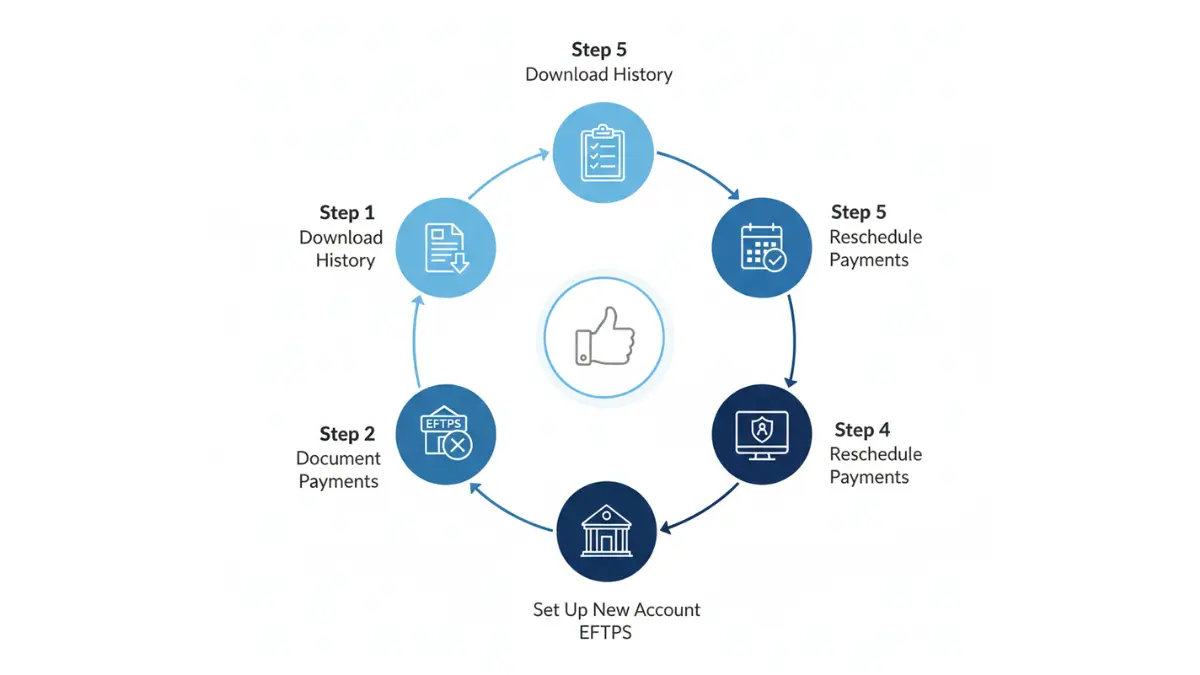
Step 1: Download Your EFTPS Payment History (By August 2026)
Log into your EFTPS account at eftps.gov and access your 15-month transaction history. Print or save as PDF for your tax records. This documentation proves payment dates if disputes arise.
Step 2: Document All Scheduled Future Payments
Review any payments scheduled beyond September 2026. Note:
- Payment dates
- Tax form numbers
- Payment amounts
- EFT acknowledgment numbers
Step 3: Cancel EFTPS Scheduled Payments
You must cancel scheduled payments at least 2 business days before the scheduled date. Call 1-800-555-3453 or use the online portal. Save your cancellation confirmation numbers.
Step 4: Set Up IRS Online Account
Visit IRS.gov and create your account:
- Click “Create Account”
- Choose ID.me or Login.gov
- Verify identity with government-issued ID
- Add bank account information
- Set up security preferences
Step 5: Reschedule Payments in New System
Transfer your payment schedule to IRS Online Account. For quarterly estimated taxes, you can schedule all four payments at once—just like the EFTPS advance scheduling feature that many taxpayers relied on.
For Businesses (No Action Required)
If you’re a business entity using EFTPS for payroll tax deposits, continue as normal. The shutdown affects only individual taxpayers. Businesses will receive separate guidance if changes affect commercial users.
Corporate taxpayers making deposits for Form 941 (quarterly payroll taxes) must continue using EFTPS as required by federal law. There’s currently no approved alternative for federal tax deposits.
What Happens to Your EFTPS PIN and Account Data
After September 2026, your EFTPS login credentials become inactive. The Treasury Department will permanently delete individual account data following standard government record retention policies.
Important: EFTPS PINs cannot be transferred to IRS Online Account. You’ll create entirely new credentials when setting up your replacement payment method.
Common Transition Issues and Solutions
Issue: “My quarterly estimated payment is scheduled for October 2026 through EFTPS”
Solution: You must cancel that payment before the September deadline and reschedule through IRS Online Account or make the payment via Direct Pay when due.
Issue: “I have automatic payments set up for the entire 2026 tax year”
Solution: Cancel all EFTPS scheduled payments and recreate the schedule in IRS Online Account, which offers identical 365-day advance scheduling.
Issue: “Can I still use my EFTPS login to view old payment confirmations?”
Solution: Download all necessary records before September 2026. After shutdown, historical EFTPS data won’t be accessible through the portal. The IRS maintains official records, but you’ll need to request transcripts through IRS.gov.
Just as understanding tax refund timing helps plan finances, knowing your payment transition timeline prevents costly late payment penalties.
Business Users: Why EFTPS Remains Mandatory
While individual access ends in 2026, businesses face a different reality. Federal law requires corporations to deposit federal tax obligations electronically, making EFTPS the primary approved system.
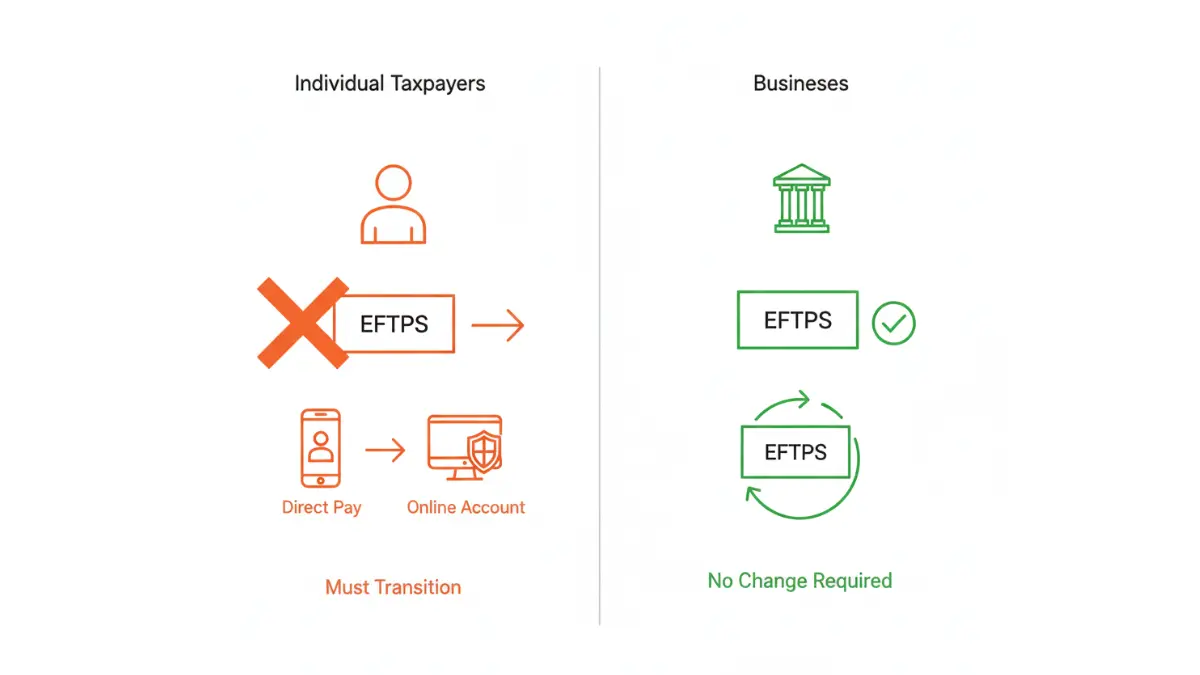
Required Business Uses for EFTPS
Federal Tax Deposits (FTDs): Employment taxes must be deposited electronically per IRS regulations. This includes:
- Social Security and Medicare taxes (FICA)
- Federal income tax withholding
- Federal Unemployment Tax (FUTA)
Corporate Estimated Payments: C-corporations making quarterly estimated tax payments exceeding certain thresholds must use electronic payment methods.
Payroll Service Providers: Third-party payroll processors typically use EFTPS for client tax deposits, as it allows batch processing for multiple employer accounts under single login credentials.
Business EFTPS Features Not Available Elsewhere
Batch Provider Software: Download free software from eftps.gov to process multiple client payments simultaneously. Tax professionals managing dozens of business clients rely on this capability.
Payment Limits: EFTPS accepts payments up to $50 million per transaction, far exceeding the $10 million cap on IRS Direct Pay.
Multi-Client Management: One EFTPS login can manage payments for unlimited business EINs, streamlining tax professional workflows.
Next-Day Scheduling: While individual payments required one-day advance scheduling, businesses can schedule same-day payments meeting specific criteria outlined in Treasury guidelines.
For business owners managing significant tax obligations, the precision required mirrors the attention needed when using our mortgage refinance calculator to evaluate debt restructuring decisions.
Frequently Asked Questions About EFTPS 2026 Changes
1. Can I still enroll in EFTPS as an individual in 2026?
No. Individual enrollment closed October 17, 2025. Only existing users can access the system until mandatory transition in September 2026.
2. What happens to my existing EFTPS account after September 2026?
Your account becomes inactive and inaccessible. Download payment history before the deadline, as the Treasury Department will delete individual account data.
3. Can businesses still use EFTPS indefinitely?
Yes. Business entities must continue using EFTPS for federal tax deposits and payroll obligations. The shutdown affects only individual taxpayers.
4. Is IRS Direct Pay as secure as EFTPS was?
Yes. Both systems use 256-bit SSL encryption matching banking industry standards. The IRS doesn’t store your bank information after processing payments through Direct Pay.
5. Can I schedule all four quarterly estimated payments at once with the new system?
Yes, through IRS Online Account. You can schedule up to 5 payments simultaneously and up to 365 days in advance—identical to EFTPS capabilities.
6. What if I miss the September 2026 deadline and don’t set up an alternative?
Scheduled EFTPS payments will fail after the deadline. You’ll need to make emergency payments using Direct Pay or card payments to avoid penalties. Set calendar reminders now.
7. Does the EFTPS shutdown affect payroll tax deposits for my small business?
No. Business payroll deposits must continue through EFTPS. The shutdown affects only individual income tax, estimated tax, and personal tax payments.
8. Can I still pay federal taxes by check instead of electronic methods?
While checks remain technically accepted, Executive Order 14247 strongly discourages them. The IRS may delay processing or request electronic payment setup, extending your payment timeline.
9. How do I download my EFTPS payment history before losing access?
Log into eftps.gov, navigate to payment history, and print or save all transactions from the past 15 months. Keep these records for IRS audit protection.
10. What’s the best EFTPS alternative for quarterly estimated tax payments?
IRS Online Account provides the closest match to EFTPS functionality, including advance scheduling for all four quarterly payments and payment history tracking.
11. Will the IRS notify me before my EFTPS access ends in September 2026?
Yes. The IRS will send notices to all enrolled individual users several months before the mandatory transition deadline, outlining required actions and alternatives.
Disclaimer
This article is for educational purposes only and does not constitute financial, tax, or legal advice. Tax laws, IRS procedures, and payment systems change frequently. The information provided reflects policies accurate as of February 2026 but may be updated by the U.S. Treasury Department or Internal Revenue Service.
Always consult with a qualified tax professional, Certified Public Accountant, or IRS representative for guidance specific to your tax situation. For the most current official information regarding federal tax payment methods and EFTPS transition timelines, visit IRS.gov or call the IRS directly at 1-800-829-1040.
financeauthorityhub.com provides educational tools and resources to help you make informed financial decisions. Our comprehensive financial calculators and expert-reviewed guides complement professional tax advice but should never replace it.
Related Articles
 Tax Filing & Deductions
W2 Form 2026: Read Every Box + Avoid Costly Mistakes
February 9, 2026 Tax Filing & Deductions
W9 Form 2026: Avoid 24% Penalty + Fill Guide
February 9, 2026 Tax Filing & Deductions
eFile Free in 2026: Get Your Refund 3x Faster [IRS]
February 7, 2026 Tax Filing & Deductions
TurboTax Free 2026: Only 37% Qualify — Do You Make the Cut?
February 7, 2026 Tax Filing & Deductions
Tax Refund 2026: Who Gets $1,000 More & How Fast
February 7, 2026 Tax Filing & Deductions
Structured Settlement Payments, Taxes, and Your Rights
May 7, 2026 Tax Filing & Deductions
1040 Tax Form 2026: Avoid 7 Costly Filing Mistakes
February 10, 2026 Tax Filing & Deductions
Tax Refund Up 20% in 2026: How to Claim Your $1,000 Starting January 26
January 17, 2026 Tax Filing & Deductions
1099 Form: Types, Deadlines + $340 Penalty (2026)
February 7, 2026
Informational disclaimer
The content on Finance Authority Hub is provided for general informational and educational purposes only and should not be considered personalized financial, investment, tax, legal, or professional advice. Financial decisions depend on your individual goals, income, risk tolerance, location, and regulatory situation. Before acting on any information, strategy, estimate, or calculator result, consult a qualified licensed professional who can evaluate your specific circumstances.