
Sales Tax Calculator: Exact Rate by State (Free)
Sales Tax Calculator
Calculate sales tax for multiple items with discounts, shipping, taxable/non-taxable lines, tax-inclusive or tax-exclusive pricing, detailed breakdown tables, scenarios, and CSV export.
Inputs
Exclusive mode uses: tax = taxable × rate; inclusive mode extracts tax from a tax-included total using: tax = total × rate ÷ (1+rate). [web:198][web:199]
Each item supports qty, unit price, % discount, fixed discount, and taxable/non-taxable status.
Results
Mode & rate
Mode: —
Effective rate: —
Main: — • Local: — • Special: —
Subtotal math
Gross subtotal: —
Net before order disc: —
Order discount: —
Net after order disc: —
Tax + total
Shipping: —
Taxable (net basis): —
Tax: —
Total: —
Tax breakdown (approx)
Main tax: —
Local tax: —
Special tax: —
Eff on taxable: — • Eff on total: —
Line-item breakdown (very detailed)
| # | Item | Qty | Unit | Gross | Item discounts | Order disc alloc | Net | Taxable | Tax (alloc) | Line total |
|---|
Rate sensitivity (same basket)
| Scenario | Effective rate | Tax | Total |
|---|
Results appear after you click “Calculate.”
In This Article
What Is a Sales Tax Calculator — And Why Your State Rate Alone Is Wrong
Most Americans pay the wrong sales tax amount — not intentionally, but because the U.S. has over 12,000 individual tax jurisdictions. Your state rate is just the starting point. Counties, cities, and special districts layer additional percentages on top, making your real combined rate significantly higher.
This free sales tax calculator gives you the exact combined rate — state + local + special — for any purchase, in any state, instantly.
Quick Answer: Sales tax = Purchase Price × Combined Tax Rate. On a $500 purchase at an 8.5% combined rate, your tax is $42.50, making the total $542.50.
What This Tool Calculates That Others Don’t:
- Multiple items in a single order (with individual taxable/non-taxable flags)
- Item-level and order-level discounts
- Shipping taxability (varies by state)
- Tax-exclusive pricing (tax added at checkout) and tax-inclusive pricing (tax buried in the price)
- Rate sensitivity scenarios (what happens if rate changes ±1%)
- Full CSV export for business records
What This Means For You: Even two neighboring ZIP codes in the same state can carry different combined rates. Always use the full combined rate — not just the state rate — to avoid underpaying or overcharging.
How to Calculate Sales Tax — Step-by-Step Guide (2026)
You don’t need an accountant to calculate sales tax correctly. Follow these five steps every time.
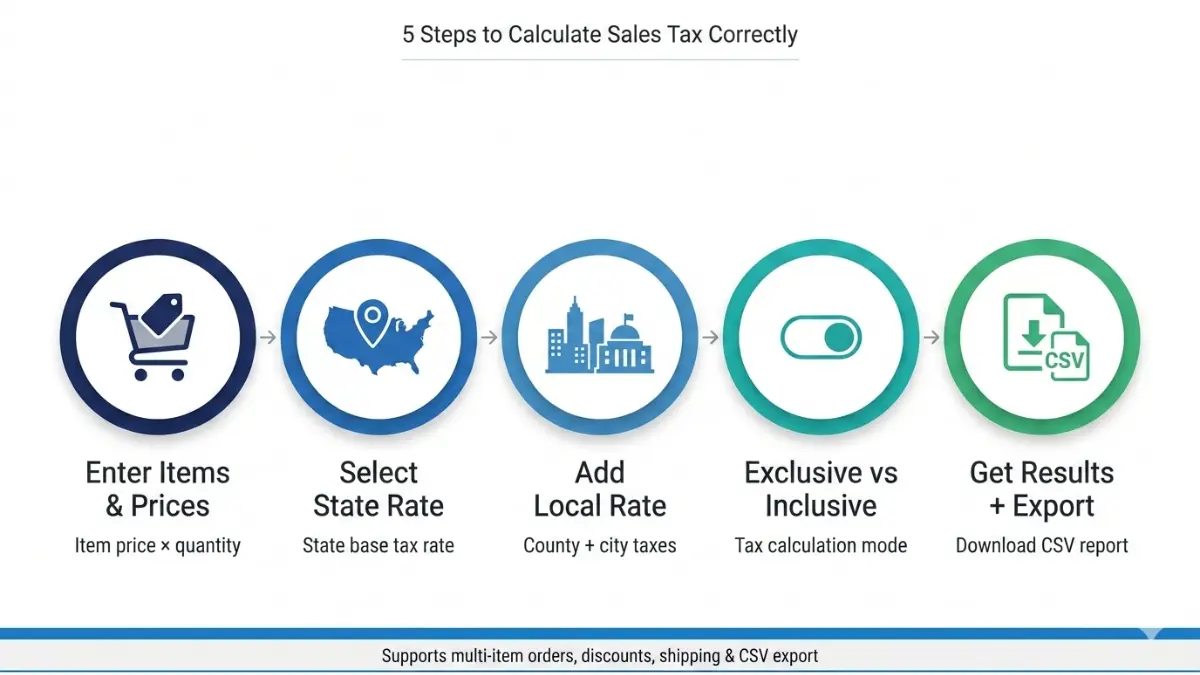
Step 1 — Enter Your Items and Prices
Add each item you’re purchasing with its unit price and quantity. Mark items that are non-taxable (groceries, prescription drugs, exempt clothing) separately — this prevents over-calculating your tax bill.
Pro tip: In states like New York, clothing under $110 per item is fully exempt. Mixing taxable and non-taxable items in one calculation without separating them is the #1 shopper mistake.
Step 2 — Select Your State Tax Rate
Every state sets a base rate. Enter the state rate for where the purchase is delivered — not where you live, and not where the seller is located. The U.S. uses destination-based sourcing for most retail sales.
Pro tip: For auto loan and vehicle purchases, the tax is based on your registration state — not the dealership’s state.
Step 3 — Add Your Local and Special Tax Rates
This is where most calculators fail you. Below your state rate, add:
- County rate (e.g., Cook County, IL adds 1.75%)
- City rate (e.g., Chicago adds 1.25% on top of that)
- Special district rate (transit, tourism, stadium taxes)
Real example: A Chicago, IL purchase at $1,000 carries a 10.25% combined rate — not Illinois’s base 6.25%. That’s $102.50 vs. $62.50. A $40 difference on just $1,000.
Step 4 — Choose Your Tax Mode
Our calculator supports two modes that no major competitor offers together:
| Mode | How It Works | When to Use |
|---|---|---|
| Tax-Exclusive | Tax added on top of price | Standard U.S. retail (most common) |
| Tax-Inclusive | Tax already buried in listed price | UK VAT, some international purchases |
Formula (Exclusive): Tax = Price × Rate Formula (Inclusive): Tax = Total × Rate ÷ (1 + Rate)
Step 5 — Get Your Instant Breakdown and Download CSV
Click Calculate to get:
- Line-by-line tax allocation per item
- Order-level discount impact on taxable base
- Rate sensitivity table (±1% scenarios)
- Full CSV download for expense tracking or business records
Businesses managing multiple purchase categories can also use our ROI calculator to factor post-tax costs into profitability analysis.
2026 Sales Tax Rates by State — Complete Reference Table
The U.S. has no federal sales tax. Every rate you pay comes from a combination of state, county, city, and district taxes — and they vary dramatically. Here are the official 2026 combined rates sourced from the Tax Foundation’s 2026 state sales tax report.
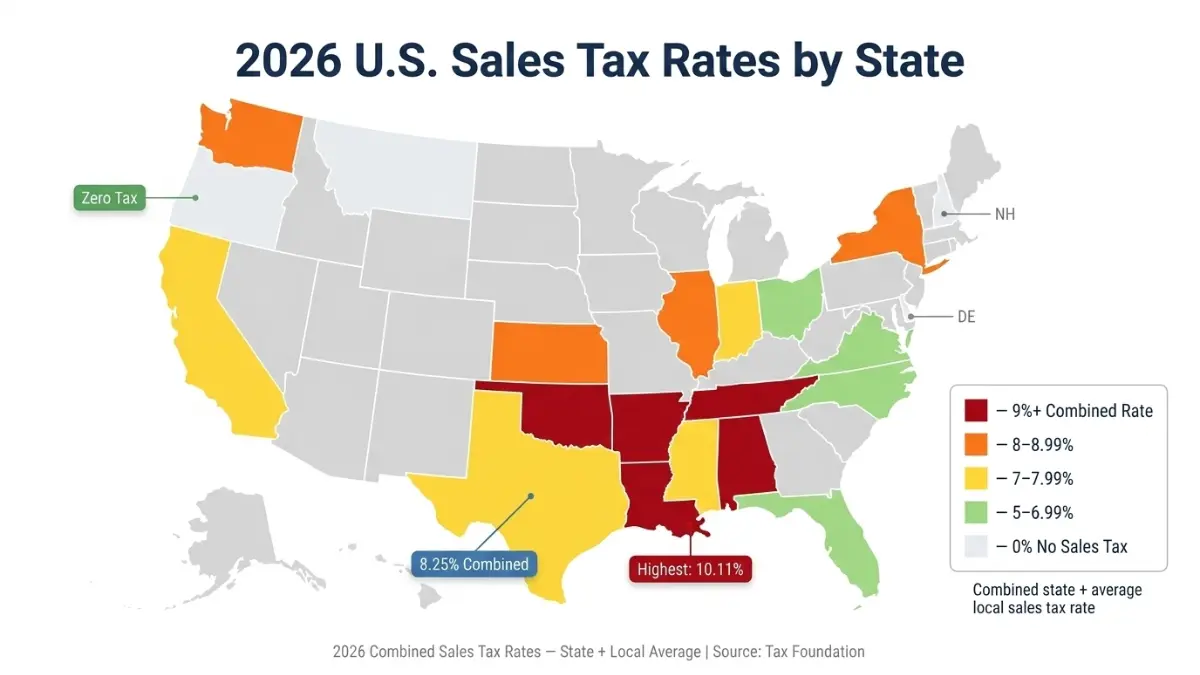
2026 State Sales Tax Rates — All 50 States
| State | State Rate | Avg. Local Rate | Max Combined Rate |
|---|---|---|---|
| Alabama | 4.00% | 5.46% | 13.50% |
| Alaska | 0.00% | 1.76% | 7.50% |
| Arizona | 5.60% | 2.77% | 11.20% |
| Arkansas | 6.50% | 2.97% | 11.50% |
| California | 7.25% | 1.43% | 10.75% |
| Colorado | 2.90% | 4.99% | 11.20% |
| Connecticut | 6.35% | 0.00% | 6.35% |
| Delaware | 0.00% | 0.00% | 0.00% |
| Florida | 6.00% | 1.01% | 7.50% |
| Georgia | 4.00% | 3.35% | 8.90% |
| Hawaii | 4.00% | 0.44% | 4.50% |
| Idaho | 6.00% | 0.03% | 8.50% |
| Illinois | 6.25% | 2.49% | 11.50% |
| Indiana | 7.00% | 0.00% | 7.00% |
| Iowa | 6.00% | 0.94% | 7.00% |
| Kansas | 6.50% | 2.22% | 11.60% |
| Kentucky | 6.00% | 0.00% | 6.00% |
| Louisiana | 4.45% | 5.11% | 11.45% |
| Maine | 5.50% | 0.00% | 5.50% |
| Maryland | 6.00% | 0.00% | 6.00% |
| Massachusetts | 6.25% | 0.00% | 6.25% |
| Michigan | 6.00% | 0.00% | 6.00% |
| Minnesota | 6.875% | 0.59% | 8.375% |
| Mississippi | 7.00% | 0.07% | 8.07% |
| Missouri | 4.225% | 4.14% | 11.99% |
| Montana | 0.00% | 0.00% | 0.00% |
| Nebraska | 5.50% | 1.44% | 7.50% |
| Nevada | 6.85% | 1.38% | 8.375% |
| New Hampshire | 0.00% | 0.00% | 0.00% |
| New Jersey | 6.625% | -0.03% | 6.625% |
| New Mexico | 5.00% | 2.72% | 9.0625% |
| New York | 4.00% | 4.54% | 8.875% |
| North Carolina | 4.75% | 2.23% | 7.50% |
| North Dakota | 5.00% | 1.97% | 8.50% |
| Ohio | 5.75% | 1.49% | 8.00% |
| Oklahoma | 4.50% | 4.56% | 11.50% |
| Oregon | 0.00% | 0.00% | 0.00% |
| Pennsylvania | 6.00% | 0.34% | 8.00% |
| Rhode Island | 7.00% | 0.00% | 7.00% |
| South Carolina | 6.00% | 1.43% | 9.00% |
| South Dakota | 4.50% | 1.90% | 6.50% |
| Tennessee | 7.00% | 2.55% | 9.75% |
| Texas | 6.25% | 1.94% | 8.25% |
| Utah | 6.10% | 1.09% | 9.05% |
| Vermont | 6.00% | 0.22% | 7.00% |
| Virginia | 5.30% | 0.43% | 7.00% |
| Washington | 6.50% | 2.73% | 10.50% |
| West Virginia | 6.00% | 0.39% | 7.00% |
| Wisconsin | 5.00% | 0.44% | 6.75% |
| Wyoming | 4.00% | 1.36% | 6.00% |
| D.C. | 6.00% | 0.00% | 6.00% |
Source: Tax Foundation, January 2026. Combined rates include state + weighted average local rates.
The 5 States With Zero Sales Tax (NOMAD States)
Five states charge no statewide sales tax at all: Alaska, Delaware, Montana, New Hampshire, and Oregon.
- Alaska is the exception — while there’s no state tax, local jurisdictions can charge up to 7.5%
- Delaware has no sales tax at any level — making it a popular destination for large purchases
- Montana, New Hampshire, and Oregon are fully tax-free for retail purchases
2026 Highest vs. Lowest Combined Rates
| Category | State | Combined Rate |
|---|---|---|
| 🔴 Highest | Louisiana | 10.11% avg. |
| 🔴 Second | Tennessee | 9.55% avg. |
| 🔴 Third | Arkansas | 9.47% avg. |
| 🟢 Lowest (taxed) | Hawaii | 4.44% avg. |
| 🟢 Second | Wisconsin | 5.42% avg. |
| 🟢 Zero tax | Oregon / Delaware / Montana / NH | 0.00% |
What This Means For You: Buying a $25,000 car in Louisiana costs $2,527 in sales tax. The same car in Oregon costs $0. Your purchase location is a major financial decision.
Sales Tax Formula + Real-World Purchase Examples
Understanding the math helps you verify every receipt and avoid overpaying.
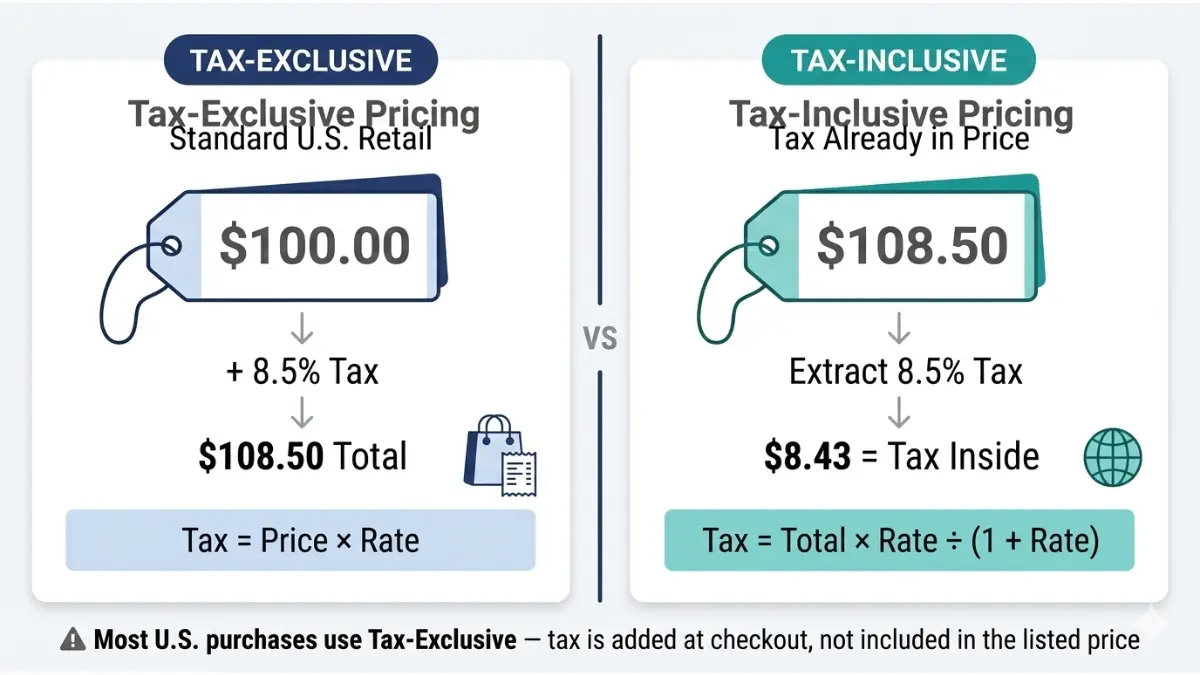
The Official Sales Tax Formula
Tax-Exclusive (standard U.S. retail):
Sales Tax = Purchase Price × (Combined Rate ÷ 100)Total Price = Purchase Price + Sales Tax
Tax-Inclusive (price includes tax — used internationally and in some U.S. contexts):
Extracted Tax = Total Price × Rate ÷ (1 + Rate)
4 Real Purchase Examples — 2026 Rates
| Purchase | State | Combined Rate | Tax Amount | Total Cost |
|---|---|---|---|---|
| $500 laptop | California (LA) | 10.25% | $51.25 | $551.25 |
| $25,000 car | Texas | 8.25% | $2,062.50 | $27,062.50 |
| $1,200 sofa | New York (NYC) | 8.875% | $106.50 | $1,306.50 |
| $80 jacket | Oregon | 0.00% | $0.00 | $80.00 |
When buying a vehicle, sales tax is one of the largest upfront costs. Use our auto loan calculator to factor the full tax amount into your financing — many buyers roll it into their loan without realizing the interest impact.
Does Sales Tax Apply to Shipping?
This is one of the most misunderstood sales tax rules in the U.S. The answer depends entirely on your state:
- Taxable shipping states (25+): Texas, California, Illinois, Pennsylvania — shipping charges are treated as part of the sale price
- Non-taxable shipping states: Florida, California (if separately stated on invoice), Virginia — shipping is generally exempt if listed separately
- Mixed states: Some states only tax shipping if the item shipped is taxable
Bottom line: Always verify shipping taxability in your specific state. The IRS Sales Tax Deduction Calculator helps consumers estimate deductible sales tax for federal itemized returns.
Tax-Inclusive vs. Tax-Exclusive: A Real-World Difference
When you buy online from international retailers or certain B2B platforms, prices are often tax-inclusive — the tax is already baked in. Here’s what that looks like:
Example: A product listed at $107.50 (tax-inclusive) at an 8.5% rate.
- Extracted tax: $107.50 × 0.085 ÷ 1.085 = $8.43
- Pre-tax price: $107.50 – $8.43 = $99.07
Our calculator handles both modes — something no top competitor currently offers in a single free tool.
Sales Tax Exemptions, Biggest Mistakes & Expert Insight
Not everything you buy is taxable. Knowing what’s exempt can save you hundreds every year.
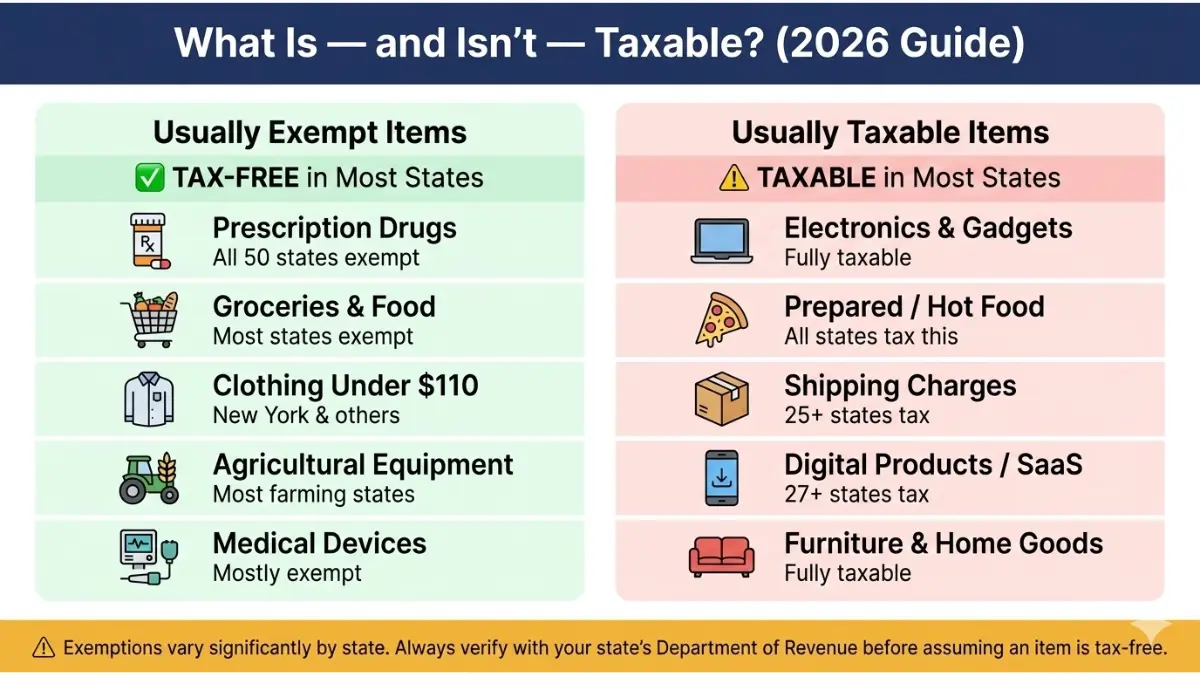
Common Sales Tax Exemptions by Category — 2026
| Category | Exempt in Most States? | Key Exceptions |
|---|---|---|
| Groceries / Food | ✅ Yes | Tennessee (4%), Mississippi (7%), South Dakota (4.5%) |
| Prescription Drugs | ✅ All 50 states | No exceptions — universally exempt |
| OTC Medications | ⚠️ Partial | Many states tax over-the-counter drugs |
| Clothing | ❌ Varies | NY exempts items under $110; most states tax all clothing |
| Digital Products / SaaS | ❌ Growing | 27+ states now tax digital goods and software subscriptions |
| Agricultural Equipment | ✅ Most states | Varies significantly by product type |
| Medical Devices | ✅ Mostly exempt | Some states tax durable medical equipment |
Key takeaway: If you’re paying sales tax on prescription medication at checkout, that’s an error — report it. All 50 states exempt prescription drugs from sales tax under state law.
Understanding your tax obligations also connects to your broader financial health. Our budget calculator can help you model annual sales tax costs as a line item in your monthly spending plan.
5 Biggest Sales Tax Mistakes — Shoppers and Businesses
Mistake #1: Using the state rate only The single most common error. Illinois’s state rate is 6.25%, but Chicago residents pay 10.25%. Using the state rate alone means you’re calculating $37.50 less tax on every $600 purchase.
Mistake #2: Assuming online purchases are tax-free This ended in 2018. The U.S. Supreme Court’s ruling in South Dakota v. Wayfair established that online sellers must collect sales tax in states where they have economic nexus — typically $100,000 in sales or 200 transactions per year. Online purchases from major retailers (Amazon, Walmart, Target) almost always include sales tax now.
Mistake #3: Ignoring use tax obligations If you buy from an out-of-state seller who doesn’t collect your state’s sales tax, you legally owe use tax — equal to your local sales tax rate — on that purchase. Most consumers are unaware of this obligation, which is reported on your state income tax return.
Mistake #4: Not knowing your exemption thresholds In New York, a single clothing item under $110 is exempt. But three items each costing $100 are all exempt individually — yet that same $300 purchase in a bundle may trigger tax. The structure of your purchase matters.
Mistake #5: Overpaying sales tax on tax-inclusive prices International purchases and some subscription services list tax-inclusive prices. Applying the tax rate again on top of a tax-inclusive price results in double-counting the tax.
Expert Panel Insight
“Sales tax is the most underestimated recurring expense in American household budgets. The average U.S. family in a high-tax state pays $1,200–$1,800 per year in sales tax without consciously tracking it. Knowing your combined rate — and what’s exempt — is the first step to controlling it.” — Laura M. Bennett, CFP®, Finance Authority Hub Expert Panel
“Post-Wayfair, businesses with even modest online sales need to track economic nexus thresholds across every state they sell into. Non-compliance isn’t just a fine risk — it’s a back-tax liability that compounds with interest. Proper sales tax calculation from day one is significantly cheaper than remediation.” — Daniel Moreau, CPA/CFP, Finance Authority Hub Expert Panel
For businesses, sales tax liability directly impacts cash flow planning. Our business loan calculator lets you factor recurring tax obligations into your financing needs.
Sales Tax vs. Use Tax — The Difference Most Americans Don’t Know
Sales tax is collected by the seller at the point of sale and remitted to the state.
Use tax is owed by the buyer when sales tax was never collected — typically on out-of-state or online purchases from sellers without nexus in your state. The rate is identical to your local sales tax rate.
Real example: You order $500 of furniture from an out-of-state retailer. They don’t charge California’s 9.5% combined rate. You legally owe California $47.50 in use tax — reported on your CA state income tax return. Most people don’t pay it. California aggressively audits for it on business returns.
Understanding your full tax picture — including federal obligations — is covered in detail in our 2026 tax brackets guide.
Frequently Asked Questions About Sales Tax
1. What is a sales tax calculator?
A sales tax calculator is a free tool that computes the exact sales tax owed on a purchase by combining your state rate, local rate, and any special district rates. This one also handles multi-item orders, discounts, and shipping.
2. How do I calculate sales tax manually?
Multiply the purchase price by your combined tax rate (as a decimal). Example: $200 purchase × 0.085 = $17.00 in tax. Add that to $200 for a $217.00 total.
3. Which states have no sales tax in 2026?
Alaska, Delaware, Montana, New Hampshire, and Oregon — the “NOMAD” states. Note that Alaska allows local municipalities to charge up to 7.5%.
4. What is the highest sales tax state in 2026?
Louisiana holds the highest combined average at 10.11%, followed by Tennessee (9.55%) and Arkansas (9.47%). Per the Tax Foundation’s 2026 data, no state-wide rate change occurred between July 2025 and January 2026.
5. Do I pay sales tax on online purchases?
Yes — in almost all cases since the 2018 South Dakota v. Wayfair Supreme Court ruling. Major retailers automatically collect the correct combined rate for your delivery address.
6. Is shipping taxable?
It depends on your state. Over 25 states tax shipping charges, including Texas and California. Florida generally exempts separately stated shipping. Always check your specific state’s rules.
7. What’s the difference between tax-exclusive and tax-inclusive pricing?
Tax-exclusive pricing adds tax at checkout (standard U.S. retail). Tax-inclusive pricing has tax already embedded in the listed price (common in UK VAT and some international B2B transactions). Our calculator handles both with a single toggle.
8. Are groceries exempt from sales tax?
Most states exempt basic grocery staples. But Tennessee taxes food at 4%, Mississippi at 7%, and South Dakota at 4.5%. Prepared or hot food is taxable in virtually every state, even those that exempt cold groceries.
9. What is use tax and do I owe it?
Use tax applies when you purchase goods from a seller who didn’t collect your state’s sales tax — common in out-of-state or international online orders. The rate equals your local sales tax rate, and it’s self-reported on your state income tax return.
10. Can small businesses use this calculator?
Yes. The tool supports multi-item purchases, order-level and item-level discounts, taxable vs. non-taxable line items, shipping taxability, and full CSV export — making it fully functional for business purchase tracking and invoice verification.
11. How often do sales tax rates change?
Frequently at the local level — counties and cities adjust rates quarterly in some states. State-level changes are rarer. For the most current official rates, always verify with your state’s department of revenue before filing.
⚠️ Disclaimer: This sales tax calculator and all supporting content are for informational and educational purposes only. Tax rates are based on publicly available 2026 data sourced from the Tax Foundation and IRS, and may not reflect the most recent local-level adjustments. This article does not constitute financial, legal, or tax advice. For decisions specific to your business or personal tax situation, consult a licensed CPA or tax professional. Official state rates are always available through your state’s department of revenue.
Informational disclaimer
The content on Finance Authority Hub is provided for general informational and educational purposes only and should not be considered personalized financial, investment, tax, legal, or professional advice. Financial decisions depend on your individual goals, income, risk tolerance, location, and regulatory situation. Before acting on any information, strategy, estimate, or calculator result, consult a qualified licensed professional who can evaluate your specific circumstances.