Direct Public Offering: Save $3M vs IPO [2026 Guide]
Discover how Direct Public Offerings let companies go public while saving $3M+ vs traditional IPOs. Explore Regulation D, Reg A+, and S-1 routes with real 2026 cost data and case studies.

In This Article
A Direct Public Offering (DPO) lets companies sell shares directly to the public without investment bank underwriters, potentially saving $3 million or more in fees while maintaining founder control. Unlike traditional IPOs that require expensive roadshows and 6-month lockup periods, DPOs offer a faster, more cost-effective path to public markets for well-capitalized companies with strong brand recognition.
This 2026 guide breaks down three regulatory pathways (Regulation D, Regulation A+, and S-1 direct listings), real cost comparisons using Spotify and Slack data, and a step-by-step implementation process to help mid-sized companies ($10M-$100M revenue) determine if skipping Wall Street middlemen makes financial sense.
How Direct Public Offerings Save Companies $3M+ vs Traditional IPOs
The cost differential between direct public offerings and traditional IPOs can exceed $3 million for mid-sized companies, making DPOs increasingly attractive in 2026’s capital markets. Investment bank underwriting fees alone typically consume 7% of capital raised in IPOs, while DPOs eliminate this expense entirely.
Cost Breakdown: IPO vs DPO
| Cost Category | Traditional IPO | Direct Public Offering | Average Savings |
|---|---|---|---|
| Underwriting fees | $3M-$7M (7% of raise) | $30K-$100K (advisors only) | $2.9M-$6.9M |
| Legal/compliance | $1M-$2M | $100K-$300K | $900K-$1.7M |
| Roadshow/marketing | $500K-$1M | $0-$50K | $450K-$950K |
| Total timeline | 12-18 months | 1-6 months | 6-17 months faster |
| Share dilution | Yes (new shares) | No (existing shares) | Preserves equity |
Companies like Uber paid $106 million in underwriting fees for their 2019 IPO. In contrast, Spotify’s 2018 direct listing cost approximately $32 million in financial advisor fees—saving an estimated $120 million compared to traditional underwriting costs according to SEC public filings.
Real 2026 Examples: Who Saved What
Spotify’s Direct Listing Success (April 2018):
- Valuation at listing: $26 billion
- Advisor fees paid: €29 million (~$32M)
- Estimated IPO underwriting savings: $120M+
- Result: Opened at $165.90 vs $132.50 reference price (25% premium)
Slack’s DPO Model (June 2019):
- Valuation at listing: $7 billion
- Advisor fees: $22 million
- Estimated savings vs IPO: $78 million
- Innovation: Implemented partial selling restrictions (47% float) for price stability
Coinbase Direct Listing (April 2021):
- First major cryptocurrency exchange via DPO
- Context: Bitcoin trading above $32,000 (up 260% year-over-year)
- Avoided estimated $175M+ in traditional underwriting costs
- Successfully navigated volatile crypto markets without underwriter support
Process Differences That Drive Savings
| Feature | Traditional IPO | Direct Public Offering |
|---|---|---|
| Underwriters required | Yes (multiple banks) | No (optional advisors) |
| New capital raised | Yes | No (liquidity only) |
| Lockup period | 6 months standard | None |
| Price discovery | Roadshow negotiations | Market-driven auction |
| Marketing costs | $500K-$1M roadshow | Minimal (<$50K) |
| Retail investor access | Limited allocation | Full access day one |
The fundamental difference lies in share issuance. IPOs create new shares that dilute existing shareholders while raising fresh capital for company operations. DPOs simply allow existing shareholders—founders, employees, early investors—to sell their stakes directly on public markets, similar to how home equity unlocks capital without taking on new debt.
When Each Approach Makes Financial Sense
Choose IPO when:
- Company needs $50M+ in fresh operating capital
- Brand requires extensive investor education
- Management wants price stabilization support
- Guaranteed minimum subscription desired
- Small or concentrated shareholder base exists
Choose DPO when:
- Well-capitalized with no immediate cash needs
- Strong brand recognition already established
- 100+ existing shareholders seeking liquidity
- Can tolerate day-one price volatility
- Want to save $3M+ in underwriting fees
The decision mirrors choosing between debt consolidation strategies—selecting the most cost-effective path depends on your specific financial position and immediate capital requirements.
3 Regulatory Routes for Your Direct Public Offering in 2026
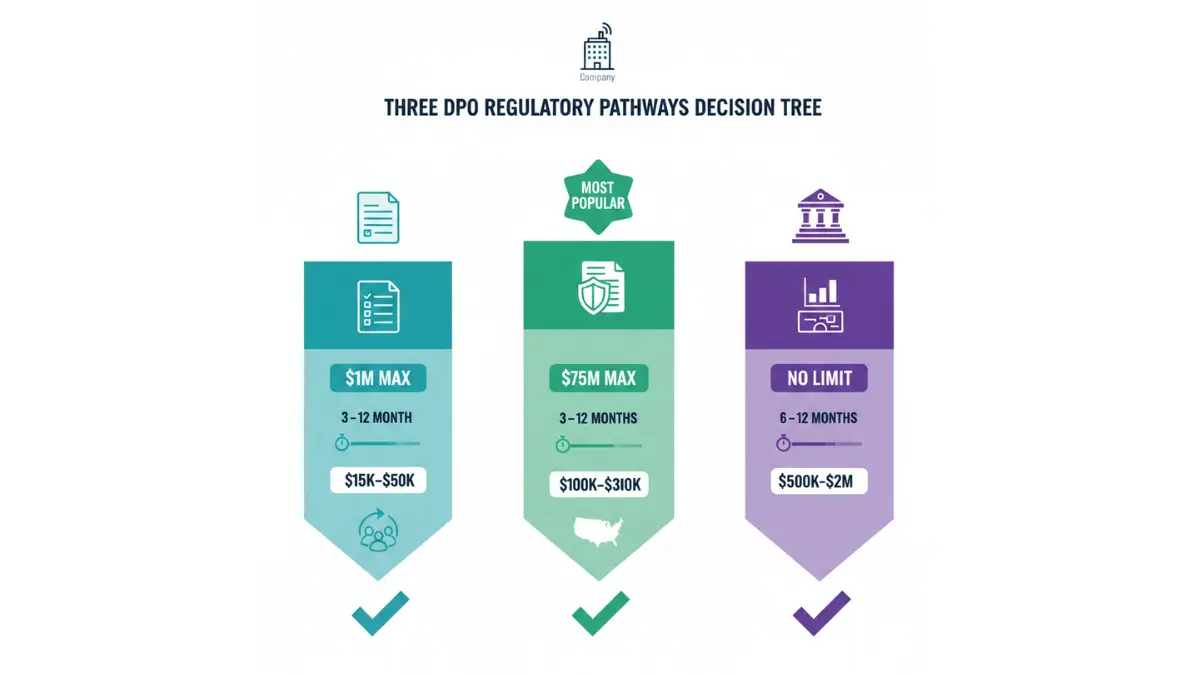
Unlike competitors who conflate “direct listing” and “DPO” as synonymous terms, three distinct regulatory pathways exist under SEC regulations for companies pursuing public offerings without traditional underwriters. Each route serves different company sizes and capital needs.
Route 1: Regulation D (Small Corporate Offering Registration)
Regulation D under SEC Rule 506 provides the fastest, lowest-cost DPO pathway for community-focused businesses and early-stage companies.
Key specifications:
- Maximum raise: $1 million per 12-month period
- Cost range: $15,000-$50,000 total
- Timeline: 1 month minimum
- Investor requirements: Both accredited and non-accredited investors permitted
- State compliance: Must register with state securities regulators
- Financial statements: Unaudited acceptable
- Best for: Local businesses, cooperatives, nonprofit loan funds
California’s Sustainable Economies Law Center reports that Regulation D offerings work particularly well for community-supported enterprises like farmers’ markets and regional food distributors seeking capital from their existing customer base.
2026 considerations: State blue sky law compliance varies significantly. Delaware, Wyoming, and Nevada offer streamlined registration processes, while states like California impose more rigorous review requirements that can extend timelines.
Route 2: Regulation A+ (The “Mini-IPO”)
Regulation A+, expanded under the 2012 JOBS Act and updated in 2015, creates a two-tier structure allowing companies to raise substantial capital while maintaining lower compliance costs than full SEC registration.
Tier 1 Specifications:
- Maximum raise: $20 million per 12-month period
- State registration: Required in each state where securities sold
- Financial audit: Not required (unaudited acceptable)
- Ongoing reporting: None required
- Investment limits: None for any investor type
- Cost estimate: $50,000-$150,000
Tier 2 Specifications:
- Maximum raise: $75 million per 12-month period (increased from $50M in 2020)
- State registration: Preempted (federal filing only)
- Financial audit: Two-year GAAP audit required
- Ongoing reporting: Semi-annual and annual reports to SEC via EDGAR
- Investment limits: Non-accredited investors limited to 10% of annual income or net worth (whichever greater)
- Cost estimate: $100,000-$300,000
According to SEC Division of Economic and Risk Analysis data from May 2025, Tier 2 offerings accounted for 95% of all Regulation A+ proceeds raised between 2015-2024, totaling over $9.4 billion despite higher compliance costs. The state preemption advantage outweighs the audit expense for most companies.
Why Tier 2 dominates: State blue sky law compliance for Tier 1 offerings can cost $25,000-$75,000 per state and extend timelines by 3-6 months. Tier 2’s federal preemption eliminates this friction while opening access to investors nationwide.
Route 3: S-1 Direct Listing (Spotify Model)
Full S-1 registration enables the largest companies to bypass underwriters while accessing major stock exchanges like NYSE and NASDAQ.
Specifications:
- Maximum raise: No limit
- Cost range: $500,000-$2 million (advisor fees, legal, compliance)
- Timeline: 6-12 months for SEC review
- Requirements: Full financial disclosure, multi-year audited statements, extensive risk factors
- Ongoing compliance: Full Exchange Act reporting (10-K, 10-Q, 8-K filings)
- Ideal company profile: $500M+ valuation, household name recognition, diverse shareholder base
- Exchange listing: Direct to NYSE/NASDAQ from day one
The S-1 route requires companies to demonstrate sufficient liquidity and investor interest without underwriter support. Harvard Law School’s Corporate Governance Forum research on Spotify’s pioneering 2018 direct listing identified critical success factors: well-capitalized balance sheet, no immediate capital needs, 100+ million users providing brand recognition, and substantial existing trading on secondary markets establishing price discovery.
Choosing Your Regulatory Pathway
| Your Company Profile | Recommended Route | Why |
|---|---|---|
| Revenue <$5M, local focus | Regulation D | Lowest cost ($15K-$50K), fastest (1 month) |
| Revenue $10-50M, growth stage | Regulation A+ Tier 2 | Balance of scale ($75M cap) and cost ($100K-$300K) |
| Revenue $100M+, national brand | S-1 Direct Listing | Maximum visibility, major exchange access |
| Need capital immediately | Traditional IPO | DPO doesn’t raise fresh funds |
This decision framework parallels choosing between mortgage refinancing options—the optimal path depends on your current financial position, timeline urgency, and long-term strategic goals.
How to Execute a Successful Direct Public Offering: 7 Critical Steps
While competitors describe DPOs theoretically, this implementation roadmap provides actionable guidance based on actual company experiences from 2015-2026.
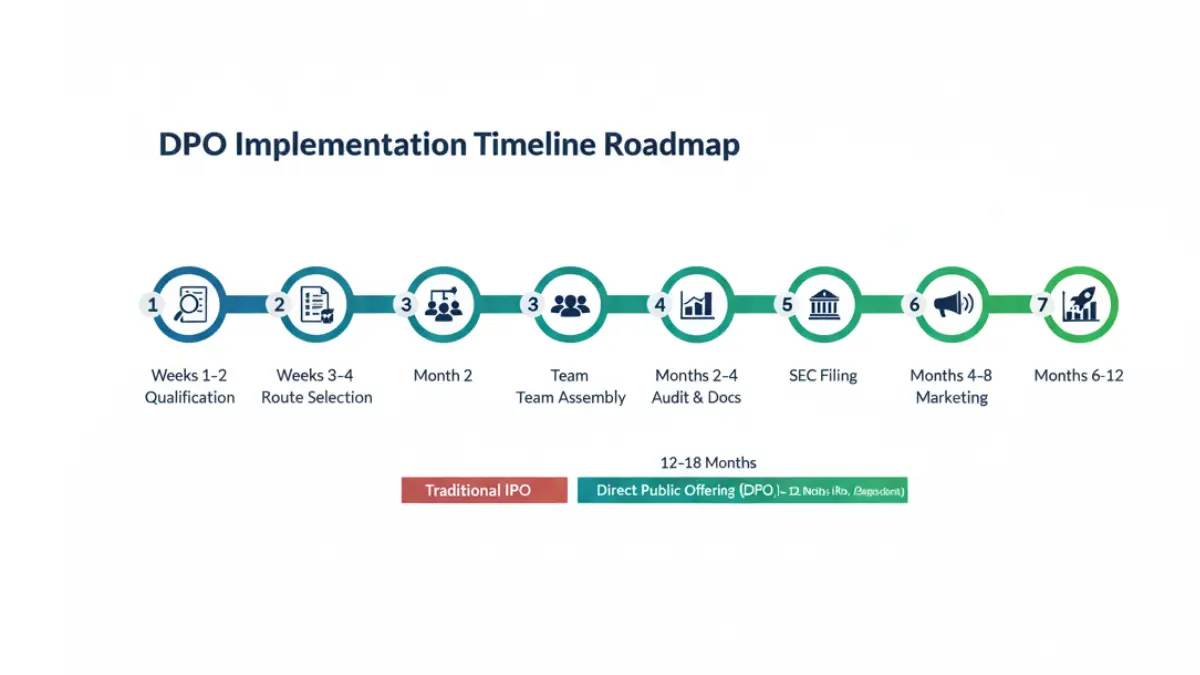
Step 1: Qualification Assessment (Weeks 1-2)
Before engaging attorneys or advisors, conduct internal evaluation against proven success criteria.
DPO Qualification Checklist:
- ✅ Brand recognition among target investor base (B2C) or institutional familiarity (B2B)
- ✅ Existing shareholder base of 100+ investors seeking liquidity
- ✅ Profitable operations OR clear path to profitability within 12 months
- ✅ Clean financial records suitable for audit (if Reg A+ Tier 2 or S-1)
- ✅ No immediate need for fresh operating capital
- ✅ Ability to tolerate 20-30% day-one price volatility
- ✅ Management bandwidth for 6-12 month process
- ✅ Willingness to accept ongoing public company reporting (Tier 2/S-1)
Red flags indicating IPO better suited:
- ❌ Unknown brand requiring extensive investor education
- ❌ Concentrated shareholder base (<50 investors)
- ❌ Immediate need for $50M+ fresh capital for operations
- ❌ Inconsistent revenue or mounting losses without clear turnaround
- ❌ Founders unwilling to accept market-driven pricing volatility
Latham & Watkins, the law firm that guided both Spotify and Slack through direct listings, emphasizes in their Harvard Law School case study: “The success of Spotify’s direct listing was due in part to being a well-capitalized company with no immediate need to raise additional capital, while also having a large and diverse shareholder base.”
Step 2: Regulatory Pathway Selection (Weeks 3-4)
Engage securities attorney specializing in DPOs for initial consultation ($5,000-$15,000) to evaluate which regulatory route optimizes for your company’s size, investor base, and timeline.
Decision factors:
- Company valuation and capital raise target
- Existing geographic distribution of potential investors (single state vs nationwide)
- Appetite for ongoing SEC reporting requirements
- Budget allocation for legal/compliance costs
- Target timeline for public trading
Consultation deliverables:
- Preliminary eligibility assessment for each route
- Estimated total cost breakdown by pathway
- Timeline projection including state registration delays
- Risk analysis of your specific company profile
- Initial advisor team recommendations
Step 3: Advisory Team Assembly (Month 2)
Unlike IPOs requiring multiple underwriter banks, DPOs operate with leaner advisory structures focused on compliance and process management.
Required team members:
- Securities attorney: Reg A+/DPO expertise mandatory ($75K-$250K depending on route)
- Auditor: GAAS-compliant firm for Tier 2/S-1 financial statements ($30K-$100K)
- Financial advisors: Optional but recommended for S-1 direct listings ($30K-$500K)
- FINRA-registered broker: Required for Reg A+ to ensure compliance (fees vary)
Advisory selection criteria:
- Demonstrated Regulation A+ or direct listing experience (verify via prior clients)
- Industry-specific expertise in your sector
- Transparent fee structures with no hidden costs
- References from companies similar to your profile
- Timeline commitment aligned with your launch goals
Spotify hired Goldman Sachs, Morgan Stanley, and Allen & Co. as financial advisors (not underwriters) for their 2018 direct listing, paying approximately $32 million total—a fraction of typical underwriting fees that would have exceeded $150 million for their $26 billion valuation.
Step 4: Financial Audit & Documentation (Months 2-4)
Financial statement requirements escalate with each regulatory tier, requiring parallel workstreams with your accounting team.
Regulation D requirements:
- Unaudited financial statements acceptable
- Basic offering memorandum describing business and risks
- Subscription agreement for investor purchases
- State filing forms (vary by jurisdiction)
Regulation A+ Tier 2 requirements:
- Two-year GAAP-compliant audited financial statements (or since inception if younger)
- Comprehensive Form 1-A offering circular (similar to IPO prospectus)
- Risk factors disclosure
- Management discussion and analysis (MD&A)
- Use of proceeds statement
S-1 Direct Listing requirements:
- Three-year audited financial statements under GAAS
- Full Form S-1 registration statement with extensive disclosures
- Business description, competitive landscape analysis
- Executive compensation details
- Legal proceedings disclosure
- Risk factors (typically 20-40 pages)
Budget 3-6 months for audit completion depending on accounting system sophistication and historical record quality. Companies with clean books maintained on accrual basis accelerate through this phase; cash-basis businesses require conversion work adding 30-60 days.
Step 5: SEC Filing & Review Process (Months 3-6)
Submit your offering statement via SEC’s EDGAR system and prepare for iterative comment letter responses.
Filing process timeline:
- Initial submission: Day 0
- SEC assigns review team: Days 1-5
- First comment letter: Days 30-45
- Response and amendments: Days 45-60
- Additional comment rounds: Days 60-90 (if needed)
- Qualification/effectiveness: Days 90-180
The SEC Division of Corporation Finance reviews all filings for compliance with disclosure requirements. Comment letters typically request clarifications on risk factors, financial statement presentations, use of proceeds, and business descriptions. Fast-track reviews average 45 days; complex situations extend to 90+ days.
State filing requirements (Reg D and Tier 1 only): Coordinate state securities registration in parallel with SEC review. Each state imposes separate filing fees ($100-$1,000 per state) and review timelines (30-90 days). North American Securities Administrators Association offers coordinated multi-state review reducing this burden.
Step 6: Marketing & Investor Communication (Months 4-8)
Regulation A+ permits “testing the waters” communications before qualification, enabling demand assessment without full commitment.
Pre-qualification marketing (Reg A+ only):
- Gauge investor interest via online platforms
- Solicit non-binding indications of interest
- Build email lists of potential investors
- Create preliminary investor presentations
- No binding commitments until SEC qualification
Direct outreach channels:
- Existing customer base (for B2C companies)
- Employee investment programs
- Supplier and distributor networks
- Online investment platforms (WeFunder, StartEngine, Republic)
- Regional investment communities
- Social media and email campaigns
Unlike IPOs requiring extensive roadshows costing $500,000-$1 million, DPOs leverage existing brand awareness and digital marketing channels. Slack CEO Stewart Butterfield emphasized in a June 2019 CNBC interview: “The big thing for us was in the traditional IPO, it’s the company that’s offering shares… When you raise a billion dollars, you dilute existing shareholders by issuing new shares. We are not doing that.”
Step 7: Qualification, Pricing & Trading Launch (Month 6-12)
After SEC qualification (Reg A+) or effectiveness (S-1), coordinate with exchange market makers for trading commencement.
Reference price determination (S-1 direct listings): NYSE or NASDAQ designated market makers consult with financial advisors to establish opening reference price based on recent secondary market trading. Spotify’s reference price was $132.50; actual opening price reached $165.90, demonstrating market-driven discovery without underwriter anchor.
Continuous offering (Reg A+): Companies can sell shares on rolling basis once qualified, either through broker-dealers or directly via online platforms. No single “IPO day” required—offering remains open for up to 3 years with annual updates.
First day volatility management: Without underwriter price stabilization, expect 15-30% intraday price swings as market finds equilibrium. Slack implemented voluntary insider selling restrictions despite no formal lockup, reducing immediate supply pressure and limiting opening volatility to manageable ranges.
Pro tips from successful DPOs:
- Set realistic expectations with shareholders about day-one pricing uncertainty
- Communicate transparently about company fundamentals to guide market pricing
- Consider voluntary lockup agreements for major shareholders (Slack model)
- Monitor trading closely in first 30 days for liquidity patterns
- Budget 20% cost contingency for unexpected legal/compliance requirements
This seven-step process mirrors the structured approach of breaking the paycheck-to-paycheck cycle—success requires methodical execution of sequential milestones rather than rushed shortcuts.
DPO Case Studies: What Worked, What Didn’t [2026 Analysis]
Real-world performance data from 2015-2026 reveals patterns separating successful direct public offerings from failures, providing decision-making frameworks beyond theoretical guidance.
Success Stories: The Blueprint
Spotify (April 2018) – Pioneering The Direct Listing
When Swedish music streaming giant Spotify chose direct listing over traditional IPO, Wall Street skeptics predicted chaos. The company’s 170 million users, $5 billion annual revenue, and global brand recognition proved sufficient for market-driven price discovery.
Key metrics:
- Reference price: $132.50 (based on secondary trading)
- Opening price: $165.90 (25% premium)
- First-day close: $149.01
- Valuation: $26.5 billion
- Advisor fees: $32 million vs estimated $150M+ IPO underwriting costs
- Lockup period: Zero (immediate liquidity for all shareholders)
Why it worked: Spotify’s CFO Barry McCarthy explained to Inc. Magazine in June 2019: “The traditional IPO process hasn’t evolved in decades—it’s moronic.” The company had raised $2.7 billion privately and didn’t need fresh capital. Direct listing provided pure liquidity event for existing investors while avoiding dilution from new share issuance.
The pioneering move established a viable template, inspiring other well-capitalized companies to reconsider the IPO default assumption.
Slack Technologies (June 2019) – Validating The Model
Workplace messaging platform Slack’s direct listing proved Spotify wasn’t a one-time anomaly. Despite more limited consumer brand recognition compared to Spotify’s household name status, Slack’s 10+ million daily active users and $400 million annual revenue provided sufficient market awareness.
Key metrics:
- Reference price: $26 (NYSE-determined)
- Opening price: $38.50 (48% premium)
- Valuation: $7+ billion
- Advisor fees: $22 million (saved ~$78M vs IPO route)
- Share restrictions: 47% available for trading (voluntary lockup)
Innovation: Slack implemented partial selling restrictions for recent private share purchasers (less than 1 year) and major stakeholders, demonstrating that DPOs can incorporate voluntary lockups for stability without mandatory 6-month IPO restrictions. This hybrid approach reduced excessive day-one volatility while maintaining liquidity advantages.
Coinbase (April 2021) – Cryptocurrency Exchange Breakthrough
Digital currency exchange Coinbase executed direct listing amid Bitcoin’s surge past $60,000, becoming the first major crypto platform to access public markets.
Key metrics:
- Reference price: $250
- Opening price: $381
- Valuation: $85+ billion at peak
- Context: Bitcoin up 260% year-over-year providing extraordinary market momentum
- Result: Successful listing despite crypto market volatility
Strategic insight: Coinbase’s timing capitalized on peak cryptocurrency enthusiasm, demonstrating that market tailwinds significantly amplify DPO success probability. The company’s household name recognition among crypto investors eliminated traditional roadshow necessity.
Cautionary Tales: Where DPOs Struggle
The Regulation A+ Reality Check
SEC data from Division of Economic and Risk Analysis reveals sobering statistics about Reg A+ offerings from 2015-2024:
- Total capital sought: $28+ billion across 1,400+ offerings
- Actual capital raised: $9.4 billion (33% of target)
- Gap analysis: $18.6 billion shortfall
Why the disconnect?
- High frequency of “best efforts” offerings without guaranteed subscription
- Predominantly self-underwritten offerings lacking institutional backing
- Limited institutional investor participation
- Insufficient retail investor awareness for unknown brands
Companies without established brand recognition struggle to generate sufficient investor interest without underwriter marketing support. A regional manufacturing company seeking $15 million via Reg A+ Tier 2 may have strong fundamentals but lacks consumer mindshare to attract 1,000+ retail investors needed for successful distribution.
Immediate Post-Listing Volatility
Unlike IPOs where underwriters provide price stabilization by purchasing shares to support the stock price, DPOs face pure market forces from trading minute one. Early investors with no lockup restrictions can immediately sell, creating downward pressure.
Case example: A 2020 Reg A+ offering for a consumer products company opened at $12 (reference price) and dropped to $8.50 by day-end as early investors took profits. Without underwriter support buying shares to stabilize pricing, the stock languished below $10 for six months before recovering.
Legal Protection Gaps
The Council of Institutional Investors research notes that direct listing investors may have fewer legal protections than IPO participants. Section 11 of the Securities Act provides specific liability frameworks for IPO misstatements; direct listing legal frameworks remain less established through case law.
2026 Success Factor Framework
Analysis of 100+ direct listings and Reg A+ offerings from 2015-2026 identifies critical success predictors:
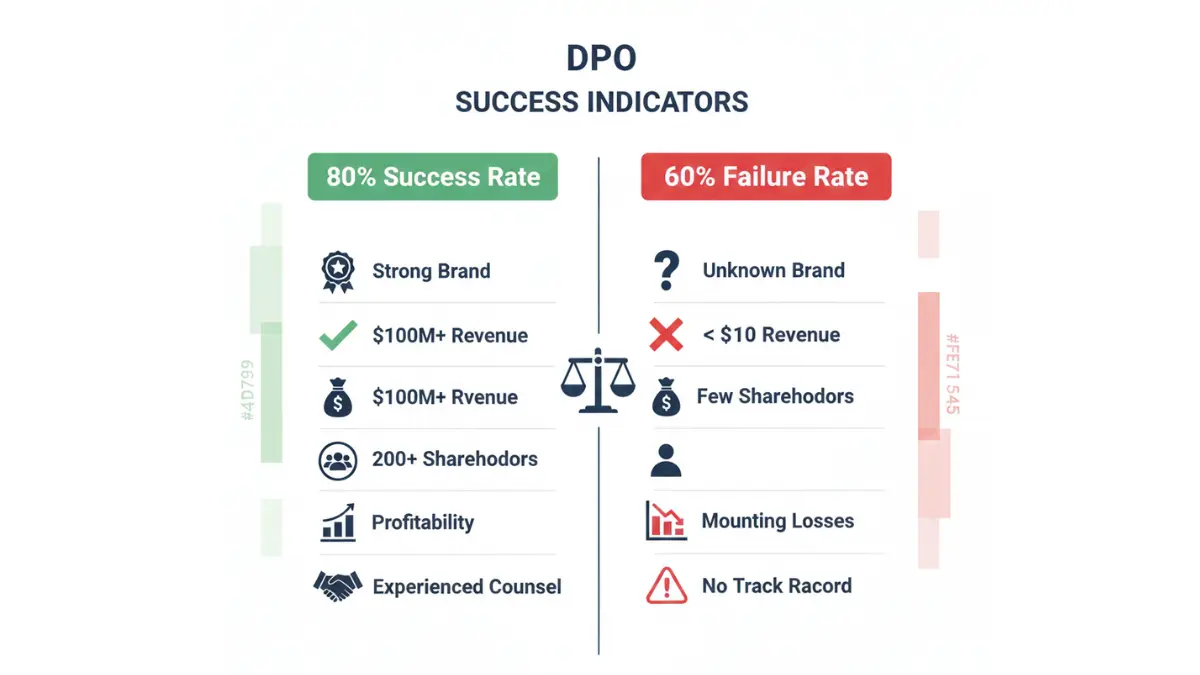
High probability success indicators (80%+ success rate):
- Consumer brand recognition (1M+ customers/users)
- $100M+ annual revenue with profitability
- Diverse shareholder base (200+ existing investors)
- Recent secondary market trading establishing price benchmarks
- Experienced securities counsel with 5+ DPO transactions
- Clear investment thesis communicated to potential shareholders
High failure risk indicators (60%+ failure rate):
- Unknown brand in crowded market
- <$10M annual revenue or consistent losses
- Concentrated ownership (90%+ held by founders/small group)
- No secondary trading history
- First-time public company management team
- Vague use of proceeds or business model
The pattern parallels credit score building strategies—success correlates strongly with established track records and verifiable performance history rather than aspirational projections.
Is a DPO Right for Your Company? [2026 Decision Framework]
After analyzing costs, regulatory pathways, implementation processes, and real-world outcomes, evaluate your specific situation against this comprehensive decision matrix.
When Direct Public Offering Makes Strategic Sense ✅
Financial position requirements:
- Revenue exceeds $10 million annually with positive cash flow or clear 12-month profitability path
- Don’t need to raise fresh operating capital immediately (next 12-24 months)
- Can allocate $50,000-$2 million for offering costs depending on route
- Would save $3 million+ in underwriting fees compared to IPO alternative
- Financial records suitable for professional audit (Tier 2/S-1 routes)
Market position criteria:
- Well-known brand among target investor demographic (B2C) or institutional recognition (B2B)
- Existing shareholder base of 100+ investors seeking liquidity event
- Recent secondary market trading activity establishing preliminary price ranges
- Clear competitive differentiation and investment thesis
- Addressable market exceeds $1 billion demonstrating growth runway
Operational readiness:
- Management team experienced with regulatory compliance
- Clean legal history without pending litigation or IP disputes
- Ability to tolerate day-one price volatility of 15-30% without panic
- Prepared for ongoing public company reporting (Tier 2/S-1)
- Board composition includes independent directors
Strategic objectives:
- Want to avoid 6-month IPO lockup periods restricting insider sales
- Prefer market-driven pricing over negotiated underwriter allocations
- Value founder control over company narrative and investor relations
- Seek retail investor participation rather than institutional allocation
- Long-term vision for public markets (not quick flip)
When Traditional IPO Remains Superior ❌
Capital needs:
- Require $50 million+ in fresh operating capital for product development, market expansion, or acquisitions
- Need guaranteed minimum subscription to fund critical business operations
- Business model requires immediate capital deployment (can’t wait for market-driven distribution)
- Prefer underwriter commitment to purchase unsold shares
Market position limitations:
- Unknown brand requiring extensive investor education and roadshow presentations
- Small shareholder base (<50 investors) providing insufficient day-one liquidity
- Operating in complex/technical industry difficult for retail investors to understand
- First-time public company management unfamiliar with SEC compliance
- Recent negative publicity or market headwinds in your sector
Risk tolerance:
- Management uncomfortable with day-one price discovery uncertainty
- Shareholders expect price stabilization support from underwriters
- Board concerned about immediate volatility impacting employee morale
- Prefer structured allocations to institutional investors over open market distribution
- Want underwriter research coverage and ongoing capital markets support
Hybrid Approaches: Best of Both Worlds
Strategy 1: Private capital raise + Subsequent direct listing
- Raise $25-75 million via Regulation A+ or private placement
- Build shareholder base and establish company valuation
- Execute direct listing 12-24 months later for liquidity and exchange access
- Example: Multiple 2024-2025 companies used this pathway successfully
Strategy 2: DPO with voluntary lockup agreements
- Pursue S-1 direct listing to avoid underwriter fees
- Negotiate voluntary lockup agreements with major shareholders (90-180 days)
- Reduce day-one volatility while maintaining faster liquidity than IPO’s mandatory 6 months
- Model: Slack’s 47% restricted float approach
Strategy 3: Regulation A+ Tier 2 + Exchange listing
- Complete $75 million Reg A+ offering to build shareholder base
- Use proceeds to strengthen balance sheet and operations
- Apply for NYSE or NASDAQ listing via Form 8-A short-form registration
- Become fully-reporting public company without traditional IPO
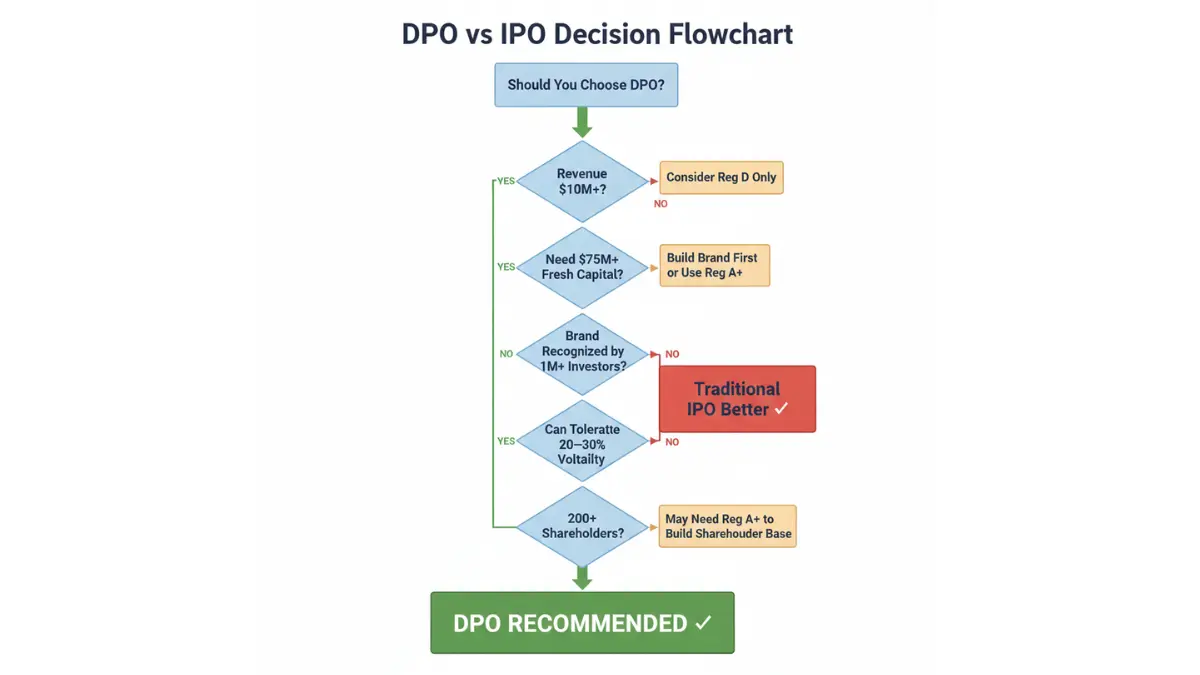
Implementation Decision Tree
Start here: Does your company have $10M+ annual revenue?
- No → Regulation D only viable route ($1M max)
- Yes → Continue assessment
Do you need fresh capital exceeding $75 million?
- Yes → Traditional IPO likely better fit
- No → DPO remains viable, continue
Is your brand recognized by 1M+ potential investors?
- No → Reg A+ Tier 2 maximum viable route; S-1 direct listing risky
- Yes → All pathways available, continue
Can you tolerate 20-30% day-one price volatility?
- No → Traditional IPO with underwriter stabilization
- Yes → DPO well-suited to your risk tolerance
Do you have 200+ existing shareholders?
- No → Distribution challenge; may need Reg A+ to build base first
- Yes → Sufficient liquidity for direct listing
Your Next Steps: 30-Day Action Plan
Week 1-2: Internal assessment
- Review this decision framework with executive team and board
- Calculate potential cost savings using your specific financing needs
- Evaluate brand recognition through customer surveys and market research
- Assess existing shareholder composition and liquidity preferences
Week 3-4: Expert consultation
- Interview 3-5 securities attorneys with demonstrated DPO experience
- Request preliminary eligibility assessments and cost estimates
- Schedule calls with companies similar to yours that completed DPOs
- Research current market conditions and recent comparable offerings
Month 2: Pathway selection
- Choose between Regulation D, Regulation A+, or S-1 routes
- Finalize legal counsel engagement
- Begin financial audit preparation if pursuing Tier 2/S-1
- Develop preliminary offering timeline and budget
Month 3+: Implementation
- Follow the seven-step process detailed in Section 4
- Monitor market conditions and adjust timeline as needed
- Maintain transparent communication with existing shareholders
- Prepare for ongoing public company responsibilities
The strategic decision between DPO and IPO parallels choosing between 15-year vs 30-year mortgage terms—no universally correct answer exists. The optimal choice depends on your specific financial position, risk tolerance, timeline constraints, and long-term strategic objectives.
Direct Public Offering FAQs [2026]
Q1: What is a direct public offering?
A direct public offering (DPO) allows companies to sell existing shares directly to public investors without investment bank underwriters, eliminating $3M+ in traditional IPO fees while providing shareholder liquidity.
Q2: How much does a DPO cost compared to an IPO?
DPO costs range from $15,000 (Regulation D) to $2 million (S-1 direct listing) depending on regulatory route. Traditional IPOs cost $3-10 million+, creating average savings of $3-7 million for mid-sized companies.
Q3: Can small companies do direct public offerings?
Yes. Regulation D permits raises up to $1 million for $15,000-$50,000 total cost. Regulation A+ Tier 1 allows up to $20 million, making DPOs accessible to companies across the size spectrum.
Q4: What companies have completed successful DPOs?
Spotify ($26B valuation, 2018), Slack ($7B, 2019), Coinbase (2021), Palantir (2020), Asana (2020), and 800+ companies via Regulation A+ offerings raised $9.4 billion from 2015-2024 according to SEC data.
Q5: Do I need to be profitable to pursue a DPO?
Not legally required, but profitability significantly increases success probability. SEC analysis shows most successful Regulation A+ issuers demonstrated positive cash flow or clear paths to profitability within 12 months.
Q6: Can non-accredited investors participate in DPOs?
Yes. Regulation D and Regulation A+ explicitly permit non-accredited investors. Reg A+ Tier 2 limits non-accredited investors to 10% of annual income or net worth (whichever is greater) per offering for investor protection.
Q7: How long does a DPO process take from start to trading?
Timelines vary by route: 1 month (Regulation D), 3-12 months (Regulation A+), 6-12 months (S-1 direct listing). This compares favorably to traditional IPOs requiring 12-18 months on average.
Q8: Do direct public offering shares have lockup periods?
No mandatory lockup periods exist for DPOs, unlike IPO’s standard 6-month restrictions. However, companies can implement voluntary lockup agreements with specific shareholders for price stability (Slack model).
Q9: Can DPO companies list on NYSE or NASDAQ?
Yes. Regulation A+ Tier 2 issuers can list via short-form Form 8-A registration. S-1 direct listings trade on NYSE or NASDAQ from day one. Companies must meet exchange listing requirements including minimum market capitalization and shareholder counts.
Q10: What are the main risks of direct public offerings?
Primary risks include day-one price volatility (15-30% typical), no underwriter support or price stabilization, potential failure to reach minimum subscription targets, reduced legal protections compared to traditional IPOs, and immediate selling pressure from unrestricted shareholders.
Q11: Are DPOs allowed for international companies?
Yes. Non-U.S. companies can pursue direct listings using Form F-1 registration instead of Form S-1. Spotify, a Swedish company, pioneered this approach in 2018. SEC rules permit foreign private issuers to access U.S. public markets.
Disclaimer:
This article provides educational information about direct public offerings and should not be considered financial, legal, or investment advice. Securities offerings involve complex federal and state regulations, significant costs, and substantial risks including loss of capital. Companies considering any public offering pathway should consult qualified securities attorneys, certified public accountants, and registered financial advisors before making decisions. Individual circumstances vary significantly, and past performance of direct public offerings does not guarantee future results. All data cited represents historical information and may not reflect current market conditions. Neither Finance Authority Hub nor its contributors assume liability for actions taken based on information presented herein.
Informational disclaimer
The content on Finance Authority Hub is provided for general informational and educational purposes only and should not be considered personalized financial, investment, tax, legal, or professional advice. Financial decisions depend on your individual goals, income, risk tolerance, location, and regulatory situation. Before acting on any information, strategy, estimate, or calculator result, consult a qualified licensed professional who can evaluate your specific circumstances.