The real Medicare cost per year, added up line by line
Medicare cost per year has a floor nobody adds up for you: $2,717.80 before a single appointment. Here is every Part A, B, D and IRMAA line.

In This Article
Medicare’s guaranteed cost in 2026 is $2,717.80 a year: twelve Part B premiums of $202.90 plus the $283 annual deductible. Everything above that depends on you.
That floor covers no hospital stay, no prescriptions and no income surcharge. It is a starting point, not an answer.
Start where your situation sits. If a bill arrived that looks too high, the income-surcharge section explains why. If you are building a retirement budget, the three worked totals give you a figure to plan against. If you are helping a parent, the Part A section covers the bill that catches families out most often.
Medicare arrives as five separate bills rather than one premium. This adds all of them up.
ℹ️ Financial Disclaimer: This article is general education, not personalized advice. It covers regulated activities — insurance coverage selection, tax treatment of income, lending and credit decisions, and retirement planning — and none of it accounts for your circumstances. Coverage choices should be discussed with a licensed insurance counselor or a free State Health Insurance Assistance Program (SHIP) counselor; income and tax questions with a CPA; broader planning with a fiduciary advisor.
What you pay for Part B every single year

Part B is the only Medicare bill that arrives every month whether you see a doctor or not.
The premium, times twelve
The standard monthly premium for 2026 is $202.90, up $17.90 from $185.00 in 2025. Twelve months of that is $2,434.80 — $214.80 more than the same coverage cost last year.
The deductible you pay once a year
Add the $283 annual Part B deductible, up from $257. Premium plus deductible is the $2,717.80 floor, and the full Part B premium breakdown covers who pays more.
| 2026 Part B cost | Amount | Key detail |
|---|---|---|
| Monthly premium | $202.90 | Usually deducted from Social Security |
| Twelve months | $2,434.80 | Paid whether or not you use care |
| Annual deductible | $283 | Once per calendar year |
| Guaranteed yearly total | $2,717.80 | Before any care at all |
Source: CMS 2026 Parts A and B premiums and deductibles, November 2025.
The 20% with no ceiling
After the deductible you pay 20% coinsurance on most covered services. Under Original Medicare alone that 20% has no annual cap, which is precisely why $2,717.80 is a floor and not a total.
Part A: free for most, until you’re admitted
About 99% of people pay no Part A premium, because 40 quarters of Medicare-covered work already paid for it.
Who pays a premium
Those with 30 to 39 quarters of coverage pay $311 monthly in 2026; those with fewer than 30 pay $565. This is a small minority, and if you worked ten years in the US it almost certainly is not you.
The deductible resets, and it isn’t yearly
The 2026 inpatient hospital deductible is $1,736 — up $60 — and it is charged per benefit period, not per year.
🔍 How It Works: A benefit period opens the day you are admitted and closes only after 60 consecutive days with no inpatient or skilled nursing care. Admitted in January, discharged, then admitted again in May? That is two benefit periods, and the deductible is charged twice.
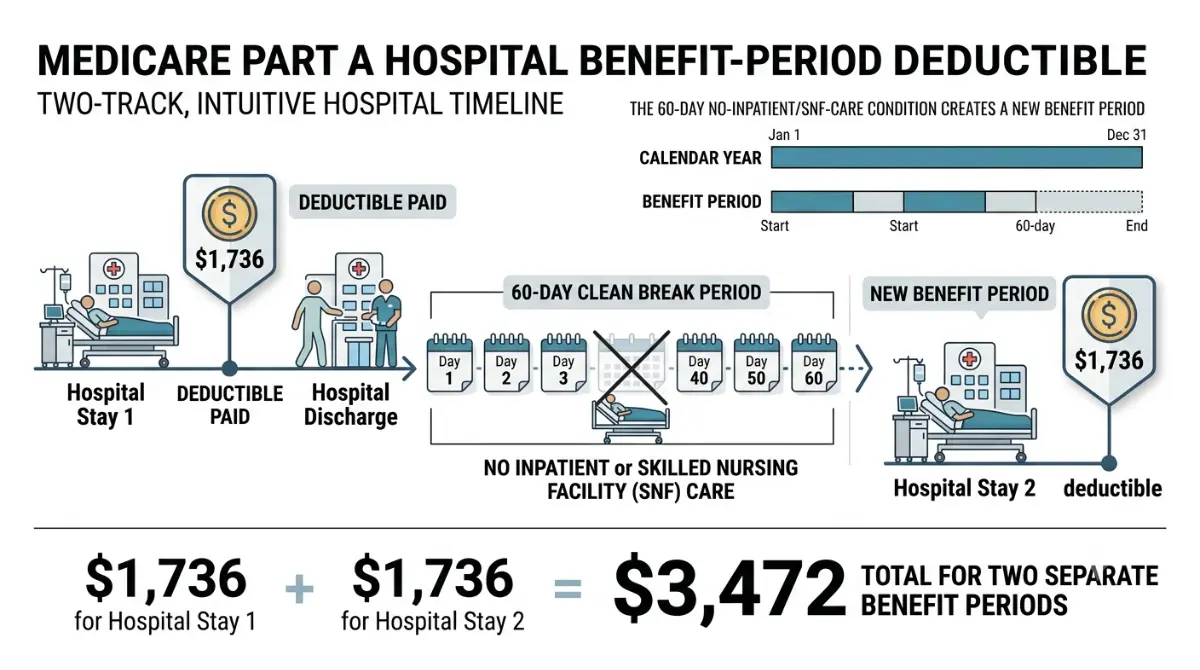
⚠️ Costly Mistake: Budgeting $1,736 as an annual hospital cost. Two separate stays in one calendar year means $3,472 — and there is no yearly ceiling on how many benefit periods you can have. The Part A deductible in detail covers the daily charges for longer stays.
What a long stay costs per day
Beyond day 60, coinsurance starts: $434 a day for days 61–90, $868 a day for lifetime reserve days, and $217 a day for skilled nursing days 21–100.
What drug coverage adds to the yearly total
Part D is the one piece of Medicare with a hard annual ceiling on what you pay for the covered thing itself.
The premium, which varies by plan
CMS projects the average standalone Part D premium at $34.50 a month for 2026, down from $38.31. That is $414 a year at the average — but plan premiums range from zero to well above it, so the average is not your number.
The deductible, capped at $615
No 2026 plan may set a deductible above $615. Many set it lower, and some set it at zero for certain drug tiers.
The $2,100 ceiling and what happens after

You pay 25% coinsurance until your out-of-pocket drug spending reaches $2,100, and then you pay nothing for covered drugs for the rest of the year.
💡 Expert Note: The coverage gap that used to sit in the middle of Part D — the “donut hole” — no longer exists. Under the 2026 Part D benefit structure, there are three phases, and the last one costs you nothing. Our guide to the $2,100 cap works through how spending counts toward it.
How income changes the number: IRMAA
Roughly 8% of enrollees pay an income surcharge on top of the standard premiums, and it moves two bills at once.
The threshold
IRMAA starts above $109,000 in modified adjusted gross income filing individually, or $218,000 filing jointly.
🔍 How It Works: The brackets are cliffs, not tax-style tiers. One dollar over a threshold moves your entire premium to the next tier — it is not applied only to the amount above the line. And the income tested is from your tax return two years back, so 2026 premiums rest on your 2024 return.
What the first tier costs per year
Tier one adds $81.20 monthly to Part B and $14.50 to Part D — $1,148.40 across the year. At the top bracket, Part B alone is $689.90 a month, and Part B plus the Part D surcharge reaches $9,370.80 a year.
✅ Action Step: If your income dropped because of a qualifying life-changing event — retirement, a spouse’s death, divorce, loss of a pension — file Form SSA-44 with Social Security to have a more recent year used instead. Before any large withdrawal, Roth conversion or property sale, ask a CPA one specific question: will this push my MAGI across an IRMAA threshold two years from now?

Three 2026 annual totals, added up in full
These are calculations from published CMS figures, not survey averages of what people spend. Every input appears above.
| 2026 profile | What it adds up to | Annual total |
|---|---|---|
| Original Medicare only, standard income | $202.90 × 12 + $283 deductible | $2,717.80 (plus uncapped 20% coinsurance) |
| Plus standalone drug coverage, heavy prescription year | $2,717.80 + $414 premium + $2,100 drug ceiling | $5,231.80 (plus any Medigap premium) |
| First IRMAA tier, single filer over $109,000 | $284.10 × 12 + $174 Part D surcharge + $283 | $3,866.20 (before any plan premium) |
Sources: CMS 2026 Parts A and B premiums and deductibles; CMS projected 2026 Part D plan premiums, September 2025. Medigap premiums are left blank deliberately — they vary by insurer, state, age and health history, and no honest national figure exists. Use your own quote.
A Medicare Advantage plan restructures these numbers rather than removing them: you still pay the Part B premium, and the plan sets its own copays and annual limit.
Four things that blow up the yearly total
Most of the damage comes from four assumptions, and three are avoidable if you catch them early.
Treating the Part A deductible as annual
It resets per benefit period. Two hospital stays sixty days apart cost twice.
Assuming the $2,100 cap covers doctor bills
It covers Part D drugs only. Nothing on the medical side counts toward it.
Enrolling late
The late enrollment penalty is permanent, not a one-time fee. Medicare’s own worked example shows a two-year Part B delay raising the 2026 premium to $243.50 a month — for life. The Part D penalty adds 1% of $38.99 for each uncovered month.
⚠️ Costly Mistake: Relying on Original Medicare alone through a serious illness. With no annual out-of-pocket limit on the 20% coinsurance, a single hospitalization plus follow-up care can run past every figure in this article combined.
Medicare cost per year: quick answers
1. How much does Medicare cost per year?
At minimum $2,717.80 in 2026 — the $202.90 monthly Part B premium across twelve months, plus the $283 annual deductible.
2. Is Medicare Part A free?
Premium-free for roughly 99% of beneficiaries with 40 quarters of coverage. Everyone else pays $311 or $565 monthly.
3. How often do you pay the Part A deductible?
Once per benefit period, not per year. Two separate hospital stays in one year can mean $3,472.
4. What is the most Part D can cost per year?
Drug cost sharing stops at $2,100 in 2026. Your plan premium sits on top of that ceiling. Compare plans with a SHIP counselor before switching.
5. Does Original Medicare cap what you pay in a year?
No. Without supplemental coverage, the 20% Part B coinsurance has no annual limit at all. A SHIP counselor can review your coverage free of charge.
6. What income triggers IRMAA in 2026?
Modified adjusted gross income above $109,000 filing individually, or $218,000 jointly, taken from your tax return two years earlier. Confirm your bracket with a CPA.
7. How much does the first IRMAA tier add per year?
$1,148.40 — an extra $81.20 monthly on Part B and $14.50 on Part D. A CPA can confirm which tier applies.
8. What is the highest Medicare premium in 2026?
$689.90 monthly for Part B plus a $91.00 Part D surcharge, which totals $9,370.80 across the year.
9. How much is the Part B late enrollment penalty?
An extra 10% for each full year of delay, permanently. A two-year delay makes the 2026 premium $243.50 monthly.
10. How much did Medicare go up in 2026?
The Part B premium rose $17.90 monthly — $214.80 across the year. The Part A deductible rose $60.
11. Is Medicare Advantage cheaper per year?
Not automatically. You still pay the Part B premium; Advantage plans change the cost structure rather than removing the cost. A SHIP counselor can compare total annual cost for your situation.
Turning this into your number
Three blanks separate the figures above from your actual cost: your Part D plan premium, your Medigap premium if you carry one, and whether you cross the IRMAA threshold.
✅ Action Step: Call 1-800-MEDICARE or your state SHIP office — both free, neither sells plans — and ask which coverage combination produces the lowest total annual cost for your prescriptions, doctors and county. Then place that figure against your income in the retirement income calculator.
CMS resets every figure here each November. Check back then.
Informational disclaimer
The content on Finance Authority Hub is provided for general informational and educational purposes only and should not be considered personalized financial, investment, tax, legal, or professional advice. Financial decisions depend on your individual goals, income, risk tolerance, location, and regulatory situation. Before acting on any information, strategy, estimate, or calculator result, consult a qualified licensed professional who can evaluate your specific circumstances.