
Overtime Calculator: Calculate Time and a Half Pay Instantly (2026)
Overtime Calculator
Calculate gross pay with a transparent “regular rate + overtime premium” breakdown. In the U.S. (FLSA context), overtime is generally paid at not less than time-and-a-half of the regular rate for hours over 40 in a workweek, and the regular rate is derived as remuneration ÷ hours worked. [web:346][web:347]
Inputs
This tool models “regular rate” as (straight-time pay + includable earnings) ÷ total hours, then adds the overtime premium. [web:347]
Overtime rules vary globally (daily OT, double-time, exemptions, etc.). Treat this as a planning/education calculator.
Results
Gross pay (workweek)
—
Effective hourly: —
Hours breakdown
Total: —
Regular: —
Overtime: —
Rates
Regular rate: —
OT rate: —
Threshold: — @ —
Overtime impact
Remuneration (base + includable): —
OT premium add-on: —
Pay period equivalents (approx.)
Weekly: — • Biweekly: — • Monthly: — • Annual: —
Optional net view
Estimated deductions: — = — • Estimated net: —
What went into “regular rate”
Base straight-time component: — • Includable earnings: —
Step-by-step math
Scenario table (OT hours × multiplier)
| Multiplier | OT hours | Total hours | Regular rate | Gross pay |
|---|
Results appear after you click “Calculate.”
In This Article
An overtime calculator helps you instantly compute gross pay when you work beyond your standard hours. Under U.S. federal law, most nonexempt employees earn time and a half — 1.5× their regular rate — for every hour worked over 40 in a workweek. Use our free overtime pay calculator above to see your exact gross pay, overtime premium, and full pay period breakdown in seconds.
What Is an Overtime Calculator — and How Does It Work?
An overtime calculator is a financial tool that computes your total gross pay when overtime hours are involved. It goes beyond simple multiplication — it factors in your regular rate of pay, overtime hours, non-discretionary bonuses, and pay type (hourly or salaried).
Our overtime pay calculator above gives you:
- Gross weekly pay broken into regular and overtime portions
- Your true regular rate of pay (required by FLSA)
- A scenario table showing how different OT hours and multipliers affect your paycheck
- Pay period projections — weekly, biweekly, monthly, and annual
- An optional net pay estimate after deductions
If you want to see how your overtime income fits into your bigger financial picture, our Salary Calculator and Budget Calculator are powerful companion tools to run alongside this one.
How to Calculate Overtime Pay in 2026 (Step-by-Step)
Most workers assume overtime pay is just “hourly rate × 1.5 × extra hours.” That’s partially right — but the FLSA-compliant method is more precise, and getting it wrong costs you money.
Step 1 — Find Your Regular Rate of Pay
Your regular rate of pay is not always your base hourly wage. According to the U.S. Department of Labor’s Wage and Hour Division, it is calculated as:
Regular Rate = Total Remuneration ÷ Total Hours Worked
“Total remuneration” includes your hourly wages plus any non-discretionary bonuses (attendance bonuses, shift differentials, production bonuses). Discretionary bonuses — those given at the employer’s sole discretion — are excluded.
Real example: You earn $20/hour, work 45 hours, and receive a $50 production bonus this week.
- Total remuneration: ($20 × 45) + $50 = $950
- Regular rate: $950 ÷ 45 = $21.11/hour
Step 2 — Calculate Your Overtime Hours
Federal standard: Overtime kicks in after 40 hours per workweek for most nonexempt employees. Some states set stricter daily thresholds (covered in Section 4).
- Total hours worked: 45
- Regular hours: 40
- Overtime hours: 5
Step 3 — Apply the Overtime Multiplier
Standard U.S. overtime is time and a half (1.5×). The overtime premium is only the extra 0.5× on top of straight time (which is already included in your base pay).
OT Premium = Regular Rate × 0.5 × OT Hours
Continuing the example:
- OT premium: $21.11 × 0.5 × 5 = $52.78
- Total gross pay: $950 + $52.78 = $1,002.78
Step 4 — Quick Reference Calculation Table
| Component | Formula | Example ($20/hr, 45 hrs + $50 bonus) |
|---|---|---|
| Base straight-time | $20 × 45 hrs | $900.00 |
| Non-discretionary bonus | — | $50.00 |
| Total remuneration | — | $950.00 |
| Regular rate | $950 ÷ 45 hrs | $21.11/hr |
| Overtime hours | 45 − 40 | 5 hrs |
| OT rate (time & a half) | $21.11 × 1.5 | $31.67/hr |
| OT premium add-on | $21.11 × 0.5 × 5 | $52.78 |
| Total gross pay | $950 + $52.78 | $1,002.78 |
Key takeaway: Always include non-discretionary bonuses when calculating the regular rate. Most employers — and most online calculators — skip this step, causing underpayment.

To see how your overtime earnings affect your long-term wealth, try pairing this with our Compound Interest Calculator to model what consistent overtime savings can grow into over time.
Who Qualifies for Overtime Pay? Exempt vs. Nonexempt Explained
Not every worker is entitled to overtime pay. The Fair Labor Standards Act divides employees into two categories: exempt and nonexempt.
FLSA Nonexempt Employees — You Qualify
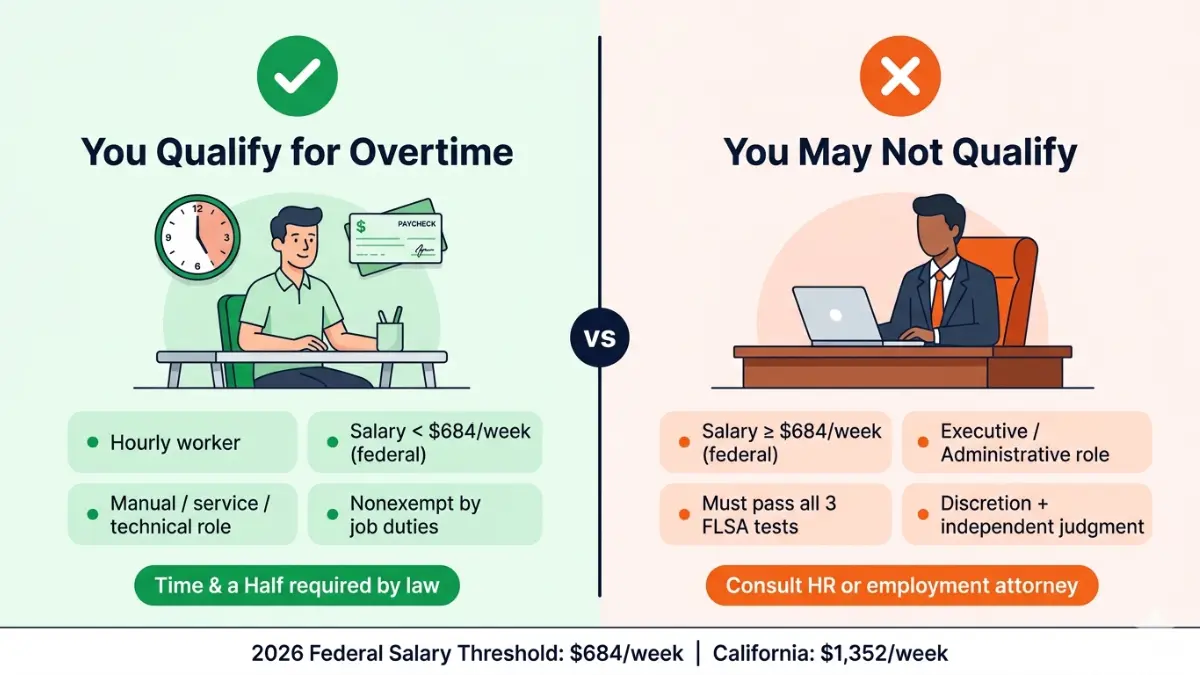
You are almost certainly eligible for overtime pay if you are:
- An hourly worker in the private or public sector
- A salaried worker earning less than $684 per week ($35,568/year) under 2026 federal rules
- A worker in a manual labor, service, or technical role regardless of job title
- A part-time employee who crosses 40 hours in a single workweek
The DOL’s FLSA Overtime Advisor confirms: if you are covered and nonexempt, your employer cannot waive your right to overtime — even by mutual agreement.
FLSA Exempt Employees — You May Not Qualify
To be classified as exempt, an employee must meet all three tests simultaneously:
- Salary basis test — Paid a fixed salary not reducible based on work quality/quantity
- Salary level test — Earns at least $684/week ($35,568/year) federally as of 2026
- Duties test — Primarily performs executive, administrative, or professional functions
Exempt vs. Nonexempt Quick Reference (2026)
| Employee Type | OT Eligible? | Threshold | Notes |
|---|---|---|---|
| Hourly worker | ✅ Yes | 40 hrs/week (federal) | Most common category |
| Salaried < $684/week | ✅ Yes | 40 hrs/week | Below federal threshold |
| Executive/Manager | ❌ Usually Exempt | N/A | Must pass all 3 tests |
| Administrative (office) | ❌ Usually Exempt | N/A | Discretion + independent judgment required |
| California hourly | ✅ Yes | 8 hrs/day OR 40 hrs/week | State law is stricter |
| Computer professional (CA) | ❌ Exempt if ≥ $58.85/hr | N/A | California Labor Code §515.5 |
Important: Independent contractors are not covered by FLSA. Misclassification of employees as contractors is one of the most common — and costly — payroll violations employers commit.
If your overtime income is helping you pay down debt, our Debt-to-Income Ratio Calculator can show you exactly how that extra income improves your financial profile.
Overtime Rules by State — 2026 Update
Federal law sets the floor. But six states and Puerto Rico enforce daily overtime thresholds that trigger premium pay regardless of weekly hours. If you live in one of these states, your overtime pay calculator must reflect local rules — not just FLSA.
U.S. State Overtime Comparison Table (2026)
| State | Daily OT Trigger | Weekly Threshold | Double Time | 2026 Notes |
|---|---|---|---|---|
| Federal (FLSA) | None | 40 hrs | No | Baseline for all states |
| California | After 8 hrs/day | 40 hrs/week | After 12 hrs/day OR 8 hrs on 7th consecutive day | Min wage $16.90/hr; exempt salary = $70,304/yr |
| Alaska | After 8 hrs/day | 40 hrs/week | No | Agriculture and aquatic work exemptions apply |
| Colorado | After 12 hrs/day or 12 consecutive hrs | 40 hrs/week | No | Higher of daily or weekly calculation applies |
| Nevada | After 8 hrs/day (if earning < 1.5× min wage) | 40 hrs/week | No | Threshold tied to state minimum wage |
| Texas / Florida / New York | None | 40 hrs/week | No | Follow federal FLSA rules |
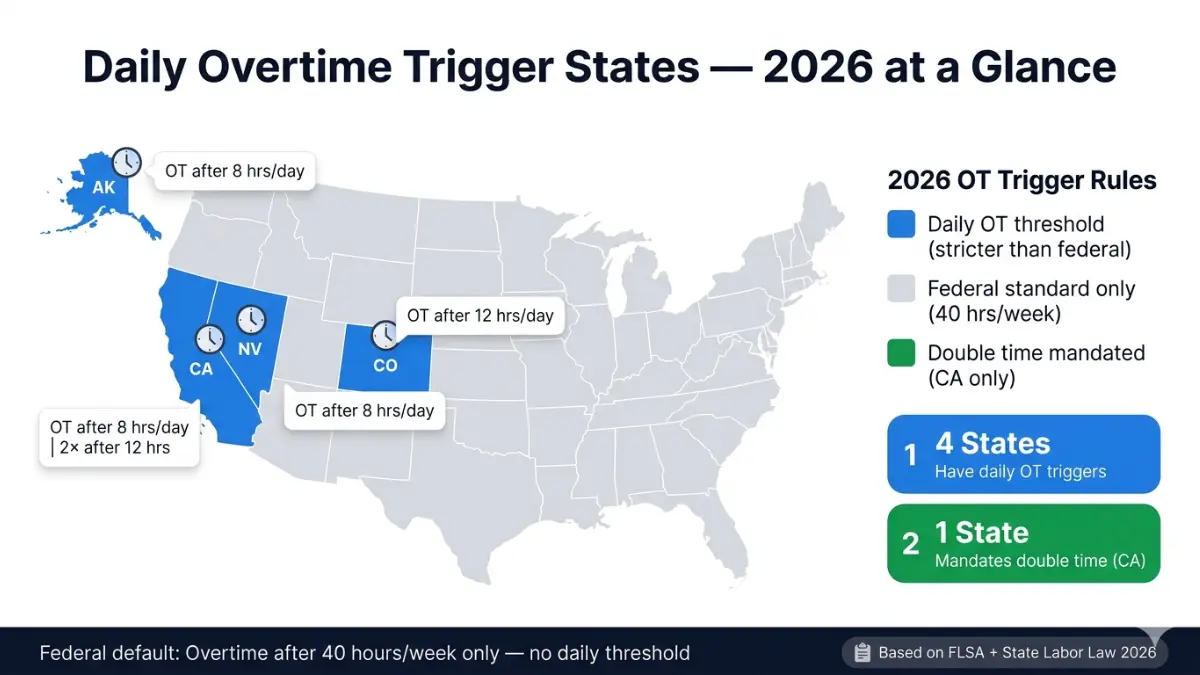
California workers: As of January 1, 2026, the state minimum wage is $16.90/hour, which means the overtime-exempt salary threshold is $70,304/year. If your salary is below $70,304 annually, you are almost certainly entitled to overtime under California law regardless of your job title.
Remote workers: The overtime laws of the state where you physically perform your work apply — not where your employer is headquartered. A Texas-based company employing you remotely from California must pay California overtime rules.
For workers weighing whether to refinance or redirect overtime earnings, our Refinance Calculator can help model whether paying down your mortgage faster makes financial sense.
No Tax on Overtime 2026 — What the New Law Means for Your Paycheck
Millions of American workers don’t yet know they can deduct up to $12,500 in overtime pay from their 2025 federal taxes. This is the biggest change to overtime pay in a generation.
What Is the Overtime Tax Deduction (OBBBA)?
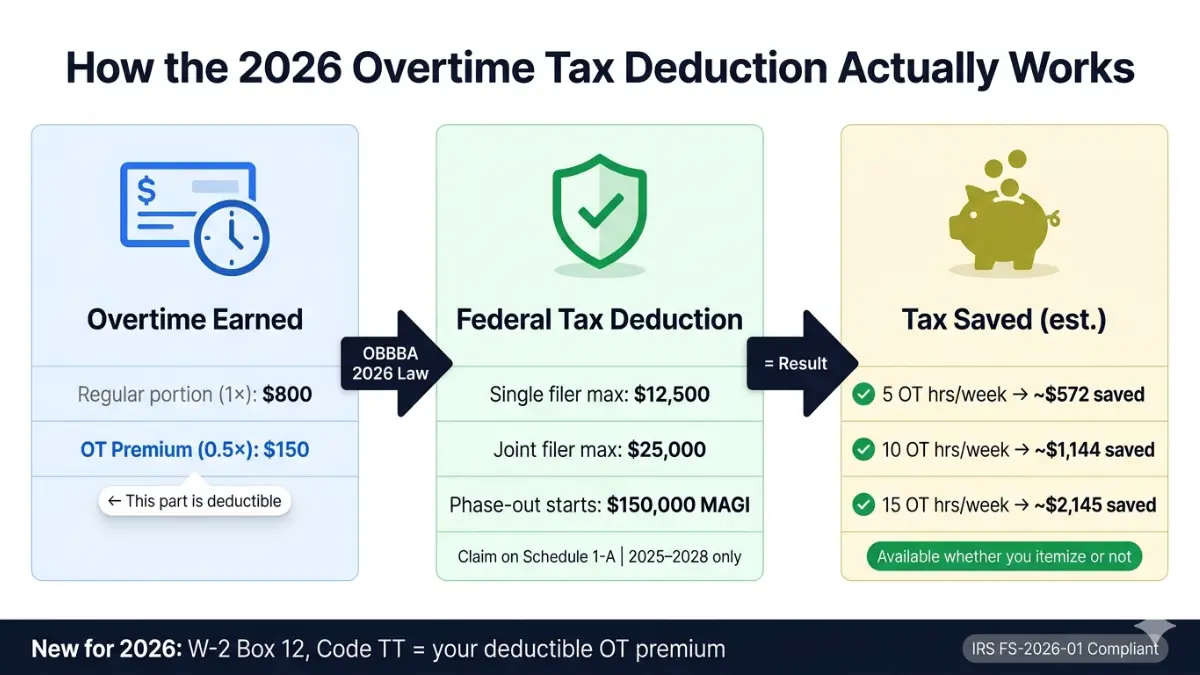
The One, Big, Beautiful Bill Act (P.L. 119-21), signed July 4, 2025, introduced a federal income tax deduction for qualified overtime compensation. According to the IRS’s official guidance on the no-tax-on-overtime deduction, only the premium portion of overtime qualifies — specifically the “half” of “time-and-a-half.”
Plain English: If you earn $20/hr and are paid $30/hr for overtime (1.5×), the deductible portion is the extra $10/hr — not the full $30.
Who Qualifies for the No-Tax-on-Overtime Deduction?
You must meet all of the following criteria per IRS FAQ FS-2026-01:
- ✅ Covered by and not exempt from the FLSA
- ✅ Have a valid Social Security number issued before your tax return due date
- ✅ If married, you must file a joint return to claim the deduction
- ✅ Overtime was paid as required under FLSA Section 7 (29 U.S.C. §207)
- ✅ Overtime is reported on Form W-2, 1099-NEC, or 1099-MISC (for tax year 2026 onward)
Deduction Limits and Phase-Out (2025–2028)
| Filing Status | Max Deduction | MAGI Phase-Out Begins | Phase-Out Rate |
|---|---|---|---|
| Single / Head of Household | $12,500 | $150,000 | $100 reduction per $1,000 over limit |
| Married Filing Jointly | $25,000 | $300,000 | $100 reduction per $1,000 over limit |
Estimated Tax Savings Table (2026, 22% Federal Bracket)
| Weekly OT Hours | Annual OT Premium | Est. Federal Tax Saved |
|---|---|---|
| 5 hrs @ $20/hr | ~$2,600 | ~$572 |
| 10 hrs @ $20/hr | ~$5,200 | ~$1,144 |
| 15 hrs @ $25/hr | ~$9,750 | ~$2,145 |
| 20 hrs @ $25/hr | ~$13,000 | ~$2,750 (capped at $12,500 deduction) |
What This Means For You: The deduction is above-the-line — you can claim it whether you itemize or take the standard deduction. You do not need to itemize to benefit.
2026 W-2 Reporting Change — Box 12, Code TT
Starting with the 2026 tax year, employers are required to separately report your qualified overtime premium on your W-2 using Box 12, Code TT. This makes it straightforward to identify the deductible amount.
For 2025 (filed in 2026): Employers are not required to report it separately, but some may voluntarily report it in Box 14 or via a separate payroll statement. If you don’t receive a separate figure, use the IRS Schedule 1-A worksheets.
Action step: Ask your payroll department now to confirm they are tracking overtime premium separately for your 2026 W-2. This prevents headaches at tax time.
If your overtime earnings are boosting your retirement contributions, our 401(k) Calculator can show you the long-term compounding impact of redirecting that extra take-home pay into pre-tax retirement savings.
Overtime Calculator — Frequently Asked Questions
1. What is time and a half pay?
Time and a half is 1.5× your regular hourly rate for each overtime hour worked. If your regular rate is $20/hour, your time and a half rate is $30/hour. It applies to hours worked over 40 in a workweek for most U.S. nonexempt employees under FLSA.
2. How do I calculate overtime pay manually?
Use this formula: OT Gross = (Hourly Rate × 40) + (Hourly Rate × 1.5 × OT Hours). For salaried nonexempt workers, divide weekly salary by 40 to get the regular rate first, then apply 1.5× to overtime hours. Always include non-discretionary bonuses in the regular rate calculation.
3. Does overtime get taxed more than regular pay?
No — overtime is taxed at the same marginal rates as regular income. However, earning more in a single week can push some dollars into a higher bracket temporarily. The 2026 OBBBA deduction significantly reduces federal tax on the OT premium portion for qualifying workers through 2028.
4. What is included in the regular rate of pay?
The regular rate includes hourly wages, shift differentials, non-discretionary bonuses, commissions, and piece-rate earnings divided by total hours worked. It does not include discretionary bonuses, vacation/holiday pay, or expense reimbursements.
5. Can salaried employees get overtime pay?
Yes — salaried employees who earn less than $684/week ($35,568/year) federally are nonexempt and entitled to overtime. In California, that threshold is $1,352/week ($70,304/year). Salary alone does not create an exemption — the duties test must also be met.
6. What is double time pay?
Double time is 2× your regular rate. It is not required under federal law, but California mandates it for hours over 12 in a single workday and for hours over 8 on the seventh consecutive workday of a workweek. Some union contracts and employer policies also provide double time for holiday work.
7. Is there really no tax on overtime in 2026?
Technically, the OBBBA creates a deduction — not a full exemption. You still have overtime withheld from your paycheck, but you deduct the qualifying premium (up to $12,500/$25,000) on your federal return. Social Security and Medicare taxes (FICA) still apply to all overtime pay.
8. How many overtime hours can I legally work per week?
Federal law sets no maximum cap on overtime hours for most workers. Your employer can legally require as many overtime hours as needed — they just must pay time and a half. Some state laws and union contracts do impose limits. The DOL Wage and Hour Division oversees compliance.
9. Does California have different overtime rules than federal law?
Yes — significantly so. California requires 1.5× pay after just 8 hours in a single workday, plus double time after 12 hours in a day. The federal standard only triggers at 40 hours per week. California workers should use our calculator with a custom daily threshold, not the federal 40-hour default.
10. What is the salary threshold for overtime exemption in 2026?
Federally, the threshold is $684/week ($35,568/year). In California, it is $1,352/week ($70,304/year) — set at twice the state minimum wage. New York and Washington also have higher state thresholds. Earnings alone do not create an exemption; the duties test must also be satisfied.
11. Can I use this calculator if I’m paid a salary, not hourly?
Yes. Our calculator supports weekly salary and annual salary pay types. It converts your salary to a regular hourly rate (salary ÷ 40 hours) for FLSA purposes, then computes the overtime premium on top. This is the correct method for nonexempt salaried workers.
⚠️ Disclaimer: This article and calculator are provided for educational purposes only and do not constitute legal, tax, financial, or payroll advice. Overtime laws vary by jurisdiction, employment contract, industry, and individual classification. FLSA rules, state laws, and IRS regulations referenced are current as of March 2026 and are subject to change. The OBBBA overtime deduction is currently set to expire after tax year 2028. Always consult a qualified employment attorney, certified payroll professional (CPP), or licensed tax advisor for guidance specific to your situation. The IRS.gov and DOL.gov are authoritative sources for current federal rules.

Informational disclaimer
The content on Finance Authority Hub is provided for general informational and educational purposes only and should not be considered personalized financial, investment, tax, legal, or professional advice. Financial decisions depend on your individual goals, income, risk tolerance, location, and regulatory situation. Before acting on any information, strategy, estimate, or calculator result, consult a qualified licensed professional who can evaluate your specific circumstances.