
Currency Converter: Live Exchange Rates 2026
Currency Converter
Convert between 22 currencies with live/historical FX rates, fees & spread, inverse rate, a full conversion matrix, compare-to-past mode, shareable link, and CSV export.
Inputs
Models a worse customer rate vs “mid” rate.
Tip: Use Live source for full “convert to all currencies” table; manual mode is best for offline or custom rates.
Results
Pair
—
Amount: —
Rate
—
—
Fees & spread
Spread: —
Fee (from): —
Fee (to): —
Converted
Gross: —
Net from: —
Net received: —
Effective rate & metadata
Effective rate (after fees): —
Source: — • As of: — • Fetched at (UTC): —
Convert to all supported currencies (matrix)
| Currency | Rate (per 1 From) | Converted amount | Value of 1 From |
|---|
Results appear after you click “Convert.”
In This Article
Currency Converter: How Live Exchange Rates Work and How to Get the Best Rate in 2026
A currency converter is a tool that calculates how much one currency is worth in another using live or historical foreign exchange rates. Use the converter above to instantly convert between 22 major currencies — including USD, EUR, GBP, INR, CAD, AUD, JPY, and more — powered by real-time ECB reference data. You can also model bank fees, spreads, and compare historical rates in seconds.
What Is a Currency Converter and How Does It Work?
A currency converter takes an amount you enter, applies the current exchange rate between two currencies, and returns the converted value. It’s the fastest way to answer the most common financial question travelers, investors, and businesses ask every day: how much is this in my currency?
How Our Currency Converter Works
The tool above is powered by the Frankfurter API, which aggregates reference rates published by the European Central Bank (ECB). Here’s what happens when you click Convert:
- Step 1: You enter an amount and select your From and To currencies
- Step 2: The tool fetches the latest mid-market rate from ECB reference data
- Step 3: It applies any spread % or fixed fee you entered (optional)
- Step 4: It returns your gross converted amount, net received after fees, effective rate, and a full matrix of all 22 supported currencies
What This Tool Does That Competitors Don’t
| Feature | Our Converter | XE.com | Yahoo Finance |
|---|---|---|---|
| Live mid-market rate | ✅ | ✅ | ✅ |
| Historical date mode | ✅ | ❌ | ❌ |
| Fee + spread modeling | ✅ | ❌ | ❌ |
| Compare rate change over time | ✅ | ❌ | ❌ |
| Full 22-currency matrix | ✅ | ❌ | ❌ |
| CSV export | ✅ | ❌ | ❌ |
| Shareable link | ✅ | ❌ | ❌ |
| Zero ads, zero popups | ✅ | ❌ | ❌ |
What This Means For You: Most free currency converters only show the raw mid-market rate. They don’t show what you’ll actually receive after a bank charges its markup and transfer fee. Our tool shows you the real-world number — so you can make a truly informed decision before sending money abroad. You can also explore our full suite of financial calculators at FinanceAuthorityHub to plan every aspect of your financial life.
Mid-Market Rate vs. Bank Rate — The Hidden Cost of Currency Exchange
This is what most currency converter tools never explain — and it costs Americans billions of dollars every year.

What Is the Mid-Market Rate?
The mid-market rate (also called the interbank rate or “real” exchange rate) is the exact midpoint between the buy price and sell price of two currencies on the global foreign exchange market. It is the rate banks use when trading with each other — and it’s the rate our converter displays.
According to the Federal Reserve’s H.10 Foreign Exchange Rates release, bilateral exchange rate data reflects certified rates used for customs and regulatory purposes. These are the benchmark rates — not what your bank offers retail customers.
Why Banks Charge More Than the Real Rate
When you walk into a bank or use a bank wire to convert currency, you are not getting the mid-market rate. Banks add a markup (also called a spread or margin) on top of the real rate to generate profit. This margin is rarely disclosed upfront.
Real Example: Converting $10,000 USD to EUR
| Provider | Rate Offered | EUR You Receive | Hidden Cost |
|---|---|---|---|
| Mid-market rate (real) | 1 USD = 0.920 EUR | €9,200 | $0 |
| Major U.S. bank | 1 USD = 0.887 EUR | €8,870 | ~$330 lost |
| Airport kiosk | 1 USD = 0.810 EUR | €8,100 | ~$1,100 lost |
| Online FX service | 1 USD = 0.915 EUR | €9,150 | ~$50 lost |
A 2–4% bank markup on a $10,000 transfer means you lose $200–$400 in hidden fees. On a $100,000 business payment, that’s $2,000–$4,000 gone — silently.
What This Means For You
- Always benchmark any rate you’re offered against the mid-market rate first — use the converter above as your reference
- Never convert currency at airport kiosks or hotel desks — spreads run 8–15%
- For large transfers, even a 0.5% better rate on $50,000 saves you $250
- If you’re managing debt across currencies or consolidating international loans, our Debt Consolidation Calculator helps you model the true cost in your home currency
Why Do Exchange Rates Change? 6 Key Factors in 2026
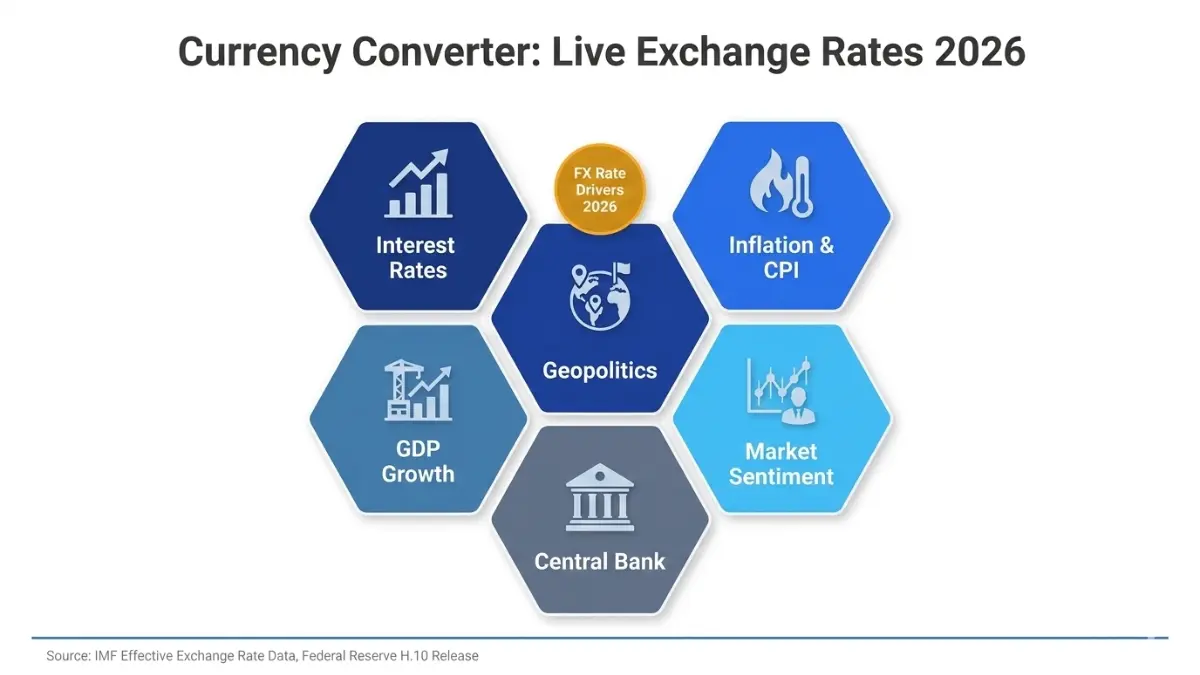
Exchange rates are never fixed. They shift constantly — sometimes by the minute — in response to economic data, policy decisions, and global events. Here are the six forces driving currency conversion rates in 2026.
1. Central Bank Interest Rate Decisions
When a central bank raises interest rates, its currency typically strengthens because higher yields attract foreign investors. The Federal Reserve, European Central Bank (ECB), and Bank of England all made rate decisions in early 2026 that directly moved USD, EUR, and GBP exchange rates.
2. Inflation and CPI Reports
Higher inflation erodes a currency’s purchasing power over time. When the U.S. CPI comes in above expectations, the USD often weakens relative to lower-inflation currencies like the Swiss Franc (CHF). According to the IMF Effective Exchange Rate dataset, the U.S. dollar’s real effective exchange rate fell approximately 4.7% in 2025 — a trend continuing into 2026.
3. GDP Growth and Economic Outlook
Strong GDP growth signals a healthy economy, which attracts capital inflows and strengthens a currency. The UK’s forecast of 0.9% GDP growth for 2026 kept the British Pound (GBP) relatively stable despite domestic inflation pressure.
4. Geopolitical Events and Trade Policy
Trade tariffs, sanctions, and geopolitical tensions cause rapid currency fluctuations. In 2026, new U.S. trade policy announcements triggered immediate moves in USD/CNY and USD/CAD pairs. These are the moments when using the historical rate comparison feature in our tool pays off most.
5. Market Sentiment and Speculative Trading
Roughly 70% of daily FX market volume is driven by speculation — not actual trade or remittance. Institutional traders betting on economic outcomes move rates far more than real-world transactions do.
6. Central Bank Interventions
Governments occasionally intervene directly to stabilize their currency. Japan’s Ministry of Finance has historically intervened in USD/JPY markets when the Yen weakens excessively — a pattern that recurred in 2025 and remained a risk factor heading into 2026.
Quick Reference Table: 2026 Rate Drivers
| Factor | How It Moves Rates | 2026 Example |
|---|---|---|
| Rate hike | Currency strengthens | Fed pause kept USD mixed |
| High inflation | Currency weakens | UK inflation pressured GBP |
| Strong GDP | Currency strengthens | Eurozone recovery lifted EUR |
| Trade war risk | Currency weakens | USD/CNY volatility on tariff news |
| Central bank buy | Currency strengthens | BoJ USD/JPY interventions |
If you’re planning a major purchase or international investment, our Inflation Calculator helps you measure how purchasing power shifts over time across currencies.
How to Get the Best Currency Exchange Rate — 7 Expert Tips for 2026
Most people overpay on currency conversion not because good rates don’t exist, but because they don’t know where to look. Here’s how to stop leaving money on the table.
“Before any international money transfer, always establish the mid-market rate as your baseline. Any provider charging more than 1.5% above that rate should be questioned.” — Laura M. Bennett, CFP, Senior Financial Expert, FinanceAuthorityHub.com
7 Proven Tips to Maximize Your Currency Exchange Rate
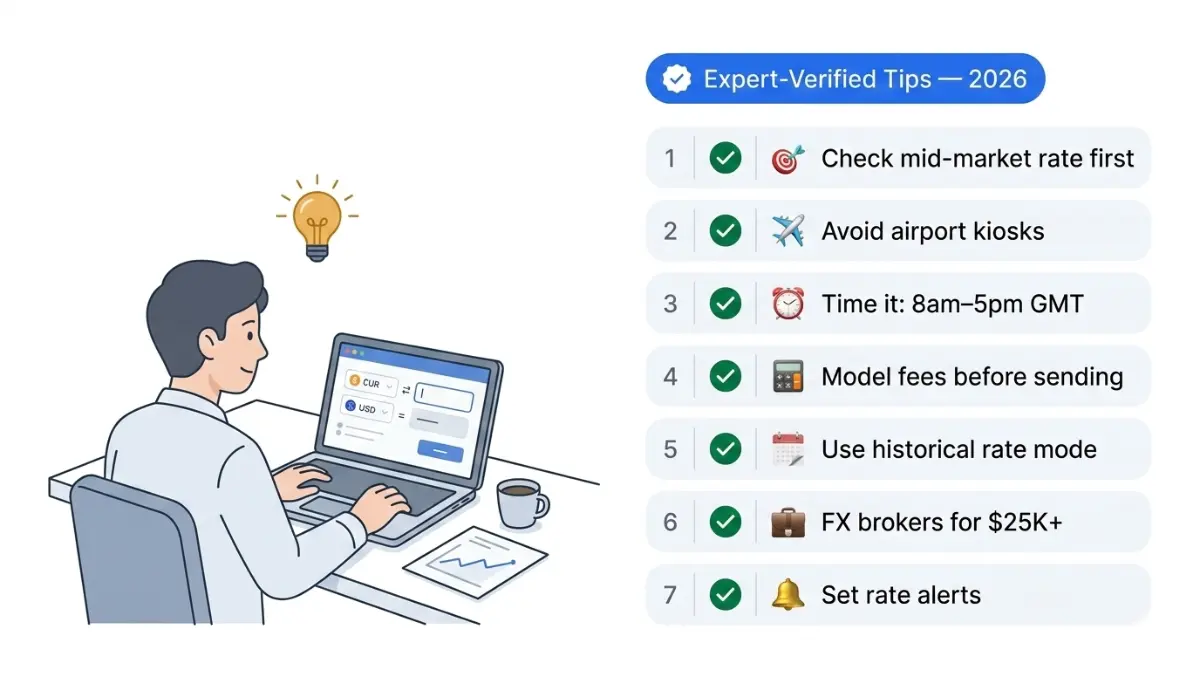
1. Always check the mid-market rate first. Use the currency converter above before approaching any bank or transfer service. The rate it shows is your benchmark — if a provider is offering more than 2% below it, walk away.
2. Avoid airport and hotel exchange desks. These consistently charge the worst foreign exchange rates — often 8–15% below mid-market. On a $2,000 travel budget, that’s $160–$300 lost before your trip starts.
3. Time large conversions strategically. The Federal Reserve’s H.10 release shows that FX markets are most liquid between 8am–5pm GMT, when London and New York trading sessions overlap. Rates are tightest (best for consumers) during this window.
4. Model the true cost before you send. Use the spread % and fixed fee fields in our converter to simulate what any bank or transfer provider will actually give you. Enter their rate as a manual rate to see the gap vs. real mid-market.
5. Use the historical rate feature to spot trends. Our tool’s date-mode lets you pull rates from any past date. Compare today’s rate against 30 or 90 days ago — if your currency has recently weakened, waiting a few days may save you money.
6. For transfers over $25,000, use a specialist FX broker. Major banks often charge 2–3% on large transfers. Specialist brokers like dedicated FX services typically charge 0.3–0.8%, saving you hundreds to thousands of dollars. For context, if you’re sending money internationally to fund a home purchase, our Home Affordability Calculator helps you model that purchase in your home currency.
7. Set rate alerts and wait for your target. Use the compare-mode feature in our tool to track rate movements. If EUR/USD is trending toward your target, setting a reminder to convert at that level can meaningfully improve your return. Pairing this with our Investment Calculator helps you model the long-term impact of when you convert investment proceeds.
Major Currency Exchange Rates — 2026 Quick Reference
Understanding how to read a currency pair is the first step to using a currency converter intelligently.
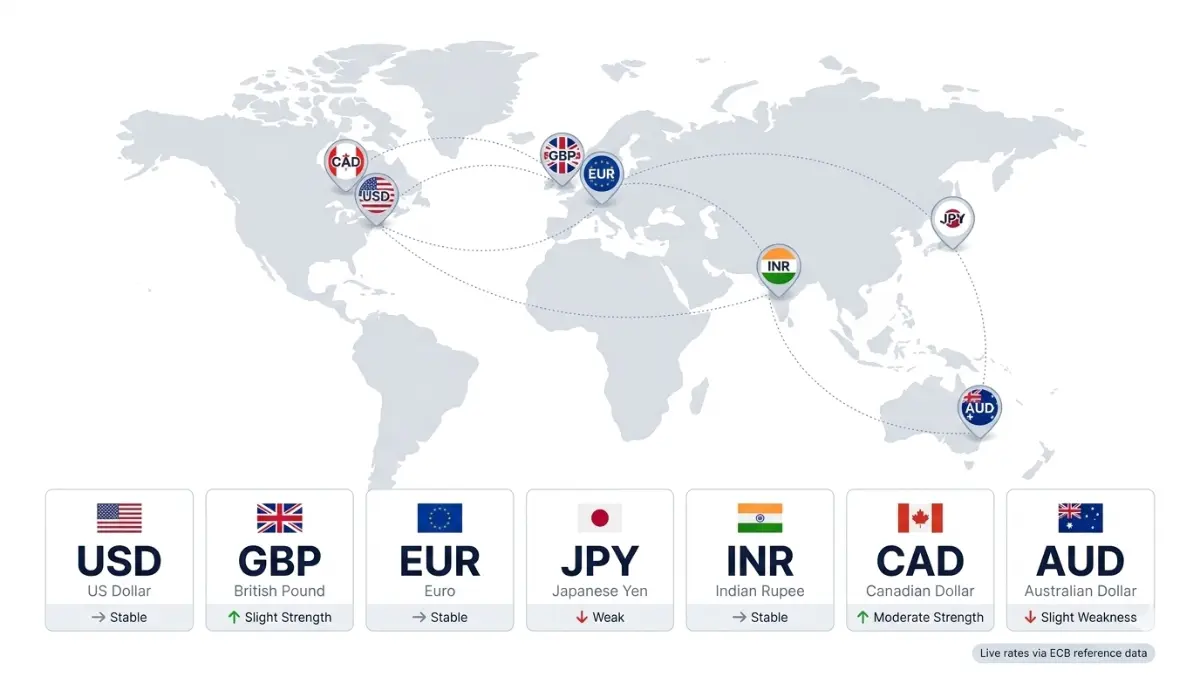
A currency pair like USD/EUR = 0.92 means 1 US Dollar buys 0.92 Euros. The first currency (USD) is the base; the second (EUR) is the quote. The number tells you how many units of the quote currency you get per 1 unit of the base.
Most Searched Currency Pairs in 2026
| Pair | Direction | 2026 Trend | Primary Use Case |
|---|---|---|---|
| USD/EUR | US Dollar → Euro | USD slightly weaker vs early 2025 | Travel, EU business, expat payments |
| USD/GBP | US Dollar → British Pound | GBP recovering slowly | UK remittances, trade |
| USD/INR | US Dollar → Indian Rupee | INR gradual softening | Remittances, outsourcing payments |
| USD/JPY | US Dollar → Japanese Yen | JPY recovering from 2024 lows | Tourism to Japan, trade |
| USD/CAD | US Dollar → Canadian Dollar | Oil-driven volatility | North America cross-border |
| EUR/GBP | Euro → British Pound | Tight range post-Brexit | EU-UK business |
| GBP/AUD | British Pound → Australian Dollar | AUD supported by commodities | UK-Australia remittance |
What the IMF Says About 2026 Rate Trends
According to IMF Effective Exchange Rate data published in January 2026, the U.S. dollar experienced a real effective depreciation of approximately 4.7% during 2025, while the Euro saw broad-based appreciation. The Japanese Yen, after strengthening in H1 2025, reversed course — ending 2025 about 5.1% weaker in real effective terms.
What This Means For You: If you’re converting USD to JPY in early 2026, the Yen’s partial recovery means you receive fewer Yen per Dollar than in mid-2025. Use the historical compare feature in our converter to see exactly how much rates have shifted for your currency pair.
For those managing international mortgage payments or refinancing a property with income in a foreign currency, our Mortgage Refinance Calculator helps you account for exchange rate risk in your repayment modeling.
Frequently Asked Questions About Currency Conversion
1. What is a currency converter?
A currency converter is a digital tool that calculates the equivalent value of one currency in another using current or historical exchange rates. It takes your input amount, applies the applicable FX rate, and returns the converted value — often with fee and spread modeling included.
2. What is the mid-market exchange rate?
The mid-market rate is the midpoint between the buy and sell prices of two currencies on the global forex market. It is the benchmark “real” rate — the rate banks use when trading with each other — and is what our currency converter displays before any provider markup is applied.
3. Is this currency converter free to use?
Yes, completely free. There are no ads, no registration requirements, and no hidden fees. You can convert between 22 currencies, model bank spreads, download CSV reports, and compare historical rates — all at zero cost.
4. How often are the exchange rates updated?
Our tool uses the Frankfurter API, which sources rates from the European Central Bank (ECB). Rates are refreshed on every business day. The tool also caches rates for one hour to ensure fast load times while maintaining accuracy.
5. Why is the rate my bank offers different from the converter?
Banks add a markup — typically 2–4% — above the mid-market rate displayed by our currency converter. This markup is how banks profit on foreign currency exchange transactions. It is usually not disclosed as a separate fee — it’s embedded into the rate you’re quoted.
6. Can I use this tool to convert historical exchange rates?
Yes. Select “Choose a historical date” under the Date field to pull exchange rates for any past date supported by the ECB data set. You can also enable the Compare Mode to see how rates have changed over 1 day, 7 days, 30 days, or 1 year.
7. What currencies does this converter support?
Our currency converter currently supports 22 major world currencies: USD, EUR, GBP, INR, CAD, AUD, NZD, SGD, HKD, JPY, CNY, KRW, CHF, SEK, NOK, DKK, AED, SAR, ZAR, BRL, MXN, and IDR. These cover over 95% of global currency conversion volume.
8. When is the best time to exchange currency?
The best time to convert currency is during the London–New York session overlap (approximately 8am–12pm EST), when forex market liquidity is highest and bid-ask spreads are tightest. Avoiding weekends and major central bank announcement days also reduces rate volatility risk.
9. How do I calculate currency exchange manually?
Multiply your amount by the exchange rate. Example: $500 USD × 0.92 (EUR/USD rate) = €460. For the inverse, divide: €460 ÷ 0.92 = $500 USD. Our tool handles all of this automatically, plus applies any fees and returns an effective rate after costs.
10. What factors affect exchange rates in 2026?
The six main drivers of currency exchange rates in 2026 are: central bank interest rate decisions, inflation data, GDP growth, geopolitical events, speculative trading volume, and direct central bank market interventions. All six are explained in detail in Section 3 above.
11. Is the rate shown the same as what I’ll receive when sending money?
No. Our currency converter shows the mid-market rate — the real, unmarketed rate. Any bank, app, or transfer service will offer you a slightly worse rate to cover their costs and profit margin. Use the fee and spread fields in our tool to model the real-world rate you’ll actually receive.
Related Financial Tools You May Find Useful
Managing money across borders involves more than just currency conversion. Here are tools that complement your foreign exchange planning:
- Savings Calculator — Model how currency-adjusted savings grow over time
- ROI Calculator — Calculate returns on international investments after currency conversion
- Budget Calculator — Plan travel or expat budgets in any target currency
⚠️ Disclaimer: This tool and article are provided for educational and informational purposes only and do not constitute financial, investment, or legal advice. Exchange rates displayed are mid-market reference rates sourced from the European Central Bank via the Frankfurter API and are indicative only — they do not represent rates available for actual transactions. Real transaction rates from banks and money transfer services will differ. FinanceAuthorityHub.com and its expert panel are not responsible for any financial decisions made based on the information presented here. Always consult a qualified financial professional before making significant currency exchange or international transfer decisions.
Informational disclaimer
The content on Finance Authority Hub is provided for general informational and educational purposes only and should not be considered personalized financial, investment, tax, legal, or professional advice. Financial decisions depend on your individual goals, income, risk tolerance, location, and regulatory situation. Before acting on any information, strategy, estimate, or calculator result, consult a qualified licensed professional who can evaluate your specific circumstances.